Decline Crunch
Core
Track this exercise in SmartWorkout
Log sets, weights and progress for free, with no workout limits.


Body Part: Abs
Description
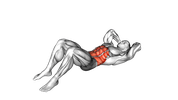
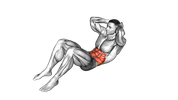
Decline crunches are an abdominal exercise performed on a decline bench, targeting the rectus abdominis with an emphasis on the upper portion of the muscle. This exercise increases the resistance compared to regular crunches due to the decline angle, providing an effective workout for core strength and stability.
How to Perform
- Adjust the decline bench to a comfortable angle, typically between 15 to 30 degrees.
- Sit on the bench and secure your feet under the padded rollers.
- Lie back with your hands placed behind your head or crossed over your chest.
- Engage your core by pulling your navel towards your spine.
- Exhale and lift your upper body towards your knees by contracting your abdominal muscles.
- Pause briefly at the top of the movement, ensuring maximum contraction.
- Inhale and slowly lower your upper body back to the starting position with control.
- Repeat for the desired number of repetitions.
What Muscles Work
Primary Muscle:
Tips
- Keep your movements controlled to maximize muscle engagement and avoid using momentum.
- Focus on using your core muscles rather than pulling on your neck or head with your hands.
- Maintain a consistent breathing pattern; exhale as you crunch up and inhale as you lower down.
- Ensure that the decline angle is not too steep to prevent unnecessary strain on your lower back.
- Start with a moderate number of repetitions and increase as you build strength and endurance.
- If you experience discomfort in your neck, try placing a towel behind your head for support.
Common Mistakes
- Using momentum instead of controlled movement.
- Pulling on the neck or head with the hands.
- Raising the torso too high, reducing abdominal engagement.
- Allowing the lower back to arch off the bench.
- Failing to engage the core throughout the exercise.
- Positioning feet incorrectly, leading to instability.
- Rushing through repetitions without proper form.
- Not maintaining a neutral spine alignment.
Recommended Exercises
Explore exercises related to Decline Crunch for abs training and similar movement patterns.






Choose a workout plan or create your own - for free
Ready-made plans for every goal, a free plan creator, hundreds of exercises and an advanced workout journal - all in SmartWorkout.