One-Arm Cable Pushdown
Also known as: Single-Arm Cable Pushdown, Single-Arm Tricep Pushdown, One-Arm Cable Pressdown
Track One-Arm Cable Pushdown in SmartWorkout and watch your numbers go up
Log sets, weights and progress for free, with no workout limits.


Description
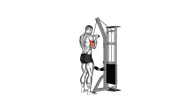
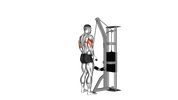
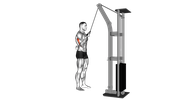
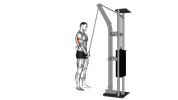
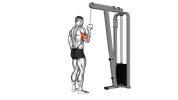
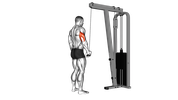
Hinge toward a high pulley with your free hand braced on the frame and push a single rope grip down to a straight elbow, training one triceps at a time. You feel it along the back of your upper arm, hardest at lockout. The pulley sits in front of you, so the cable still pulls at an angle when the arm is straight and the bottom of the rep stays loaded. Pick it over a two-arm pushdown when one arm lags or the stronger side does more than its share. The braced hinge keeps your torso still, which makes this a good place to learn a strict pushdown.
How to Perform
- Set one pulley at the top of the column and clip on a single rope grip. A triceps rope works too; hold just one end.
- Take it in your working hand with a neutral grip: palm toward your thigh, thumb toward the cable, little finger by the knob, wrist straight.
- Face the machine from a long step away, feet hip-width, and grab an upright of the frame at shoulder height with your free hand.
- Push your hips back until your torso leans about 30–40 degrees forward, back flat and both shoulders square to the machine.
- Bring the rope to the start: upper arm against your ribs, elbow bent about 90 degrees, hand in front of your lower ribs.
- Straighten the elbow, pushing down and slightly back until your hand reaches your thigh and the rope lies flat under your fist. Hold half a second.
- Let the forearm rise over 2–3 seconds to 90 degrees. After the last rep, let the rope rise to the start before you let go, then switch arms.
What Muscles Work
Primary Muscle:
Tips
- Do 2–4 sets of 10–15 reps per arm, a rep or two short of failure. Start with your weaker arm and give the other one the same number.
- Add reps before weight. Once both arms get 15 on all sets with a full lockout and a still upper arm, add the smallest weight step and start again at 10.
- One plate is a big jump for a single arm, so expect a few sessions at each weight. Functional trainers often run a 2:1 pulley ratio, so compare numbers only on the same machine.
- You should feel this only in the back of the working arm; the bracing arm and your abs just hold you in place. If the front of the shoulder or the chest joins in, the elbow is drifting forward or body weight is pushing, so take a plate off. A sharp twinge at the point of the elbow means too much load or a hard snap into lockout.
- Weight getting easy? Take 3–4 seconds on the way up and hold the lockout for a full second before you add load. If the elbow won't stay pinned, do the two-handed rope version for a few weeks.
- Substitutes: One-Arm Triceps Cable Pushdown, done upright with a D-handle, when there is nothing to hold on to; Rope Triceps Pushdown for both arms at once with the same neutral grip; Cable Triceps Pushdown with a straight bar to move the most weight; One-Arm Reverse Grip Triceps Cable Pushdown for a palm-up variation.
Common Mistakes
- Letting the elbow wander: forward on the way up until the hand reaches your chest, or out to the side as the stack gets heavy. Keep the upper arm against your ribs, point the elbow back and end the return at 90 degrees.
- Bobbing the torso, hinging deeper on each push and standing up on each return so body weight moves the stack. Set the hinge once, press your free hand into the frame and move only the forearm.
- Bending the wrist or turning the hand palm-down at the bottom. Keep the wrist straight and the thumb toward the cable; the rope turns in your fist, your hand doesn't.
- Hanging on the bracing arm and twisting toward the working side. The free hand only steadies you: both shoulders stay square to the machine, and the working shoulder stays down, away from your ear.
Recommended Exercises
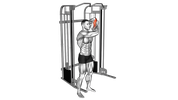
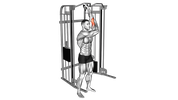
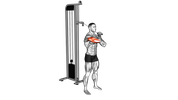
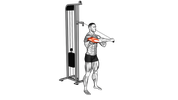
Explore exercises related to One-Arm Cable Pushdown for triceps training and similar movement patterns.
Choose a workout plan or create your own - for free
Ready-made plans for every goal, a free plan creator, hundreds of exercises and an advanced workout journal - all in SmartWorkout.