Seated Cable Horizontal French Press
Also known as: Seated Cable French Press, Cable French Press Facing Away, Seated High Cable Triceps Extension
Track Seated Cable Horizontal French Press in SmartWorkout and watch your numbers go up
Log sets, weights and progress for free, with no workout limits.


Description
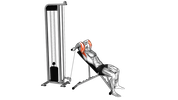
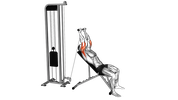
Sit with your back to a high pulley and press a short bar from behind your head until your straight arms point forward at eye level, not at the ceiling. The long head gets the biggest stretch while the bar is behind your head, and all three heads straighten the elbows. The seat and upright back pad take balance and your lower back out of the lift, unlike the standing high-pulley version. The cable also keeps pulling once your arms are straight, where a dumbbell or EZ bar goes light.
How to Perform
- Set one pulley of a cable station to the very top and clip on a short straight bar.
- Put a bench with the back pad set upright right in front of the machine, so you sit with your back to the stack.
- Take the bar overhand, hands about head-width apart, sit down and bring it behind your head. Elbows fully bent, pointing up, no wider than your shoulders.
- Sit tall with your back on the pad and your feet flat and wide.
- If the plates touch down with the bar behind your head, slide the bench a little farther from the machine.
- Exhale and straighten your elbows until the bar is above your head. Your upper arms stay beside your head for this part.
- With your elbows locked, push the bar forward in an arc until your arms point straight ahead at eye level. Hold it there for a second.
- Reverse the path: raise the straight arms back over your head, then bend your elbows and lower the bar behind your head over 2–3 seconds.
- To end the set, bring the bar back over your head before you let go or stand up, so the stack can't snap it into your head.
What Muscles Work
Primary Muscle:
Tips
- Sets of 10–15 reps are typical; heavier sets of 6–10 also work. Keep the same weight until all your sets reach the top of the range with the full arc and your back on the pad, then go up one plate and start again from the bottom of the range.
- On two-tower stations the plate number often doesn't match what the bar feels like, so compare loads only on the same machine. If one plate is too big a jump, use the add-on weight.
- With the bar behind your head you should feel a strong stretch along the back of your upper arm, up toward the armpit. In the forward part, the back of your shoulder and your lats help hold the straight arms. Nothing should show up in your lower back or neck.
- Pain at the front of the shoulder or inside the elbow in the stretch? Start each rep with the bar above your head instead of behind it and go lighter. Once the stretch feels easy, pause there for 1–2 seconds to make it harder.
- Substitutes: High Pulley Overhead Triceps Extension, standing with a rope, when no bench is free; Overhead Cable Triceps Extension (Bar), which finishes pointing at the ceiling; EZ-Bar Seated Triceps Extension or Dumbbell Seated Triceps Extension when every cable is taken.
Common Mistakes
- Sitting facing the machine or hooking up the low pulley. The cable then pulls the bar forward and the second half has no resistance; sit with your back to the stack and use the top pulley.
- Bringing the arms forward while the elbows are still bent. That turns the rep into a bent-arm pullover. Straighten your elbows fully over your head first, then move the straight arms.
- Stopping at 90° with the bar above your head. Lower it behind your head until your elbows are fully bent, and go lighter if you can't get there.
- Dropping the arms below eye level or peeling your back off the pad to finish the forward part. Stop as soon as your arms point straight ahead.
- Letting the stack yank the bar back behind your head. Take 2–3 seconds on the way down and stop the weight in the stretch; the plates shouldn't touch between reps.
Recommended Exercises
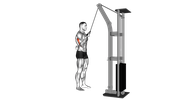
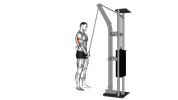
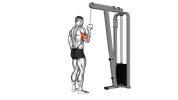
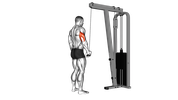
Explore exercises related to Seated Cable Horizontal French Press for triceps training and similar movement patterns.
Choose a workout plan or create your own - for free
Ready-made plans for every goal, a free plan creator, hundreds of exercises and an advanced workout journal - all in SmartWorkout.