Triceps Pushdown V-Bar
Also known as: V-Bar Triceps Pushdown, V-Grip Tricep Pushdown, V-Bar Cable Pushdown
Track Triceps Pushdown V-Bar in SmartWorkout and watch your numbers go up
Log sets, weights and progress for free, with no workout limits.


Description
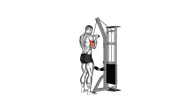
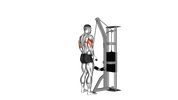
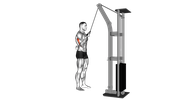
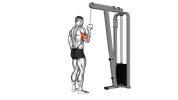
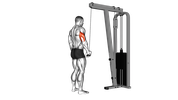
Facing a high pulley, you push a V-bar from your lower chest down to your thighs by straightening your elbows, which trains your triceps and little else. The angled handles hold your hands about 10 cm apart with the palms turned slightly in, a good fit if a flat overhand grip on a straight bar bothers your wrists or elbows. Unlike a rope, both hands stay fixed on one handle, so you can usually load a bit more. You feel it along the back of your upper arm, mostly the lateral and medial heads, and hardest at lockout, where the stack is still up and pulling.
How to Perform
- Set the pulley at the top of the cable column and clip the V-bar's swivel ring onto the cable.
- Take one angled handle in each hand, palms down and turned slightly in, hands about 10 cm apart. Wrap your thumbs and keep your wrists straight.
- Stand facing the stack about a forearm's length from the column, feet hip-width or narrower, knees soft, chest up. The cable hangs almost straight down.
- Pull the bar to your lower chest and pin your elbows to your ribs, bent about 90 degrees, upper arms vertical. The plates are already lifted.
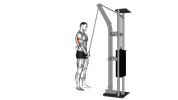
- Push the bar down and slightly back in an arc until your arms are fully straight and your hands reach the front of your thighs. Only the forearms move.
- Hold the lockout for half a second and squeeze the back of your arms; the stack is at its highest here and still pulling.
- Let the bar rise over 2–3 seconds along the same arc. Stop when your forearms are level with the floor, before your elbows slide forward.
- When the set is done, let the bar rise to chest height before letting go. Dropped at the bottom, the cable whips it toward your face.
What Muscles Work
Primary Muscle:
Tips
- Take 2–4 sets of 10–15 reps to one or two reps short of failure. The last set can go all the way, since you can simply stop on a cable.
- Add reps before weight. Once you get 15 on all sets with a full lockout and still upper arms, move the pin down one plate and restart at 10. One plate is a big jump on a two-arm triceps move, so expect a few sessions at each weight. Compare numbers only on the same machine, because pulley ratios differ.
- Feel it in the front of your shoulders or your chest? Your elbows are drifting forward or you're leaning over the bar. Sharp pain at the tip of the elbow means the weight is too heavy or you're slamming into lockout: go lighter and straighten smoothly.
- When a weight gets easy, slow the return to 3 seconds and hold the lockout for a full second. If your elbows won't stay pinned, drop the weight and end the return at navel height until they do.
- Substitutes: Cable Triceps Pushdown, with a straight bar at about shoulder width, if you want a wider grip; Rope Triceps Pushdown when your elbows prefer a neutral grip and you like spreading your hands at the bottom; EZ-Bar Tricep Pushdown for a slightly wider angled grip; Band Triceps Pushdown for training at home.
Common Mistakes
- Elbows sliding forward on the way up until the bar reaches your face, so your shoulders start pressing it down. Keep your upper arms vertical and end the return when your forearms are level with the floor.
- Leaning over the bar and pushing with your body weight, shoulders rolled forward. Stand tall, step in until the cable hangs straight down, and take a plate off.
- Stopping a few degrees short of straight arms, or bouncing out of the bottom. Lock your elbows out on every rep and pause there for half a second.
- Elbows flaring out as the bar goes down. Point them straight back; with your hands this close, your forearms should stay close together all the way.
- Wrists bending back over the angled handles. Keep your knuckles facing forward and push through the heel of your hand.
Recommended Exercises
Explore exercises related to Triceps Pushdown V-Bar for triceps training and similar movement patterns.
Choose a workout plan or create your own - for free
Ready-made plans for every goal, a free plan creator, hundreds of exercises and an advanced workout journal - all in SmartWorkout.