Cable Lat Pulldown
Also known as: Lat pulldown, Lat pull-down, Cable pulldown
Track this exercise in SmartWorkout
Log sets, weights and progress for free, with no workout limits.


Description
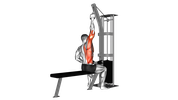
Sit under a high pulley and pull a long bar from straight arms down to your upper chest to build a wider, stronger back. Your lats are the main movers, helped by the teres major and minor and by the lower and middle traps, which pull your shoulder blades down and together. Your biceps and forearms assist, but they shouldn't give out first. This is the standard lat pulldown: the load can start far below body weight and go up one plate at a time, so it fits beginners working toward their first pull-up as well as advanced lifters adding back volume.
How to Perform
- Sit facing the stack and set the thigh pad so your thighs are locked in, feet flat and knees bent about 90°.
- Stand back up and take the bar overhand on the straight part just inside the bends, about one and a half shoulder widths apart, thumbs around it.
- Sit down with the bar at arm's length and let your shoulders rise. Chest up, lean back 10–15° from the hips, and keep that angle until the set is done.
- Start each rep by pulling your shoulders down, away from your ears, before your elbows bend.
- Drive your elbows down and slightly back toward your sides until the bar passes in front of your face and reaches your upper chest, just below the chin.
- Pause for a moment with your shoulder blades down and together, then let the bar rise over 2–3 seconds until your arms are straight and you feel a stretch under your armpits.
- At the end of the set, let the bar go all the way up (or stand up with it) before you let go, so the plates don't slam into the stack.
What Muscles Work
Primary Muscle:
Secondary Muscles:
Tips
- Sets of 8–15 build muscle and sets of 5–8 build strength; beginners do well with 10–15 on a weight they can pull to the chest without leaning back. Progress the reps before the plates. When you can do the top number in each set with the same torso angle, move the pin down one plate (usually 5 kg) and go back to the bottom of the range. If the stack jumps in 7 kg plates or more, stay on each weight longer or use the small add-on weight if the machine has one.
- The sides of your back and the area under your shoulder blades should do the work, with a stretch under the armpits at the top; the back of your shoulders works too. If your biceps and forearms burn out first, you're pulling with your hands. Treat them as hooks and lead with your elbows.
- Can't feel your back yet? Learn the shoulders-down start on the Lat Pulldown Machine, where the path is fixed, or pause for a second at the chest with a lighter weight. To make it harder, take 3–4 seconds on the way up or pause 2 seconds at the bottom. Assisted pull-ups bridge the gap to pull-ups; as a rough guide, clean sets of 8–10 with close to your body weight mean you're ready to try unassisted pull-ups.
- Substitutes: Wide Grip Lat Pulldown (hands at the ends of the bar), Cable Wide Neutral Grip Lat Pulldown (easier on the wrists and shoulders), Lat Pulldown Machine, Assisted Pull-Up.
Common Mistakes
- Leaning further back with every rep until the pulldown turns into a row. Set a slight lean at the start, hold it, and take a plate off if you can't finish the set without swinging.
- Pulling with your hands and curling the wrists, so your biceps and forearms quit before your back does. Keep the wrists straight, pull the shoulders down first, then drive the elbows to your sides.
- Forcing the bar lower than your upper chest and letting your shoulders roll forward toward your ears. Stop at the upper chest with your chest up and shoulder blades down.
- Half reps at the top, where the elbows never straighten and the lats never stretch. Let the bar rise all the way on every rep, taking 2–3 seconds instead of letting the stack yank your arms up.
Workout plans with this exercise
- Full body · 2 days
- Full body · 2 days
- Full body · 3 days
- Full body · 3 days
- Upper/Lower · 3 days
- Upper/Lower · 4 days
- Upper/Lower · 4 days
- Push/Pull · 4 days
- PPL · 3 days
- PPL · 3 days
- PPL · 6 days
- PPL + Upper/Lower · 5 days
- Body part split · 3 days
- Body part split · 4 days
- Body part split · 5 days
- Full body · 3 days · Glutes
- Upper/Lower · 4 days · Glutes
- Upper/Lower · 3 days · Glutes
- Upper/Lower · 5 days · Glutes
- Machines · 3 days · Glutes
- Full body · 2 days · Glutes
- Push/Pull/Legs + Arms · 4 days
- Upper/Lower · 4 days · Chest
- Upper/Lower · 4 days · V-taper
- Full Body to Split
Recommended Exercises
Explore exercises related to Cable Lat Pulldown for back training and similar movement patterns.
Choose a workout plan or create your own for free
Ready-made plans for every goal, a free plan creator, hundreds of exercises and an advanced workout journal: all in SmartWorkout.