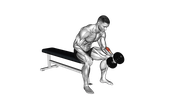
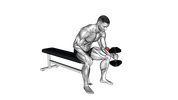
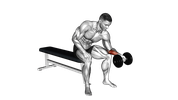
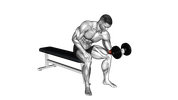
Dumbbell Reverse Curl
Also known as: Reverse Dumbbell Curl, Reverse Grip Dumbbell Curl, Dumbbell Reverse Biceps Curl
StrengthPull
Track this exercise in SmartWorkout
Log sets, weights and progress for free, with no workout limits.


Body Part: Forearms
Description
The Dumbbell Biceps Reverse Curl is an exercise targeting the biceps brachii with an emphasis on the brachialis and brachioradialis muscles. This variation involves a pronated grip, which shifts some focus from the biceps to the forearm muscles, providing a balanced arm workout.
How to Perform
- Stand upright with your feet shoulder-width apart, holding a dumbbell in each hand with a pronated grip (palms facing down).
- Keep your elbows close to your torso and your upper arms stationary throughout the movement.
- Exhale as you curl the weights upward by bending your elbows, keeping your wrists straight.
- Continue lifting until your forearms are vertical or slightly beyond, ensuring maximum contraction of the biceps.
- Inhale as you slowly lower the dumbbells back to the starting position, fully extending your arms.
- Repeat for the desired number of repetitions.
What Muscles Work
Primary Muscle:
Secondary Muscles:
Tips
- Maintain a controlled motion to maximize muscle engagement and minimize momentum.
- Focus on keeping your wrists straight to avoid unnecessary strain and ensure proper form.
- Engage your core to stabilize your body and prevent swaying during the exercise.
- Start with lighter weights to master the form before progressing to heavier loads.
- Ensure a full range of motion by fully extending and contracting your arms with each repetition.
Common Mistakes
- Using momentum to lift the weights instead of controlled motion.
- Allowing the elbows to flare out instead of keeping them close to the torso.
- Not fully extending the arms at the bottom of the movement.
- Curling the wrists instead of keeping them neutral.
- Leaning back excessively to lift heavier weights.
- Engaging the shoulders instead of isolating the biceps.
- Failing to keep a consistent tempo throughout the exercise.
- Using an incorrect grip width that reduces bicep activation.
- Not maintaining a straight back, leading to poor posture.
Recommended Exercises
Explore exercises related to Dumbbell Reverse Curl for forearms training and similar movement patterns.
Choose a workout plan or create your own - for free
Ready-made plans for every goal, a free plan creator, hundreds of exercises and an advanced workout journal - all in SmartWorkout.