Resistance Band Hip Adduction
StrengthMobilityRehabilitationFunctional
Track this exercise in SmartWorkout
Log sets, weights and progress for free, with no workout limits.


Body Part: Legs
Description
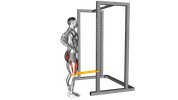
The Resistance Band Hip Adduction exercise targets the inner thigh muscles, specifically the adductors. It involves using a resistance band to create tension, which helps in strengthening and toning the inner thighs. This exercise is beneficial for improving hip stability and overall lower body strength.
How to Perform
- Attach a resistance band to a sturdy anchor point at ankle height.
- Stand sideways to the anchor point and loop the free end of the band around your inside ankle.
- Step away from the anchor point until there is tension in the band.
- Stand with feet shoulder-width apart, keeping your core engaged and back straight.
- Shift your weight onto the leg farthest from the anchor point.
- Slowly bring the banded leg across your body towards the standing leg, keeping it straight.
- Pause briefly at the peak contraction, then slowly return to the starting position.
- Repeat for the desired number of repetitions before switching legs.
What Muscles Work
Primary Muscle:
Secondary Muscles:
Tips
- Ensure that the resistance band is securely anchored to prevent slipping during the exercise.
- Maintain a slight bend in your knees to reduce strain on your joints.
- Focus on controlled movements; avoid using momentum to swing your leg.
- Keep your core engaged throughout to maintain balance and stability.
- Start with a lighter resistance band and gradually increase as you build strength.
- Perform this exercise near a wall or sturdy object for support if needed.
Common Mistakes
- Allowing the torso to lean or sway instead of maintaining an upright position.
- Using momentum to swing the leg rather than controlled movement.
- Placing the resistance band too high or too low on the leg, reducing effectiveness.
- Not keeping the standing leg stable, causing balance issues.
- Failing to engage the core, leading to poor stabilization.
- Performing the movement too quickly, compromising muscle engagement.
- Letting the foot of the moving leg rotate outward or inward instead of keeping it neutral.
- Overextending the leg beyond a comfortable range of motion, risking strain.
Recommended Exercises
Explore exercises related to Resistance Band Hip Adduction for legs training and similar movement patterns.















Choose a workout plan or create your own - for free
Ready-made plans for every goal, a free plan creator, hundreds of exercises and an advanced workout journal - all in SmartWorkout.


Start with a free plan. Keep progressing with SmartWorkout.
- users
- 200k+
- exercises with technique guides
- 1,000+
- workouts on the free plan
- ∞