Kneeling Resistance Band Glute Kickback
Also known as: Kneeling Banded Glute Kickback, Quadruped Band Kickback, Resistance Band Kickback on All Fours
Track this exercise in SmartWorkout
Log sets, weights and progress for free, with no workout limits.


Description
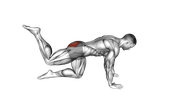
On all fours, with a loop band running from one foot to the hand on the same side, you kick that leg straight back to build your glute one side at a time. The gluteus maximus of the kicking leg does most of the work; your hamstrings help as the knee straightens, and the gluteus medius keeps your pelvis level. Unlike the Donkey Kick, the knee goes from bent to fully straight on every rep, and the band pulls hardest at the top, right where you squeeze. All you need is the band, so it works at home, as a warm-up before squats or as a high-rep finisher.
How to Perform
- Pick a long loop band, light or medium to start. A mini band is too short to reach from your foot to your hand.
- Get on all fours: hands flat under your shoulders, arms straight, knees under your hips, back flat, eyes on the floor just ahead of your hands.
- Hook one end of the band around the sole of your working foot, across the arch just in front of the heel.
- Pin the other end to the floor under the heel of your palm on the same side.
- Slide that hand forward or back until the band is just taut with your knee down.
- Brace your stomach lightly, ribs down. Lift the working knee just off the floor and drive the foot straight back as the knee straightens.
- Stop when the leg is straight and in line with your body: foot at about hip height, toes pointing down, heel pushing back.
- Squeeze the glute and hold for a second. Your hips stay level and square to the floor, and your lower back doesn't move.
- Take about 2 seconds to bend the knee and bring it back under your hip, tap the floor lightly and go again. Finish every rep on one leg, then switch.
What Muscles Work
Primary Muscle:
Secondary Muscles:
Tips
- Aim for 2–4 sets of 12–20 reps per leg with a one-second squeeze at the top; as a warm-up, 1–2 easy sets of 10–15 are plenty. Once both legs make 20 on every set with a locked knee and a clean hold, move to the next band and build the reps back up.
- Not ready for the next band? Place the anchoring hand 5–10 cm farther forward so the band stretches more at the top, or hold the top for 2–3 seconds.
- Expect the burn in the glute of the kicking leg, most during the hold, plus some work in the back of the thigh as the knee straightens. If your lower back takes over, the leg is going too high.
- Sore wrists? Rest on your fists with the band pinned under them. Kneel on a mat or folded towel, and check the band for nicks before each session, because a band that tears snaps back toward your hand and arm.
- Substitutes: Donkey Kick (no band, knee stays bent), Glute Cable Kickback (load you can measure and add in small steps), Band Standing Balance Glute Kickback (if kneeling bothers you), Glute Machine Kickback (for heavier loading).
Common Mistakes
- Arching your lower back to get the foot higher than your body. Stop when the leg is in line with your torso, ribs down, and switch to a lighter band if the arch keeps coming back.
- The hip on the working side lifts and your pelvis turns open. Keep both hip bones pointing at the floor and kick straight back, not up and out.
- Finishing with a bent knee, so the band never fully stretches. Straighten the knee all the way, push the heel back and hold for a second before you return.
- Letting the band snap your leg back in. Take about 2 seconds on the way back and set the knee down softly; if you can't, the band is too heavy.
- Rocking your whole body back and forth to help the leg. Shoulders stay over your hands and the supporting knee under your hip; only the working leg moves.
- The band slips off your foot or out from under your hand. Keep the foot flexed so the band sits across the arch, and press down with the heel of your palm, not your fingers.
Recommended Exercises
Explore exercises related to Kneeling Resistance Band Glute Kickback for gluteal training and similar movement patterns.
Choose a workout plan or create your own - for free
Ready-made plans for every goal, a free plan creator, hundreds of exercises and an advanced workout journal - all in SmartWorkout.