Low Cable Horizontal Pallof Press
Also known as: Low Cable Pallof Press
Track this exercise in SmartWorkout
Log sets, weights and progress for free, with no workout limits.


Description
Stand side-on to a low pulley and press one handle straight out from your chest with both hands, without letting the cable twist you. It's named after physical therapist John Pallof. Your trunk works here by not moving: the obliques do most of the job, with the rest of your abs helping. Because the cable rises from the floor, it also pulls your hands down and toward the stack, so your front delts and upper chest hold your arms up. Pick it when you want ab work that never bends your spine, or when the low pulley is the only one free.
How to Perform
- Set the pulley to its lowest notch, right at the floor, and clip on a single D-handle.
- Face the stack and pick the handle up with both hands, hinging at the hips rather than twisting down to it.
- Turn side-on and sidestep one or two steps out, until the plates stay lifted and the cable pulls you clearly sideways, not just down.
- Set your feet hip- to shoulder-width apart, toes forward, knees soft. Hips and shoulders face straight ahead, not toward the stack.
- Grip the handle with both hands, one over the other, fingers interlaced, thumbs up. Hold it at the bottom of your breastbone, elbows against your ribs.
- Brace, ribs down and shoulders level, then press straight out until your elbows lock and your hands reach shoulder height in front of mid-chest.
- Hold for 1–3 seconds while the cable tries to drag your hands down and toward the stack. Hands stay centered, chest faces forward.
- Take about 2 seconds to bring the handle back to your breastbone, keeping the plates off the stack, and press again.
- Finish the side, walk back to set the plates down, then turn around and do the same reps with the stack on your other side.
What Muscles Work
Primary Muscle:
Secondary Muscles:
Tips
- Two to four sets of 10–15 reps per side with a 1–2 second hold cover most needs; for strength, 3–4 sets of 6–8 with a 2–3 second hold on a stack you can only just keep still. Add reps first. Once both sides reach 15 on every set with a still torso, add the smallest plate (usually 2.5–5 kg) and drop back to 10. A longer hold, up to 5 seconds, is another step before more weight.
- The stack sets the load, but where you stand sets the cable angle: the farther you step out, the more sideways the pull and the harder the hold. Stand on the same spot every session so your numbers stay comparable.
- The sides and front of your waist should burn, with the front of your shoulders working to keep your arms up. If your lower back or neck takes over, the weight is too heavy or you're leaning or shrugging. Too hard to hold still? Press only halfway out and widen your stance. Too easy? Do it half-kneeling, with the knee nearer the stack on the floor, so your legs can't help.
- Substitutes: Cable Horizontal Pallof Press (pulley at chest height, pure anti-rotation and easier on tired shoulders), Band Pallof Press (at home or in a crowded gym), Side Plank (no equipment; your obliques resist bending sideways, as they do here).
Common Mistakes
- Hips and chest turning toward the stack as your arms straighten. Go lighter, keep your belt buckle and breastbone pointing straight ahead, and press more slowly.
- Hands drifting toward the stack or sinking toward the floor pulley at full reach. Finish with your hands in front of your breastbone at shoulder height and keep them there for the whole hold. If they still wander, drop a plate.
- Standing so close that the cable runs almost straight down, or the plates rest at the start. Then it's just a downward pull on your arms with little twist to resist. Sidestep out until the plates stay up and the cable pulls sideways.
- Leaning away from the stack or pushing your hips out to counterbalance. Keep your ribs stacked over your pelvis, shoulders level and weight even on both feet; resisting the pull is your trunk's job, not the lean's.
Recommended Exercises
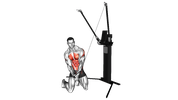
Explore exercises related to Low Cable Horizontal Pallof Press for abs training and similar movement patterns.
Choose a workout plan or create your own for free
Ready-made plans for every goal, a free plan creator, hundreds of exercises and an advanced workout journal: all in SmartWorkout.