Single Dumbbell Curl
Also known as: Two-Handed Single Dumbbell Curl, Two-Hand Dumbbell Curl, Goblet Curl
Track Single Dumbbell Curl in SmartWorkout and watch your numbers go up
Log sets, weights and progress for free, with no workout limits.


Description
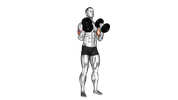
Hold one dumbbell upright in both hands, palms up under its top end, and curl it from your thighs to your upper chest to build your biceps. Both arms bend together; the two heads of the biceps do the lifting while your hands and forearms simply hold the weight. Since the arms share one dumbbell, each moves about half of it, and the next dumbbell up is a small step. It suits beginners, home workouts with a single dumbbell and light finishers after heavier curls. Your hold usually gives out before your biceps do, so switch to a barbell or EZ bar for heavy sets.
How to Perform
- Pick one dumbbell, ideally a fixed one, and hold it on end: both palms face up under the top plates, hands side by side, fingers curled around the rim.
- Stand tall with your feet about hip-width apart and your knees straight but not locked. Chest up, shoulders down, abs braced.
- Let your arms hang straight so the dumbbell sits vertically in front of your thighs, handle pointing at the floor, elbows at your sides.
- Bend both elbows together and curl the weight up. The bottom end tips forward as your forearms rise; let it tip, but don't let it swing.
- Stop when your hands reach your upper chest and your forearms are almost vertical, then squeeze for about a second.
- Take about 2 seconds to lower until your elbows are fully straight and the dumbbell hangs vertically again.
- Bend your knees at the end of the set and set the dumbbell down on the floor or back on the rack.
What Muscles Work
Primary Muscle:
Tips
- Curl 8–15 reps, or 6–10 if the hold still feels secure at that weight. Stay with one dumbbell and add reps until you get the top number cleanly in all sets, then take the next dumbbell and start again from the bottom. That step is usually 2–2.5 kg, only about 1–1.25 kg per arm. Log the weight of the one dumbbell.
- Both upper arms work at the front, hardest at the top. A tired lower back means you're leaning back; if the front of your shoulders takes over, your elbows are drifting forward.
- Can't keep your elbows still? Go lighter and stop at mid-chest for a few sessions, or use the Machine Biceps Curl. To make it harder, take 3–4 seconds on the way down.
- With an adjustable dumbbell, check both collars before every set: the bottom plates hang right over your feet.
- Substitutes: Dumbbell Biceps Curl (a dumbbell in each hand, the better pick when one arm lags), Barbell Biceps Curl (for heavier sets), EZ-Bar Biceps Curl (easier on the wrists), Bar Cable Biceps Curl.
Common Mistakes
- Leaning back or pushing your hips forward to get the dumbbell moving. Brace your abs and keep your chest still; if you still sway, take a lighter dumbbell.
- Elbows drifting forward and up at the top, so your front delts start doing the lifting. Keep your elbows against your ribs and stop when your hands reach your upper chest.
- Wrists bending back under the plates. Keep your wrists straight and your palms flat under the top end; if you can't, the dumbbell is too heavy.
- Letting the stronger arm do most of the work, so the dumbbell drifts to one side. Keep your hands centered in front of your body and both elbows level.
Recommended Exercises
Explore exercises related to Single Dumbbell Curl for biceps training and similar movement patterns.

Choose a workout plan or create your own for free
Ready-made plans for every goal, a free plan creator, hundreds of exercises and an advanced workout journal: all in SmartWorkout.