Barbell Floor Press
StrengthPush
Track this exercise in SmartWorkout
Log sets, weights and progress for free, with no workout limits.


Body Part: Chest
Description
The Barbell Floor Press is a compound upper body exercise that targets the chest, triceps, and shoulders. It is performed by lying on the floor and pressing a barbell from chest level to arm's length above the torso. This exercise minimizes shoulder strain and emphasizes tricep engagement due to the limited range of motion.
How to Perform
- Lie on your back on the floor with your legs bent and feet flat.
- Position the barbell over your chest, gripping it slightly wider than shoulder-width apart.
- Engage your core and press your upper back into the floor.
- Lower the barbell until your upper arms touch the floor, keeping elbows at a 45-degree angle to your body.
- Pause briefly, then press the barbell back up to the starting position by extending your arms.
- Repeat for the desired number of repetitions.
What Muscles Work
Primary Muscle:
Secondary Muscles:
Tips
- Keep your core tight throughout the movement to stabilize your body.
- Ensure your wrists remain straight and aligned with your forearms to avoid strain.
- Focus on controlled movements; avoid bouncing the barbell off the floor.
- Maintain a consistent grip width to ensure balanced muscle activation.
- Use a spotter if lifting heavy to ensure safety during the exercise.
Common Mistakes
- Failing to keep wrists straight, leading to potential wrist strain.
- Allowing elbows to flare out excessively, reducing shoulder stability.
- Arching the lower back, which can disengage core muscles.
- Bouncing the bar off the floor, losing control and reducing muscle engagement.
- Not aligning the barbell with the mid-chest, causing uneven pressure distribution.
- Using a grip that's too wide, limiting range of motion and shoulder mobility.
- Lowering the bar too quickly, compromising control and increasing injury risk.
- Neglecting to retract shoulder blades, reducing upper back support.
- Pressing with uneven force, leading to imbalanced muscle development.
- Failing to engage the triceps fully, limiting pressing power.
Recommended Exercises
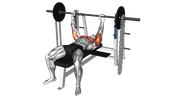
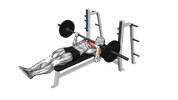
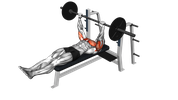
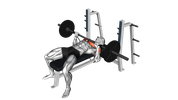
Explore exercises related to Barbell Floor Press for chest training and similar movement patterns.
Choose a workout plan or create your own - for free
Ready-made plans for every goal, a free plan creator, hundreds of exercises and an advanced workout journal - all in SmartWorkout.