Bayesian Cable Curl (Face Away)
Also known as: Bayesian Curl, Face-Away Cable Curl, Two-Arm Bayesian Curl
Track Bayesian Cable Curl (Face Away) in SmartWorkout and watch your numbers go up
Log sets, weights and progress for free, with no workout limits.


Description
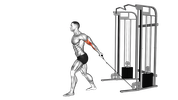
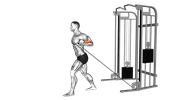
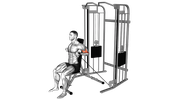
Curl a low cable handle in each hand with your back to the machine, starting from straight arms behind your body, to load your biceps from a deep stretch. The cables pull back and down, so the rep is hardest near the bottom, right where a standing dumbbell curl has almost no load. Both heads of the biceps do the work, while your forearm muscles help and hold the handles. With a cable for each arm, your torso stays square and nothing twists. The one-arm Bayesian Cable Curl uses a single cable, and the seated version moves this setup onto a bench.
How to Perform
- On a two-stack cable station, set both pulleys to the lowest notch, clip a single D-handle to each and load both stacks equally.
- Take a handle in each hand, palms facing forward, and stand between the pulleys with your back to the machine.
- Walk out about one step, until both stacks stay lifted with your arms straight and drawn slightly behind your hips.
- Stagger your feet with one foot a stride ahead, rear heel up and knees soft. Chest up, shoulder blades back and down, abs braced.
- Curl both handles at once, bending only at the elbows. The elbows stay back while your forearms swing forward and up.
- Stop with your hands in front of your lower chest, palms facing you and elbows still behind your torso. Squeeze for about a second.
- Lower over 2–3 seconds until both elbows are fully straight and the cables draw your arms back. Pause in the stretch, shoulders still back.
- When the set is over, walk back toward the machine until the plates rest, and only then let go of the handles.
What Muscles Work
Primary Muscle:
Secondary Muscles:
Tips
- Go for 2–4 sets of 10–15 reps close to failure.
- Add reps at the same weight first; once you get 15 clean reps in all sets, move the pin down one hole on both stacks (usually 2.5–5 kg each) and build back up from 10.
- Start lighter than on a regular cable curl, since the stretched bottom is the hardest part. Change both stacks together and log the weight the same way every session: many crossover stations have a 2:1 pulley, so the number on the stack isn't what you actually lift.
- At the bottom you should feel a strong stretch along the front of your upper arm, from the elbow crease toward the shoulder, and at the top a hard squeeze. A mild pull across the front of the shoulder is normal. A sharp pinch there or in the elbow crease means take half a step back toward the machine or go lighter.
- To make it harder without adding weight, lower over 3–4 seconds and pause for 1–2 seconds in the bottom stretch.
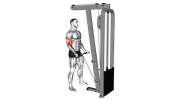
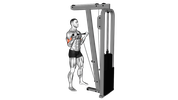
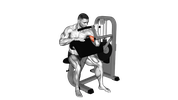
- Substitutes: Bayesian Cable Curl (one arm at a time, for when only one pulley is free), Bayesian Cable Curl Seated (the same two-handle setup on a bench), Seated Incline Biceps Curl (dumbbells, a similar stretched start). If your shoulders hurt with the arms behind you, switch to the Bar Cable Biceps Curl facing the machine.
Common Mistakes
- Elbows drifting forward as the hands rise until the upper arms hang vertical. Now it's an ordinary cable curl. Keep the elbows behind your torso and stop at your lower chest, not your chin.
- Standing so close that the plates touch down at the bottom and the stretch disappears. Walk out until both stacks stay up with straight arms, and keep that spot for the whole set.
- Rocking forward to start each rep or leaning back at the top; if you feel it in your lower back, this is why. Brace in the staggered stance and keep your chest still, and go one plate lighter if it keeps happening.
- Ending the lowering with the elbows still bent. That skips the stretch this exercise is built around, so straighten both arms fully and pause on every rep.
- One arm running ahead of the other. Move both handles at the same speed and end the set when one arm can't keep up.
Recommended Exercises
Explore exercises related to Bayesian Cable Curl (Face Away) for biceps training and similar movement patterns.





Choose a workout plan or create your own for free
Ready-made plans for every goal, a free plan creator, hundreds of exercises and an advanced workout journal: all in SmartWorkout.