Korean Dip
StrengthPush
Track this exercise in SmartWorkout
Log sets, weights and progress for free, with no workout limits.


Description
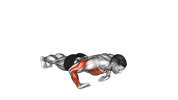
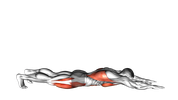
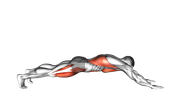
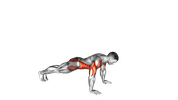
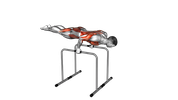
The Korean Dip is an advanced bodyweight exercise that targets the triceps, shoulders, and chest. It involves a unique movement pattern that requires significant upper body strength and stability. In this version it is performed on parallel bars: as you lower into the dip, you lean the torso well forward and let the straight legs travel back behind you, then return to an upright support.
How to Perform
- Begin by positioning yourself between parallel bars, gripping them firmly with your palms facing inward.
- Lift your body off the ground by straightening your arms, ensuring your shoulders are directly above your wrists.
- Lower your body by bending your elbows until your upper arms are parallel to the ground.
- As you lower into the dip, lean your torso well forward and let your straight legs travel back behind you, so your body tilts at about 45 degrees.
- Pause briefly at the bottom, keeping your core engaged and your body in a straight line from head to heels.
- Return to the starting position by reversing the movement, bringing your legs back under you and pushing up through your arms.
What Muscles Work
Primary Muscle:
Secondary Muscles:
Tips
- Focus on maintaining control throughout the movement to prevent swinging.
- Engage your core muscles to stabilize your body during the transition phase.
- Keep your elbows close to your body to maximize tricep engagement.
- Practice on lower bars initially if you're new to this exercise to build confidence and strength.
- Ensure proper warm-up of shoulders and wrists before attempting the Korean Dip to reduce injury risk.
Common Mistakes
- Failing to maintain a straight body line, leading to excessive arching or sagging.
- Allowing the shoulders to roll forward, reducing scapular engagement.
- Dropping too quickly into the dip without controlled descent.
- Not achieving full range of motion by stopping too high or going too low.
- Neglecting to keep elbows close to the body, causing flaring.
- Using momentum instead of muscle strength to push back up.
- Inadequate core engagement, leading to instability.
- Overextending the neck by looking up or down instead of keeping it neutral.
Recommended Exercises
Explore exercises related to Korean Dip for chest training and similar movement patterns.


Choose a workout plan or create your own for free
Ready-made plans for every goal, a free plan creator, hundreds of exercises and an advanced workout journal: all in SmartWorkout.