Glute Bridge on Bench
StrengthCoreFunctional
Track this exercise in SmartWorkout
Log sets, weights and progress for free, with no workout limits.


Body Part: Gluteal
Description
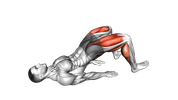
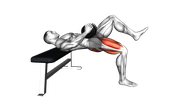
The Glute Bridge on Bench is an effective exercise targeting the gluteal muscles, hamstrings, and core. By elevating the shoulders on a bench, this variation increases the range of motion, providing a greater challenge and more significant muscle activation compared to the standard glute bridge.
How to Perform
- Sit on the ground with your upper back resting against a bench, knees bent, and feet flat on the floor.
- Place your feet hip-width apart and position them so that your shins are vertical when you lift your hips.
- Rest your arms on the bench for stability or cross them over your chest.
- Engage your core and squeeze your glutes as you lift your hips toward the ceiling until your body forms a straight line from shoulders to knees.
- Hold the top position for a moment, ensuring maximum contraction in the glutes.
- Slowly lower your hips back to the starting position without letting them touch the ground.
- Repeat for the desired number of repetitions.
What Muscles Work
Primary Muscle:
Secondary Muscles:
Tips
- Ensure that your feet are positioned correctly; they should be directly under your knees at the top of the movement.
- Focus on squeezing your glutes throughout the exercise to maximize muscle activation.
- Keep your core engaged to maintain stability and prevent arching of the lower back.
- Avoid pushing through your heels excessively; aim for balanced pressure across your entire foot.
- Control the movement during both lifting and lowering phases to enhance muscle engagement and prevent injury.
Common Mistakes
- Feet placed too far from the bench, reducing glute activation.
- Feet too close to the bench, limiting range of motion.
- Arching the lower back instead of hinging at the hips.
- Failing to keep the core engaged, leading to lower back strain.
- Allowing knees to collapse inward, reducing glute engagement.
- Raising hips unevenly, causing imbalance and reduced effectiveness.
- Not aligning shoulders, hips, and knees at the top position.
- Using momentum instead of controlled movement, reducing muscle activation.
- Dropping hips too quickly on the descent, risking lower back discomfort.
- Not squeezing glutes at the top of the movement, missing peak contraction.
Recommended Exercises
Explore exercises related to Glute Bridge on Bench for gluteal training and similar movement patterns.
Choose a workout plan or create your own - for free
Ready-made plans for every goal, a free plan creator, hundreds of exercises and an advanced workout journal - all in SmartWorkout.