KAS Glute Bridge
Track KAS Glute Bridge in SmartWorkout and watch your numbers go up
Log sets, weights and progress for free, with no workout limits.


Description
The KAS Glute Bridge is an exercise focused on strengthening the gluteal muscles. It differs from the hip thrust mainly in the range of motion and execution technique. In the KAS Glute Bridge, the movement is more controlled and limited, allowing for greater focus on glute activation. The exercise is performed on an elevated surface, similar to the hip thrust, but with a smaller range of motion. The name 'KAS' comes from Kasemira 'Kass' Loxley, a personal trainer who popularized this version of the glute bridge.
How to Perform
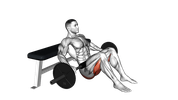
- Sit on the floor with your back against a bench or elevated surface, knees bent, feet flat on the ground.
- Place a barbell over your hips, holding it with both hands.
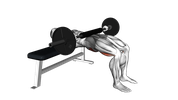
- Engage your glutes and lift your hips upward until your body forms a straight line from shoulders to knees.
- Pause at the top for a moment, focusing on squeezing your glutes.
- Slowly lower your hips back to the starting position, controlling the movement.
What Muscles Work
Primary Muscle:
Secondary Muscles:
Tips
- Ensure your feet are hip-width apart to maintain stability.
- Control the movement during both lifting and lowering phases to maximize glute engagement.
- Avoid lifting hips too high. Focus on muscle tension rather than height.
- Breathe regularly: inhale while lowering and exhale while lifting your hips.
- If you're a beginner, start without added weight to master the technique.
- Focus on keeping your shoulder blades stable on the elevated surface throughout the exercise.
- Avoid excessive arching of the lower back. Keep your spine in a neutral position.
Common Mistakes
- Feet placed too far from the glutes, reducing activation and engagement.
- Allowing the knees to collapse inward, leading to poor alignment and reduced glute activation.
- Hyperextending the lower back instead of lifting through the hips, increasing the risk of lower back strain.
- Not maintaining a neutral spine, which can lead to unnecessary stress on the back.
- Raising the hips too high, causing the lower back to arch excessively.
- Failing to engage the core, resulting in instability and reduced effectiveness.
- Using momentum to lift the hips instead of controlled muscle engagement.
- Not squeezing the glutes at the top of the movement, minimizing activation.
- Feet positioned too wide apart, which can reduce glute engagement.
- Allowing the head and neck to lift off the ground, causing strain.
Recommended Exercises
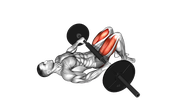
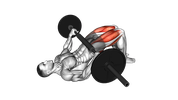
Explore exercises related to KAS Glute Bridge for glutes training and similar movement patterns.
Choose a workout plan or create your own for free
Ready-made plans for every goal, a free plan creator, hundreds of exercises and an advanced workout journal: all in SmartWorkout.
Start with a free plan. Keep progressing with SmartWorkout.
- users
- 200k+
- exercises with technique guides
- 1,000+
- workouts on the free plan
- ∞