Single Leg Press
Also known as: Single-Leg Leg Press, One-Leg Press, Unilateral Leg Press
Track this exercise in SmartWorkout
Log sets, weights and progress for free, with no workout limits.


Description
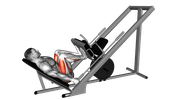
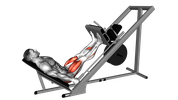
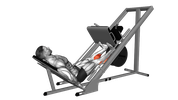
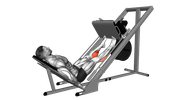
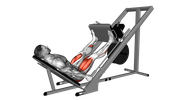
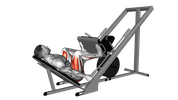
Press the sled of a 45-degree leg press with one leg while the other foot rests on the frame, so each thigh works on its own. The quads on the front of the working thigh do almost all the work; the inner and back of the thigh help a little. Your back stays on the pad, which makes it a good pick when one leg lags or when you want more quad work without loading your spine. Choose it over the Bulgarian split squat when balance, not leg strength, ends your sets. A seated stack-loaded leg press works the same way.
How to Perform
- Load the plates evenly on both sides of the sled. For your first sets, start well under half of what you press with two legs.
- Slide all the way back so your hips sit deep in the seat and your back and head rest on the pad.
- Put both feet on the platform, press the sled off the stops and turn the safety handles out to free it.
- Take one foot down and rest it flat on the frame near the floor, well clear of the sled and the stops.
- The working foot stays flat on its own side of the platform, in line with that hip, toes up or turned out a touch.
- Hold the seat handles and pull down lightly so both hips stay pinned to the seat.
- Bend the knee and lower the sled over about 2 seconds, the knee heading straight for the shoulder on the same side.
- At about 90 degrees at the knee, before that hip rolls up, press back through the whole foot and stop short of lockout.
- At the end of the set, put the free foot back on the platform, turn the safety handles in and switch legs.
What Muscles Work
Primary Muscle:
Secondary Muscles:
Tips
- Use 6–10 reps per leg for strength and 10–15 for size, up to about 20 on a lighter last set. Start with your weaker leg and stop the stronger one at the same count and depth. Once both legs reach the top of your range, add 5 kg (2.5 kg per side) and drop back to the bottom of the range; go to 2.5 kg jumps when progress slows.
- Foot height is the lever that matters. Higher on the platform gives you more hip bend, lower gives more knee bend and more quad work, as long as your heel stays flat at the bottom.
- The front of the working thigh should do most of the work. Pinching at the front of the hip or your tailbone lifting means you went too deep; pain at the front or inside of the knee usually comes from the knee caving or the heel lifting.
- Substitutes: Leg Press (both feet, the easier version), Lever Horizontal Leg Press (also works one leg at a time), Dumbbell Bulgarian Squat (harder, adds balance), Dumbbell Split Squat. Stuck on the last reps? Let the free foot rest lightly on the platform to help. To make it harder, pause 2 seconds at the bottom or take 3–4 seconds to lower.
Common Mistakes
- Unracking or racking the sled with one leg. Use both feet to press it off the stops and to set it back on the safety catches; go single-leg only in between.
- Working foot in the middle of the platform, so the knee angles inward and the pelvis twists. Set it on its own side, in line with the hip, and keep the knee over your second and third toes.
- The working-side hip rolls up off the seat at the bottom. Cut the depth to where both hips stay flat, pull down on the handles and move the foot a little higher.
- Knee caving in on the way up. Turn the toes out slightly, push the knee out over the foot and take weight off until it stays in line.
- Heel lifting at the bottom so you push from the toes. Move the foot up until the whole sole stays flat, then press through the mid-foot and heel.
Recommended Exercises
Explore exercises related to Single Leg Press for legs training and similar movement patterns.
Choose a workout plan or create your own - for free
Ready-made plans for every goal, a free plan creator, hundreds of exercises and an advanced workout journal - all in SmartWorkout.


Start with a free plan. Keep progressing with SmartWorkout.
- users
- 200k+
- exercises with technique guides
- 1,000+
- workouts on the free plan
- ∞