Lu Raises
Also known as: Dumbbell Lu Raises, Plate Lu Raises, Lu Lateral Raise
Track this exercise in SmartWorkout
Log sets, weights and progress for free, with no workout limits.


Description
Raise a light plate in each hand out to your sides and on up until your arms are vertical overhead, building your side delts and overhead strength. Up to shoulder height the side delts do most of the work; above it the front delts help more and your traps rotate the shoulder blades upward. That overhead half sets it apart from the regular lateral raise, which stops at shoulder height. The lift is named after the Chinese weightlifter Lu Xiaojun, and weightlifters and CrossFit athletes use it as a warm-up or a shoulder-day finisher. You need pain-free overhead mobility: your arms should reach vertical without your back arching.
How to Perform
- Hold a light plate in each hand (1.25–5 kg) upright by its inner edge, fingers hooked through the center hole. Light dumbbells held thumbs forward work the same way.
- Stand tall with your feet hip- to shoulder-width apart and knees soft, plates together in front of your thighs, faces pointing forward.
- Pull your ribs down, squeeze your glutes and unlock your elbows slightly. That elbow angle stays the same until the set is over.
- Sweep both arms out to the sides in one wide arc, thumbs leading, in line with your body or slightly in front. No pause at shoulder height.
- Keep going until your arms are vertical, plates side by side overhead and a few inches apart so they don't clash. Hold one second without leaning back.
- Lower along the same arc over 2–3 seconds, stop just short of your thighs and start the next rep from a dead stop.
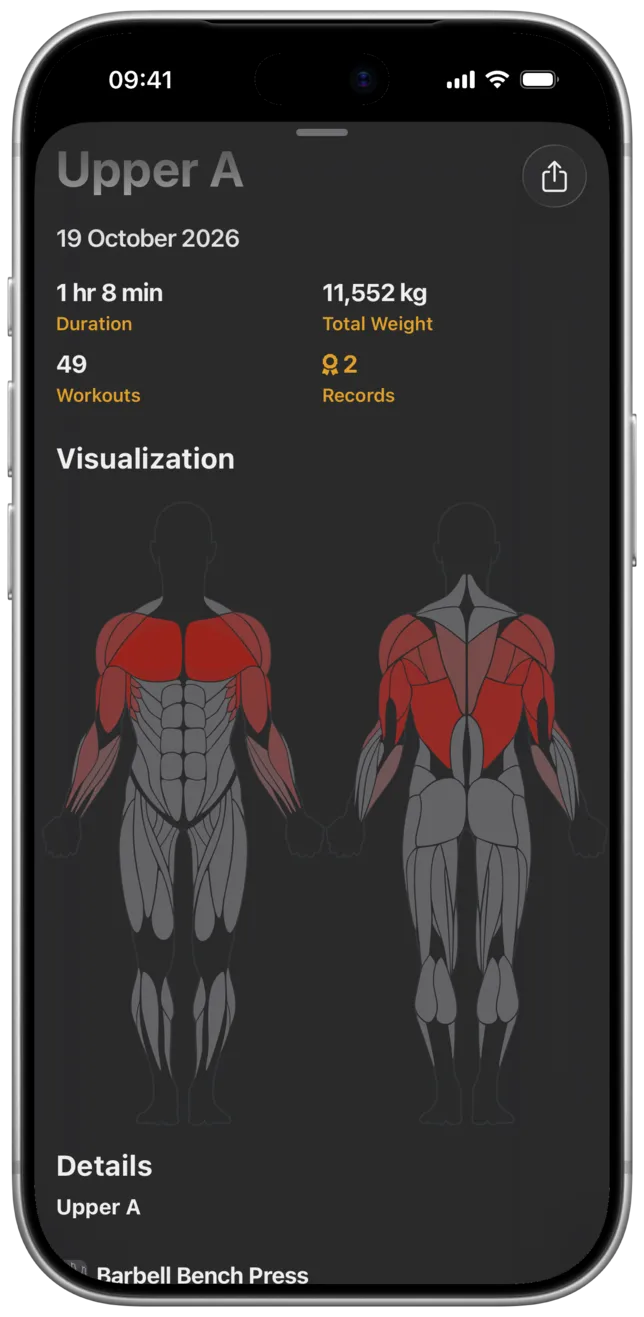
What Muscles Work
Primary Muscle:
Secondary Muscles:
Tips
- Sets of 10–15 reps work well, up to 20. This isn't a low-rep lift, so stay at 8 or more. Keep the same plates until you reach 15 on every set with arms fully vertical and no lean-back, then move up one weight and drop back to 10.
- Going from 2.5 to 5 kg doubles the load. Bridge the jump with light dumbbells or fractional plates (1–1.25 kg per hand), or first add a 2–3 second pause overhead and a 3–4 second lowering.
- The burn belongs on the outside of your shoulders and peaks around shoulder height; higher up, the front of the shoulder and your upper back between neck and shoulder blades join in. Feeling your neck from the first inch means you're shrugging. A pinch on top of the shoulder with your arms overhead? Check that your thumbs point up and use only the pain-free part of the arc.
- Substitutes: Dumbbell Lateral Raise when going above shoulder height hurts, Cable Y Raise for an overhead finish with tension at the bottom, Band Lateral Raise at home.
Common Mistakes
- Stopping at shoulder height. That's a plain lateral raise; go lighter and finish every rep with your arms vertical.
- Leaning back or arching your lower back to get the plates overhead. Keep your ribs down and glutes squeezed, and if your arms still can't reach vertical, end the arc where your back stays neutral.
- Bending the elbows on the way up until the raise turns into a press or an upright row. Set a soft elbow at the start, leave it alone and keep the plates on a wide arc, far from your head.
- Thumbs and palms turning down in the top half. That can pinch the front of the shoulder; lead with your thumbs so the plate faces point forward, and keep your palms facing forward once your arms are overhead.
Recommended Exercises
Explore exercises related to Lu Raises for shoulders training and similar movement patterns.



Choose a workout plan or create your own for free
Ready-made plans for every goal, a free plan creator, hundreds of exercises and an advanced workout journal: all in SmartWorkout.