Cable Bench Press
StrengthPush
Track this exercise in SmartWorkout
Log sets, weights and progress for free, with no workout limits.


Body Part: Chest
Description
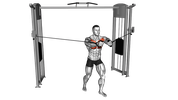
The Cable Bench Press is a variation of the traditional bench press that utilizes a cable machine to provide constant tension throughout the movement. This exercise targets the pectoral muscles, triceps, and anterior deltoids. It is performed on a flat bench with cables attached to a low pulley system, allowing for a controlled and smooth range of motion.
How to Perform
- Set up a flat bench between two low pulley machines. Attach D-handle attachments to each cable.
- Lie on the bench with your feet flat on the floor, ensuring your back is in contact with the bench.
- Grab each handle with an overhand grip and position your hands at chest level, elbows bent at approximately 90 degrees.
- Press the handles upward by extending your arms, keeping your wrists straight and aligned with your forearms.
- Pause briefly at the top of the movement, ensuring full contraction of the chest muscles.
- Slowly lower the handles back to the starting position, maintaining control and tension in the cables.
- Repeat for the desired number of repetitions.
What Muscles Work
Primary Muscle:
Secondary Muscles:
Tips
- Maintain a neutral spine throughout the exercise to prevent lower back strain.
- Focus on squeezing your chest muscles as you press the handles upward for maximum engagement.
- Keep your elbows slightly tucked in to reduce stress on the shoulder joints.
- Control the movement both upwards and downwards to maximize muscle tension and effectiveness.
- Avoid locking out your elbows completely at the top of the movement to maintain continuous tension on the muscles.
- Ensure that your shoulder blades remain retracted and stable against the bench during the exercise.
Common Mistakes
- Allowing the elbows to flare out excessively, leading to shoulder strain.
- Arching the lower back too much, reducing core engagement.
- Failing to maintain a controlled tempo, causing momentum to take over.
- Not fully retracting the shoulder blades, limiting chest activation.
- Bringing the cables too low, which can shift focus away from the chest.
- Locking out the elbows at the top, reducing tension on the muscles.
- Positioning the bench too far from the cables, altering the line of pull.
- Using too much weight, compromising form and control.
- Neglecting to keep feet planted, affecting stability and power.
Recommended Exercises
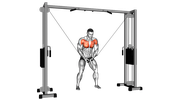
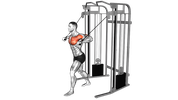
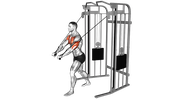
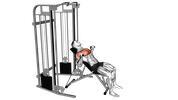
Explore exercises related to Cable Bench Press for chest training and similar movement patterns.
Choose a workout plan or create your own - for free
Ready-made plans for every goal, a free plan creator, hundreds of exercises and an advanced workout journal - all in SmartWorkout.