Decline Chest Press
Also known as: Decline Press Machine, Machine Decline Chest Press, Plate-Loaded Decline Press
Track this exercise in SmartWorkout
Log sets, weights and progress for free, with no workout limits.


Description
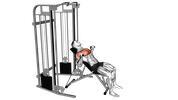
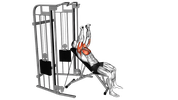
Sit upright in a decline press machine and push the handles forward and slightly down from your lower chest to build the lower part of your chest. The muscles worked are mainly the lower chest, the fibers that run toward your breastbone, and then the middle chest; your triceps take over near lockout and the front delts help only a little. You get the decline angle without lying head-down on a bench, with no bar to unrack and no spotter needed, so beginners and people training alone can push their sets close to failure. The independent levers also show you if one side is weaker.
How to Perform
- Load the same plates on both levers, or set the pin on a stack machine, and adjust the seat so the handles start level with your lower chest, just below the nipples.
- Sit with your hips all the way back and your back and head on the pad. Feet flat, about hip to shoulder width apart, knees bent close to 90°.
- Take the handles overhand, hands a little wider than your shoulders, knuckles up and wrists stacked straight over your forearms.
- Pull your shoulder blades back and down into the pad. Your elbows sit about 45–60° from your sides, slightly behind the handles.
- Press both handles forward and down along the machine's arc until your arms are almost straight in front of your lower chest. Shoulders stay on the pad and the elbows never lock.
- Take about 2 seconds to bring the handles back beside your lower chest, where you should feel a stretch across the bottom of your chest. Touch lightly without resting the plates, then press again.
- When the set is done, guide the handles back onto their stops before you let go, so the levers don't slam.
What Muscles Work
Primary Muscle:
Secondary Muscles:
Tips
- It fits as a second or third chest exercise: 3–4 sets of 8–12 reps, or 5–8 for strength.
- Add reps first. Once you get 12 on all sets with your shoulders still on the pad, add the smallest plate per side (2 × 1.25 kg or 2 × 2.5 kg) or move the pin one hole. Log plates per side and your seat setting; the lever changes the real resistance, so the total won't match your barbell numbers.
- Expect to feel it along the bottom edge of your chest toward the breastbone, and in your triceps near the top. If the front of your shoulders does most of the work, the seat is too low or your shoulders are leaving the pad. A pinch at the front of the shoulder at the bottom means shorten the stretch or go lighter.
- New to it? Use lighter plates and stop a little short at the bottom for the first few weeks. To make it harder without more weight, take 3–4 seconds on the way back or pause for 1–2 seconds at the bottom.
- Substitutes: Decline Barbell Bench Press for heavy low-rep sets with a spotter, Decline Dumbbell Bench Press when all you have is a decline bench, Chest Dips for a bodyweight lower-chest press, and Plate-Loaded Chest Press when the decline machine is taken.
Common Mistakes
- Setting the seat too low, so the handles start at shoulder height and the lift turns into a flat or incline press with lots of front-delt work. Raise the seat until the handles line up with your lower chest.
- Rolling your shoulders forward off the pad at the top to reach a few more inches. Keep your shoulder blades pinned back and stop when your arms are almost straight.
- Bringing the handles only halfway back, so your lower chest never gets stretched. Return them beside your chest on every rep, and drop a plate if you can't get there.
- One lever running ahead of the other because the plates don't match or your stronger arm takes over. Load both sides the same and move the handles at the same speed; when one arm slows down, the set is over.
Recommended Exercises
Explore exercises related to Decline Chest Press for chest training and similar movement patterns.
Choose a workout plan or create your own - for free
Ready-made plans for every goal, a free plan creator, hundreds of exercises and an advanced workout journal - all in SmartWorkout.