Glute Machine Kickback
Also known as: Glute Kickback Machine, Standing Machine Glute Kickback, Rear Kick Machine
Track Glute Machine Kickback in SmartWorkout and watch your numbers go up
Log sets, weights and progress for free, with no workout limits.


Description
Lean your hips into the pad and push the roller back with one foot until your hip is fully extended, building your glutes one leg at a time. The main muscle worked is the gluteus maximus of the kicking leg, while the gluteus medius keeps your pelvis level. Your hips and forearms rest on pads, so your spine carries no load and you don't have to fight for balance. Pick it over the cable kickback when you want a fixed path and quick weight changes, usually after squats, hip thrusts or Romanian deadlifts, or as low-fatigue glute work on an upper-body day.
How to Perform
- Set the lever so the roller meets the middle of your sole when your thigh is under your hip and your knee is bent about 90°.
- Step onto the platform facing the pads, weight behind you, and lean the front of your hips into the upright pad with both hip bones square to it.
- Rest your forearms on the arm pads and hold the handles. They keep you in place; you don't pull on them.
- Stand on one leg, foot flat under your hip and knee soft. Put the heel and arch of the other foot on the roller, toes pointing down.
- Brace your abs, ribs down, and push the roller back through your heel. Hip and knee straighten together, as if you were pushing the floor away behind you.
- Stop when your thigh is about 30° behind vertical and squeeze your glute for half a second. The foot stays low; height isn't the goal.
- Take about 2 seconds to bring the knee back to 90° and stop just before the weight touches down.
- Finish every rep on one leg, then switch, starting with the weaker side if there is one. Step off only once your foot is off the roller.
What Muscles Work
Primary Muscle:
Tips
- Do 2–4 sets of 10–15 reps per leg, stopping 1–2 reps short of failure. Add reps before load. When both legs reach 15 in all sets with the half-second squeeze, add the smallest weight step and go back to 10. That step is often 2.5–5 kg, a big jump for one leg, so spending a few sessions at the same weight is normal.
- The buttock of the working leg should do the work, hardest in the last third of the kick. Sharp pain in your lower back or the front of the hip means stop and shorten the range.
- To make it harder without adding weight, slow the return to 3 seconds and hold the end for 1–2 seconds. If you can't straighten the hip without arching, learn the pattern with the Donkey Kick first.
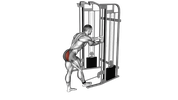
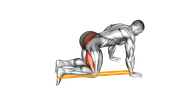
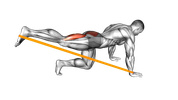
- Substitutes: Glute Cable Kickback, Band Standing Balance Glute Kickback, Kneeling Resistance Band Glute Kickback, Donkey Kick. The cable version is the closest swap with real load; the band versions work at home.
Common Mistakes
- Arching your lower back to get the leg higher. Stop at full hip extension, thigh about 30° behind vertical, hips on the pad and ribs down. If the arch keeps creeping in, drop the weight.
- Your pelvis twists open toward the working side as the leg goes back. Keep both hip bones on the pad and the knee pointing at the floor, and shorten the kick if the hips still turn.
- Curling the heel toward your butt instead of pushing the roller back. You'll usually feel a cramp in the back of the thigh. Drive through the heel and let the knee straighten as the hip opens: the roller travels back, not up.
- Pushing your body away from the pad and yanking on the handles. Leave your forearms relaxed on the pads; only the working leg moves.
- Letting the weight slam down and bouncing out of the bottom. Take about 2 seconds on the way back and stop just before it touches.
Recommended Exercises
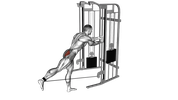
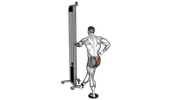
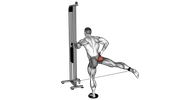
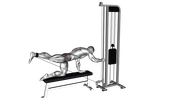
Explore exercises related to Glute Machine Kickback for glutes training and similar movement patterns.

Choose a workout plan or create your own for free
Ready-made plans for every goal, a free plan creator, hundreds of exercises and an advanced workout journal: all in SmartWorkout.