Leg Press
Also known as: 45-Degree Leg Press, Sled Leg Press, Incline Leg Press
Track this exercise in SmartWorkout
Log sets, weights and progress for free, with no workout limits.


Description
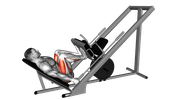
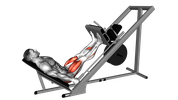
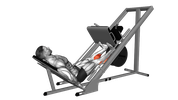
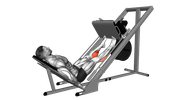
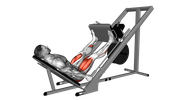
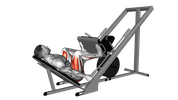
Sit back in a 45-degree leg press and drive the loaded sled up its rails with both feet to build your quads and glutes without a bar on your back. The quads, on the front of your thighs, do most of the work; the glutes kick in hard at the bottom, where your hips fold deepest. Your back and head stay on the pad, so you can take heavy sets close to failure even when your back or shoulders limit heavy squats. Pick it over the horizontal press for heavier loads and a deeper hip bend, and over the hack squat when you want your torso fully supported.
How to Perform
- Load the same plates on both sides of the sled so it runs evenly on the rails.
- Sit all the way back, hips down in the seat, with your back and head on the pad.
- Set your feet flat in the middle of the platform, about hip-width apart, toes turned slightly out.
- Press the sled just off the stops, turn the safety handles out to free it, then take hold of the seat handles beside your hips.
- From the top, legs almost straight, bend your knees and hips and lower the sled over about 2 seconds, knees tracking over your toes.
- Keep going until your thighs near your ribs, about 90 degrees at the knee or a bit deeper. Stop before your hips curl off the seat.
- Without bouncing, drive the sled back up through your whole foot, heels down, and stop just short of locking your knees.
- At the top of the final rep, turn the safety handles back in while the sled is at the top, then let it down onto them.
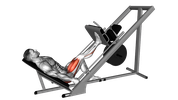
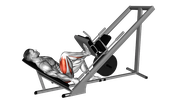
What Muscles Work
Primary Muscle:
Secondary Muscles:
Tips
- For strength, use sets of 5–8; for muscle, 8–15, and many push the last set to 20 because the sled is safe to take close to failure.
- Once all your sets hit the top number, add 10 kg (a 5 kg plate per side) and drop back to the bottom of the range; switch to 5 kg jumps when progress slows. Count the load the same way every session, since the empty sled weighs something different on every machine.
- Foot placement changes the work. Higher on the platform means more hip bend and more glutes; lower means more knee bend and more quads, but your heels lift sooner. Narrow and wide stances are listed as separate exercises.
- Expect to feel it mostly in the front of your thighs, plus the glutes near the bottom. Lower-back pressure or your tailbone lifting means you went deeper than your hips allow. If the front of the knee hurts, check that your knees follow your toes and your heels stay down.
- To make it easier, cut the depth to about 90 degrees at the knee, or use the Lever Horizontal Leg Press: it's easier to get in and out of, and its pin stack allows small jumps. To make it harder without adding plates, pause for 2 seconds at the bottom of every rep or move to the Single Leg Press.
- Substitutes: Lever Horizontal Leg Press, Machine Hack Squat, Smith Squat, Dumbbell Goblet Squat.
Common Mistakes
- Hips and lower back peeling off the seat at the bottom as your tailbone tucks under. Stop the descent just before that point, or set your feet a little higher on the platform.
- Knees caving in as you press. Push them out in line with your second and third toes, turn your toes slightly out and take some weight off if they still drift.
- Snapping the knees straight at the top. Stop just short of lockout and keep the legs working; a locked knee under a heavy sled is the main injury risk on this machine.
- Quarter reps with a tall stack of plates. Strip weight until you reach about 90 degrees at the knee on every rep, and keep the same depth from set to set so the progress you log is real.
- Pushing on your knees with your hands. Keep your hands on the seat handles; if you need them to finish a rep, that rep ends the set.
Recommended Exercises
Explore exercises related to Leg Press for legs training and similar movement patterns.
Choose a workout plan or create your own - for free
Ready-made plans for every goal, a free plan creator, hundreds of exercises and an advanced workout journal - all in SmartWorkout.


Start with a free plan. Keep progressing with SmartWorkout.
- users
- 200k+
- exercises with technique guides
- 1,000+
- workouts on the free plan
- ∞