Cable Rear Delt Fly
Also known as: Cable Reverse Fly, Rear Delt Cable Fly, Standing Cable Reverse Fly
Track this exercise in SmartWorkout
Log sets, weights and progress for free, with no workout limits.


Description
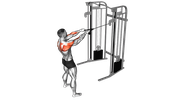
Face a cable crossover, hold the high cables crossed in front of your chest and sweep your arms out into a T to build the backs of your shoulders. The rear delts do most of the work, with help from the middle traps between your shoulder blades and the infraspinatus that sits on them. Crossing the cables starts each rep with your hands on the far side of your chest for a longer arc, and the stack pulls from the first inch, where a bent-over dumbbell raise has almost no load. Unlike a face pull, the elbows never bend: your arms stay long and only sweep out and back.
How to Perform
- Set both pulleys at the top, well above your head. Hold the bare cable ends or clip a single D-handle to each.
- Cross the cables: right hand on the left pulley's cable, left hand on the right one. Thumbs up, elbows slightly bent.
- Face the machine from the middle and step back until the cables are taut, wrists crossed in front of your chest at shoulder height.
- Set your feet hip- to shoulder-width apart, knees soft, ribs down and glutes lightly squeezed so the high cables can't tip you forward.
- Keeping that elbow angle fixed, sweep your arms out and back at shoulder height, as if the backs of your hands push the cables apart.
- Stop once your arms line up with your shoulders and your body forms a T. Hold a second, shoulder blades together, shoulders low.
- Take 2–3 seconds to follow the same arc back until your wrists cross again. The plates stay off the stack between reps.
- When the set is done, bring your hands back to the crossed start and lower the stacks before letting go, so the cables don't snap back.
What Muscles Work
Primary Muscle:
Secondary Muscles:
Tips
- Take 2–4 sets of 12–20 reps close to failure here; the rear delts recover fast, so two or three sessions a week are fine. Add reps at the same pin until you get 20 in each set with a one-second hold at the T, then move each stack up one plate and drop back to 12.
- Go light at first. Both stacks add up, and many dual-pulley stations use 2:1 or 4:1 pulleys, so pin numbers don't carry over from one machine to another. If one plate is too big a jump, use the add-on weights or hold the T longer before you move the pin.
- Rear shoulders and the area between your shoulder blades should do the work. Burning in your neck means you're shrugging, and a pinch at the front of the shoulder means your arms went past your body.
- Can't hold the T yet? Use the lightest pin and open only until your hands are about 45° out. Once the full arc is easy, a 2-second hold and a 3-second return come before more weight.
- Substitutes: Machine Reverse Flyes if you want your chest on a pad and the simplest setup, One-Arm Cable Rear Delt Fly when only one column is free (your other hand can brace), and Bent Over Dumbbell Lateral Raise if all you have is dumbbells.
Common Mistakes
- Bending the elbows and pulling your hands toward your shoulders like a row. Set the slight bend at the start, keep it to the last rep and think "push the cables apart", not "pull".
- Hands sinking toward your hips as the arms open, so the fly turns into a straight-arm pulldown. Finish in a T, not a Y pointing down, and go one plate lighter if your arms keep sinking.
- Shrugging as the arms open. Keep your neck long and let the shoulder blades travel back, not up toward your ears.
- Taking each cable in the hand on its own side, or standing too close, so the cables hang slack at the start. Cross them and step back until they're taut with your wrists crossed.
- Leaning back or rocking to swing the arms open. Stand tall with your ribs down, or use a short split stance; if you still need the rock, the weight is too heavy.
- Pulling the arms behind your body at the end and pushing your chest forward. Stop at the T, arms in line with your shoulders, and hold there.
Recommended Exercises
Explore exercises related to Cable Rear Delt Fly for shoulders training and similar movement patterns.
Choose a workout plan or create your own - for free
Ready-made plans for every goal, a free plan creator, hundreds of exercises and an advanced workout journal - all in SmartWorkout.