Barbell Reverse Lunges
StrengthBalanceFunctional
Track this exercise in SmartWorkout
Log sets, weights and progress for free, with no workout limits.


Body Part: Legs
Description
The Barbell Reverse Lunge is a compound lower-body exercise that targets the quadriceps, hamstrings, glutes, and calves. It involves stepping backward into a lunge position while holding a barbell across the upper back, requiring balance and core stability.
How to Perform
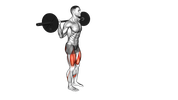
- Begin by standing upright with your feet hip-width apart and a barbell resting across your upper back. Grip the barbell with both hands slightly wider than shoulder-width.
- Engage your core and maintain an upright torso throughout the movement.
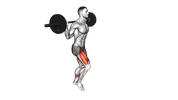
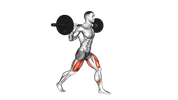
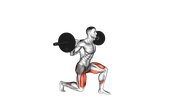
- Step backward with your right foot, lowering your hips until both knees are bent at approximately 90 degrees. Your front knee should be directly above your ankle, and your back knee should hover just above the ground.
- Push through the heel of your left foot to return to the starting position.
- Repeat the movement with your left foot stepping back to complete one full repetition.
- Continue alternating legs for the desired number of repetitions.
What Muscles Work
Primary Muscle:
Secondary Muscles:
Tips
- Keep your chest lifted and shoulders back to maintain proper posture.
- Focus on a controlled descent to prevent losing balance.
- Ensure your front knee does not extend beyond your toes to protect your joints.
- Use a mirror or a spotter to check form and alignment during the exercise.
- Start with a lighter weight to master the technique before progressing to heavier loads.
- Breathe in as you step back and exhale as you push forward to return to the starting position.
Common Mistakes
- Allowing the front knee to cave inward, which can strain the knee joint.
- Leaning the torso too far forward, reducing glute and hamstring engagement.
- Stepping back too narrowly, compromising balance and stability.
- Not maintaining a vertical shin on the front leg, increasing stress on the knee.
- Failing to keep the core engaged, leading to a loss of control and balance.
- Pushing off primarily with the toes instead of the heel, reducing posterior chain activation.
- Dropping the back knee too quickly, risking a lack of control and potential injury.
- Allowing the barbell to roll onto the neck, causing discomfort and improper weight distribution.
- Not lowering the back knee close enough to the ground, limiting the range of motion.
- Holding the breath throughout the movement, which can affect stability and control.
Recommended Exercises
Explore exercises related to Barbell Reverse Lunges for legs training and similar movement patterns.
Choose a workout plan or create your own - for free
Ready-made plans for every goal, a free plan creator, hundreds of exercises and an advanced workout journal - all in SmartWorkout.


Start with a free plan. Keep progressing with SmartWorkout.
- users
- 200k+
- exercises with technique guides
- 1,000+
- workouts on the free plan
- ∞