How often to change your workout routine and exercises

You should change your workout routine less often than you think: once per block, usually every 4-8 weeks, and only the exercises that have stalled. An exercise where the weight or the reps go up from week to week stays for the next block. Changing exercises every workout or every week takes away your one measure of progress: the same movement compared week after week.
How often should you change your workout routine: a decision per exercise
You review your workout plan at the end of a block, or mesocycle, which in the gym usually lasts 4-8 weeks. At that point you look at each exercise on its own, not at the plan as a whole:
| What your log shows | What to do |
|---|---|
| The weight or the reps went up in the last 3 weeks | Keep the exercise for the next block |
| The numbers have stalled for about 3 weeks, even though the sets were hard | Change the variation or the rep range in the next block |
| The movement hurts a joint | Switch right away to a variation that doesn't hurt |
| The machine is taken or your gym doesn't have the equipment | Swap the exercise for this workout only and leave the plan as it is |
| You're bored and start skipping workouts | Change 1-2 accessory exercises and keep the main lifts |
| Your goal changed, for example from bulking to cutting | Build a new plan starting with the next block |
You can run the same block 2-3 times. With 4-week blocks that's 8-12 weeks with the same main lifts, and then you review the exercises that stalled and check whether your goal has changed. There's more on what to do after a block on its own page.
Why changing exercises too often costs you progress
Changing exercises too often costs you progress because every new exercise is a new starting point. Progressive overload means doing more in the same movement over time: one more rep or 2.5 kg more. To see it, you need several workouts in a row with the same exercise.
Even a different machine for the same movement gives you a new number, because the same pin on two different models means a different resistance. If you train chest on a different machine every week, every workout is your first one, and you can't tell whether you got stronger or just found a lighter stack.
Research doesn't say that changing exercises always hurts. In a review of 8 studies on 241 young men, planned exercise variation seemed to improve gains, while excessive, random variation might hinder them (Kassiano et al. 2022). In an 8-week study of 21 trained men, random exercise variation gave similar muscle growth and more motivation (Baz-Valle et al. 2019). The takeaway for your plan: change an exercise for a specific reason, not out of habit.
Muscle confusion: a myth the research doesn't back
Muscle confusion, the idea that you have to surprise your muscles with new exercises every workout or they stop growing, has no support in the studies above. Muscles grow when you add weight, reps or sets over time, and changing exercises at random every workout is exactly the excessive variation that might hinder gains in the Kassiano review.
The part that holds up is planned variation: a new variation for a stalled exercise at the start of a block, as in the table above. A routine that looks the same for 8-12 weeks is fine as long as the numbers in your log keep going up.
When switching exercises makes sense
Switching an exercise makes sense when you have a specific reason for it, ideally at the start of a new block:
- The movement hurts a joint. Don't wait for the block to end. Pick a variation of the same movement that doesn't hurt, for example the Front Squat instead of the Barbell Squat.
- The numbers have stalled for about 3 weeks, even though you end your sets 0-2 reps short of muscular failure. In the new block, swap the Barbell Bench Press for the Dumbbell Bench Press, for example, or move from 6-8 to 10-12 reps.
- You switch gyms, train at a hotel gym or the equipment isn't there. Pick the closest variation of the same movement and treat the first workout as a new starting point.
- The workouts bore you. If boredom makes you skip sessions, change 1-2 accessory exercises each block and keep the main lifts, because they show your progress.
How to switch an exercise without losing progress
When you switch an exercise, change as little else in the plan as possible:
- Change at the start of a block, not in the middle of it.
- Change 1-2 exercises at a time and keep the main lifts.
- Pick a variation of the same movement for the same muscle group: a press for a press, a row for a row.
- Do the first workout of the new exercise with 2-3 reps in reserve (RIR 2-3) and log the result. From the second workout on, add according to double progression: reps first, then weight.
- Keep a one-off swap out of the plan, like dumbbells on a Monday evening when every bench is taken.
Why you're not making progress in the gym: exercises are only one reason
When you're not making progress in the gym, your exercise selection is rarely the only reason. Before you change your plan, check your sleep, your food, the number of sets per muscle group and whether you end your sets close to muscular failure. The checklist with thresholds is in the section on hitting a plateau in the gym. If all of that is in order and an exercise has stalled for 3 weeks, that's when you change the variation.
Changing an exercise in your plan in SmartWorkout
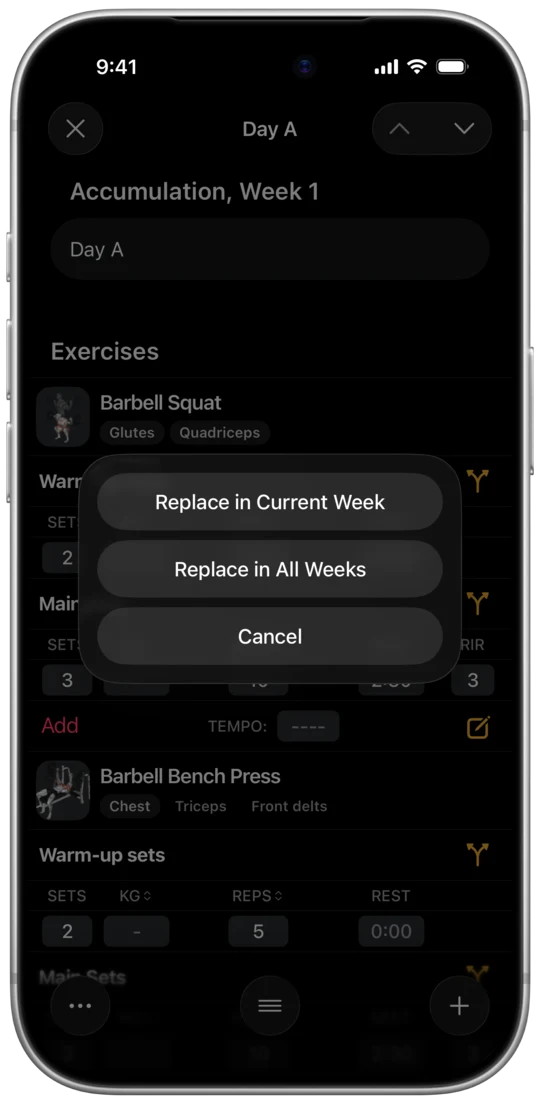
In SmartWorkout you replace an exercise in the plan editor. When the same exercise is also in other weeks, you choose “Replace in Current Week” or “Replace in All Weeks”.
Common questions
How often should you change your workout routine to build muscle?
Once per block, usually every 4-8 weeks, and only in the exercises that stopped improving. In your first months of training the same plan can work longer, as long as you add weight or reps every week.
Should I change my workout routine every month?
Not the whole routine. With 4-week blocks a month is one block, so you change only the exercises that stalled. The whole plan usually changes after 2-3 blocks (2-3 months with 4-week blocks), or when your goal changes. Main lifts that are still improving can stay in the plan much longer.
Should I change my workout routine every week?
No, and not every workout either. With changes that frequent you can't see whether you're making progress, and in the Kassiano et al. review excessive, random variation might hinder gains.
How often should I change exercises in the gym?
You change a single exercise when it has stalled for about 3 weeks despite hard sets, when it hurts, or when you don't have the equipment for it. Without one of those reasons it stays in the plan for the next block.