
Intensity techniques compared in one table
Intensity techniques, also called advanced training techniques, extend a set or cut the rest. The second group in the table doesn't extend the set; it arranges the weight and the rest periods.
| Technique | What you change | Fatigue | Time vs regular sets | Who and which exercises |
|---|---|---|---|---|
| Extend the set or cut the rest | ||||
| Drop set | after the last set, cut the weight by 20-30% with no rest | high (Havers et al. 2026) | 2-3 times shorter in some studies (Sødal et al. 2023) | after your first months; machines, cables, dumbbells |
| Rest-pause | after failure, rest 15-30 s and keep going with the same weight | high, like drop sets; a very demanding method (Iversen et al. 2021) | 35 instead of 57 minutes in one study (Prestes et al., as described by Iversen et al.) | after your first months; machines, cables |
| Myo-reps | an activation set 1-2 reps short of failure, then mini sets after 3-5 breaths (Fagerli 2023) | high, though usually without failure | shorter; similar results with 30% less tonnage (Bradshaw et al. 2026) | after your first months; isolation, machines, cables |
| Superset and circuit | an exercise for another muscle group instead of rest | higher perceived effort and more muscle damage (Zhang et al. 2025) | supersets about 37% shorter (same meta-analysis) | everyone |
| Compound set | a second exercise for the same muscle group instead of rest | high; tonnage drops (same meta-analysis) | shorter, similar to supersets | after your first months; isolation |
| Arrange the sets and the weight | ||||
| Cluster set | rests inside the set, e.g. 15-45 s, before fatigue builds (Latella et al. 2019) | lower (Davies et al. 2021) | the same or longer | heavy sets where bar speed and technique matter; squat, bench press |
| Top set and back-off sets | one heavier set, then lighter ones | moderate | same as regular sets | heavy multi-joint exercises |
| Ramp and pyramid | the weight goes up (and down) from set to set | same as regular sets | same as regular sets | everyone; multi-joint exercises |
| Warm-up sets | lighter sets before the working sets | low | a few minutes longer | everyone, before heavy sets |
| AMRAP as a test | one set for as many reps as possible | high; to failure on machines, to technical failure with a barbell | like one set | machines, and barbell lifts with a spotter |
“After your first months” means once you can judge RIR. Ratings without a source are our practice; the technique pages give the sources for the other numbers.
Forced reps, negatives and other bodybuilding methods
Guides also list methods that change the movement rather than the set structure: forced reps, cheat reps, partial reps, negatives and 21s. Forced reps and heavy negatives go past muscular failure and usually need a partner; they are the most fatiguing, so use them rarely and only on the last set. Pre-exhaustion, an isolation exercise right before a multi-joint one for the same muscle group, gave no advantage over the usual order (Trindade et al. 2022).
When intensity techniques are worth it for hypertrophy and strength
Intensity techniques don't build more muscle than regular sets with similar work: that was the result of a meta-analysis of 10 studies in trained lifters (Fonseca et al. 2023) and of a meta-analysis of 20 studies (Tsartsapakis et al. 2026). They pay off in four situations:
| Situation | Technique |
|---|---|
| short on time | a superset for different muscle groups; a drop set or rest-pause instead of the last 1-2 regular sets; myo-reps instead of 3 sets |
| reps have stalled on an isolation exercise | a drop set or rest-pause after the last set |
| heavy reps without losing bar speed | cluster sets |
| training has gone stale | any technique from the first table on 1-2 exercises; muscle grows the same, and variety guards against monotony (Krzysztofik et al. 2019) |
Drop sets and rest-pause only save time when they replace sets. In your week, a drop set counts as 1 set; that's a conservative rule, because in studies one drop set built no less muscle than 3 regular sets (how to count a drop set).
Krzysztofik et al. also suggest techniques for a plateau, but nobody has tested that, so check the usual causes of a plateau first. For strength you don't need a technique: the 2026 ACSM position stand and separate meta-analyses of drop sets and cluster sets find no difference. For hypertrophy, more muscle comes from more weekly sets, meaning higher training volume, not from the technique.
For example, Cable Triceps Pushdown and Dumbbell Biceps Curl for 3 sets of 12 each (a set takes about 40 s, rest 90 s) take about 11.5 minutes done separately. In a superset you do them back to back with 15 s to switch and rest only after the round: 3 rounds take under 8 minutes, a third less, with the same weekly sets.
What intensity techniques cost in fatigue and recovery
Techniques save time at the cost of fatigue, so plan them so they don't eat into recovery and progress (Rios et al. 2026). In studies, drop sets and rest-pause usually ended at muscular failure, while cluster sets avoided it (Tsartsapakis et al. 2026); in myo-reps the activation set and the mini sets end 1-2 reps short. Training to failure on every set extended recovery to 24-48 hours (Morán-Navarro et al. 2017). Skip drop sets and rest-pause before training the same muscle group the next day or before a strength test.
How to add an intensity technique to your program
- Keep the Barbell Squat and the Barbell Bench Press away from failure: in regular sets, as a top set with back-off sets or as cluster sets.
- Pick one technique for one reason: time, a plateau or heavy reps.
- Give a drop set or rest-pause to 1-2 isolation exercises at the end of the workout, on the last set; myo-reps usually replace 3 sets of one isolation exercise (myo-reps in a weekly plan). A superset runs through all the sets of the pair.
- Set up the equipment before the set: for a drop, the lighter pair of dumbbells right next to you; for an arm superset, dumbbells by the cable stack, so the switch takes under 20 seconds.
- Add drop sets, rest-pause and myo-reps for the last 2-3 weeks before a deload, when your weekly sets are highest, and watch your numbers on the exercises from step 1; if they drop two workouts in a row, cut the technique sooner.
Examples: the same workout with regular sets and with a technique
In each example, the intensity technique replaces or finishes the regular sets of the same exercises.
| Reason | Exercise | Regular sets | With a technique | RIR | Rest |
|---|---|---|---|---|---|
| less time | Cable Triceps Pushdown and Dumbbell Biceps Curl | 3 × 10-15 each, separately | superset, 3 rounds | 1 | 15 s to switch, 90 s after the round |
| reps have stalled | Machine Chest Fly | 3 × 10-12 × 45 kg | the same, then a drop to 35 kg × 8 after the last set | 1, 0 in the drop | 90 s, no rest before the drop |
| a heavy set plus volume | Barbell Bench Press | 4 × 6-8 × 90 kg | top set 1 × 5 × 100 kg, then 3 × 8 × 87.5 kg | 1, then 2 | 3 min |
You can work out other top set variants with the 1RM calculator in top set mode.
Which technique on which equipment
Drop sets, rest-pause and myo-reps suit pin-loaded machines, cables and dumbbells, while cluster sets and top sets suit heavy barbell lifts.
| Good fit | Techniques | Why |
|---|---|---|
| Seated Leg Extension Machine | drop set, rest-pause, myo-reps | pin-loaded, so failure is safe |
| Dumbbell Lateral Raise | drop set, myo-reps, compound set with reverse flyes | dumbbells sit in pairs on the rack, so the lighter pair is right next to you |
| Machine Chest Fly | rest-pause, drop set | you change the weight with a pin, and there's no barbell over your chest |
| Barbell Squat | cluster set, top set and back-off sets, warm-up sets | heavy reps where bar speed matters |
| Barbell Bench Press | top set and back-off sets, ramp, warm-up sets, cluster set | as with the squat; heavy mini sets with safety arms or a spotter |
| Better not | Techniques | Why |
|---|---|---|
| Barbell Squat | drop set, rest-pause, myo-reps, AMRAP without a spotter | failure with a barbell on your back is dangerous; Iversen et al. 2021 advise against drop sets |
| Deadlift | drop set, rest-pause | technique breaks down under fatigue |
Drop sets vs rest-pause vs myo-reps vs cluster sets
Drop sets, rest-pause, myo-reps and cluster sets all extend or split a single set; they differ in whether you end at failure and in how they count in your week.
| Drop set | Rest-pause | Myo-reps | Cluster set | |
|---|---|---|---|---|
| To failure | yes or close | yes | no; 1-2 reps in reserve, stop when a mini set comes out a rep shorter than the earlier ones | no |
| Weekly sets in SmartWorkout | the whole sequence is 1 set | each mini set is 1 set | each mini set is 1 set | each mini set is 1 set |
When you plan your week, studies count a whole rest-pause set and a whole cluster set as 1 set, and the author of myo-reps counts a sequence with 3-4 mini sets as about 3. So SmartWorkout will show more sets than you count in your plan; don't add mini sets just to reach a volume zone target (how to count sets).
Intensity technique vs intensification block in periodization
In training, “intensification” means three different things: a technique for one set, a block of a few weeks in a plan, and adding load in general.
| Meaning | What it is | Where to read |
|---|---|---|
| intensity technique | a change to one set or one exercise | this page |
| intensification block | several weeks in which the weight goes up and the reps go down | block periodization, mesocycle |
| adding load | more weight, reps or sets from week to week | progressive overload |
Intensity, meaning the weight as %1RM or how close you get to failure, is covered on the training intensity page.
In a block of heavy sets of 1-5 reps, drop sets, rest-pause and myo-reps get in the way, and in a deload week you drop them.
Common mistakes
- A technique instead of progression. Results depend on load, number of sets, frequency and effort, and a technique only arranges them (Rios et al. 2026). First check whether the weight or the reps go up from week to week.
- Failure on every exercise. Fatigue adds up: after three drop sets or rest-pause sets, you do the next exercises weaker. 1-2 such exercises per workout are enough.
- Mini sets on one line. Rest-pause logged as one set of 8 + 3 + 2 = 13 reps inflates your estimated 1RM and your records. Log each mini set separately.
- A compound set on a lift you want to get stronger on. A second exercise for the same muscle group lowers tonnage (Zhang et al. 2025), so do your strength exercise first and on its own. If you only need to save time, a superset for different muscle groups, e.g. triceps with biceps, saves about as much and costs no reps.
What the research says
Many studies equate the amount of work in both groups, so they can't show whether a technique lets you do more reps in the same time (Kassiano et al. 2021). The certainty ratings in the claims table are our assessment.
| Claim from the guides | What studies show | Certainty |
|---|---|---|
| More muscle | no advantage in meta-analyses of the whole group, of drop sets, cluster sets and supersets; rest-pause slightly better in one, but in the Prestes et al. study the regular-set group ended its sets far from failure (Iversen et al. 2021); the 2026 ACSM position stand lists an advantage for eccentric-only contractions, but that isn't the same as adding negatives to regular sets | moderate |
| Less time | supersets by about a third, drop sets 2-3 times shorter in some studies, rest-pause by 39% in one study | moderate |
| More strength | one meta-analysis in favor, the others and the ACSM position stand show no difference | low |
| More fatigue | higher perceived effort and lactate, slower recovery after failure; cluster sets are the exception | moderate |
| Study | Type and sample | Result | Limitation |
|---|---|---|---|
| Fonseca et al. 2023 | meta-analysis, 10 studies, trained lifters | muscle: SMD 0.00 | short studies only |
| Tsartsapakis et al. 2026 | meta-analysis, 20 studies, adults aged 18-45 | muscle: g 0.05, not significant; strength: g 0.35 | also includes velocity-based training and eccentric overload |
| Havers et al. 2026 | drop set meta-analysis, 12 studies, 274 people | muscle: SMD 0.04; perceived effort: SMD 1.62 | about 23 people per study |
| Zhang et al. 2025 | superset meta-analysis, 19 studies, 313 people | shorter sessions, similar strength and muscle | same-muscle pairs lower tonnage |
It's unknown whether no difference really means equal: the studies lasted 5-12 weeks and mostly included young men (Tsartsapakis et al. 2026), had small groups and didn't test equivalence (Rios et al. 2026). It's also unknown how many techniques per week is too many.
What SmartWorkout logs show
That 27% is ramping or unmarked warm-up sets, and unmarked warm-ups inflate weekly sets (which sets are working sets). These are lifters in our logs, mostly in Poland, and every number is an aggregate of at least 50 people.
How to log intensity techniques in SmartWorkout
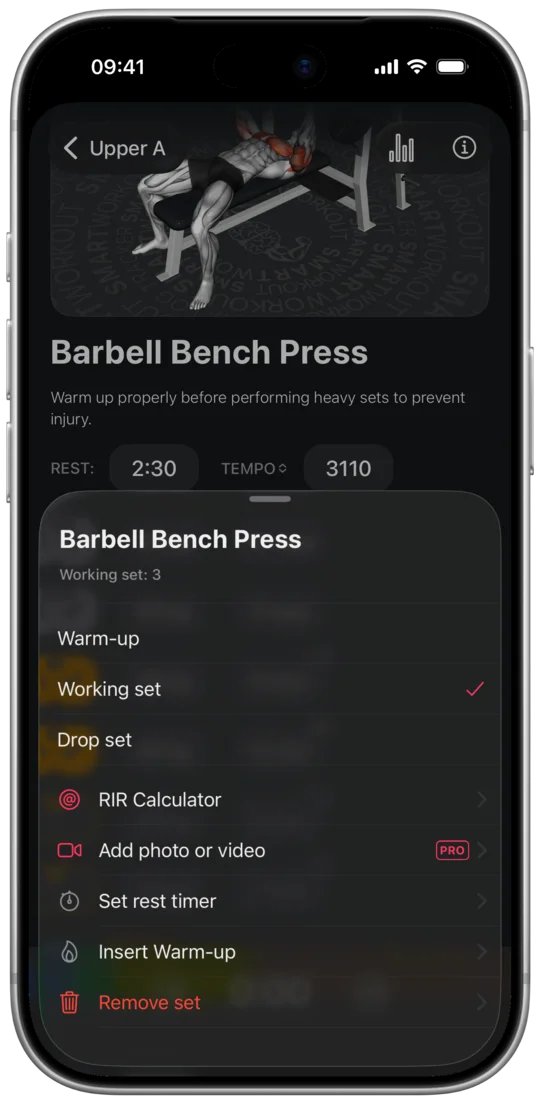
You log drop sets and warm-up sets in SmartWorkout as a set type, supersets as an exercise group, and the other techniques as regular working sets.
- Drop set: below your last working set, tap “Add Set”, open the new set's menu and choose “Drop set”. Skip the rest timer and go straight into the drop.
- Warm-up: in the set sheet, choose “Insert Warm-up”.
- Superset: on the workout screen, tap “Add Superset” and select the exercises.
- Rest-pause, myo-reps and cluster sets: log each mini set as a separate working set with a short rest (“Set rest timer”), e.g. 20 s.
- AMRAP in a plan: in the plan creator, enter the minimum reps and leave the maximum empty.
You can't choose Drop set for an exercise in a group, so do drop sets outside a superset.
In weekly sets and volume zones, SmartWorkout counts a drop set as 1 set and each mini set of rest-pause, myo-reps and cluster sets separately, because rest separates them; warm-up sets don't count.
With Premium, progression suggestions recognize a top set with back-off sets and suggest the weight for each separately, and you see each muscle group's weekly sets against the volume zones.
The fragment below combines a top set on the bench press, a drop set on lateral raises and an arm superset; you only go to failure in the drop set. You can paste it through plan import (Workout > My Plans > “+” > “Import plan”). Import costs 10 AI credits, so the welcome credits cover it.
DAY: Upper B- Barbell Bench Press | WU 3x3-5 | 1x5 RIR 1 + 3x8 RIR 2 | TEMPO 20X0 | REST 180- Chest Supported Machine Row | 3x8-12 RIR 1 | TEMPO 2011 | REST 120- Machine Chest Fly | 3x10-12 RIR 1 | TEMPO 2010 | REST 90- Dumbbell Lateral Raise | 3x12-15 RIR 1 + DROPSET 1x6-10 | TEMPO 2010 | REST 90LINKED:- Cable Triceps Pushdown | 3x10-15 RIR 1 | TEMPO 2011 | REST 0- Dumbbell Biceps Curl | 3x10-15 RIR 1 | TEMPO 2010 | REST 90END LINKEDThe free 4-day upper/lower plan also has an arm superset.
Log it in SmartWorkout
A free workout log for iPhone and Android: sets, RIR, tempo, exercise groups and plans.


Questions
What are intensity techniques in lifting?
Usually, methods that change a single set, such as drop sets, supersets or rest-pause. In program design, “intensification” is also the name for a block of a few weeks with rising weight, covered under block periodization.
What are the best intensity techniques for hypertrophy?
When you're short on time, a superset for different muscle groups or a drop set in place of the last sets of an isolation exercise. For heavy barbell reps, cluster sets. None builds clearly more muscle than regular sets, so pick the one that solves your problem.
Should beginners use intensity techniques?
They don't need to: as long as the weight or reps go up every week, drop sets and rest-pause mostly add fatigue. Reach for them when an isolation exercise hits a plateau; supersets for different muscle groups are fine from the start, because they save time and don't require failure.
How often should you use intensity techniques?
At most 1-2 exercises with a drop set, rest-pause or myo-reps per workout, and only one if you train the same muscle group 3 times a week. Supersets, top sets with back-off sets and cluster sets can go into every workout, because they don't require failure. In a deload week, cut the techniques that go to failure.
How do you know you're using too many intensity techniques?
Your numbers on heavy exercises drop for the second workout in a row, and you start the next session for the same muscle group weaker. Cut the techniques for a week or take a deload.
Do intensity techniques help you break a plateau?
Sometimes, on an isolation exercise, but nobody has tested it directly. First check your weekly sets, your sleep and whether you're really adding weight or reps.
See also
- Drop sets: what they are, how to do them and how much weight to dropA drop set (also called a strip set or descending set) is a set taken to or near failure, then continued without rest after cutting the weight by about 20-30%. In meta-analyses, drop sets built about as much muscle as regular sets in less time. One drop on the last set is usually enough.
- Myo-reps: what they are and how to do the activation set and mini setsMyo-reps are a rest-pause method developed by Børge Fagerli: an activation set stopped 1-2 reps short of failure, then 2-5 mini sets of 2-4 reps with the same weight after 3-5 deep breaths (10-15 s). In an 8-week study they built muscle and strength about as well as straight sets, in shorter sessions.
- Rest-pause sets: what they are and how to do themA rest-pause set is a set taken to muscular failure, followed by a 20-30 s pause and more reps with the same weight, usually 1-2 times. In studies it built muscle about as well as straight sets in less time, and in some studies it added slightly more strength.
- Cluster sets in lifting: what they are and how to use themA cluster set is one set split into mini sets of 1-5 reps with short rests inside the set, usually 15-45 s. In meta-analyses, cluster sets built strength and muscle about as well as traditional sets, with less velocity loss and less fatigue during the session.
- Top set and back-off sets: what they are and how much weight to dropA top set is the heaviest working set of an exercise in a session, and back-off sets are 2-4 working sets after it, done after full rest and usually 5-20% lighter. In a 6-week study of powerlifters, 2 back-off sets at 80% of the top set weight gave clearer strength gains than the top set alone.
- Supersets in the gym: what they are, examples and superset vs compound setA superset is two exercises for different muscle groups done back to back with no rest in between; you rest only after both. Two exercises for the same muscle group are usually called a compound set. In a meta-analysis of 19 studies, supersets cut session time by about 37% with similar tonnage.
- Training intensity: percentage of 1RM vs proximity to failure and how to increase itTraining intensity has two meanings in lifting: load as a percentage of one-rep max (%1RM) and effort, meaning how close to failure a set ends (RIR). At 80% of 1RM lifters average about 9 reps to failure on the bench press and 13 on the leg press. Muscle grows from about 30% of 1RM when sets end close to failure.
- How to count sets per muscle group: direct, indirect and warm-up setsCounting sets per muscle group (fractional set counting) means adding up a week's working sets: 1 for the muscle that mainly does the movement, 0.5 for a muscle that clearly assists, 0 for warm-up sets. In a meta-analysis of 67 studies, this matched muscle growth better than counting assisting muscles as 1 or 0.
Sources
- Fonseca PAB, Ide BN, Oranchuk DJ, et al. Comparison of Traditional and Advanced Resistance Training Paradigms on Muscle Hypertrophy in Trained Individuals: A Systematic Review and Meta-Analysis. Transl Sports Med. 2023;2023:9507977.
- Tsartsapakis I, Zafeiroudi A, Kouthouris C. Effects of Advanced Resistance Training Systems on Muscle Hypertrophy and Strength in Recreationally Trained Adults: A Systematic Review and Meta-Analysis. J Funct Morphol Kinesiol. 2026;11(1).
- Havers T, Micke F, Geisler S, et al. Acute and Chronic Effects of Drop-Set Training: A Meta-Analysis and Systematic Review. Sports Med Open. 2026;12(1).
- Sødal LK, Kristiansen E, Larsen S, et al. Effects of Drop Sets on Skeletal Muscle Hypertrophy: A Systematic Review and Meta-analysis. Sports Med Open. 2023;9(1):66.
- Rios MJ, Ferreira FA, Chapman DW, et al. Methods and Systems of Resistance Training: A Narrative Review Based on Contemporary Recommendations. Sports (Basel). 2026;14(8):348.
- Iversen VM, Norum M, Schoenfeld BJ, et al. No Time to Lift? Designing Time-Efficient Training Programs for Strength and Hypertrophy: A Narrative Review. Sports Med. 2021;51(10):2079-2095.
- Bradshaw JT, Sanzo K, Barakat C, et al. Similar Strength and Hypertrophic Adaptations in Less Time? Myo-Reps vs. Traditional Straight-Sets in Resistance-Trained Men. J Strength Cond Res. 2026;40(6):638-649.
- Fagerli BA. Myo-reps: a time-efficient method for maximum muscle growth. borgefagerli.com; first version 2006, revised May 2023 (Internet Archive copy of 12 March 2026).
- Davies TB, Tran DL, Hogan CM, et al. Chronic Effects of Altering Resistance Training Set Configurations Using Cluster Sets: A Systematic Review and Meta-Analysis. Sports Med. 2021;51(4):707-736.
- Latella C, Teo WP, Drinkwater EJ, et al. The Acute Neuromuscular Responses to Cluster Set Resistance Training: A Systematic Review and Meta-Analysis. Sports Med. 2019;49(12):1861-1877.
- Zhang X, Weakley J, Li H, et al. Superset Versus Traditional Resistance Training Prescriptions: A Systematic Review and Meta-analysis Exploring Acute and Chronic Effects on Mechanical, Metabolic, and Perceptual Variables. Sports Med. 2025;55(4):953-975.
- Trindade TB, Alves RC, de Castro BM, et al. Pre-exhaustion Training, a Narrative Review of the Acute Responses and Chronic Adaptations. Int J Exerc Sci. 2022;15(3):507-525.
- Krzysztofik M, Wilk M, Wojdała G, et al. Maximizing Muscle Hypertrophy: A Systematic Review of Advanced Resistance Training Techniques and Methods. Int J Environ Res Public Health. 2019;16(24):4897.
- Currier BS, D'Souza AC, Singh MAF, et al. American College of Sports Medicine Position Stand. Resistance Training Prescription for Muscle Function, Hypertrophy, and Physical Performance in Healthy Adults: An Overview of Reviews. Med Sci Sports Exerc. 2026;58(4):851-872.
- Kassiano W, de Vasconcelos Costa BD, Nunes JP, et al. Are We Exploring the Potential Role of Specialized Techniques in Muscle Hypertrophy? Int J Sports Med. 2021;42(6):494-496.