
Accumulation, transmutation and realization in numbers
Block periodization is a training plan made of consecutive blocks of 2-4 weeks, each focused on one or two goals while the other qualities are only maintained.
| Parameter | Accumulation | Transmutation | Realization | Source |
|---|---|---|---|---|
| Goal | a lot of work at a moderate weight | less work, more weight on the lifts you want to improve | peak performance for a test or meet | Issurin 2019 |
| Duration | 2-6 weeks | 2-4 weeks | 1-2 weeks | Lorenz and Morrison 2015; realization: Travis et al. 2020, Winwood et al. 2026 |
| Load | 50-70% 1RM | 75-90% 1RM | 90% 1RM or more | Lorenz and Morrison 2015 |
| Exercises | main lifts and their variations, e.g. the Paused Squat and the Close Grip Bench Press, plus accessories | mostly the lifts you want to improve | only the lifts you test | Lorenz and Morrison 2015 |
| Reps and RIR | 8-12, RIR 2-3 (about 60-74% 1RM) | 4-6, RIR 1-2 (about 79-86%) | 2-3, RIR 1-2 (about 86-92%), test at the end | our practice |
| Weekly sets per muscle group | rise to the upper part of MAV, e.g. from 12 to 16 | 1/3 to 1/2 fewer, in MEV or the lower part of MAV, e.g. 8-10 | tonnage 30-50% lower than in transmutation | our practice; tonnage: Travis et al. 2020 |
You don't drop the lifts that aren't the goal of a block: 2-4 sets a week, which is MV, with the weight you've been using are enough to maintain strength (Spiering et al. 2021). You can count your sets per muscle group in the weekly volume calculator.
Where the phase names come from and what intensification means
The first block strategies were described by Yuri Verkhoshansky in the late 1970s (Bartolomei et al. 2025). The three blocks, accumulation, transmutation and realization, are described by Vladimir Issurin, who links the last one to supercompensation (Issurin 2019).
In many Western plans the middle block is called intensification, and the blocks are simply called hypertrophy, strength and peaking. An intensification block is the stage where the weight goes up, while intensity techniques such as drop sets or rest-pause extend a single set.
When block periodization makes sense
Block periodization won't build more muscle than a regular plan and gives no reliable strength advantage. It makes sense when you want to be at your strongest on a specific day: a 1RM test, a meet or a fitness test.
The model was created for athletes who need several performance peaks in a season (Issurin 2010); the periodization page compares all the models.
| Your situation | Block periodization? | Why |
|---|---|---|
| A 1RM test or meet in 8-12 weeks | yes | realization times your peak for that day; strength athletes usually taper for 5-9 days before a meet, powerlifters longer (Winwood et al. 2026) |
| Strength in 2-3 lifts with no date | you can: alternate accumulation and transmutation, without realization, with a lighter week every 2-3 blocks (deload) | the blocks alone change the stimulus every few weeks |
| Muscle growth | you don't need it | see the section below |
| First year in the gym | no | the weight goes up week to week on a regular plan; double progression is enough |
Block periodization for hypertrophy
In studies that compared block periodization with other models, muscle grew the same (Gavanda et al. 2019) or more with a different setup: when every session combined power, strength and hypertrophy work (Bartolomei et al. 2023) and when the rep range changed every week (thigh muscles in women, Bartolomei et al. 2015). For physique, what matters most is the number of sets per week, your training volume. If you like blocks, treat transmutation as 2-3 weeks of heavier sets in which no muscle group drops below MEV.
How to set up block periodization step by step
You set up block periodization backward: from the test or meet day, count back 2 weeks of realization, 3 weeks of transmutation before them and 4 of accumulation.
- Pick 1-3 lifts the blocks should improve, e.g. the Barbell Squat and the Barbell Bench Press; keep running the other exercises as before, with double progression.
- Work out your starting point, the estimated 1RM from your last heavy set, in the 1RM calculator.
- In accumulation, do 8-12 reps at RIR 2-3 and add a set every week or every other week until the muscle group reaches the upper part of MAV.
- In transmutation, cut the sets by 1/3 to 1/2, switch to 4-6 reps and add weight every week, ending sets at RIR 1-2.
- In the first week of realization, keep the weight or add 2.5-5% and cut tonnage by 30-50%. In the test week, do one short session 4-5 days before the test, then only the test.
- After the test, take a lighter week and start the next accumulation at 65% of your new 1RM: at 105 kg, 3 × 10 with 67.5 kg.
A moderate tonnage reduction over about 2 weeks produced better squat and bench press results than bigger cuts (Travis et al. 2020).
Test the squat in a power rack with the safety pins set just below the bottom position, and the bench press with a spotter. You can plan your warm-up in the 1RM calculator's warm-up sets mode. Then make 2-3 single attempts 3-5 minutes apart: about 95% of your old 1RM, then 100%, and 102.5-105% only if the previous attempt moved fast. If you don't compete, skip the max: do a heavy set of 2-3 reps at RIR 1 and calculate your new 1RM from it in the RIR/RPE calculator.
A 9-week block periodization example in kg
In this block periodization example, someone with a 100 kg squat 1RM and an 80 kg bench press 1RM runs 9 weeks: 4 of accumulation, 3 of transmutation and 2 of realization. You can work out the weights for your own 1RM in the 1RM calculator's plan weight mode.
| Week | Sets × reps | Barbell Squat, 1RM 100 kg | Barbell Bench Press, 1RM 80 kg | RIR on the first set (usually 1 less on the last) |
|---|---|---|---|---|
| W1, accumulation | 3 × 10 | 65 kg | 52.5 kg | 3 |
| W2, accumulation | 4 × 10 | 65 kg | 52.5 kg | 3 |
| W3, accumulation | 4 × 10 | 67.5 kg | 52.5 kg | squat 2, bench 3 |
| W4, accumulation | 5 × 10 | 67.5 kg | 52.5 kg | squat 2, bench 3 |
| W5, transmutation | 4 × 6 | 77.5 kg | 62.5 kg | 2.5 |
| W6, transmutation | 4 × 5 | 80 kg | 65 kg | 2.5 |
| W7, transmutation | 4 × 4 | 85 kg | 67.5 kg | 1.5 |
| W8, realization | 3 × 3 | 87.5 kg | 70 kg | 1.5 |
| W9, realization | 2 × 2 on Monday, 1RM test on Saturday | 90 kg | 72.5 kg | 1.5 |
The table is day A. You do each lift twice a week, on a heavy and a light day, as in an 11-week block study (Wetmore et al. 2020). On day B you lift 10-15% lighter with 1 set fewer, e.g. in W5 the squat for 3 × 6 at 67.5 kg. In accumulation, day B uses the lift variations from the parameters table, and through W7 also 2-3 sets of the Deadlift. W9 has no day B.
Add weight only when the last set of the previous week left at least 1 rep in reserve; if it didn't, repeat the weight. In weeks 4 and 7 the last sets will end close to failure: when the second-to-last set leaves fewer than 2 reps, do 1-2 fewer on the last one. When even your first set has clearly less in reserve than the table says, your 1RM is lower than you assume: take off 2.5-5% and continue the progression from that weight.
The tonnage of one squat session rises to 3,375 kg in accumulation and drops by 42% from week 7 to week 8, within the range that worked best in studies. In week 9, right before the test, it drops further; strength athletes take 1.5-4 days completely off before a meet (Winwood et al. 2026).
Block vs linear vs undulating periodization
Block, linear and undulating periodization differ in how many goals you train at once and how often the weight changes.
| Block periodization | Linear periodization | Undulating periodization | |
|---|---|---|---|
| What changes | the goal of the block: more sets first, then heavier sets, peak performance at the end | the weight goes up and the reps go down (ACSM 2026 position stand) | rep range and weight every session or every week |
| Phase length | 2-4 weeks per block (Lorenz and Morrison 2015) | a phase of at least 4 weeks | 1 session or 1 week |
| Muscle growth in studies | the same as or less than with another model | the same as undulating and a non-periodized plan (ACSM 2026) | the same as linear |
Realization isn't a deload: a deload reduces fatigue so you can keep training (Bell et al. 2023), while realization cuts tonnage but keeps the heavy sets and ends with a test.
Common mistakes
- Blocks without a date. Without a test or meet, realization is two weeks of lower tonnage with no purpose. In that case, alternate accumulation and transmutation, with a lighter week every 2-3 blocks.
- Blocks in name only. The blocks are called “Hypertrophy” and “Strength”, but your log shows the same 4 × 8 for 7 weeks. After each block, check that the rep range and the number of sets have changed.
- Accumulation that's too heavy. Sets to failure in the weeks with the most sets carry fatigue into the block where the weight should go up. Go closer to failure only in transmutation.
- Zero sets outside the block's goal. After more than 7 days without training, maximal strength dropped by 1-4% in studies (Travis et al. 2020). Give every lift outside the goal, e.g. the Deadlift in a squat and bench block, 2-4 sets a week.
- Realization run like a deload. Dropping to 60% 1RM and RIR 4 in the last weeks is a deload, not realization. In taper studies tonnage always went down, while the weight stayed, rose or fell by at most 25%. Keep the transmutation weight or add 2.5-5%, and cut sets and reps.
What the research says
Block periodization has been studied mostly in competitive sport, and in strength training we found 6 direct comparisons with other models. Results for strength are mixed: a significant advantage for blocks in 1 of them (in the deadlift, in a study that didn't use the classic three blocks), a possible one in 1, an advantage for another model in 2 and no difference in 2. The author of the method collected 28 studies in its favor (Issurin 2016), but we rate the claim that blocks build more strength as weakly supported.
| Study | Type and sample | Result | Limitation |
|---|---|---|---|
| Painter et al. 2012 | 31 track and field athletes, 10 weeks, block vs daily undulating | no significant difference in strength; per unit of tonnage, the block was more efficient | competitive athletes |
| Bartolomei et al. 2014 | 24 trained men, 15 weeks, block vs a traditional model with equal work | better upper-body power, bench press strength possibly better; legs and body composition no different | conclusions from effect sizes |
| Bartolomei et al. 2015 | 17 women, 10 weeks, block vs weekly undulating | leg strength +15.2% vs +27.7% in favor of undulating; the thigh grew significantly only with undulating | small sample |
| Bartolomei et al. 2023 | 22 trained men, 10 weeks, block vs mixed sessions with equal work | mixed sessions: bench press +8.6% vs +2%, thicker chest and thigh muscles; block: higher jump | short study |
| Gavanda et al. 2019 | 47 adolescent athletes, 12 weeks, block vs daily undulating | no differences in muscle, strength or speed | on average less than a year of training |
| Micke et al. 2026 | 20 experienced functional fitness athletes, 2 × 6 weeks | block: more deadlift strength (d = 0.85) | “block” here means concentrated weeks of heavy work |
| Travis et al. 2020 | review of 7 taper studies, 103 people, mostly powerlifters and weightlifters | a moderate tonnage reduction beat larger ones; the weight stayed, fell by 8.5-25% or rose by 5.9% | few studies, short tapers |
It isn't known whether block periodization builds more strength than other models in people who train for themselves: the meta-analysis of strength training didn't analyze it separately because there were too few studies (Moesgaard et al. 2022), and the direct comparisons lasted 6-15 weeks with 17-47 people.
What SmartWorkout logs show
So a block in the plan creator is often a one-week tab, and only about one plan in four with several blocks ends with fewer sets, as realization does. We calculate every number in aggregate, from at least 50 people.
How to set up block periodization in SmartWorkout
You set up block periodization in SmartWorkout in the plan creator: each block is a separate tab with its own name and weeks.
- On the Workout tab, next to “My Plans”, tap “See All”, then “+” and “Create new plan”. In “Select load indicator”, choose RIR.
- Tap “Add Block” and “Create mesocycle”, set “Number of units” to 2, and on the “Define Microcycle” screen add the exercises and set “Number of weeks” to 4.
- On the “Define Mesocycle” screen, enter the sets, reps and RIR from the table above on each week's tab, then tap “Save”.
- Press and hold the block's tab, choose “Edit Block Name” and type “Accumulation”.
- Add a “Transmutation” block and a 2-week “Realization” block the same way. The generator offers an even number of weeks, so for transmutation choose 4 and delete the fourth week: press and hold its tab and choose “Delete”.
- At the end of realization, do the test: Workout tab > “Start Workout” > “One Rep Max Test”.
An AI plan gives you a starting week repeated for several weeks; you add the blocks afterward in the plan creator.
With Premium, you see each muscle group's sets in every week of the plan against the volume zones, so you can tell right away whether accumulation reaches MAV and transmutation stays above MEV.
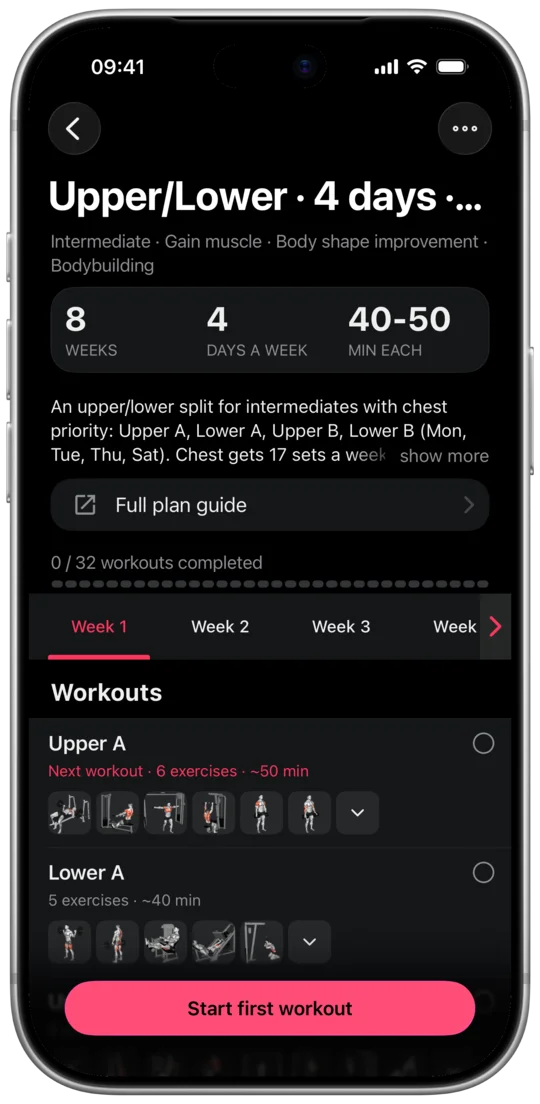
You can paste the whole example through plan import (“My Plans” > “See All” > “+” > “Import plan”) and check every block and week in the preview before saving. Import costs 10 AI credits, so the welcome credits cover it. The RIR in the fragment is the reserve from the table above, rounded down.
BLOCK: AccumulationWEEK: 1DAY: Day A- Barbell Squat | WU 2x5 | 3x10 RIR 3 | REST 150- Barbell Bench Press | WU 2x5 | 3x10 RIR 3 | REST 150DAY: Day B- Paused Squat | WU 2x5 | 2x10 RIR 3 | REST 150- Close Grip Bench Press | WU 2x5 | 2x10 RIR 3 | REST 150- Deadlift | WU 2x5 | 2x5 RIR 3 | REST 180WEEK: 2DAY: Day A- Barbell Squat | WU 2x5 | 4x10 RIR 3 | REST 150- Barbell Bench Press | WU 2x5 | 4x10 RIR 3 | REST 150DAY: Day B- Paused Squat | WU 2x5 | 3x10 RIR 3 | REST 150- Close Grip Bench Press | WU 2x5 | 3x10 RIR 3 | REST 150- Deadlift | WU 2x5 | 2x5 RIR 3 | REST 180WEEK: 3DAY: Day A- Barbell Squat | WU 2x5 | 4x10 RIR 2 | REST 150- Barbell Bench Press | WU 2x5 | 4x10 RIR 3 | REST 150DAY: Day B- Paused Squat | WU 2x5 | 3x10 RIR 3 | REST 150- Close Grip Bench Press | WU 2x5 | 3x10 RIR 3 | REST 150- Deadlift | WU 2x5 | 3x5 RIR 3 | REST 180WEEK: 4DAY: Day A- Barbell Squat | WU 2x5 | 5x10 RIR 2 | REST 150- Barbell Bench Press | WU 2x5 | 5x10 RIR 3 | REST 150DAY: Day B- Paused Squat | WU 2x5 | 4x10 RIR 3 | REST 150- Close Grip Bench Press | WU 2x5 | 4x10 RIR 3 | REST 150- Deadlift | WU 2x5 | 3x5 RIR 3 | REST 180BLOCK: TransmutationWEEK: 1DAY: Day A- Barbell Squat | WU 3x3 | 4x6 RIR 2 | REST 180- Barbell Bench Press | WU 3x3 | 4x6 RIR 2 | REST 180DAY: Day B- Barbell Squat | WU 3x3 | 3x6 RIR 4 | REST 180- Barbell Bench Press | WU 3x3 | 3x6 RIR 4 | REST 180- Deadlift | WU 3x3 | 2x4 RIR 3 | REST 180WEEK: 2DAY: Day A- Barbell Squat | WU 3x3 | 4x5 RIR 2 | REST 180- Barbell Bench Press | WU 3x3 | 4x5 RIR 2 | REST 180DAY: Day B- Barbell Squat | WU 3x3 | 3x5 RIR 4 | REST 180- Barbell Bench Press | WU 3x3 | 3x5 RIR 4 | REST 180- Deadlift | WU 3x3 | 2x4 RIR 3 | REST 180WEEK: 3DAY: Day A- Barbell Squat | WU 3x3 | 4x4 RIR 1 | REST 180- Barbell Bench Press | WU 3x3 | 4x4 RIR 1 | REST 180DAY: Day B- Barbell Squat | WU 3x3 | 3x4 RIR 4 | REST 180- Barbell Bench Press | WU 3x3 | 3x4 RIR 4 | REST 180- Deadlift | WU 3x3 | 3x4 RIR 3 | REST 180BLOCK: RealizationWEEK: 1DAY: Day A- Barbell Squat | WU 4x3 | 3x3 RIR 1 | REST 240- Barbell Bench Press | WU 4x3 | 3x3 RIR 1 | REST 240DAY: Day B- Barbell Squat | WU 3x3 | 2x3 RIR 4 | REST 180- Barbell Bench Press | WU 3x3 | 2x3 RIR 4 | REST 180WEEK: 2DAY: Day A- Barbell Squat | WU 4x3 | 2x2 RIR 1 | REST 240- Barbell Bench Press | WU 4x3 | 2x2 RIR 1 | REST 240Add the accessory exercises in the plan creator.
Log it in SmartWorkout
A free workout log for iPhone and Android: sets, RIR, tempo, exercise groups and plans.


Questions
What is block periodization?
Block periodization is a training plan made of consecutive blocks of 2-4 weeks, each focused on one or two goals while the other qualities are only maintained. Most often there are three blocks: accumulation, transmutation and realization.
What is the difference between block and linear periodization?
Linear periodization is one longer cycle in which the reps go down and the weight goes up about every 4 weeks. Block periodization splits this shift from lighter to heavier sets into shorter blocks of 2-4 weeks with one goal each, and maintains the other qualities with a small number of sets. With one test a year both work about the same; blocks fit better when you compete several times a season.
How long should a training block be?
In block periodization a block is shorter than a typical mesocycle (4-8 weeks): usually 2-4 weeks, accumulation up to 6, and realization before a test 1-2. A full cycle of three blocks therefore usually lasts 5-12 weeks; how to plan a single block is covered on the mesocycle page.
Will I lose muscle during a strength block?
No, as long as the weight stays high. In a review of studies, younger people maintained strength and muscle even with 1 session a week and 1 set per exercise, for up to 32 weeks; there are fewer studies in advanced lifters, so in a strength block don't go below MEV, 4 weekly sets, for any muscle group.
Is block periodization good for beginners?
Not at first: the weakest lifters progress fastest on any sensible plan, and blocks add nothing there. Come back to them when neither the weight nor the reps have gone up for a few weeks, or when you set a test date.
Is block training the same as block periodization?
In the gym, yes: block training is the everyday name for a plan laid out in blocks of a few weeks, each with a different goal.
See also
- Periodization in strength training: linear, undulating and block modelsPeriodization is planned variation of load, sets and reps across weeks, usually in a linear, undulating or block model. In a meta-analysis of 35 studies it produced slightly larger strength gains than a program with constant sets and reps, but no extra muscle growth.
- Linear periodization training: how it works and who it's forLinear periodization (or traditional periodization) is a plan in which the load rises and the reps per set fall every few weeks, e.g. from 4 × 10 at 65% of 1RM to 5 × 3 at 85% over 12 weeks. In meta-analyses it built as much muscle as undulating periodization; in one, trained lifters gained a bit less strength with it.
- Undulating periodization: changing the load across the weekUndulating periodization is a plan in which the rep range and load change from session to session (daily undulating periodization, DUP) or every week, e.g. 8, 6 and 4 reps across three sessions. In meta-analyses muscle grew the same as with linear periodization; one of three found a strength edge in trained lifters.
- Mesocycle training: how long a training block lasts and how to plan oneA mesocycle (training block) is a block of several weeks, usually 4-8, built around one goal and often ending with a lighter week (deload). It is made of microcycles, usually one training week each, and several mesocycles form a macrocycle, usually a year.
- Deload week: what it means, how often to deload and how to do itA deload (deload week) is a planned period of lighter training, usually 5-7 days, that reduces fatigue before the next training block. Coaches cut the number of sets or reps by 30-50% and stop sets further from failure. In studies, neither a lighter week nor a week off reduced muscle growth.
- Training volume: what it is and what MEV, MAV and MRV meanIn hypertrophy training, training volume is the number of working sets a muscle group gets per week. In a meta-analysis of 67 studies, growth was measurable from about 4 weekly sets, with each extra set adding less; the 2026 ACSM position stand links 10 or more weekly sets to more growth.
- Training intensity: percentage of 1RM vs proximity to failure and how to increase itTraining intensity has two meanings in lifting: load as a percentage of one-rep max (%1RM) and effort, meaning how close to failure a set ends (RIR). At 80% of 1RM lifters average about 9 reps to failure on the bench press and 13 on the leg press. Muscle grows from about 30% of 1RM when sets end close to failure.
- Supercompensation: what the theory says, how long it takes and why it is a simplificationSupercompensation is a model in which performance drops after training, recovers and briefly rises above the starting level. It is a simplification: strength usually returns within 1-3 days after a hard session, and the fitness-fatigue model better explains why a hard block pays off only after a lighter week.
Sources
- Lorenz D, Morrison S. Current concepts in periodization of strength and conditioning for the sports physical therapist. Int J Sports Phys Ther. 2015;10(6):734-47.
- Issurin VB. Biological Background of Block Periodized Endurance Training: A Review. Sports Med. 2019;49(1):31-39.
- Travis SK, Mujika I, Gentles JA, et al. Tapering and Peaking Maximal Strength for Powerlifting Performance: A Review. Sports (Basel). 2020;8(9):125.
- Winwood PW, Travis SK, Barnes MJ, et al. Tapering and Peaking in the Weight Lifting Sports: A Systematic Review of Athletes' Self-Reported Strategies. Sports Med. 2026 (online 18.08.2026). doi:10.1007/s40279-026-02500-w.
- Spiering BA, Mujika I, Sharp MA, et al. Maintaining Physical Performance: The Minimal Dose of Exercise Needed to Preserve Endurance and Strength Over Time. J Strength Cond Res. 2021;35(5):1449-1458.
- Bartolomei S, Mammadova G, Manno R, et al. Echoes of the Modern Training Periodization Concepts in Russia Before the October 1917 Revolution. J Strength Cond Res. 2025;39(12):1327-1330.
- Issurin VB. Benefits and Limitations of Block Periodized Training Approaches to Athletes' Preparation: A Review. Sports Med. 2016;46(3):329-38.
- Issurin VB. New horizons for the methodology and physiology of training periodization. Sports Med. 2010;40(3):189-206.
- Gavanda S, Geisler S, Quittmann OJ, et al. The Effect of Block Versus Daily Undulating Periodization on Strength and Performance in Adolescent Football Players. Int J Sports Physiol Perform. 2019;14(6):814-821.
- Bartolomei S, Zaniboni F, Verzieri N, et al. New Perspectives in Resistance Training Periodization: Mixed Session vs. Block Periodized Programs in Trained Men. J Strength Cond Res. 2023;37(3):537-545.
- Bartolomei S, Stout JR, Fukuda DH, et al. Block vs. Weekly Undulating Periodized Resistance Training Programs in Women. J Strength Cond Res. 2015;29(10):2679-87.
- Wetmore AB, Moquin PA, Carroll KM, et al. The Effect of Training Status on Adaptations to 11 Weeks of Block Periodization Training. Sports (Basel). 2020;8(11):145.
- Currier BS, D'Souza AC, Singh MAF, et al. American College of Sports Medicine Position Stand. Resistance Training Prescription for Muscle Function, Hypertrophy, and Physical Performance in Healthy Adults: An Overview of Reviews. Med Sci Sports Exerc. 2026;58(4):851-872.
- Bell L, Strafford BW, Coleman M, et al. Integrating Deloading into Strength and Physique Sports Training Programmes: An International Delphi Consensus Approach. Sports Med Open. 2023;9(1):87.
- Painter KB, Haff GG, Ramsey MW, et al. Strength gains: block versus daily undulating periodization weight training among track and field athletes. Int J Sports Physiol Perform. 2012;7(2):161-9.
- Bartolomei S, Hoffman JR, Merni F, et al. A comparison of traditional and block periodized strength training programs in trained athletes. J Strength Cond Res. 2014;28(4):990-7.
- Micke F, Huelle J, D'Hulst G, et al. Block periodization vs. traditional periodization in high-intensity functional training: a randomized crossover study. Front Physiol. 2026;17:1810477.
- Moesgaard L, Beck MM, Christiansen L, et al. Effects of Periodization on Strength and Muscle Hypertrophy in Volume-Equated Resistance Training Programs: A Systematic Review and Meta-analysis. Sports Med. 2022;52(7):1647-1666.