
Types of periodization training in one table
Periodization training is a plan of changes to load, sets and reps across weeks, laid out in advance for a specific goal. You'll usually see three models: linear, undulating and block.
| Model | What changes | How many weeks | What a week looks like | Who it's for |
|---|---|---|---|---|
| Linear | the weight goes up and the reps go down (2026 ACSM position stand) | e.g. 12: three phases, a change about every 4 weeks (Grgic et al. 2017) | every session in the same rep range: 3 × 8, then 3 × 6 in the next phase, then 3 × 4 (Rhea et al. 2002) | lifters past their first year whose weight no longer goes up every session; before a 1RM test |
| Undulating (daily or weekly) | rep range and weight, from session to session or from week to week | any length, usually 4-8 week blocks (our practice) | e.g. Monday 8, Wednesday 6, Friday 4 reps per set (Rhea et al. 2002) | lifters who do the same exercise 2-3 times a week; trained lifters who want strength |
| Block | each block has one goal: volume first, then weight, then peak performance (Issurin 2019) | a few weeks per block (ACSM 2026), e.g. accumulation about 4, transmutation about 3, realization 1-2 (our practice) | accumulation: 8-12 reps and more sets week to week; transmutation: 4-6 reps and more weight; realization: 2-3 reps and fewer sets | advanced lifters with a date: a meet, a 1RM test, a fitness exam |
| Constant week with progression | weight or reps, from session to session | 6-8 (our practice; our plans have 8); for intermediates, a lighter week at the end (deload) | the same week, with the weight going up by double progression | beginners (no planned deload) and most people training for physique |
In studies, the last row without the lighter week serves as the non-periodized program: constant sets and reps (ACSM 2026). If you keep adding weight in it, muscle grows about as much as with the other models (results below).
Macrocycle, mesocycle and microcycle
Periodization is planned on three time scales, from a week to a year.
| Cycle | How long it lasts | In the gym |
|---|---|---|
| Microcycle | usually a week (Evans 2019) | your training week, e.g. 4 upper/lower days |
| Mesocycle | usually about a month (Evans 2019), in practice 4-8 weeks, 1-4 in the block model; coaches most often put the lighter week at its end (Bell et al. 2023) | one block in your plan |
| Macrocycle | usually a year (Evans 2019) | several blocks built toward one goal |
How to build one block and when to end it is covered on the mesocycle page.
Periodization for hypertrophy and for strength
Periodization gives a bit more strength than a program with constant sets and reps where only the weight goes up, but it doesn't build more muscle. For physique, training volume, meaning your weekly sets, matters more, and so does whether you keep adding weight or reps.
That's the result of a meta-analysis of 35 studies with equated amounts of work (Moesgaard et al. 2022), and the 2026 ACSM position stand concludes that with progressive overload, periodization is not clearly better than a constant program. The meta-analysis authors link the strength advantage to adaptations of the nervous system, not the muscle. That fits how a periodized block ends: with sets of 2-4 reps, which are the closest thing to a 1RM test.
| Your situation | What's enough |
|---|---|
| You're in your first year and the weight goes up every week | a constant week and double progression |
| You train for physique 3-5 times a week | 6-8 week blocks ending in a deload, weekly sets in the MEV or MAV zone; if you want changes within the block, add a set every 2 weeks |
| You want strength in the barbell lifts | an undulating or linear model in those lifts; in the same meta-analysis, undulating gave more strength only to trained lifters |
| You have a date: a meet, a 1RM test, a fitness exam | blocks built toward that date; in the last 1-2 weeks, fewer sets and reps, but the weight stays at 90% 1RM or more (realization) |
| You've been stuck for a few weeks | check sleep, sets and weight selection first (plateau); change the model only after that |
The other planning topics are collected in the periodization and planning section.
How to periodize your training step by step
- Write down your goal and date, e.g. “barbell squat, test in 12 weeks” or “more muscle, no date”.
- Set the block length: 4-8 weeks. Past your first year of training, end it with a lighter week; in your first year, take a lighter week only when two sessions in a row go worse in most exercises. If the block ends with a test, the last weeks are a taper before the test (fewer sets and reps at a heavy weight), not a deload; take the lighter week after the test.
- Pick the model for your goal from the table above and keep it until the block ends.
- Make the first week a calibration week: choose weights that leave one more rep in reserve than the plan says (RIR 1 higher).
- Write down the rule for the following weeks, e.g. “barbell squat: 4 × 10, +2.5 kg every week, fourth week lighter, then 4 × 6”.
- After the block, compare your main lift in the same rep range: with a constant week, week 2 against the last regular week; in a linear or block model, week 1 of this block against week 1 of the next one, or your test result.
If the plan gives RIR instead of kilograms, on a weaker day the same RIR comes out at a lower weight and the plan still works.
With a constant week, you start the next block from the weights of your last regular week. In a linear or block model, you go back to the week 1 rep range with a weight based on your new 1RM, or 2.5-5 kg more than in week 1 of the last block, e.g. after a test in week 12 you start 4 × 10 at 67.5-70 kg instead of 65 kg. If you lift more in the same rep range at the same RIR, the block worked; compare your estimated 1RM only across sets with a similar number of reps.
In most gyms the smallest plates are 1.25 kg, so the bar goes up in 2.5 kg steps. On a 100 kg barbell squat that's 2.5%, but on a 40 kg barbell bench press it's over 6%, so in lighter lifts it's better to progress by adding reps. In the lighter week, leave the pin on a machine where it was and cut the number of sets, so you don't have to find your weights again after the deload.
Strength and physique coaches usually program a lighter week every 4-6 weeks (Bell et al. 2023). In our plans the deload comes only in week 8, because weeks 2-7 are identical, you end your sets at RIR 1-2 and fatigue builds slowly. After a block with a rising number of sets or with sets to failure, take the lighter week earlier.
Periodization examples: the barbell squat in three models
In these examples the Barbell Squat is done by someone with an estimated 1RM of 100 kg, so percent of 1RM and kilograms are the same numbers. You can work out the weights for your own 1RM in the 1RM calculator's plan weight mode.
| Model | Weeks or days | Sets × reps × weight | Reps in reserve on set 1 (approx.) |
|---|---|---|---|
| Linear | W1-W3 / W5-W7 / W9-W11; W4 and W8 lighter, W12 test | 4 × 10 × 65-70 kg / 4 × 6 × 75-80 kg / 5 × 3 × 82.5-85 kg, in W11 4 × 2 × 90 kg | in each phase from about 3 down to 1-2 |
| Undulating (daily) | Monday / Wednesday / Friday | 3 × 8 × 72.5 kg / 3 × 6 × 77.5 kg / 3 × 4 × 82.5 kg | about 2-3 on each day |
| Block | accumulation W1-W4 / transmutation W5-W7 / realization W8-W9 | 3-5 × 10 × 65-67.5 kg / 4 × 6 × 77.5 kg → 4 × 4 × 85 kg / 3 × 3 × 87.5 kg, then 2 × 2 × 90 kg and the test | 2-3 / from 2-3 to 1-2 / 1-2 |
Do the 1RM test in a rack with the safeties set just below the bottom position, after the warm-up from the 1RM calculator; without a test, the estimated 1RM from your last heavy set is enough.
Only the main lift changes with the model, while the Romanian Deadlift and the Seated Leg Curl stay in a fixed rep range with double progression for the whole block.
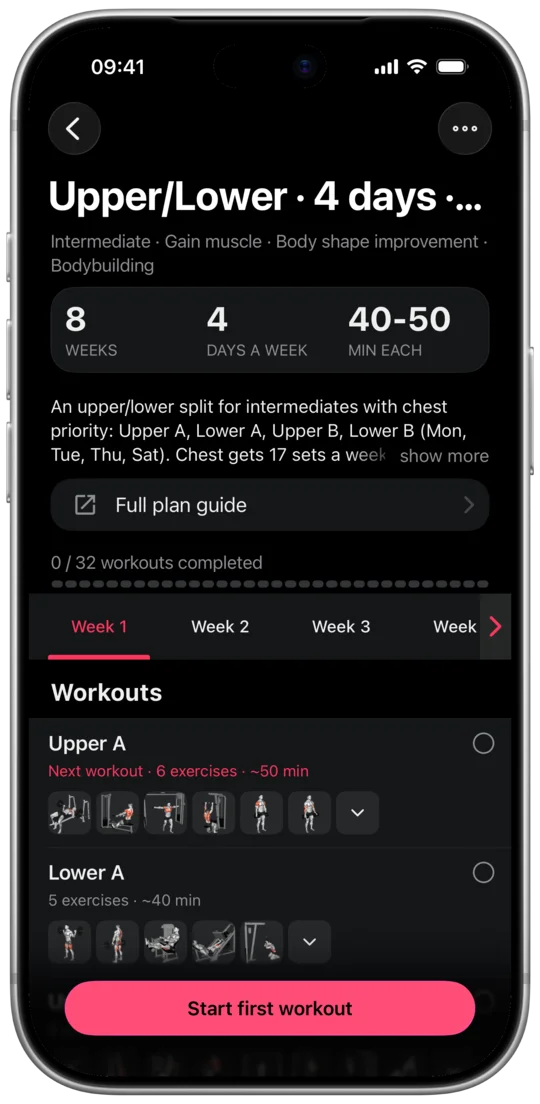
In the free 4-day upper/lower plan for intermediates, the Barbell Bench Press has three sets of 6-10 reps at RIR 3 in week 1, the same at RIR 2 in weeks 2-7, and two sets at RIR 4 in week 8. That's the constant week from the last row of the models table, and you progress with double progression.
- Chest sets
- Quad sets
Periodization vs linear progression and double progression
Periodization plans changes several weeks ahead, while progression tells you what to change in your next session.
| Periodization | Linear progression | Double progression | |
|---|---|---|---|
| What you plan | changes to sets, reps and weight for a whole block or cycle | +2.5 kg every session at the same reps | reps up to the top of the range first, then weight |
| When you change the scheme | after the block, as planned | after the third failed session in a row you take off about 10%; when that stops working, you switch to double progression | when for several weeks neither your reps nor your weight go up |
| Who it's for | trained lifters with a strength goal or a date | your first months in the gym | everyone, inside a periodized block too |
Periodization sets the phases and their goals, while programming picks the exercises, sets and reps within each phase (Lorenz and Morrison 2015).
Common mistakes
- A plan on paper only. The weeks are called “accumulation” and “transmutation”, but your log shows the same weights and reps for the whole block. If your log doesn't show which week was hard, the plan isn't working.
- Periodization instead of sets. With the same amount of work, changing the model adds no muscle (result above). Before you rebuild a block, count the weekly sets for each muscle group.
- A peak with no date. A taper, meaning 1-2 weeks with fewer sets and reps at 90% 1RM, only makes sense when a test or a meet is on the calendar. Without a date, alternate blocks with more sets and blocks of heavier sets, or train a constant week with progression.
- A week off instead of a deload for no reason. In the only study on this, a week without training halfway through a 9-week program gave no extra muscle, and leg strength came out slightly worse (Coleman et al. 2024). If you don't need a break, deload instead: fewer sets, ended with about 4 reps in reserve.
What the research says about periodization
Meta-analyses compare periodization with a program of constant sets and reps, or the linear model with the undulating one; the certainty ratings in the claims table are our assessment. Read ES (effect size) like this: about 0.2 is a small effect, 0.5 moderate, 0.8 large.
| Claim from guides | What studies show | Certainty |
|---|---|---|
| Periodization gives more strength | yes, in three meta-analyses, from a small advantage (ES 0.31) to a moderate one (0.43); the large effect in Rhea and Alderman (0.84) drops to 0.25 when only the variation itself is compared, with the amount of work, frequency and load equated; ACSM 2026 considers the effect on strength unresolved | moderate |
| Periodization gives more muscle | no: with equal work there's no difference, including between the linear and undulating models | moderate to high |
| Undulating beats linear | mixed for strength: two meta-analyses found no difference, one an advantage for undulating in trained lifters, and one found undulating programs better against constant ones (an indirect comparison); no difference for muscle | low |
| Study | Type and sample | Result | Limitation |
|---|---|---|---|
| 2026 ACSM position stand | overview of 137 systematic reviews, more than 30,000 people | muscle: no effect in 4 reviews; periodization matters less than was thought | definitions of periodization differ across reviews |
| Moesgaard et al. 2022 | meta-analysis, 35 studies with equated amounts of work | strength: ES 0.31 in favor of periodization; muscle: ES 0.13, not significant; undulating vs linear for strength: ES 0.31, 0.61 in trained and 0.06 in untrained lifters; for muscle 0.05 | the undulating advantage in trained lifters is borderline significant |
| Williams et al. 2017 | meta-analysis, 18 studies | 1RM: ES 0.43 in favor of periodization; undulating programs more favorable | compared only with constant programs |
| Rhea and Alderman 2004 | meta-analysis | ES 0.84 overall; 0.25 for variation alone after equating amount of work, frequency and load | 11 studies (per Afonso et al.), wide spread of results |
| Harries et al. 2015 | meta-analysis, 17 studies, 510 people | linear vs undulating: no difference in upper or lower body strength | short studies, mixed training experience |
| Grgic et al. 2017 | meta-analysis, 13 studies, 417 people | linear vs daily undulating: muscle effect size −0.02, no difference | almost only untrained people |
| Zhang et al. 2026 | meta-analysis, 29 studies, 704 people | linear vs undulating: upper body and squat strength SMD 0.08, no difference | some studies had health goals |
In the Grgic et al. 2017 meta-analysis, studies lasted 12 weeks on average, and the other meta-analyses are also mostly made up of short programs. Whether any model wins over years is unknown. No study has compared periodization with a program adjusted as you go, without a preset scheme (Afonso et al. 2019), and ACSM notes that the order of changes in a plan is poorly studied.
What SmartWorkout logs show
Most longer plans built in the creator are therefore a constant week, the last row of the models table, and roughly one in three changes something between weeks. Every number is based on at least 50 people.
How to plan periodization in SmartWorkout
You build periodization in SmartWorkout in the plan creator: a plan is split into blocks, a block into weeks, and you edit each week separately.
- On the Workout tab, next to “My Plans”, tap “See All”, then “+” and “Create new plan”.
- Tap “Select load indicator” and choose RIR, RPE or 1RM (percent of your one-rep max) for the whole plan.
- Tap “Add Block” and “Create mesocycle”, choose the number of workouts per week (1-6), and on the “Define Microcycle” screen the number of weeks (2, 4, 6, 8, 10 or 12) and the exercises for each workout.
- On the “Define Mesocycle” screen each week has its own tab: change its sets, rep ranges or RIR according to your model and tap “Save”. The creator doesn't change them from week to week on its own.
- If you plan a deload, leave fewer sets and raise the RIR in the last week of the block. There's no separate deload feature.
- Add the next block with “Add Block” again. Press and hold a block's tab to clone it (“Clone”) or rename it (“Edit Block Name”), e.g. to “Accumulation”.
An AI plan repeats one week for several weeks; you add blocks and changes between weeks afterward in the plan creator.
With Premium, you see each muscle group's sets in every week of the plan against the volume zones, so you can tell right away whether the number of sets rises through the block.
You can paste the first week of a block through plan import (“Import plan” in the same “+” menu) and build the following weeks in the plan creator by cloning the week and changing the ranges. Import costs 10 AI credits, so the welcome credits cover it.
DAY: Lower A- Barbell Squat | WU 2x5 | 4x10 RIR 3 | TEMPO 20X0 | REST 180- Romanian Deadlift | 3x8-10 RIR 3 | TEMPO 3010 | REST 150- Leg Press | 3x10-12 RIR 2 | TEMPO 2010 | REST 120- Seated Leg Curl | 3x10-15 RIR 2 | TEMPO 2011 | REST 90This is week 1 of the linear block from the example above. In week 2, set the barbell squat to RIR 2, in week 3 to RIR 1.5, in week 4 do 2 × 10 at RIR 3, and from week 5 switch to 4 × 6 at RIR 3.
Log it in SmartWorkout
A free workout log for iPhone and Android: sets, RIR, tempo, exercise groups and plans.


Questions
What is periodization in training?
Periodization training is a plan of changes to load, sets and reps across weeks, laid out in advance for a specific goal. Changes you make from day to day without a plan aren't periodization yet.
What are the three types of periodization?
Linear, undulating (daily or weekly) and block. For physique, a constant week with progression is enough too, so pick the model by your goal, not by its name.
Do you need periodization to build muscle?
No. In studies lasting a few months, muscle grew the same with and without periodization; what decides it is the number of hard sets per week and adding weight or reps, and you can do that in a plan where every week looks the same.
What periodization is best for beginners?
None in particular: as long as the weight goes up week to week, double progression is enough. Add a linear or undulating model for your main lifts when strength is your goal and progress slows despite good sleep and a steady number of sets.
What is the difference between linear progression and linear periodization?
Linear progression adds about 2.5 kg every session at the same reps and suits your first months in the gym. Linear periodization plans the change over weeks: the weight goes up and the reps go down every few weeks, as decided before the block starts.
How long should a training block be?
One block (mesocycle) usually lasts 4-8 weeks, and 1-4 weeks in block periodization. Our free plans run 8 weeks, with week 1 used to find your weights (calibration), and the intermediate ones add a deload in week 8. In your first year, take a lighter week only when two sessions in a row go worse in most exercises.
See also
- Linear periodization training: how it works and who it's forLinear periodization (or traditional periodization) is a plan in which the load rises and the reps per set fall every few weeks, e.g. from 4 × 10 at 65% of 1RM to 5 × 3 at 85% over 12 weeks. In meta-analyses it built as much muscle as undulating periodization; in one, trained lifters gained a bit less strength with it.
- Undulating periodization: changing the load across the weekUndulating periodization is a plan in which the rep range and load change from session to session (daily undulating periodization, DUP) or every week, e.g. 8, 6 and 4 reps across three sessions. In meta-analyses muscle grew the same as with linear periodization; one of three found a strength edge in trained lifters.
- Block periodization: accumulation, transmutation and realizationBlock periodization is a plan built from consecutive blocks of 2-4 weeks (accumulation up to 6), each with one main goal: accumulation (more sets), transmutation (heavier sets) and realization (fewer sets before a test). In studies it built no more muscle, and results for strength are mixed.
- Mesocycle training: how long a training block lasts and how to plan oneA mesocycle (training block) is a block of several weeks, usually 4-8, built around one goal and often ending with a lighter week (deload). It is made of microcycles, usually one training week each, and several mesocycles form a macrocycle, usually a year.
- Deload week: what it means, how often to deload and how to do itA deload (deload week) is a planned period of lighter training, usually 5-7 days, that reduces fatigue before the next training block. Coaches cut the number of sets or reps by 30-50% and stop sets further from failure. In studies, neither a lighter week nor a week off reduced muscle growth.
- How to make a workout plan for the gym: exercises, sets, order and session lengthA workout plan (or workout program) is a written training week: days, exercises, sets, reps, reps in reserve (RIR) and rest. To make one, start with the number of days, then pick exercises and count weekly sets per muscle group. The 2026 ACSM position stand advises at least 2 sets per exercise and 2-3 reps in reserve.
- Progressive overload: what it is, linear vs double progression, and how to break a plateauProgressive overload is the gradual increase of training demands, most often load, reps or sets. The ACSM advises adding 2-10% load once you do 1-2 reps over your target in two sessions in a row. In an 8-week study, adding reps built about as much muscle as adding load.
- Training volume: what it is and what MEV, MAV and MRV meanIn hypertrophy training, training volume is the number of working sets a muscle group gets per week. In a meta-analysis of 67 studies, growth was measurable from about 4 weekly sets, with each extra set adding less; the 2026 ACSM position stand links 10 or more weekly sets to more growth.
Sources
- Currier BS, D'Souza AC, Singh MAF, et al. American College of Sports Medicine Position Stand. Resistance Training Prescription for Muscle Function, Hypertrophy, and Physical Performance in Healthy Adults: An Overview of Reviews. Med Sci Sports Exerc. 2026;58(4):851-872.
- Moesgaard L, Beck MM, Christiansen L, et al. Effects of Periodization on Strength and Muscle Hypertrophy in Volume-Equated Resistance Training Programs: A Systematic Review and Meta-analysis. Sports Med. 2022;52(7):1647-1666.
- Williams TD, Tolusso DV, Fedewa MV, et al. Comparison of Periodized and Non-Periodized Resistance Training on Maximal Strength: A Meta-Analysis. Sports Med. 2017;47(10):2083-2100.
- Rhea MR, Alderman BL. A meta-analysis of periodized versus nonperiodized strength and power training programs. Res Q Exerc Sport. 2004;75(4):413-22.
- Harries SK, Lubans DR, Callister R. Systematic review and meta-analysis of linear and undulating periodized resistance training programs on muscular strength. J Strength Cond Res. 2015;29(4):1113-25.
- Grgic J, Mikulic P, Podnar H, et al. Effects of linear and daily undulating periodized resistance training programs on measures of muscle hypertrophy: a systematic review and meta-analysis. PeerJ. 2017;5:e3695.
- Zhang Z, Ya X, Zhao X, et al. Comparison of linear and undulating periodization resistance training on athletic capacities and health promotion: a systematic review and meta-analysis. Front Public Health. 2026;14:1707627.
- Rhea MR, Ball SD, Phillips WT, et al. A comparison of linear and daily undulating periodized programs with equated volume and intensity for strength. J Strength Cond Res. 2002;16(2):250-5.
- Issurin VB. Biological Background of Block Periodized Endurance Training: A Review. Sports Med. 2019;49(1):31-39.
- Evans JW. Periodized Resistance Training for Enhancing Skeletal Muscle Hypertrophy and Strength: A Mini-Review. Front Physiol. 2019;10:13.
- Afonso J, Rocha T, Nikolaidis PT, et al. A Systematic Review of Meta-Analyses Comparing Periodized and Non-periodized Exercise Programs: Why We Should Go Back to Original Research. Front Physiol. 2019;10:1023.
- Lorenz D, Morrison S. Current concepts in periodization of strength and conditioning for the sports physical therapist. Int J Sports Phys Ther. 2015;10(6):734-47.
- Bell L, Strafford BW, Coleman M, et al. Integrating Deloading into Strength and Physique Sports Training Programmes: An International Delphi Consensus Approach. Sports Med Open. 2023;9(1):87.
- Coleman M, Burke R, Augustin F, et al. Gaining more from doing less? The effects of a one-week deload period during supervised resistance training on muscular adaptations. PeerJ. 2024;12:e16777.