
An undulating week by the numbers
Undulating periodization is a way of planning in which the rep range and load of the same exercise change from session to session or from week to week, for example 8, 6 and 4 reps across three sessions a week. It's one of the three main models of training periodization, alongside linear and block.
| Parameter | Value | Source |
|---|---|---|
| What changes | rep range and load, often the number of sets too | Grgic et al. 2017 |
| Classic week | Monday 8, Wednesday 6, Friday 4 reps per set, 3 sets each | Rhea et al. 2002 |
| Same exercise per week | 2-3 times; with one session a week, only weekly undulating works | follows from the definition |
| Effort | RIR 2 on all days, RIR 3 in the first week | our practice; Rhea et al. took sets to failure |
| Block length | 4-8 weeks, the last one lighter (deload) | our practice; the length of a typical mesocycle |
| Effect | strength: at most a little more than linear, only in trained lifters and not in every meta-analysis; muscle: the same | Moesgaard et al. 2022 |
- Undulating: reps per set
- Linear: reps per set
Daily vs weekly undulating periodization
Daily undulating periodization (DUP) changes the rep range every session, while weekly undulating periodization (WUP) keeps one range for the whole week and changes it the next. Another name for both is nonlinear periodization. Weekly undulating is the option for exercises you do once a week, but it has little research behind it: in a 9-week study linear, daily and weekly undulating gave similar strength (Buford et al. 2007), and in a 12-week study linear gave more strength than weekly undulating (Apel et al. 2011).
Who gets more strength from undulating periodization
Undulating periodization doesn't build more muscle than a fixed rep range or the linear model. It may give a little more strength in an exercise you do 2-3 times a week, if you've been training for more than a year.
In a meta-analysis of volume-equated studies, muscle grew the same as with the linear model, and undulating gave more strength only to trained lifters (Moesgaard et al. 2022). Two other meta-analyses found no difference in strength, and the newer of them found none in trained lifters either.
| Your situation | What to choose |
|---|---|
| First year of training, the weight goes up every week | a fixed rep range and double progression; undulating adds nothing here |
| You train for physique 3-4 times a week | undulating or a fixed range, whichever you prefer; the result will be similar |
| You've trained for over a year and want more strength in an exercise you do 2-3 times a week | daily undulating, e.g. 8, 6 and 4 reps |
| You do the exercise once a week | weekly undulating, linear, or its sets split over 2 sessions (frequency) |
| You have a meet or 1RM test date | undulating where the days drop to 2-4 reps in the last 2 weeks and the test week is lighter, or block |
Undulating takes more work: three weights and three progressions instead of one, and each range comes back once a week, so each day progresses more slowly than a fixed range done 3 times a week.
Muscle growth depends on the number of weekly sets, not on undulating the ranges. Three days of 3 squat sets make 9 weekly sets for the quads and glutes, the upper part of MEV, the same as 3 × 8-10 on each of those days without undulating. You can count your week in the sets per muscle group calculator.
How to set up an undulating week step by step
- Pick 1-2 exercises you do 2-3 times a week, e.g. Barbell Squat and Barbell Bench Press; leave the rest of the plan as it is.
- Give each day a different rep range: 8-10, 6-8 and 4-6, or 10-12 and 5-6 with two sessions of the exercise a week.
- Set the same effort target for all days: RIR 2, and RIR 3 in the first week.
- Work out each day's weight from a recent set in the plan weight mode of the 1RM calculator.
- Do the 4-6 rep day when you're rested: on Friday when Wednesday is lighter (variant below), or on Monday when you run out of energy by Friday.
- Progress each day separately: add reps up to the top of the range, then 2.5 kg (two 1.25 kg plates), and compare Monday with Monday.
In 18 powerlifters, a strength day placed after a power day (fast reps, not to failure) gave more tonnage and a bigger bench press 1RM gain than one placed after a hypertrophy day (Zourdos et al. 2016). When trained men chose the order of the days themselves, results were similar to a fixed order (Colquhoun et al. 2017), so treat the order as flexible.
Undulating periodization examples in kg
In this example, the lifter has an estimated 1RM of 100 kg in the barbell squat and 80 kg in the barbell bench press. The weights are chosen so that you reach the bottom of the range at RIR 2, and rest is 3 minutes.
| Day | Sets and range | Barbell Squat | Barbell Bench Press | RIR |
|---|---|---|---|---|
| Monday | 3 × 8-10 | 75 kg (75%) | 60 kg (75%) | 2 |
| Wednesday | 3 × 6-8 | 77.5 kg (78%) | 62.5 kg (78%) | 2 |
| Friday | 3 × 4-6 | 82.5 kg (83%) | 67.5 kg (84%) | 2 |
Once you get 3 × 10 at RIR 2 on Monday, add 2.5 kg the next Monday and go back to 8 reps; Wednesday and Friday progress at their own pace.
If you prefer a lighter midweek, do 5 × 3 with 70 kg in the squat and 55 kg in the bench press on Wednesday instead of 3 × 6-8, driving the bar up fast and staying far from failure. Sets like these do little for muscle, so for size add 1 set each on Monday and Friday.
In the weekly version, the same lifter squats 3 × 8-10 in week 1, 3 × 6-8 in week 2 and 3 × 4-6 in week 3, with the weights from the table, then starts over. With one squat session a week, do 4-5 sets instead of 3 to stay in MEV.
To combine undulating with linear, take 1 rep off each day every 2 weeks and add weight. That's how lifters trained in an 8-week study: from 8, 6 and 4 reps at RPE 6-8 in week 2 to 6, 4 and 2 at RPE 8-10 in week 6 (Helms et al. 2018).
Which exercises to undulate
You use undulating periodization for exercises you do 2-3 times a week; with a barbell you undulate weight and reps, with dumbbells and cables mostly reps.
| Exercise | Why it fits |
|---|---|
| Barbell Bench Press | you do it often, and 2.5 kg is about 4% of the working weight; do the 4-6 rep day with a spotter or in a rack with safeties |
| Barbell Squat | an exercise from undulating studies in trained lifters, e.g. Helms et al. 2018; do the 4-6 rep day in a rack with the safeties set just below the bottom of your squat |
| Leg Press | undulated in Rhea et al. 2002; you can do the heavy day without a spotter, with the sled's safety stops set just below the bottom of the movement |
| Wide Grip Lat Pulldown | the stack step is often 5-7 kg, so on the 6-8 and 10-12 days you add reps first, then move the pin |
| Barbell Overhead Press | at 40 kg a 2.5 kg step is about 6%, so as with dumbbells you add reps first |
| Incline Dumbbell Bench Press | 6-8 and 10-12 ranges; heavy dumbbells for 4 reps are hard to get into position |
Undulating vs linear and block periodization
Undulating periodization changes the rep range every session or every week, linear every few weeks, and block periodization with each new block, where every block has a single goal.
| Daily undulating (DUP) | Weekly undulating | Linear | Block | |
|---|---|---|---|---|
| Example | Mon 8, Wed 6, Fri 4 reps | a week of 8s, a week of 6s, a week of 4s | 4 weeks of 8s, 4 of 6s, 4 of 4s | accumulation, transmutation, realization |
| Strength in studies | in trained lifters a little more than linear in one meta-analysis, no difference in two others | little research: the same or less strength than linear | the reference point | in track and field athletes no significant difference from daily undulating (Painter et al. 2012) |
Common mistakes
- Same weight on all days. With a 1RM of 100 kg, a set of 4 with 75 kg leaves more than 4 reps in reserve, so the heavy day stops being heavy. Work out each day's weight separately.
- Comparing different days. Monday's 75 kg for 8 reps after Friday's 82.5 kg for 4 is the same strength level, not a drop in form. Compare a day with the same day, or the estimated 1RM from sets at the same RIR.
- Every day to failure. In a study of an undulating week, most sets ended 3-4 reps short of failure, and strength and muscle still went up (Helms et al. 2018). Stay at RIR 2; go closer to failure, to RIR 0-1, at most in the last weeks of the block and in sets of 2-4 reps.
- Undulating without adding weight. Changing ranges alone doesn't replace progression: according to the ACSM 2026 position stand, when the load is progressed, periodization isn't clearly better than a fixed plan. Give each day its own progression, as in step 6 of the setup above.
What the research says
The certainty ratings in the claims table are our assessment.
| Claim in guides | What studies show | Certainty |
|---|---|---|
| Undulating gives more strength than linear | a little more in trained lifters in one meta-analysis; no difference in two others, including the newest, which also found none in trained lifters | low |
| Undulating builds more muscle | no: the same as linear in two meta-analyses and in the ACSM 2026 position stand, the same as a constant 8-12 RM range in 19 trained men (Schoenfeld et al. 2016) | moderate |
| For size you need to undulate with high reps | 12-10-8 and 6-4-2 with equated tonnage (the 6-4-2 group did more sets) gave similar strength and muscle thickness in 16 trained men over 8 weeks (Klemp et al. 2016) | low (one small study) |
| Changing it up every day “confuses the muscles” | not shown; Moesgaard et al. link the strength edge to the nervous system, Harries et al. to the novelty of the stimulus | low (hypotheses) |
| Study | Type and sample | Result | Limitation |
|---|---|---|---|
| ACSM 2026 position stand | overview of 137 systematic reviews | undulating, linear and non-periodized plans: the same hypertrophy; the effect on strength can't be settled | reviews define periodization differently |
| Moesgaard et al. 2022 | meta-analysis, 35 volume-equated studies, some with a non-periodized plan | undulating vs linear: 1RM ES 0.31; trained 0.61, untrained 0.06; muscle ES 0.05 | the edge in trained lifters is borderline significant |
| Harries et al. 2015 | meta-analysis, 17 studies, 510 people | no difference in upper or lower body strength | short studies, mixed training experience |
| Grgic et al. 2017 | meta-analysis, 13 studies, 303 people in the linear and undulating groups | muscle: d −0.02, no difference | all studies but one in untrained people; 12 ± 5 weeks on average |
| Zhang et al. 2026 | meta-analysis, 29 studies, 704 people | bench press and squat: SMD 0.08, no difference, also in the trained subgroup | asymmetric funnel plot for the squat, possible publication bias |
Whether undulating builds more muscle in people who have trained for years is unknown, because the muscle studies included almost only untrained people.
What SmartWorkout logs show
Most of these plans change only the reps between days and keep the effort target, as in the example above. Every number is based on at least 50 people.
How to set up undulating periodization in SmartWorkout
You set up undulating periodization in SmartWorkout in the plan creator: you add the same exercise to several workouts of the week and give each one a different rep range.
- On the Workout tab, next to “My Plans”, tap “See All”, then “+” and “Create new plan”.
- Tap “Select load indicator” and choose RIR for the whole plan.
- Tap “Add Block” and “Create mesocycle”, and choose 3 under “Number of units”.
- On the “Define Microcycle” screen, choose “Number of weeks”, e.g. 6, and add the same exercises to each unit with a different range: 3 × 8-10, 3 × 6-8 and 3 × 4-6, RIR 2 everywhere.
- On the “Define Mesocycle” screen each week has its own tab: set RIR 3 in week 1, cut the sets and raise the RIR in the last week (deload), then tap “Save”.
The creator doesn't raise weights from week to week, so on each day you add reps up to the top of the range yourself, then 2.5 kg.
The estimated 1RM next to every set lets you compare 75 kg for 8 with 82.5 kg for 4 at the same RIR.
With Premium, you know what to do at your next workout: add a rep, add weight or stay at your current target.
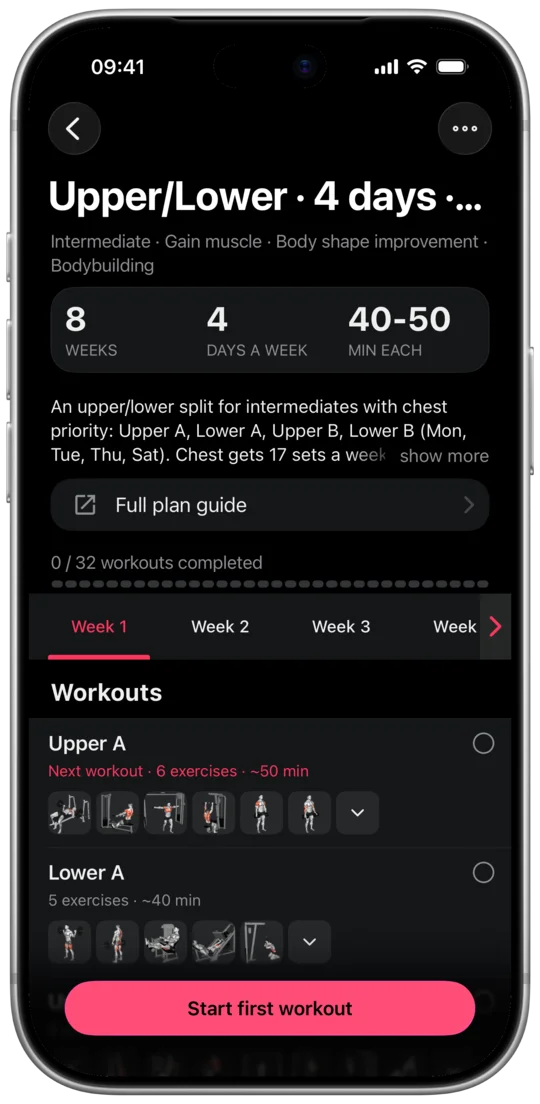
You can also paste an undulating week through plan import (the same “+”, then “Import plan”) and check it in the preview. Import costs 10 AI credits, so the welcome credits cover it. Then add the rest of the workout to each day.
The warm-up sets calculator works out your warm-up weights.
DAY: Monday- Barbell Squat | WU 2x5 | 3x8-10 RIR 2 | TEMPO 20X0 | REST 180- Barbell Bench Press | WU 2x5 | 3x8-10 RIR 2 | TEMPO 20X0 | REST 180DAY: Wednesday- Barbell Squat | WU 2x5 | 3x6-8 RIR 2 | TEMPO 20X0 | REST 180- Barbell Bench Press | WU 2x5 | 3x6-8 RIR 2 | TEMPO 20X0 | REST 180DAY: Friday- Barbell Squat | WU 3x3 | 3x4-6 RIR 2 | TEMPO 20X0 | REST 180- Barbell Bench Press | WU 3x3 | 3x4-6 RIR 2 | TEMPO 20X0 | REST 180The help article on the plan creator explains how blocks, weeks and the mesocycle generator work.
Log it in SmartWorkout
A free workout log for iPhone and Android: sets, RIR, tempo, exercise groups and plans.


Questions
What is undulating periodization?
Undulating periodization is a way of planning in which the rep range and load of the same exercise change from session to session or from week to week, for example 8, 6 and 4 reps across three sessions a week.
Linear vs undulating periodization: which is better?
For muscle it makes no difference. For strength after your first year of training, undulating may give a little more if you do the exercise 2-3 times a week; the edge is small and didn't show up in every meta-analysis. You can build either one around a 1RM test date: fewer reps in the last weeks, then a lighter week.
Is undulating periodization good for hypertrophy?
Yes, as good as a fixed rep range with the same number of weekly sets. Choose it if you like variety and it makes sticking to the plan easier.
Should beginners use undulating periodization?
They don't need to: as long as the weight goes up from week to week, double progression is enough. In untrained people, undulating gave no more strength than linear in a meta-analysis.
What is the difference between daily and weekly undulating periodization?
Daily undulating needs 2-3 sessions of the same exercise a week, because the range changes in each of them. Weekly undulating changes the range every week, so you can run it even with one session of the exercise a week.
See also
- Periodization in strength training: linear, undulating and block modelsPeriodization is planned variation of load, sets and reps across weeks, usually in a linear, undulating or block model. In a meta-analysis of 35 studies it produced slightly larger strength gains than a program with constant sets and reps, but no extra muscle growth.
- Linear periodization training: how it works and who it's forLinear periodization (or traditional periodization) is a plan in which the load rises and the reps per set fall every few weeks, e.g. from 4 × 10 at 65% of 1RM to 5 × 3 at 85% over 12 weeks. In meta-analyses it built as much muscle as undulating periodization; in one, trained lifters gained a bit less strength with it.
- Block periodization: accumulation, transmutation and realizationBlock periodization is a plan built from consecutive blocks of 2-4 weeks (accumulation up to 6), each with one main goal: accumulation (more sets), transmutation (heavier sets) and realization (fewer sets before a test). In studies it built no more muscle, and results for strength are mixed.
- Training frequency: how many times a week to train each muscle groupTraining frequency is the number of sessions per week in which a muscle group does working sets. How often to train a muscle depends on weekly sets: with the same sets, muscles grow about the same with 1 or several sessions (meta-analysis of 25 studies). Strength improves more with 2 or more.
- Rep ranges: how many reps for hypertrophy, strength and cuttingA rep range is the span of reps, such as 8-12, in which a set with a given weight should end. For muscle growth the exact number matters little: in studies, muscle grew similarly with sets of about 5 to more than 30 reps close to failure, while strength grew most with loads of 80% of 1RM or more.
- RIR (reps in reserve): what it means and how to estimate itRIR (reps in reserve) is the number of good reps left before failure when a set ends. RIR 0 means no reps left, and RIR 2-3 in a plan means ending the set with 2-3 reps still in the tank. In a meta-analysis of 12 studies, lifters had on average 1 rep more left than they thought.
- Training volume: what it is and what MEV, MAV and MRV meanIn hypertrophy training, training volume is the number of working sets a muscle group gets per week. In a meta-analysis of 67 studies, growth was measurable from about 4 weekly sets, with each extra set adding less; the 2026 ACSM position stand links 10 or more weekly sets to more growth.
Sources
- Currier BS, D'Souza AC, Singh MAF, et al. American College of Sports Medicine Position Stand. Resistance Training Prescription for Muscle Function, Hypertrophy, and Physical Performance in Healthy Adults: An Overview of Reviews. Med Sci Sports Exerc. 2026;58(4):851-872.
- Moesgaard L, Beck MM, Christiansen L, et al. Effects of Periodization on Strength and Muscle Hypertrophy in Volume-Equated Resistance Training Programs: A Systematic Review and Meta-analysis. Sports Med. 2022;52(7):1647-1666.
- Grgic J, Mikulic P, Podnar H, et al. Effects of linear and daily undulating periodized resistance training programs on measures of muscle hypertrophy: a systematic review and meta-analysis. PeerJ. 2017;5:e3695.
- Harries SK, Lubans DR, Callister R. Systematic review and meta-analysis of linear and undulating periodized resistance training programs on muscular strength. J Strength Cond Res. 2015;29(4):1113-25.
- Zhang Z, Ya X, Zhao X, et al. Comparison of linear and undulating periodization resistance training on athletic capacities and health promotion: a systematic review and meta-analysis. Front Public Health. 2026;14:1707627.
- Rhea MR, Ball SD, Phillips WT, et al. A comparison of linear and daily undulating periodized programs with equated volume and intensity for strength. J Strength Cond Res. 2002;16(2):250-5.
- Buford TW, Rossi SJ, Smith DB, et al. A comparison of periodization models during nine weeks with equated volume and intensity for strength. J Strength Cond Res. 2007;21(4):1245-50.
- Apel JM, Lacey RM, Kell RT. A comparison of traditional and weekly undulating periodized strength training programs with total volume and intensity equated. J Strength Cond Res. 2011;25(3):694-703.
- Zourdos MC, Jo E, Khamoui AV, et al. Modified Daily Undulating Periodization Model Produces Greater Performance Than a Traditional Configuration in Powerlifters. J Strength Cond Res. 2016;30(3):784-91.
- Colquhoun RJ, Gai CM, Walters J, et al. Comparison of Powerlifting Performance in Trained Men Using Traditional and Flexible Daily Undulating Periodization. J Strength Cond Res. 2017;31(2):283-291.
- Helms ER, Byrnes RK, Cooke DM, et al. RPE vs. Percentage 1RM Loading in Periodized Programs Matched for Sets and Repetitions. Front Physiol. 2018;9:247.
- Painter KB, Haff GG, Ramsey MW, et al. Strength gains: block versus daily undulating periodization weight training among track and field athletes. Int J Sports Physiol Perform. 2012;7(2):161-9 (online 2011).
- Klemp A, Dolan C, Quiles JM, et al. Volume-equated high- and low-repetition daily undulating programming strategies produce similar hypertrophy and strength adaptations. Appl Physiol Nutr Metab. 2016;41(7):699-705.
- Schoenfeld BJ, Contreras B, Ogborn D, et al. Effects of Varied Versus Constant Loading Zones on Muscular Adaptations in Trained Men. Int J Sports Med. 2016;37(6):442-7.