How long a deload lasts, how often to deload and how much to cut
A deload is a planned period of lighter strength training, usually a week, that reduces physical and mental fatigue so you start the next block rested (Bell et al. 2023). In training periodization, a deload usually closes a mesocycle, a block of several weeks of work toward one goal.
A deload changes three things, from most to least important: the number of sets, that is volume, reps in reserve measured as RIR, and the weight.
| Parameter | Value | Source |
|---|---|---|
| How long | Usually a week. If you deload only when you feel worn out, a few days is enough, sometimes a single lighter workout. | Bell et al. 2026 |
| How often | Every 4-8 weeks, usually in the last week of a block. | Bell et al. 2026; a deload in every mesocycle: coach consensus (Bell et al. 2023) |
| Sets | Do 1-2 sets fewer than usual: keep 2 of 3, and 2 of 4. When you are very tired, 1 is enough. | coach interviews (Bell et al. 2022), Bell et al. 2026 |
| Reps in reserve | End the set while you still have 3-4 reps left (RIR 3-4). That is 1-3 more than usual. | Bell et al. 2026, Bell et al. 2022 |
| Weight | The same if you do fewer reps. If you do the same reps, take off about 10%. Go lighter also when your joints hurt or you do heavy sets of 1-5 reps. | Bell et al. 2026, athlete survey (Rogerson et al. 2024) |
| Days and exercises | Train on the same days and do the same exercises. You can cut back the accessory ones. | Bell et al. 2023; Rogerson et al. 2024 |
Who needs a deload and when
A deload doesn't build muscle or strength; it clears fatigue. In studies, neither a lighter week (Pancar et al. 2026) nor even a full week off (Coleman et al. 2024) took away muscle growth. The fitness-fatigue model explains why performance rises only after a lighter week; see supercompensation.
You often read that skipping deloads leads to overtraining. In strength training, studies rarely confirm it, and the only reliable sign is performance that keeps dropping for a long time (Grandou et al. 2020). Frequent deloads probably aren't needed (Bell et al. 2026). How often you deload depends on how hard the block is (Bell et al. 2022).
| Your situation | What to do |
|---|---|
| First year of training, weight goes up every week or more often | no planned deload, as in our beginner plans; when fatigue builds up, take a few days off |
| Weights now go up less often than weekly, you train in 6-8 week blocks | deload in the last week of the block |
| A plan made of several short blocks of 3-4 weeks, each with a different rep range or different exercises | you can deload less often than every block, e.g. once every 12-16 weeks, while your numbers keep rising; right away with the signs listed below. This is how plans are written, not a research finding |
| A block with deliberate overreaching: you add sets week after week, muscle groups reach 20 weekly sets (MRV), or many sets end at failure | deload closer to every 4 weeks than every 8 |
| Sore joints or tendons, an old injury flares up | deload: fewer sets and about 10% lighter, and swap the exercise that hurts for a pain-free variation |
| A hard week at work or at home | deload: fewer sets, any weight you like; if you're short on time, fewer workouts too |
| A meet or a 1RM test in 1-2 weeks | a taper, meaning less work before competing, instead of a deload |
| Vacation, illness, travel | a break; afterwards you come back the same way as after a deload |
You can count each muscle group's sets in your week with the weekly volume calculator.
Signs you need a deload
You take a deload on demand when fatigue arrives before the end of the block.
| Sign | What to do |
|---|---|
| Two workouts in a row weaker in most exercises, even though sleep and food were normal | deload from the next workout, without waiting for the end of the block |
| HRV below your normal or a higher resting heart rate for several days in a row, plus weaker lifts | deload from the next workout; one low morning is not a reason yet |
| Joints or tendons hurt after heavy sets, an old injury flares up | deload with about 10% less weight; if it doesn't settle after a week, see a physical therapist |
| Sharp, pinpoint pain, or pain that changes your technique | don't wait for a deload: skip the movement that hurts and see a physical therapist |
| Exhaustion, illness, or performance dropping for several weeks | a few days without training first, then a deload (Bell et al. 2026) |
| One exercise has stalled while the rest keep improving | not a reason to deload: take about 10% off that exercise and rebuild the reps, and if it stalls again, change the rep range or the exercise, as with a plateau |
Same weight or lighter
On a deload you always do fewer sets, and the weight either stays or drops by about 10%. The sources describe this as one deload with different settings (Bell et al. 2022). All coaches in the consensus agreed that volume goes down, and 95% that the weight can stay, but only with fewer sets (Bell et al. 2023). The simplest deload keeps the weight and the reps and only cuts sets. If you also want more reps in reserve, you get them in one of two ways.
| Same weight, fewer reps | Lighter weight, same reps | |
|---|---|---|
| When | end of a block, weaker workouts, a hard week outside the gym | the same, and especially with sore joints or tendons, an old injury flaring up, or sets of 1-5 reps |
| Example after 80 kg 3 × 8 at RIR 2 | 80 kg 2 × 6 at RIR 4 | 72.5 kg 2 × 8, about 10% lighter, with about 5 reps in reserve |
| Source | coach consensus and athlete survey | the same; with sore joints, coaching practice |
Both are in use: coaches in the interviews more often keep the weight and cut sets (Bell et al. 2022), while 84% of athletes in the survey lower the weight on compound lifts (Rogerson et al. 2024). With sets of 3-5 reps, the same weight at RIR 4 would give 1-3 reps at most, and with singles and doubles none at all, so pick the lighter weight there. With sore joints, the coaches in the interviews lower the weight or swap the exercise that hurts, e.g. for a variation that doesn't load the spine, and sometimes deload only the slightly injured muscle group.
If you end sets at failure in regular weeks, leave at least 1-2 reps in reserve on the deload: training to failure lengthens recovery (Morán-Navarro et al. 2017). If you already stop short of failure, cutting sets is enough.
Deloading for stress and a "fried nervous system"
Stress outside the gym is a reason to deload for 31% of athletes in the survey (Rogerson et al. 2024), but no source ties it to a specific weight. In that case cut sets; coaches in the consensus also allow fewer workouts a week when life is very busy (Bell et al. 2023).
A "fried nervous system" after heavy sets is a popular explanation that research supports poorly. After 10 sets of 5 squats at 80% 1RM, fatigue lasted up to 72 hours, but according to the authors it didn't come mainly from the nervous system (Thomas et al. 2018). What clearly slows recovery is training to failure, even at the same number of reps (Morán-Navarro et al. 2017). When heavy sets move slowly, start with fewer sets and more reps in reserve; take weight off with sets of 1-5 reps or when your joints hurt.
How to deload, step by step
A deload is the same plan with fewer sets and more reps in reserve in every set.
- Plan the deload for the last week of the block, after 3-7 weeks of work; if you deload less often, take it earlier when signs of fatigue show up.
- In each exercise keep part of the working sets: of 4 keep 2, of 3 keep 2, of 2 keep 1.
- Keep the weights from the last week, and on machines the same pin and the same seat setting.
- End every set with 4 reps in reserve, that is at RIR 4.
- Train on the same days, with the same exercises, the same rest periods and the same warm-up sets.
- Accessory exercises such as the dumbbell lateral raise can drop to 1 set, and drop sets, rest-pause and sets to failure are cut for this week.
About 60% of the sets stay in the week, and at RIR 4 each one has 2-3 fewer reps, so the total reps fall by roughly half. In the athlete survey, 79% reduce the number of sets and 85% end compound sets further from failure (Rogerson et al. 2024). It's a good week for technique: film a set of bench presses, for example, and check the bar path (Bell et al. 2023).
If you lower the weight instead of steps 3-4, with dumbbells that's usually one pair down the rack, e.g. on the seated dumbbell shoulder press from 22 kg to 20 kg. You can work out the weight for a different RIR in the RIR/RPE calculator.
How to come back after a deload
After the deload you start the next block from the weights of the last week before the deload, and you don't treat the light deload sets as a reference point. If you restart the plan from the beginning, work out the weight for the new plan's first week from the last week before the deload with the 1RM calculator in plan weight mode. If you deloaded because of sore joints, go back to the full weight only in the exercises that stopped hurting. After a full week off, the first workout can feel heavy: according to the study authors, participants often said they felt out of rhythm rather than rested (Coleman et al. 2024).
Deload week example in kg
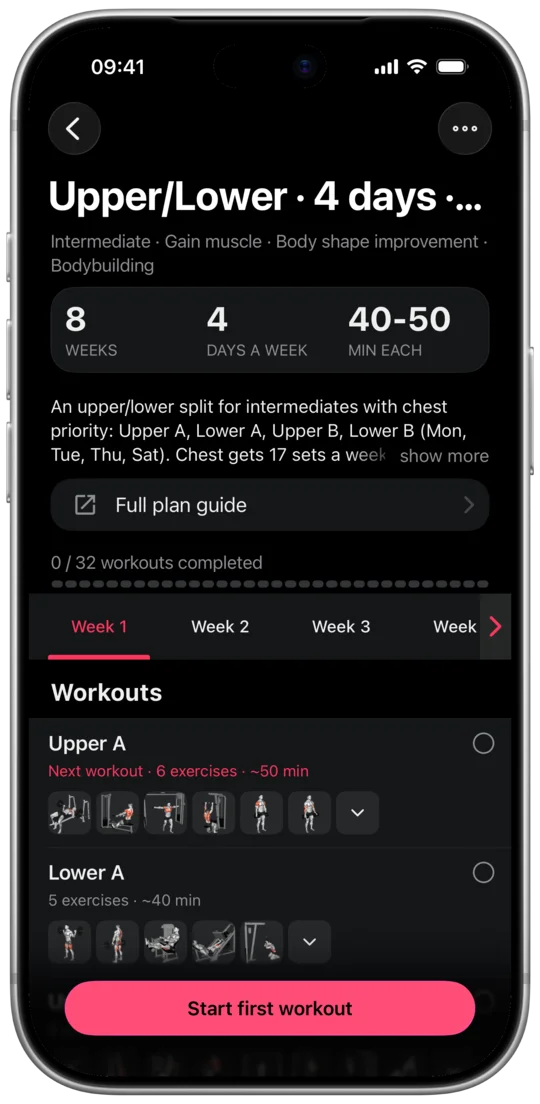
This is week 8, the deload, in the free 4-day upper/lower plan for intermediates: the first five exercises of the Upper A day for someone who benches 80 kg in week 7.
| Exercise | Week 7 | Week 8 (deload) | Rest |
|---|---|---|---|
| Barbell Bench Press | 80 kg, 3 × 8, RIR 2 | 80 kg, 2 × 6, RIR 4 | 180 s |
| Barbell Bent Over Row | 70 kg, 3 × 8, RIR 2 | 70 kg, 2 × 6, RIR 4 | 150 s |
| Seated Dumbbell Shoulder Press | 22 kg, 3 × 10, RIR 2 | 22 kg, 2 × 8, RIR 4 | 120 s |
| Cable Lat Pulldown | 60 kg, 3 × 12, RIR 1 | 60 kg, 2 × 9, RIR 4 | 120 s |
| Cable Middle Chest Fly | 15 kg, 2 × 14, RIR 1 | 15 kg, 1 × 11, RIR 4 | 60 s |
At the same weight, reps in reserve go up by as much as the reps go down: 8 reps at RIR 2 means 10 at most, so at RIR 4 you stop at 6. The Upper A day shrinks from about 50 to about 30 minutes. In our plans the deload sits in week 8 because weeks 2-7 are the same and fatigue builds up slowly.
- Back: weekly sets
- Chest: weekly sets
During the deload, back drops from the MAV zone to MEV, and chest stays in MEV. The beginner plans have no deload week: you end sets at RIR 2, the weights are still light, and when fatigue builds up a few days off are enough.
Deload vs week off, taper and off-season
A deload, a week off, a taper and an off-season differ in whether you train at all, for how long and why.
| Deload | Week off | Taper | Off-season (transition) | |
|---|---|---|---|---|
| What you do | you train: fewer sets, more reps in reserve, sometimes a lighter weight | you don't train | 30-70% less work, weight usually high (85% 1RM or more), ending with 2-7 days off (Travis et al. 2020) | lighter, often different activity |
| How long | a week | a week | 1-2 weeks | several weeks |
| When | end of a block, a drop in performance, sore joints | vacation, illness | before a meet or a 1RM test | after a season or a race, e.g. a marathon |
| Why | to rest before the next block | to rest | to clear fatigue before competing | a break from the season |
| Muscle and strength | even with a harsher deload than usual (about 70% fewer sets, once a week), muscle grew as much as without it (Pancar et al. 2026) | muscle grew the same, strength more slowly (Coleman et al. 2024); 2 weeks off didn't lower strength in trained men (Hwang et al. 2017) | goal: peak strength on competition day | no gym studies |
A week off slowed strength gains; nobody has compared it with a lighter week on that point, but during a lighter week you keep training with weights close to your working ones. In block periodization, a taper is the realization block before a test or a meet.
Common deload mistakes
- Lighter, but the same number of sets. A deload starts with cutting sets by 30-50%, and the coaches in the consensus agreed on that (Bell et al. 2023); a lighter weight alone at the full number of sets is a rare practice.
- A vacation and a deload back to back. A week away followed by a deload means two weeks without full training; arrange the block so the vacation falls where the deload would be.
- New exercises during the deload. An unfamiliar movement easily leaves you sore, and this week is meant to reduce fatigue (Bell et al. 2022). Bring in new exercises in the first week of the next block, unless you're replacing an exercise that hurts.
- Deloading for the sake of it. If your numbers are still going up in the last week of the block and your joints don't hurt, repeat week 7 and deload a week later, or skip the deload, because in our plans the next block starts with a week at RIR 1 higher anyway.
- A deload instead of a diagnosis. If performance has been dropping for several weeks despite a lighter week, check your sleep and food, and if you feel unwell, see a doctor: overtraining syndrome is diagnosed only after ruling out illness, undereating or iron deficiency (Meeusen et al. 2013).
What the research says about deloading
There is little research on deloading: two short experiments, while the "how often" and "how much" numbers come from interviews, surveys and a coach consensus. No study has tested whether, with fewer sets, it's better to keep the weight or lower it by 10%. The certainty ratings in the claims table are our assessment.
| Claim from guides | What studies show | Certainty |
|---|---|---|
| You won't grow without deloads | in two experiments, muscle grew the same with and without a deload | low: two short studies |
| A week off will cost you muscle | a week off didn't reduce leg muscle growth in trained lifters; in another study, trained men's strength didn't drop after 2 weeks off, but according to a review, a break longer than 7 days lowers maximal strength by 1-4% (Travis et al. 2020) | low to moderate: one muscle study, reviews for strength |
| A deload means lighter weights | coaches agree on cutting the number of sets; most athletes lower the weight on compound lifts, usually by about 10% | moderate: expert agreement, no experiments |
| Heavy sets overload the nervous system | fatigue after heavy squats didn't come mainly from the nervous system; training to failure is more likely what lengthens recovery | low: small studies, single sessions |
| Without deloads you risk overtraining | in strength training, overtraining is rarely confirmed | moderate |
| Study | Type and sample | Result | Limitation |
|---|---|---|---|
| Bell et al. 2023 | Delphi consensus of coaches: 34 in round 1, 21 in round 3 | definition of a deload; full agreement that volume goes down; 95% agreement that the weight can stay if volume goes down | expert opinion |
| Bell et al. 2022 | interviews with 18 strength and physique coaches | cutting sets by 25% to over 50% matters most; effort and weight only when that isn't enough or joints hurt | interviews, small group |
| Rogerson et al. 2024 | survey, 246 strength and physique athletes | deload on average 6.4 days every 5.6 weeks; 79% reduce the number of sets, 84% lower the weight on compound lifts; reasons: the plan (65%), soreness and joint pain (63%), stalled progress (54%), stress outside training (31%) | self-report, not measurement |
| Bell et al. 2026 | review with recommendations | sets cut by 25-45%, 40-60% or 60-90%, depending on how much recovery is needed; weight about 10% lower or 1-3 more reps in reserve; with extreme fatigue, days off first | expert recommendations, not an experiment |
| Coleman et al. 2024 | 39 trained lifters (29 men, 10 women), 9 weeks; a week off in the middle | leg muscles grew the same, leg strength rose more without the break | deload as a week off, not a lighter week; legs only |
| Pancar et al. 2026 | 19 untrained men, 8 weeks; one leg and one arm with a deload in weeks 4 and 8 (2 sets once a week) | muscle and 10RM rose the same with 18% fewer sets over the whole program | untrained, two single-leg and single-arm exercises; a harsher deload than usual; the second deload came right before final testing |
| Thomas et al. 2018 | 10 athletes; squats 10 × 5 at 80% 1RM, jumps and sprints | fatigue after squats lasted up to 72 hours, but didn't come mainly from the nervous system | small sample, single sessions |
| Morán-Navarro et al. 2017 | 10 resistance-trained men; bench press and squat, 3 × 10 to failure or 6 × 5 with half the reps in reserve | training to failure slowed the recovery of jump height and bar speed for 24-48 hours, despite the same number of reps | small sample, 72-hour follow-up |
It's unknown whether regular deloads give more muscle or strength over longer periods than training without them, or whether a lighter weight helps sore joints more than just cutting sets: both experiments lasted about two months, and neither changed the deload weight on its own.
How to plan a deload in SmartWorkout
In versions older than 5.4, you plan a deload in SmartWorkout as a separate week in the plan creator, with fewer sets and RIR 4, cloned from the last week of the block:
- On the Workout tab, in “My Plans”, open the plan and choose “Edit” from the menu.
- Press and hold the tab of the last week before the deload, e.g. “Week 7”, and choose “Clone”. The copy goes to the end of the block as the next week.
- In the new week, delete some of the working sets in each exercise; keep the warm-up sets.
- Set RIR 4 on every working set and save the plan.
If you prefer a lighter weight, keep the reps from week 7 in the plan and enter a weight about 10% lower during the workout. If the deload comes before the end of the block, you don't need to change the plan: in the workout, do fewer sets and end each one at RIR 4.
In our free plans for intermediates, week 8 is already a deload. That week, don't add weight or reps even when a set feels easy: that's the point.
With Premium, you see each muscle group's sets in every week of the plan against the volume zones, so the deload shows up right away as a drop, e.g. from MAV to MEV.
If your plan lives in your notes or comes from a coach, add the deload week to it and paste the whole thing through plan import (Workout › My Plans › “+” › “Import plan”). Import costs 10 AI credits, so the welcome credits cover it. This is how the first five exercises of the Upper A day look in the deload week:
DAY: Upper A (deload)- Barbell Bench Press | WU 2x5 | 2x6-10 RIR 4 | TEMPO 20X0 | REST 180- Barbell Bent Over Row | 2x6-10 RIR 4 | TEMPO 2010 | REST 150- Seated Dumbbell Shoulder Press | 2x8-12 RIR 4 | TEMPO 2010 | REST 120- Cable Lat Pulldown | 2x8-12 RIR 4 | TEMPO 2011 | REST 120- Cable Middle Chest Fly | 1x10-15 RIR 4 | TEMPO 2011 | REST 60Log it in SmartWorkout
A free workout log for iPhone and Android: sets, RIR, tempo, exercise groups and plans.


Questions
What is a deload week in the gym?
A deload is a planned period of lighter strength training, usually a week, that reduces physical and mental fatigue so you start the next block rested. You train on the same days with the same exercises, just with fewer sets.
How often should you deload?
When you plan it ahead, every 4-8 weeks, at the end of a block: about every 8 when your weeks are the same, every 4 after a block with rising sets or sets to failure. Frequent deloads probably aren't needed, so a plan made of several short blocks needs one at the end, earlier only with signs of fatigue.
Should you cut weight or sets on a deload?
You always cut sets. You can keep the weight and end sets with 4 reps in reserve, or take off about 10% at the same reps; most athletes in a survey do the latter on compound lifts. With sore joints or tendons, coaches usually lower the weight.
How much should you reduce on a deload week?
Do 30-50% fewer sets, e.g. keep 2 of 3 or 2 of 4. If you also lower the weight, about 10% is enough, e.g. from 100 kg to 90 kg. With heavy fatigue, sets can drop more, even by 60-90%.
Will I lose muscle during a deload week?
No. Even a full week off in the middle of a 9-week program didn't reduce leg muscle growth in trained lifters, and during a deload week you still train every muscle group.
Is a deload the same as an off-season?
No. An off-season is several weeks of lighter, often different activity after a season or a race, e.g. a marathon. A deload is one lighter week, after which you go back to the same plan.
See also
- Mesocycle training: how long a training block lasts and how to plan oneA mesocycle (training block) is a block of several weeks, usually 4-8, built around one goal and often ending with a lighter week (deload). It is made of microcycles, usually one training week each, and several mesocycles form a macrocycle, usually a year.
- Periodization in strength training: linear, undulating and block modelsPeriodization is planned variation of load, sets and reps across weeks, usually in a linear, undulating or block model. In a meta-analysis of 35 studies it produced slightly larger strength gains than a program with constant sets and reps, but no extra muscle growth.
- Training volume: what it is and what MEV, MAV and MRV meanIn hypertrophy training, training volume is the number of working sets a muscle group gets per week. In a meta-analysis of 67 studies, growth was measurable from about 4 weekly sets, with each extra set adding less; the 2026 ACSM position stand links 10 or more weekly sets to more growth.
- RIR (reps in reserve): what it means and how to estimate itRIR (reps in reserve) is the number of good reps left before failure when a set ends. RIR 0 means no reps left, and RIR 2-3 in a plan means ending the set with 2-3 reps still in the tank. In a meta-analysis of 12 studies, lifters had on average 1 rep more left than they thought.
- Progressive overload: what it is, linear vs double progression, and how to break a plateauProgressive overload is the gradual increase of training demands, most often load, reps or sets. The ACSM advises adding 2-10% load once you do 1-2 reps over your target in two sessions in a row. In an 8-week study, adding reps built about as much muscle as adding load.
- Block periodization: accumulation, transmutation and realizationBlock periodization is a plan built from consecutive blocks of 2-4 weeks (accumulation up to 6), each with one main goal: accumulation (more sets), transmutation (heavier sets) and realization (fewer sets before a test). In studies it built no more muscle, and results for strength are mixed.
- Supercompensation: what the theory says, how long it takes and why it is a simplificationSupercompensation is a model in which performance drops after training, recovers and briefly rises above the starting level. It is a simplification: strength usually returns within 1-3 days after a hard session, and the fitness-fatigue model better explains why a hard block pays off only after a lighter week.
- Heart rate variability (HRV): meaning, normal range and low HRVHeart rate variability (HRV) is the variation in time between consecutive heartbeats, measured in milliseconds. Healthy people differ several times over, mostly because of genes, age and how HRV is measured, so a reading is judged against the same person's normal over recent weeks, not against a chart.
Sources
- Bell L, Strafford BW, Coleman M, et al. Integrating Deloading into Strength and Physique Sports Training Programmes: An International Delphi Consensus Approach. Sports Med Open. 2023;9(1):87.
- Bell L, Nolan D, Immonen V, et al. "You can't shoot another bullet until you've reloaded the gun": Coaches' perceptions, practices and experiences of deloading in strength and physique sports. Front Sports Act Living. 2022;4:1073223.
- Bell L, Darragh IAJ, Travis SK, et al. A Practical Approach to Deloading: Recommendations and Considerations for Strength and Physique Sports. Strength Cond J. 2026;48(4):413-423 (online 2025).
- Rogerson D, Nolan D, Androulakis Korakakis P, et al. Deloading Practices in Strength and Physique Sports: A Cross-sectional Survey. Sports Med Open. 2024;10(1):26.
- Coleman M, Burke R, Augustin F, et al. Gaining more from doing less? The effects of a one-week deload period during supervised resistance training on muscular adaptations. PeerJ. 2024;12:e16777.
- Pancar Z, Ilhan MT, Darendeli MK, et al. Effects of deload periods in resistance training on muscle hypertrophy and strength endurance in untrained young men using a randomized within subject design. Sci Rep. 2026;16(1):10299.
- Hwang PS, Andre TL, McKinley-Barnard SK, et al. Resistance Training-Induced Elevations in Muscular Strength in Trained Men Are Maintained After 2 Weeks of Detraining and Not Differentially Affected by Whey Protein Supplementation. J Strength Cond Res. 2017;31(4):869-881.
- Thomas K, Brownstein CG, Dent J, et al. Neuromuscular Fatigue and Recovery after Heavy Resistance, Jump, and Sprint Training. Med Sci Sports Exerc. 2018;50(12):2526-2535.
- Grandou C, Wallace L, Impellizzeri FM, et al. Overtraining in Resistance Exercise: An Exploratory Systematic Review and Methodological Appraisal of the Literature. Sports Med. 2020;50(4):815-828.
- Travis SK, Mujika I, Gentles JA, et al. Tapering and Peaking Maximal Strength for Powerlifting Performance: A Review. Sports (Basel). 2020;8(9):125.
- Meeusen R, Duclos M, Foster C, et al. Prevention, diagnosis, and treatment of the overtraining syndrome: joint consensus statement of the European College of Sport Science and the American College of Sports Medicine. Med Sci Sports Exerc. 2013;45(1):186-205.