
Training to failure at a glance
| Parameter | Value | Source |
|---|---|---|
| Muscular failure | despite full effort, you cannot do the next rep through the full range of motion without swinging or changing your form | Refalo et al. 2023 |
| Muscle growth | no clear advantage over sets ended short of failure; a small plus in trained lifters | Grgic et al. 2022 |
| Strength | no advantage; sets with reps in reserve give the same | Davies et al. 2016 |
| Light loads (20 reps or more) | end at RIR 0-1 by feel; a set far from failure gives much less | Lasevicius et al. 2022, Nóbrega et al. 2018 |
| Fatigue | clearly greater than after sets with reps in reserve | Vieira et al. 2022 |
| Where failure fits | the last set of a machine, cable or dumbbell isolation exercise | our practice |
You don't need to train to failure: sets ended 1-2 reps short give the same strength and almost the same muscle growth, and they are less fatiguing. Failure is useful on the last set of a safe exercise, and with light weights you stop just short of it.
- To failure
- RIR 1-2
Muscular failure, technical failure and other set end points
Failure in strength training is the point in a set where the next good rep won't go up. There are two such end points: muscular and technical.
Muscular failure
Muscular failure is the point where, despite full effort, you cannot do the next rep through the full range of motion without swinging or changing your form (Refalo et al. 2023). Research also calls it momentary muscular failure, and in effort terms it is RIR 0 or RPE 10.
Technical failure
Technical failure ends the set before muscular failure: on the first rep where your form breaks down, even though the target muscle could still do a rep or two. Something weaker than the target muscle ends the set: your lower back, your grip, your torso or your body position. You log it the same way as muscular failure, as RIR 0.
In the barbell squat, technical failure means your hips rising faster than your shoulders, so the squat turns into a good morning, or your lower back rounding. In the squat and in the barbell bench press, a rep that grinds up for several seconds or drifts off its bar path also ends the set: the next one usually stalls. In dumbbell lateral raises, technical failure means heaving the weight up with your hips. On heavy compound lifts it comes clearly before muscular failure, on machines almost together with it, and in dumbbell isolation work you have to watch for it yourself, because the movement is easy to cheat.
Some guides call it muscular failure only when the weight won't move even with swinging; in research and in RIR, cheat reps don't count.
Forced reps, cheat reps, partial reps and negative reps go past failure, and drop sets and rest-pause extend a set beyond it.
How to tell you've reached failure
You recognize failure by bar speed and form.
- A rep stalls mid-range despite full effort: that's muscular failure. The first clearly slower rep is not failure yet, because the weight slows down gradually (Zourdos et al. 2016); 1-3 reps are usually left after it (reserve signals).
- Your position breaks down: your hips shoot up, your lower back rounds, your body starts swinging or you cut the range of motion. That's technical failure, even if the rep went up.
- Muscle burn and grimacing tell you nothing about your reserve.
When to train to failure for hypertrophy and strength
Proximity to failure measures effort, and %1RM measures load; together they describe training intensity. Whether to end a set at failure depends on the exercise, your goal and your rep range.
| Situation | To failure? | Why |
|---|---|---|
| Hypertrophy: machines, cables, dumbbell isolation | you can on the last set, the rest at RIR 1-2 | muscles grow more the closer to failure you end your sets (Robinson et al. 2024), and you can set a failed rep down yourself, with no weight above you |
| Hypertrophy: heavy barbell compound lifts | no, RIR 1-3 | failure doesn't build more muscle (Grgic et al. 2022), and form breaks before the muscle gives out |
| Strength | no | strength grows similarly across a wide RIR range (Robinson et al. 2024) |
| Light weight, 20 reps or more | close: RIR 0-1 by feel | a set ended a dozen or more reps short of failure gave much less (Lasevicius et al. 2022), while in untrained people a reserve of 1-2 actual reps was enough (Nóbrega et al. 2018); in a long set you usually have more left than you feel (judging RIR) |
| First months of training or a return after a break | no, RIR 2-3; the exception is a test set on a machine | learn good form first, then test how well you judge RIR; failure also causes the most soreness (fatigue study by Refalo et al. 2023) |
| Older adults | no, RIR 1-3; closest to failure on machines | failure may strain the blood vessels, and with poor form it risks injury (ACSM 2026) |
| 1-2 days before a hard session for the same muscle group or a competition | no | recovery after sets to failure takes longer, up to 24-48 h (Morán-Navarro et al. 2017) |
How to train to failure safely
- Pick an exercise where you can set a failed rep down on your own: a machine, a cable or a dumbbell isolation exercise, such as the Seated Leg Extension Machine, the Machine Chest Fly or the Cable Triceps Pushdown.
- Save failure for the last set of that exercise, and put the exercise itself at the end of the work for that muscle group.
- Do full-range reps at the same tempo until one stalls mid-range despite full effort. If you start swinging or cutting the range of motion earlier, end the set on that rep.
- Set the failed rep down under control: on a machine, lower the stack all the way, let the cable handle back slowly, lower the dumbbells along your body.
- Log the set as RIR 0 (RPE 10).
- If failure came before your last set, rest 30-60 s longer before the next one or take 5-10% off the weight (rest between sets).
In the barbell bench press, set the safety arms in the rack or ask for a spotter even at RIR 1-2, because your call on the reserve can be off.
Examples of sets to failure in kg
In each example, failure comes only on the last set of the exercise, or not at all.
| Exercise | Sets: weight × reps | RIR | Rest | Purpose |
|---|---|---|---|---|
| Seated Leg Extension Machine | 50 kg × 15, 13, 12 | 1, 1, 0 | 90 s | failure on the last set only |
| Dumbbell Lateral Raise | 7 kg × 20, 16, 14 | 1, 1, 0 | 60 s | light weight, so every set close to failure |
| Barbell Bench Press | 80 kg × 8, 8, 7 | 2, 2, 2 | 180 s | heavy compound lift without failure |
Failure takes reps away from the sets that follow, so 3 sets with reps in reserve give a similar rep total to 3 sets to failure. That's also what an 8-week study found, for total tonnage too (Refalo et al. 2024).
None of our free plans has a set with an RIR 0 target, because sets with 1-2 reps in reserve build muscle about as well with less fatigue (same study). Failure on the last machine set is an option when you want to check your reserve calls or you do few sets per muscle group.
Which exercises to take to failure
An exercise suits failure if you can stop it at any moment without help and with no weight above you.
| Good fit | Why |
|---|---|
| Seated Leg Extension Machine | a machine, so you can lower the stack at any moment |
| Machine Chest Fly | isolation on a machine, with no barbell over your chest |
| Cable Triceps Pushdown | after failure the bar goes back up on its own |
| Dumbbell Lateral Raise | you can put a light weight down at any moment, and at 15-20 reps you usually have more left than you feel |
| Seated Leg Curl | hamstring isolation with no load on your spine; after failure the pad returns on its own |
| Dumbbell Biceps Curl | you can set the dumbbells down without help; swinging comes easily here, so it teaches technical failure well |
| Push-Up | safe failure, you just lie down on the floor; with your feet elevated it comes sooner |
| With reps in reserve or a spotter | Why |
|---|---|
| Barbell Squat | a barbell on your back, and form breaks before the muscle gives out; stop at RIR 1-3 |
| Barbell Bench Press | a barbell over your chest; take the Machine Chest Press to failure instead |
| Deadlift | your back loses position before failure; leave 2-3 reps |
| Leg Press | failure only with the safety stops set, and the set ends when your hips lift off the pad at the bottom; never with high blood pressure (see the warning above) |
Training to failure vs RIR 1-2, AMRAP and drop sets
| To failure (RIR 0) | RIR 1-2 | AMRAP | Drop set | |
|---|---|---|---|---|
| Where the set ends | at muscular or technical failure | 1-2 reps before failure | as many reps as you can: on a machine to failure, with a barbell at technical failure at the latest; in a plan with a minimum, e.g. “10+” | at or just before failure you cut the weight by 20-30% right away and keep going |
| Fatigue | high | lower | high | highest |
| Used for | the last set of a safe exercise, a test of your reserve calls | most working sets | testing a load and estimating your 1RM in the 1RM calculator | saving time on isolation exercises |
Common mistakes
- Failure on every set. After sets to failure, strength and bar speed drop more and muscle damage is greater than after sets with reps in reserve (Vieira et al. 2022), while muscles grow at most a little more. If you go to failure, do it only on the last set of an exercise. If a training block has many sets to failure, schedule a deload closer to every 4 weeks than every 8.
- Calling failure too early. People with at least a year of training ended sets convinced the next rep wouldn't go up, on average 2 reps before actual failure (Armes et al. 2020). Once every few weeks, push the last machine set to failure and compare the result with your call.
- Light weight far from failure. At 30% 1RM, sets ended far from failure produced a 2.8% increase in quadriceps cross-sectional area over 8 weeks, and sets to failure 7.8% (Lasevicius et al. 2022). At 20 reps or more, end the set at RIR 0-1 by feel.
- Failure early in the workout. Fatigue after failure lowers your strength on the following sets, so with several exercises per muscle group, the authors of the fatigue study by Refalo et al. 2023 suggest varying proximity to failure. Save failure for the last 1-2 exercises for that muscle group.
What the research says about training to failure
Studies compare training to failure with sets ended earlier for muscle growth, strength and fatigue.
| Study | Type and sample | Result | Limitation |
|---|---|---|---|
| Refalo et al. 2023 | meta-analysis, 15 studies | no advantage for momentary muscular failure (ES 0.12, not significant); with any definition of failure, a “trivial” advantage (ES 0.19) | strict definition of failure in 5 of 9 studies |
| Grgic et al. 2022 | meta-analysis, 15 studies, young adults | no significant difference in strength or muscle growth; ES 0.15 in favor of failure in trained people | 6-14 weeks, most studies in untrained people |
| Robinson et al. 2024 | series of meta-regressions | muscles grow more the closer to failure; strength grows similarly across a wide RIR range | RIR estimated from study descriptions; exploratory analysis |
| Vieira et al. 2022 | meta-analysis of fatigue, 12 studies | after failure, a bigger drop in strength and speed (SMD -0.96), more muscle damage and higher RPE | acute fatigue only |
| Refalo et al. 2024 | 18 trained people, 8 weeks; one leg to failure, the other at RIR 1-2 | quadriceps growth of 0.181 cm with failure and 0.182 cm with reps in reserve; less fatigue at RIR 1-2 | one muscle group, small sample |
| Hermann et al. 2025 | 42 trained people, 9 exercises, 8 weeks | failure slightly better on some muscle measures, strength similar | one set per exercise |
| Lasevicius et al. 2022 | 25 untrained men, 8 weeks, leg extensions | 30% 1RM: +7.8% to failure, +2.8% about 15 reps short of failure (not significant); 80% 1RM: +8.1% to failure, +7.7% about 6 reps short of failure | one exercise |
| Fatigue study by Refalo et al. 2023 | 24 trained people, 6 sets of the barbell bench press at 75% 1RM | from the first to the last set, bar speed fell by 22% with sets to failure and 9% at RIR 1; no differences after 48 h | one exercise, one session |
| The 2026 ACSM position stand | overview of 137 systematic reviews | failure is not necessary for strength, muscle growth or power; a set close to failure or at 2-3 RIR is enough | recommendations for healthy adults |
These results don't contradict each other: muscles grow more the closer to failure you end a set, but the difference between a reserve of 1-2 reps and failure is small and usually not significant. A set far from failure gives clearly less, especially with a light weight.
The best reserve for muscle and strength is unknown: according to the 2026 ACSM position stand, there is too little evidence to set an exact RIR. It is also unclear whether partial reps after failure add muscle: in untrained people they added calf muscle (Larsen et al. 2025), while in trained people they did no better than partial reps from the start of the set (Larsen et al. 2025).
What SmartWorkout logs show about failure
Lifters log failure more often where it costs the least: on isolation exercises and on the last set of an exercise. Since you usually have more left than you feel, though, some sets logged as RIR 0 still had reps in reserve. We convert sets logged in RPE to RIR, and we calculate every number in aggregate, from at least 50 people.
How to log a set to failure in SmartWorkout
You log a set to failure in SmartWorkout as RIR 0, or as RPE 10 on the RPE scale, with no separate flag (logging RIR, RPE and tempo); in a plan you can also set RIR 0 as the target for a set.
- Open “Workout Settings” (the settings icon on the workout screen) and under “Effort scale” check that “Scale type” is set to RIR.
- After a set to failure, enter the reps, tap “RIR” on the keyboard and pick 0. The keyboard shows the description “Maximal effort. You could not have done another repetition.”
- If you're not sure whether another rep would have gone up, pick 0.5.
- In the plan creator, choose RIR as the “Load Indicator” and set RIR 0 only on the last set of an exercise.
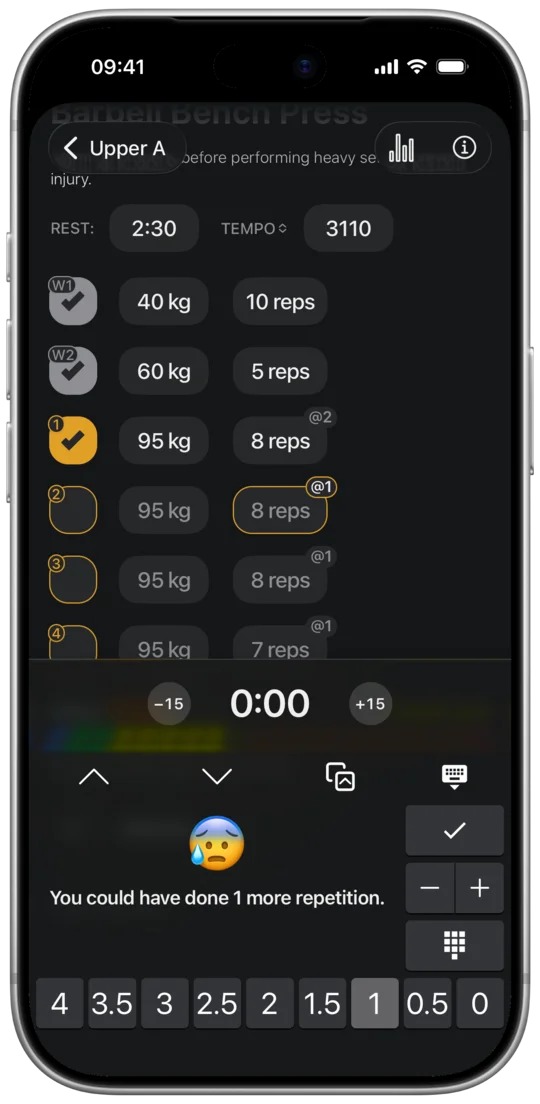
In Premium, suggestions for your next workout take your logged RIR into account, so you know whether to add a rep, add weight or stay at your current target (progression suggestions).
This fragment is the Lower A day from the 4-day upper/lower plan for intermediates with one change: the plan ends machine sets at RIR 1, while here the last sets of the seated leg curl and the seated leg extension go to failure. You can paste it through plan import (Workout > My Plans > “+” > “Import plan”). Import costs 10 AI credits, so your welcome credits cover it.
DAY: Lower A- Barbell Squat | WU 2x5 | 3x6-10 RIR 2 | TEMPO 20X0 | REST 180- Romanian Deadlift | 3x8-12 RIR 2 | TEMPO 3010 | REST 150- Seated Leg Curl | 2x10-15 RIR 1 + 1x10-15 RIR 0 | TEMPO 2011 | REST 90- Seated Leg Extension Machine | 1x10-15 RIR 1 + 1x10-15 RIR 0 | TEMPO 2011 | REST 90- Calf Leg Press | 3x10-15 RIR 1 | TEMPO 2210 | REST 60- Kneeling Cable Abs Crunches | 2x10-15 RIR 1 | TEMPO 2011 | REST 60Log it in SmartWorkout
A free workout log for iPhone and Android: sets, RIR, tempo, exercise groups and plans.


Questions
Is training to failure better than leaving reps in reserve?
For most sets, leave 1-2 reps in reserve: muscles grow about the same, and the set feels less unpleasant (Refalo et al. 2025). If you go to failure at all, save it for the last set of a machine, cable or dumbbell isolation exercise.
Should you train to failure every set?
No. Failure on every set brings much more fatigue and at most a little more muscle. On the barbell squat, the deadlift and the barbell bench press, don't take any set to failure.
Is one set to failure enough?
One set per exercise works: in 42 trained lifters it produced strength and muscle gains over 8 weeks, with or without failure (Hermann et al. 2025). More weekly sets build more muscle, though, so treat a single set as a fallback when you're short on time.
How many sets to failure per week?
Studies give no number, but the authors of the fatigue study by Refalo et al. 2023 suggest going closer to failure when you do fewer sets or have 48-72 h between sessions for that muscle group. In our practice, with 10-20 weekly sets per muscle group, at most 2-4 go to failure: the last sets of 1-2 machine, cable or isolation exercises, with 2 sessions per muscle group per week.
What is the difference between muscular and technical failure?
Muscular failure is the point where, despite full effort, you cannot do another rep through the full range of motion without swinging or changing your form. Technical failure ends the set earlier: on the first rep where your form breaks down, even though the target muscle could still do a rep or two. Something weaker than the target muscle ends the set: your lower back, your grip, your torso or your body position.
Should you train to failure on a cut?
We know of no studies that compared this. In our practice the rules on this page still apply, but when your weights drop from week to week on a cut, drop the sets to failure first and only then cut the number of sets.
See also
- RIR (reps in reserve): what it means and how to estimate itRIR (reps in reserve) is the number of good reps left before failure when a set ends. RIR 0 means no reps left, and RIR 2-3 in a plan means ending the set with 2-3 reps still in the tank. In a meta-analysis of 12 studies, lifters had on average 1 rep more left than they thought.
- RPE scale for lifting: what it is and what RPE 8, 9 and 10 meanThe RPE scale (rating of perceived exertion) in strength training rates a set by the reps left in reserve: RPE 10 means none left, RPE 9 one and RPE 8 two. It is a different scale from the Borg scale used in endurance training, which rates overall exertion.
- AMRAP: what it means and how to do an AMRAP set at the gymAn AMRAP set (as many reps as possible) is a set in which you do as many clean reps as you can with a given weight. Plans write it as “10+”: a minimum with no upper limit. In CrossFit the same abbreviation means a timed workout: as many rounds as possible, e.g. in 20 minutes.
- Rest-pause sets: what they are and how to do themA rest-pause set is a set taken to muscular failure, followed by a 20-30 s pause and more reps with the same weight, usually 1-2 times. In studies it built muscle about as well as straight sets in less time, and in some studies it added slightly more strength.
- Drop sets: what they are, how to do them and how much weight to dropA drop set (also called a strip set or descending set) is a set taken to or near failure, then continued without rest after cutting the weight by about 20-30%. In meta-analyses, drop sets built about as much muscle as regular sets in less time. One drop on the last set is usually enough.
- Training intensity: percentage of 1RM vs proximity to failure and how to increase itTraining intensity has two meanings in lifting: load as a percentage of one-rep max (%1RM) and effort, meaning how close to failure a set ends (RIR). At 80% of 1RM lifters average about 9 reps to failure on the bench press and 13 on the leg press. Muscle grows from about 30% of 1RM when sets end close to failure.
- Rep ranges: how many reps for hypertrophy, strength and cuttingA rep range is the span of reps, such as 8-12, in which a set with a given weight should end. For muscle growth the exact number matters little: in studies, muscle grew similarly with sets of about 5 to more than 30 reps close to failure, while strength grew most with loads of 80% of 1RM or more.
- Training volume: what it is and what MEV, MAV and MRV meanIn hypertrophy training, training volume is the number of working sets a muscle group gets per week. In a meta-analysis of 67 studies, growth was measurable from about 4 weekly sets, with each extra set adding less; the 2026 ACSM position stand links 10 or more weekly sets to more growth.
Sources
- Refalo MC, Helms ER, Trexler ET, et al. Influence of Resistance Training Proximity-to-Failure on Skeletal Muscle Hypertrophy: A Systematic Review with Meta-analysis. Sports Med. 2023;53(3):649-665 (online 2022).
- Grgic J, Schoenfeld BJ, Orazem J, et al. Effects of resistance training performed to repetition failure or non-failure on muscular strength and hypertrophy: A systematic review and meta-analysis. J Sport Health Sci. 2022;11(2):202-211 (online 2021).
- Robinson ZP, Pelland JC, Remmert JF, et al. Exploring the Dose-Response Relationship Between Estimated Resistance Training Proximity to Failure, Strength Gain, and Muscle Hypertrophy: A Series of Meta-Regressions. Sports Med. 2024;54(9):2209-2231.
- Refalo MC, Helms ER, Robinson ZP, et al. Similar muscle hypertrophy following eight weeks of resistance training to momentary muscular failure or with repetitions-in-reserve in resistance-trained individuals. J Sports Sci. 2024;42(1):85-101.
- Hermann T, Mohan AE, Enes A, et al. Without Fail: Muscular Adaptations in Single-Set Resistance Training Performed to Failure or with Repetitions-in-Reserve. Med Sci Sports Exerc. 2025;57(9):2021-2031.
- Currier BS, D'Souza AC, Singh MAF, et al. American College of Sports Medicine Position Stand. Resistance Training Prescription for Muscle Function, Hypertrophy, and Physical Performance in Healthy Adults: An Overview of Reviews. Med Sci Sports Exerc. 2026;58(4):851-872.
- Davies T, Orr R, Halaki M, et al. Effect of Training Leading to Repetition Failure on Muscular Strength: A Systematic Review and Meta-Analysis. Sports Med. 2016;46(4):487-502.
- Lasevicius T, Schoenfeld BJ, Silva-Batista C, et al. Muscle Failure Promotes Greater Muscle Hypertrophy in Low-Load but Not in High-Load Resistance Training. J Strength Cond Res. 2022;36(2):346-351.
- Nóbrega SR, Ugrinowitsch C, Pintanel L, et al. Effect of Resistance Training to Muscle Failure vs. Volitional Interruption at High- and Low-Intensities on Muscle Mass and Strength. J Strength Cond Res. 2018;32(1):162-169.
- Vieira JG, Sardeli AV, Dias MR, et al. Effects of Resistance Training to Muscle Failure on Acute Fatigue: A Systematic Review and Meta-Analysis. Sports Med. 2022;52(5):1103-1125 (online 2021).
- Refalo MC, Helms ER, Hamilton DL, et al. Influence of Resistance Training Proximity-to-Failure, Determined by Repetitions-in-Reserve, on Neuromuscular Fatigue in Resistance-Trained Males and Females. Sports Med Open. 2023;9(1):10.
- Refalo MC, Helms ER, Hamilton DL, et al. The Effect of Proximity-To-Failure on Perceptual Responses to Resistance Training. Eur J Sport Sci. 2025;25(3):e12266.
- Armes C, Standish-Hunt H, Androulakis-Korakakis P, et al. "Just One More Rep!" - Ability to Predict Proximity to Task Failure in Resistance Trained Persons. Front Psychol. 2020;11:565416.
- MacDougall JD, Tuxen D, Sale DG, et al. Arterial blood pressure response to heavy resistance exercise. J Appl Physiol (1985). 1985;58(3):785-90.
- Zourdos MC, Klemp A, Dolan C, et al. Novel Resistance Training-Specific Rating of Perceived Exertion Scale Measuring Repetitions in Reserve. J Strength Cond Res. 2016;30(1):267-75.
- Larsen S, Swinton PA, Sandberg NØ, et al. Resistance training beyond momentary failure: the effects of past-failure partials on muscle hypertrophy in the gastrocnemius. Front Psychol. 2025;16:1494323.
- Larsen S, Sandberg NØ, Schoenfeld BJ, et al. Resistance Training Beyond Momentary Failure: The Effects of Past-Failure Partials Versus Initial Partials on Calf Muscle Hypertrophy Among a Resistance-Trained Cohort. Eur J Sport Sci. 2025;25(9):e70030.