
Training intensity at a glance: load and effort
| Measure | What it tells you | Number | Source |
|---|---|---|---|
| %1RM | set weight relative to your one-rep max | for strength: at least 80% of 1RM | ACSM 2026 |
| %1RM and muscle | the load from which muscles grow | from about 30% of 1RM, when the set ends close to failure | Schoenfeld et al. 2021 |
| Reps at %1RM | how many reps you get to failure | on average about 5 at 90% of 1RM and about 15 at 70% | Nuzzo et al. 2024 |
| RIR | reps left to failure at the end of a set | enough effort: a set close to failure or RIR 2-3 | ACSM 2026 |
| RIR-based RPE | the same reserve on a 10-point scale | RPE = 10 − RIR | Zourdos et al. 2016 |
| Tempo | how long one rep takes | similar muscle growth with reps lasting 0.5-8 s | Schoenfeld et al. 2015 |
Load intensity vs intensity of effort
In the gym, “intensity” means two things: the load relative to your one-rep max, and effort, meaning how close to failure a set ends. The first is load intensity, given as %1RM; the 2026 ACSM position stand uses it interchangeably with load. Researchers call the second intensity of effort and treat it as a continuous scale, not a failure-or-not choice (Fisher et al. 2022); in the effort and intensity section of this knowledge base we simply call it effort.
With a 100 kg 1RM, 80 kg × 3 and 80 kg × 9 have the same load intensity, 80%, but a completely different effort: the first leaves a lot in reserve, the second ends close to failure. So “3 × 8” with no percentage and no RIR doesn't say how hard a set should be.
Percentage of one-rep max (%1RM)
Percentage of one-rep max (%1RM) is the weight of a set divided by your 1RM, the heaviest weight you can lift once through a full range of motion, multiplied by 100. With a 120 kg 1RM, a set with 90 kg is 75% of 1RM. Kilograms alone are absolute intensity; %1RM is relative intensity.
You don't have to test your 1RM: calculate an estimated 1RM (e1RM) from a heavy set of 3-10 reps in the RIR/RPE mode of the 1RM calculator, which accounts for reps in reserve; a formula without RIR treats the set as one to failure and underestimates 1RM from a set with reps left.
A percentage is based on a 1RM you measured earlier, so it doesn't account for fast changes in 1RM in beginners, fatigue after a hard block or off days (Helms et al. 2016).
How many reps you can do at 70, 80 and 90% of 1RM
A meta-regression of 269 studies worked out how many reps you can do to failure at 70, 80 and 90% of 1RM (Nuzzo et al. 2024). The last column is the %1RM chart by reps and RIR from our calculator.
| %1RM | To failure in the meta-regression | Calculator chart |
|---|---|---|
| 90% | about 5 | 3-4 |
| 80% | about 9 on the bench press, about 13 on the leg press | 7-8 |
| 70% | about 15 (14 on the bench press, 19 on the leg press) | 11 |
Sex, age and training experience changed the number of reps little; the exercise and the type of training people did changed it a lot. At 60% of 1RM people did more reps in the squat than in the bench press (Shimano et al. 2006), and on the leg press at 70% of 1RM endurance runners averaged 40 reps and weightlifters 18 (Richens and Cleather 2014). The spread between people grows as the load drops: about 2.5 reps at 80% of 1RM and about 4.4 at 60%. So “3 × 8 at 80%” is a set to failure for one lifter and a set with 3 reps in reserve for another.
The calculator chart assumes fewer reps than the meta-regression, most of all at lighter loads, so a plan based on the chart's percentages usually leaves you more reps in reserve than the chart suggests.
Effort: how close to failure you end the set
Effort is described by RIR, the number of reps left to failure at the end of a set, or by RPE on a 10-point scale, where RPE 8 is RIR 2. RIR 0 is muscular failure; the RIR levels and the choice of scale (RIR vs RPE) have their own pages.
Helms et al. 2016 link the two measures: at 83% of 1RM you get about 6 reps to failure, so 5 reps is RIR 1 and 3 reps is RIR 3.
Intensity for hypertrophy vs intensity for strength
For muscle, the load can be light or heavy as long as the set ends close to failure. For strength, you need heavy sets.
| Goal | Load | Effort | Source |
|---|---|---|---|
| Muscle | from about 30% of 1RM; in practice 6-20 reps, 6-10 on heavy barbell lifts | RIR 0-3; muscles grow more closer to failure | range: our practice; effort: Robinson et al. 2024 |
| Muscle, light load | under 70% of 1RM, usually 20 or more reps (over 30 at 30% of 1RM) | perceived RIR 0-1, because in a long set you usually have more left than you feel | failure: Lasevicius et al. 2022 (paragraph below); RIR 0-1: our practice |
| Strength | main sets on the big lifts from 80% of 1RM, usually 1-6 reps; accessory sets lighter | RIR 1-3 is enough | ACSM 2026; Robinson et al. 2024 |
| First months of training | an 8-12 rep range without %1RM, because 1RM goes up week by week | RIR 2-3; you usually have more left than you think, so every few weeks check your rating with a machine test set | our practice |
In experienced lifters, loads of 80-100% of 1RM build the most strength (Helms et al. 2016); early on, strength also goes up with moderate loads. On the big lifts, combine the two: the percentage sets the weight, and RIR checks whether it fits the day. The same review gives the example of 3 × 3 at 90% of 1RM with the note “RIR 0-1 on every set”: if you can't get 3 reps, the weight goes down, and if more than 1 is left, it goes up.
The load mainly changes strength: in a network meta-analysis, strength rose most after loads above 80% of 1RM, while muscle grew about the same with every way of training (Currier et al. 2023). Heavy loads, though, need more sets to match moderate ones for muscle, and light sets take a long time, so for hypertrophy the middle of the range is the most convenient (Schoenfeld et al. 2021).
The lighter the load, the more effort matters. In untrained men, leg extensions at 30% of 1RM stopped about 15 reps short of failure gave no significant muscle growth, while going to failure did; at 80% of 1RM, failure added nothing (Lasevicius et al. 2022).
How to increase training intensity
You increase training intensity in two ways: end sets closer to failure, or use a heavier weight for fewer reps, which raises your %1RM (step 4). Adding weight as you get stronger (step 3) is progressive overload: the kilograms go up while the percentage of 1RM stays about the same (ACSM 2026).
- Log weight, reps and RIR for every working set.
- If you end your working sets at RIR 3-4, move down to RIR 1-2. Save RIR 0 for the last set of a machine, cable or isolation exercise.
- Once all working sets reach the top of the rep range at the target RIR, add the smallest weight step, following double progression. The RIR/RPE calculator works out the new weight.
- On your main strength lift, change the rep range, e.g. from 8-12 to 4-6: at RIR 2 that's about 80% of 1RM instead of 63-74%.
- If reps have stalled on an isolation exercise or you're short on time, do the last set as a drop set or another intensity technique.
- Rest at least 60-90 s, 2-3 minutes on heavy multi-joint lifts and 3-5 minutes between sets of 1-5 reps (rest between sets).
On a barbell the smallest jump is usually 2.5 kg: two 1.25 kg plates. With light dumbbells the next pair is a big jump (10 to 12 kg is 20%), so add reps first.
You often read that shorter rest makes a workout more intense. Research shows the opposite: in a meta-analysis of 9 studies, rest periods longer than 60 s produced slightly more muscle growth, probably because you lift less after a short rest (Singer et al. 2024).
Example: the same workout written in %1RM and in RIR
The same workout can be written as a percentage of 1RM or as reps with RIR; the kilograms come from the 1RM calculator chart, rounded to 2.5 kg.
| Exercise | Written in %1RM | Written in RIR | Rest |
|---|---|---|---|
| Barbell Squat, 1RM 120 kg | 4 × 5 at 80%: 95 kg | 4 × 5 RIR 2: about 95 kg (first set RIR 2-3) | 3 min |
| Barbell Bench Press, 1RM 100 kg | 3 × 8 at 75%: 75 kg | 3 × 8 RIR 1-2: about 72.5 kg (first set RIR 2-3) | 2-3 min |
| Dumbbell Lateral Raise | not used, because nobody tests a 1RM on this exercise | 3 × 12-15 RIR 1, e.g. 8 kg | 60-90 s |
The calculator chart describes a fresh first set, while the RIR target in a plan applies to every set. At a fixed weight the reserve shrinks from set to set; if nothing is left on the fourth set, the weight was too heavy for that day. On an off day, a plan written in %1RM keeps you at 95 kg and the set ends closer to failure, while a plan written in RIR has you lower the weight.
The free 4-day upper/lower plan, intermediate version (from week 2), uses no percentages: the barbell bench press is 3 × 6-10 at RIR 2, and cable and isolation exercises are at RIR 1, because if you misjudge your reserve there and hit failure, nothing bad happens.
Which exercises to plan in %1RM and which in RIR
Percentages suit heavy barbell lifts where 1RM is easy to estimate; RIR suits machines, cables and dumbbells.
| Good fit for %1RM | Why |
|---|---|
| Barbell Bench Press | the most research on reps at %1RM; add RIR 1-3 to the percentage |
| Barbell Squat | usually more reps than the bench press at the same percentage; percentage with RIR 1-3 |
| Deadlift | the last reps are the easiest to grind out with bad form; percentage with RIR 2-3 |
| Barbell Overhead Press | there is almost no data on reps at %1RM (Nuzzo et al. 2024), so always pair the percentage with RIR |
| Better in RIR | Why |
|---|---|
| Dumbbell Lateral Raise | nobody tests a 1RM, and the weight goes up a whole pair of dumbbells at a time |
| Seated Leg Extension Machine | failure is safe here, so it's easy to aim for RIR 0-1 |
| Leg Press | clearly more reps than the bench press at the same percentage, and 1RM depends on the machine |
Training volume vs intensity, tonnage and rest
Intensity describes a set, while volume, tonnage and rest describe the whole workout.
| Load intensity | Effort | Volume | Tonnage | Rest | |
|---|---|---|---|---|---|
| What it measures | weight relative to 1RM | reps in reserve at the end of a set | sets per muscle group per week | weight × reps | time between sets |
| Example | 80 kg with a 100 kg 1RM = 80% | 8 reps when 10 were possible = RIR 2 | 12 sets for chest | 3 × 8 × 80 kg = 1,920 kg | 120 s |
For muscle, with sets close to failure, the number of sets matters more than the load: according to the 2026 ACSM position stand, muscles grew more with 10 or more sets per week. In SmartWorkout, 4-10 sets (MEV) is the target for a regular muscle group, because that's where each set adds the most growth, but it's a minimum, not a ceiling; the 1-2 muscle groups you want to bring up faster aim for MAV, 10-20 sets. You can count your week in the sets per muscle group calculator.
Common mistakes
- Sweat and pump as a gauge. Sweat, pump and soreness say nothing about the load or the reps in reserve. Judge a set by %1RM and RIR.
- Percentages from an old 1RM. A percentage of an old result gives the wrong weight, because 1RM goes up or down (see above). Estimate your 1RM every 4-8 weeks from a heavy set, or add a RIR target to the percentage.
- The percentage chart as gospel. At the same percentage, people and exercises differ by several reps (see above). Use the chart as a starting point and adjust the weight after the first set.
- Failure on the big lifts. Failure adds no strength (ACSM 2026), and its advantage for muscle in a meta-analysis was trivial (Refalo et al. 2023); according to ACSM, for some people it may be inadvisable because of injury risk as technique breaks down. On the squat, deadlift and barbell bench press, end your sets at RIR 1-3, and go closer to failure on machines and isolation exercises.
What the research says
Research asks how many reps you get at a given %1RM and what grows: strength or muscle.
| Study | Type and sample | Result | Limitation |
|---|---|---|---|
| Nuzzo et al. 2024 | meta-regression, 269 studies, 7,289 people | result above | 66% of groups were men |
| Currier et al. 2023 | network meta-analysis, 178 strength studies (5,097 people) and 119 hypertrophy studies (3,364 people) | result above | different programs compared in one network |
| Lasevicius et al. 2022 | 25 untrained men, 8 weeks, leg extensions | result above | untrained lifters, one exercise |
| Refalo et al. 2023 | meta-analysis, 15 studies | result above (effect size 0.19), no effect of %1RM | different definitions of failure |
| Robinson et al. 2024 | series of meta-regressions | result above | RIR estimated from study descriptions; exploratory analysis |
| Helms et al. 2018 | 21 trained men, 8 weeks, squat and bench press | load from %1RM vs load set by RPE: similar gains, RPE may have given a small strength advantage | small sample |
| The 2026 ACSM position stand | overview of 137 reviews, more than 30,000 people | strength: result above; muscle: greater growth from 10 sets per week; failure not required | too little data to set an exact target RIR |
It's unknown how many reps you get at a given percentage in most exercises other than the bench press and leg press, and which target RIR works best; most studies involve young men, and studies on women alone are few.
What SmartWorkout logs show about intensity
Lifters in our logs, mostly in Poland, rate heavy sets as close to failure as light ones. We advise otherwise: on the big lifts, 1-3 reps in reserve, and in long sets closer to failure, because at lighter loads you judge your reserve less accurately (Halperin et al. 2022). Every number is based on at least 50 people.
How to set intensity in SmartWorkout
In SmartWorkout you log weight and effort (RIR or RPE) for every working set, and a plan sets the target as a percentage of 1RM, RIR or RPE.
- Open “Workout Settings” (the settings icon on the workout screen) and under “Effort scale” choose the “Scale type”: RIR or RPE (logging RIR, RPE and tempo).
- Enter the weight and reps of a working set, tap “RIR” on the keyboard and pick your reserve from 0 to 4 (in 0.5 steps).
- Check the e1RM next to the set, the 1RM estimated from weight and reps. The app calculates it without RIR, as for a set to failure, so for percentages use a set of 3-6 reps that ended at RIR 0-1.
- In the plan creator (Workout > My Plans > “+” > “Create new plan”), set the “Load Indicator” to “1RM” to plan in percentages, or to “RIR” or “RPE” to plan effort.
A plan with the 1RM indicator shows the target for each set as a percentage, and you work out the kilograms yourself, e.g. in the plan weight mode of the 1RM calculator.
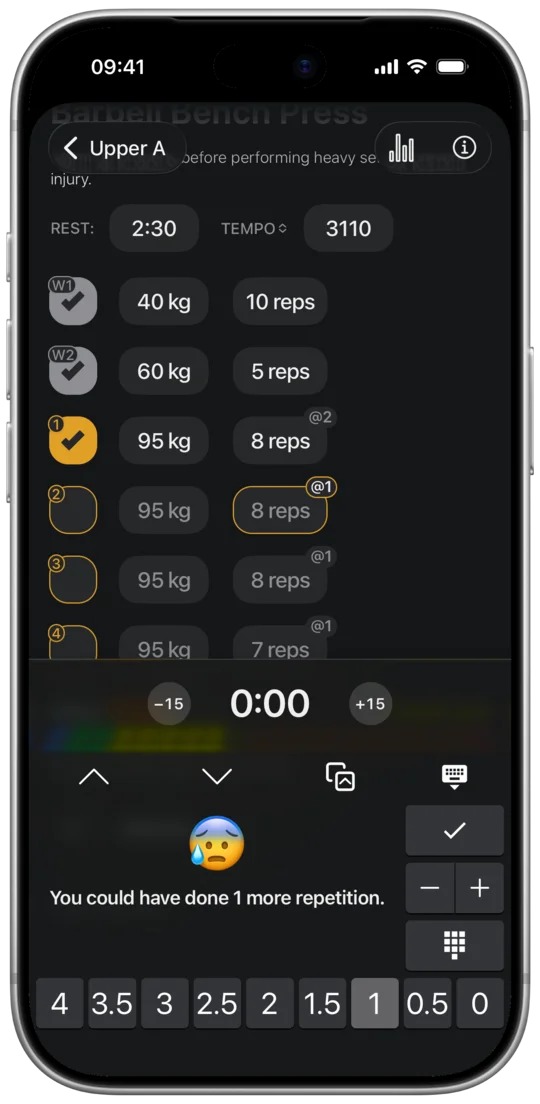
With Premium, you know what to do next workout: add a rep, add weight or stay at your current target, and the suggestions take your logged RIR into account (progression suggestions).
You can paste this strength day with loads in %1RM through plan import (Workout > My Plans > “+” > “Import plan”); the first set leaves about 2-4 reps in reserve. Raise the percentage by 2.5 points each week (80, 82.5, 85%) if the last set of the previous week ended with at least 1 rep in reserve; if not, repeat the week. That's how the load goes up in linear periodization; after 3-4 weeks, estimate your new 1RM from your last heavy set. The warm-up sets mode of the 1RM calculator lays out the warm-up weights. Import costs 10 AI credits, so the welcome credits cover it.
DAY: Strength A- Barbell Squat | WU 5x1-10 | 4x5 80% 1RM | TEMPO 20X0 | REST 180- Barbell Bench Press | WU 5x1-10 | 4x5 80% 1RM | TEMPO 20X0 | REST 180- Barbell Overhead Press | WU 4x2-10 | 3x6 75% 1RM | TEMPO 20X0 | REST 150Log it in SmartWorkout
A free workout log for iPhone and Android: sets, RIR, tempo, exercise groups and plans.


Questions
What is training intensity?
In the gym, training intensity has two meanings: load as a percentage of your one-rep max (%1RM) and effort, meaning how close to failure a set ends (RIR). With a 100 kg 1RM, 80 kg × 3 and 80 kg × 9 have the same load intensity, 80%, but a completely different effort.
How do you calculate percentage of 1RM?
Divide the weight by your 1RM and multiply by 100: 80 kg with a 100 kg 1RM is 80%. If you don't know your 1RM, estimate it from a heavy set in the 1RM calculator and log effort separately as RIR.
How do you increase training intensity?
First check that you end your working sets no more than 2-3 reps short of failure; if more are left, cut the reserve. Then add reps and weight. Shorter rest doesn't raise intensity and can cost you reps on the sets that follow.
How many reps can you do at 80% of 1RM?
On average about 9 to failure on the bench press and about 13 on the leg press. You'll find your own number after the first set rated with RIR, because people differ here by several reps.
Is volume or intensity more important for hypertrophy?
With sets close to failure, the number of sets matters more, and the load can be anything from about 30% of 1RM. For strength, the load matters more; how many sets to do for muscle growth is covered on the training volume page.
Do you have to lift heavy to build muscle?
Not heavy, but close to failure: a light weight builds muscle when you end the set at a perceived RIR 0-1. A light set stopped a dozen or more reps short of failure does almost nothing.
See also
- RIR (reps in reserve): what it means and how to estimate itRIR (reps in reserve) is the number of good reps left before failure when a set ends. RIR 0 means no reps left, and RIR 2-3 in a plan means ending the set with 2-3 reps still in the tank. In a meta-analysis of 12 studies, lifters had on average 1 rep more left than they thought.
- RPE scale for lifting: what it is and what RPE 8, 9 and 10 meanThe RPE scale (rating of perceived exertion) in strength training rates a set by the reps left in reserve: RPE 10 means none left, RPE 9 one and RPE 8 two. It is a different scale from the Borg scale used in endurance training, which rates overall exertion.
- Training to failure: when it helps and when it just adds fatigueTraining to failure means ending a set only when, despite full effort, you cannot complete the next rep through a full range of motion without changing your form. In a meta-analysis of 15 studies it built no significantly more muscle or strength than stopping short of failure, and it is clearly more fatiguing.
- Lifting tempo: how to read 3010, 31X0 and other tempo codesLifting tempo (rep tempo) is a code for how many seconds each of the four phases of a rep takes: lowering, pause in the stretch, lifting and pause at the top. A 3010 tempo means 3 s down and 1 s up with no pauses. In a meta-analysis of 8 studies with sets to failure, reps of 0.5 to 8 s built similar muscle.
- Intensity techniques in lifting: which work, what they cost and when to use themIntensity techniques (also called advanced training techniques) extend a set or cut the rest, as drop sets, rest-pause and supersets do. In meta-analyses with similar work they built no more muscle than straight sets, but supersets, drop sets and rest-pause cut session time by a third or more.
- Rep ranges: how many reps for hypertrophy, strength and cuttingA rep range is the span of reps, such as 8-12, in which a set with a given weight should end. For muscle growth the exact number matters little: in studies, muscle grew similarly with sets of about 5 to more than 30 reps close to failure, while strength grew most with loads of 80% of 1RM or more.
- Progressive overload: what it is, linear vs double progression, and how to break a plateauProgressive overload is the gradual increase of training demands, most often load, reps or sets. The ACSM advises adding 2-10% load once you do 1-2 reps over your target in two sessions in a row. In an 8-week study, adding reps built about as much muscle as adding load.
- Training volume: what it is and what MEV, MAV and MRV meanIn hypertrophy training, training volume is the number of working sets a muscle group gets per week. In a meta-analysis of 67 studies, growth was measurable from about 4 weekly sets, with each extra set adding less; the 2026 ACSM position stand links 10 or more weekly sets to more growth.
Sources
- Currier BS, D'Souza AC, Singh MAF, et al. American College of Sports Medicine Position Stand. Resistance Training Prescription for Muscle Function, Hypertrophy, and Physical Performance in Healthy Adults: An Overview of Reviews. Med Sci Sports Exerc. 2026;58(4):851-872.
- Fisher JP, Steele J, Smith D. Intensity of effort and momentary failure in resistance training: Are we asking a binary question for a continuous variable? J Sport Health Sci. 2022;11(6):644-647.
- Nuzzo JL, Pinto MD, Nosaka K, et al. Maximal Number of Repetitions at Percentages of the One Repetition Maximum: A Meta-Regression and Moderator Analysis of Sex, Age, Training Status, and Exercise. Sports Med. 2024;54(2):303-321 (online 2023).
- Helms ER, Cronin J, Storey A, et al. Application of the Repetitions in Reserve-Based Rating of Perceived Exertion Scale for Resistance Training. Strength Cond J. 2016;38(4):42-49.
- Zourdos MC, Klemp A, Dolan C, et al. Novel Resistance Training-Specific Rating of Perceived Exertion Scale Measuring Repetitions in Reserve. J Strength Cond Res. 2016;30(1):267-75.
- Schoenfeld BJ, Ogborn DI, Krieger JW. Effect of repetition duration during resistance training on muscle hypertrophy: a systematic review and meta-analysis. Sports Med. 2015;45(4):577-85.
- Schoenfeld BJ, Grgic J, Van Every DW, et al. Loading Recommendations for Muscle Strength, Hypertrophy, and Local Endurance: A Re-Examination of the Repetition Continuum. Sports (Basel). 2021;9(2):32.
- Shimano T, Kraemer WJ, Spiering BA, et al. Relationship between the number of repetitions and selected percentages of one repetition maximum in free weight exercises in trained and untrained men. J Strength Cond Res. 2006;20(4):819-23.
- Currier BS, Mcleod JC, Banfield L, et al. Resistance training prescription for muscle strength and hypertrophy in healthy adults: a systematic review and Bayesian network meta-analysis. Br J Sports Med. 2023;57(18):1211-1220.
- Lasevicius T, Schoenfeld BJ, Silva-Batista C, et al. Muscle Failure Promotes Greater Muscle Hypertrophy in Low-Load but Not in High-Load Resistance Training. J Strength Cond Res. 2022;36(2):346-351.
- Refalo MC, Helms ER, Trexler ET, et al. Influence of Resistance Training Proximity-to-Failure on Skeletal Muscle Hypertrophy: A Systematic Review with Meta-analysis. Sports Med. 2023;53(3):649-665 (online 2022).
- Robinson ZP, Pelland JC, Remmert JF, et al. Exploring the Dose-Response Relationship Between Estimated Resistance Training Proximity to Failure, Strength Gain, and Muscle Hypertrophy: A Series of Meta-Regressions. Sports Med. 2024;54(9):2209-2231.
- Singer A, Wolf M, Generoso L, et al. Give it a rest: a systematic review with Bayesian meta-analysis on the effect of inter-set rest interval duration on muscle hypertrophy. Front Sports Act Living. 2024;6:1429789.
- Helms ER, Byrnes RK, Cooke DM, et al. RPE vs. Percentage 1RM Loading in Periodized Programs Matched for Sets and Repetitions. Front Physiol. 2018;9:247.
- Richens B, Cleather DJ. The relationship between the number of repetitions performed at given intensities is different in endurance and strength trained athletes. Biol Sport. 2014;31(2):157-61.
- Halperin I, Malleron T, Har-Nir I, et al. Accuracy in Predicting Repetitions to Task Failure in Resistance Exercise: A Scoping Review and Exploratory Meta-analysis. Sports Med. 2022;52(2):377-390 (online 2021).