
Lifting tempo key numbers
| Parameter | Value | Source |
|---|---|---|
| The X | lifting with maximal intended velocity, counted as 0.5 s | Wilk et al. 2021 |
| Rep duration | 0.5 to 8 s: similar muscle growth with sets to failure; over 10 s worse (few studies) | Schoenfeld et al. 2015 |
| Longer lowering and the weight | with a 5 s lowering, bench press 1RM 6% lower than at your own pace, no change at 2 s; for working sets, start about 10% lighter | Wilk et al. 2020; the 10% is our practice |
What each digit of a tempo code means
A lifting tempo is written as four characters, and each one says how many seconds one phase of the rep takes: 3010 is 3 s of lowering, 0 s of pause in the stretch, 1 s of lifting and 0 s of pause at the top. You'll also see the same code with dashes or slashes (3-0-1-0, 3/0/1/0) or with three digits and no pause at the top: 311 (3-1-1) is 3 s down, a 1 s pause and 1 s up. If the digits don't fit the movement, check the plan's legend, because some coaches order the phases differently.
| Code | Lowering | Pause in the stretch | Lifting | Pause at the top | One rep |
|---|---|---|---|---|---|
| 2010 | 2 s | 0 | 1 s | 0 | 3 s |
| 3010 | 3 s | 0 | 1 s | 0 | 4 s |
| 4010 | 4 s | 0 | 1 s | 0 | 5 s |
| 3110 | 3 s | 1 s | 1 s | 0 | 5 s |
| 20X0 | 2 s | 0 | X | 0 | 2.5 s |
First digit: the lowering, or eccentric phase
The eccentric phase is the part of a rep where the muscle lengthens under load, usually the lowering; the concentric phase is where the muscle shortens and you lift the weight. In the bench press the eccentric is lowering the bar to your chest, and in the lat pulldown it's the bar going back up as your arms straighten.
A longer lowering phase doesn't build more muscle on its own: in a meta-analysis of 9 studies, the effect on muscle size was close to zero and uncertain, while strength in trained lifters went up similarly or more (Amdi and King 2025). Training only the lowering, with help on the way up, is called negative reps.
Second and fourth digits: the pause in the stretch and at the top
The second digit is the pause where the muscle is most stretched: the bar on your chest, the bottom of a squat, arms straight with the bar up in a lat pulldown. The fourth digit is the pause after the lift: in leg extensions or lat pulldowns it's a squeeze in the contraction, and in the squat and bench press a breath with your joints locked out.
A pause reduces the bounce, the elastic energy from a fast turnaround into the lift (Wilk et al. 2020), so reps become comparable: in 17 trained lifters, a 2 s pause made lifting velocity at the same weight more repeatable (Pallarés et al. 2014). That's the idea behind the paused bench press and the paused squat; the pause usually lasts about 1 s in the bench press and 1-3 s in the squat.
The X: lifting as fast as you can
An X only ever goes in third place and means lifting with maximal intended velocity, e.g. a barbell squat at a 20X0 tempo. With a heavy weight, X is the intent, not the speed: above 85% of 1RM even a maximal effort produces a slow lift (Wilk et al. 2021).
Deliberately slowing the lift costs strength: after 6 weeks of bench pressing, 1RM went up 10% with a slower lift and 18% when lifting as fast as possible (González-Badillo et al. 2014). In a meta-analysis of 15 studies, fast and moderately slow reps produced similar strength gains (Davies et al. 2017), so the X takes nothing away, but it doesn't guarantee a gain either.
Lifts that start with the concentric
The order of the digits never changes, but in the deadlift, pull-ups, rows and curls you start the first rep with the lift, that is, from the third digit.
Read a Deadlift at 21X0 like this: you pull the bar off the floor as fast as you can (X), don't pause at lockout (0), lower it under control over 2 s (2) and let it rest on the floor for a second (1). Here the second digit isn't a pause under load but a dead stop: every rep starts from zero, with no bounce. You read the pull-up from a dead hang and the lat pulldown the same way: 2011 is 1 s of pulling, a second with the bar at your chest, 2 s on the way back and straight into the next rep.
When lifting tempo matters
Tempo on its own doesn't build more muscle: with reps from 0.5 to 8 s, growth was similar, and in those studies every set ended at failure (Schoenfeld et al. 2015). A slower tempo at the same rep count takes a set closer to failure, so how hard a set is still comes down to intensity, meaning the weight, and RIR. You write down a tempo mainly so that 80 kg × 8 today means the same as 80 kg × 8 a month from now.
| Goal | Tempo | Why |
|---|---|---|
| Muscle | 2010, 3010 or 20X0 | growth is similar, so pick the tempo that gives you the most control over the weight |
| Strength in compound lifts | 20X0 | a 2 s lowering doesn't lower your max (Wilk et al. 2020) |
| Less weight: heavy loads bother your joints, or your dumbbells are too light | 3010 or 4010 | a lighter weight at a slower tempo still stimulates muscle and strength (Wilk et al. 2021) |
| Technique at the bottom, powerlifting | 31X0 in the squat and bench press | in powerlifting the bar must stop on your chest in the bench press |
| Beginners | 3010 | a 3 s lowering makes a movement easier to learn (our practice); in the squat, a 4 s lowering gave a bigger 1RM gain than 1 s (Kojic et al. 2024) |
| Power and jumping | short lowering, X | jump height improved more after a shorter lowering (Amdi and King 2025) |
How to train with a tempo
- When you stretch the lowering to 4-5 s, start about 10% lighter, e.g. go from 80 kg to 72.5 kg on the barbell bench press, and adjust after the first set by RIR.
- Count the seconds in your head (“one-thousand-one, one-thousand-two”) or run a metronome at 60 beats per minute.
- Pause under load and under tension: the bar sits still on your chest but you don't let it sink, and your shoulder blades stay pulled back; in the squat, keep your torso braced at the bottom. On a cable machine the plates hang just above the stack, because plates resting on the stack are already a rest. In dumbbell flyes, pause low, but before you feel a pull in the front of your shoulder.
- Keep the same tempo for an exercise through the whole mesocycle, because only then can you see progressive overload. Change the tempo with a new block, e.g. from a paused 31X0 bench press to 20X0 in a strength block, and record new baseline results.
A slower tempo costs reps: at 70% of 1RM, five bench press sets to failure added up to 16 reps when both the lowering and the lift were slow (6040), against 28 at 2020 (Wilk et al. 2018). That's why the 1RM calculator will show a lower estimated 1RM from a slow set.
Tempo examples in kilograms and seconds
In SmartWorkout plans for intermediates, the first compound lift of the day usually has a 20X0 tempo, because you lift a heavy rep as fast as you can anyway. The other exercises get a 2-3 s lowering, and 1-2 exercises for a priority muscle group often get a 1 s pause in the stretch. The table shows week 2 of the 4-day upper/lower plan and the chest priority plan.
| Exercise | Tempo | Set | Rest | Set duration (approx.) |
|---|---|---|---|---|
| Barbell Bench Press | 20X0 | 80 kg × 8, RIR 2 | 180 s | 20 s |
| Cable Lat Pulldown | 2011 | 55 kg × 12, RIR 1 | 120 s | 48 s |
| Romanian Deadlift | 3010 | 70 kg × 10, RIR 2 | 150 s | 40 s |
| Dumbbell Chest Fly | 3110 | 12 kg dumbbells × 12, RIR 1 | 60 s | 60 s |
Tempo on cables, machines and dumbbells
A tempo is easiest to hold on machines and cables, because they guide the path of the movement.
| Good fit | Why |
|---|---|
| Machine Chest Fly | you set the depth of the stretch with the starting position of the arms |
| Wide Grip Lat Pulldown | the bar is easy to hold at your chest for a second |
| Seated Leg Extension Machine | a second in the contraction with your legs straight |
| Seated Incline Biceps Curl | your back rests on the bench, so swinging is hard on a slow lowering |
| Cyclist Squat | heels on a plate or wedge keep you balanced deep in the knee bend, so a slow lowering and a pause at the bottom stay controlled |
Tempo vs time under tension and negatives
| Tempo | Time under tension (TUT) | Negatives | |
|---|---|---|---|
| What it is | the duration of each of the four phases of a rep | total time of a set under load; follows from tempo and rep count | the eccentric phase only; you get back up with help |
| When it makes sense | in every set, so results from different sessions are comparable | not as a goal | before your first full pull-up, or as a short add-on for strength in advanced lifters |
Common mistakes
- Slow lifting for the “feel”. A 3-4 s lift doesn't build more muscle, and in some studies it produced smaller strength gains (see the X above); reps longer than 10 s did worse, though there are few studies (Schoenfeld et al. 2015). Keep control on the way down and lift in 1 s or with an X.
- Bouncing instead of 0. A 0 in second place is a smooth turnaround without a stop, not a bounce: the bar touches your chest without hitting it and moves up under muscle power.
- Jerking on the X. If your hips come off the bench or your shoulder blades shift on the X, lift slower until your setup stops changing.
- Counting on heavy sets. With a heavy weight close to failure, counting seconds can be impossible and may hurt your technique (Wilk et al. 2021); on the last reps, watch only the bar path.
What the research says about tempo
| Study | Type and sample | Result | Limitation |
|---|---|---|---|
| Schoenfeld et al. 2015 | meta-analysis, 8 studies with training to failure | result above | few studies with very slow reps |
| Enes et al. 2025 | Bayesian meta-analysis, 14 studies | effect size 0.09 in favor of a faster tempo (credible interval -0.04 to 0.22), i.e. negligible | differences possible under specific conditions |
| The 2026 ACSM position stand | overview of reviews | fast and slow reps and time under tension had no effect on muscle growth; power improves after fast lifting | based on reviews |
| Amdi and King 2025 | meta-analysis, 9 studies, 166 people (46% trained) | longer lowering: muscle g = 0.05, strength g = 0.25; jump better after a shorter one (g = -0.73) | wide confidence intervals |
| Wilk et al. 2020 | 90 trained men, bench press 1RM test | 121.4 kg at own pace, 113.8 kg with a 5 s and 107.1 kg with an 8 s lowering | one exercise, one test |
It's unknown whether the pause in the stretch on its own changes muscle growth, because training studies changed it together with other phases of the rep.
What SmartWorkout logs show
The most common codes give a rep of 3-5 s, the middle of the range in which studies see no difference in muscle growth. Every number is based on at least 50 people.
How to log tempo in SmartWorkout
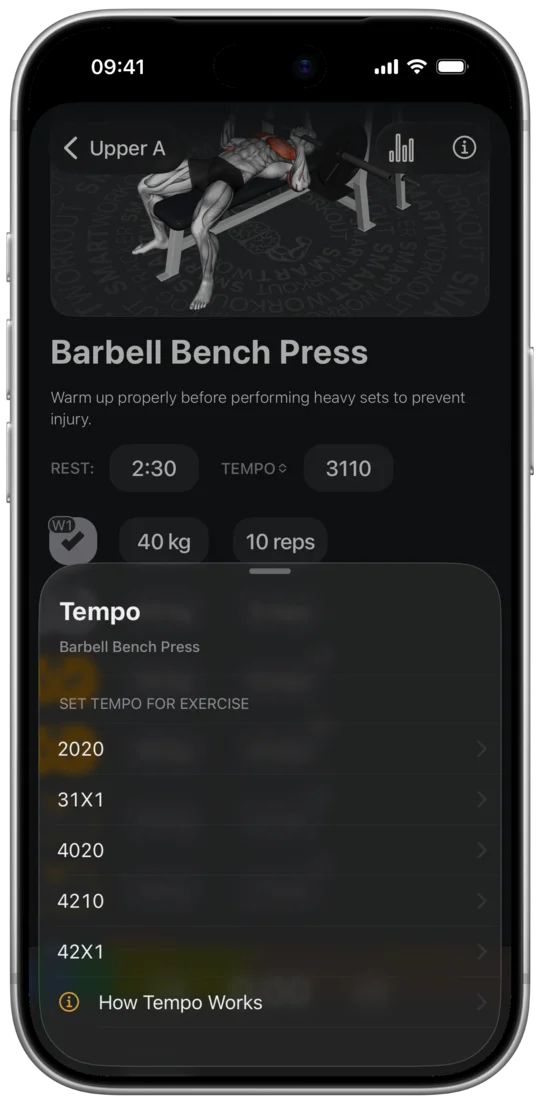
You set the tempo in SmartWorkout per exercise: the four characters apply to all its sets, in the workout log, in templates and in plans.
- Find the “TEMPO” field below the exercise's sets. If it isn't there, open Profile > Settings > “Workout Settings” and turn on “Show tempo” in the “Workout Tempo” section.
- Tap the field and enter four characters, e.g. 3010. You can enter an X only in third place.
- Or tap the “TEMPO” label and pick a preset tempo from the “Set tempo for exercise” list.
This fragment combines the exercises and tempos from both plans in the table above into one day, with a pause on the chest (31X0) in the bench press. You can paste it through plan import (Workout > My Plans > “+” > “Import plan”). Import costs 10 AI credits, so the welcome credits cover it.
DAY: Upper A- Barbell Bench Press | WU 2x5 | 3x6-10 RIR 2 | TEMPO 31X0 | REST 180- Cable Lat Pulldown | 3x8-12 RIR 1 | TEMPO 2011 | REST 120- Dumbbell Chest Fly | 3x10-15 RIR 1 | TEMPO 3110 | REST 60- Seated Incline Biceps Curl | 3x10-15 RIR 1 | TEMPO 3010 | REST 60The help article on logging RIR, RPE and tempo explains how tempo works in the app.
Log it in SmartWorkout
A free workout log for iPhone and Android: sets, RIR, tempo, exercise groups and plans.


Questions
What does a 3010 tempo mean?
You lower the weight for 3 s, don't stop at the bottom, lift it in about 1 s and start the next rep right away. It's a good tempo for learning a movement; a set of 8 reps takes about 32 s.
What do 2010, 4010 and 3110 tempos mean?
Each differs from 3010 by one digit: 2010 has a shorter lowering, 4010 a longer one, and 3110 adds a 1 s pause in the stretch. At 4010, start about 10% lighter than at 2010 and adjust by RIR; in a 1RM test, a 5 s lowering already cut the result by about 6%, and over a set of several reps the gap grows.
What is 3-1-1 tempo in lifting?
It's the three-digit version of the code, without the pause at the top: 3 s lowering, a 1 s pause in the stretch and 1 s lifting. Written with four digits, it's 3110.
What is the best lifting tempo for hypertrophy?
There isn't one, as long as your sets end equally close to failure, and time under tension isn't a goal either: in the 2026 ACSM position stand it didn't consistently change training outcomes. Pick a tempo that keeps the weight under control through the full range of motion, such as 2010 or 3010, keep it every session and count hard sets per muscle group per week (training volume), not seconds.
What does X mean in a tempo?
X means lifting with maximal intended velocity, as fast as you can while keeping your position. It appears only in third place, the lifting phase, and with a heavy weight the bar still moves slowly: X is the intent, not the speed.
How do you read tempo on a deadlift?
You read the digits in the usual order, but start the first rep from the third digit, because the bar sits on the floor. If the second digit is 1, the bar rests on the floor every rep; with 0 it only touches the floor, without bouncing the plates.
See also
- RIR (reps in reserve): what it means and how to estimate itRIR (reps in reserve) is the number of good reps left before failure when a set ends. RIR 0 means no reps left, and RIR 2-3 in a plan means ending the set with 2-3 reps still in the tank. In a meta-analysis of 12 studies, lifters had on average 1 rep more left than they thought.
- Negative reps: how to train the eccentric phaseNegative reps (negatives, eccentric-only reps) are reps with only the eccentric phase: the weight is lowered over 3-5 s, and a partner, the other limb or a bench gets it back up. Muscles are 20-40% stronger when lowering. Studies of heavier lowering show no more muscle growth than regular sets.
- Training to failure: when it helps and when it just adds fatigueTraining to failure means ending a set only when, despite full effort, you cannot complete the next rep through a full range of motion without changing your form. In a meta-analysis of 15 studies it built no significantly more muscle or strength than stopping short of failure, and it is clearly more fatiguing.
- Rep ranges: how many reps for hypertrophy, strength and cuttingA rep range is the span of reps, such as 8-12, in which a set with a given weight should end. For muscle growth the exact number matters little: in studies, muscle grew similarly with sets of about 5 to more than 30 reps close to failure, while strength grew most with loads of 80% of 1RM or more.
- Training volume: what it is and what MEV, MAV and MRV meanIn hypertrophy training, training volume is the number of working sets a muscle group gets per week. In a meta-analysis of 67 studies, growth was measurable from about 4 weekly sets, with each extra set adding less; the 2026 ACSM position stand links 10 or more weekly sets to more growth.
- Progressive overload: what it is, linear vs double progression, and how to break a plateauProgressive overload is the gradual increase of training demands, most often load, reps or sets. The ACSM advises adding 2-10% load once you do 1-2 reps over your target in two sessions in a row. In an 8-week study, adding reps built about as much muscle as adding load.
- Training intensity: percentage of 1RM vs proximity to failure and how to increase itTraining intensity has two meanings in lifting: load as a percentage of one-rep max (%1RM) and effort, meaning how close to failure a set ends (RIR). At 80% of 1RM lifters average about 9 reps to failure on the bench press and 13 on the leg press. Muscle grows from about 30% of 1RM when sets end close to failure.
Sources
- Wilk M, Zajac A, Tufano JJ. The Influence of Movement Tempo During Resistance Training on Muscular Strength and Hypertrophy Responses: A Review. Sports Med. 2021;51(8):1629-1650.
- Schoenfeld BJ, Ogborn DI, Krieger JW. Effect of repetition duration during resistance training on muscle hypertrophy: a systematic review and meta-analysis. Sports Med. 2015;45(4):577-85.
- Wilk M, Golas A, Zmijewski P, et al. The Effects of the Movement Tempo on the One-Repetition Maximum Bench Press Results. J Hum Kinet. 2020;72:151-159.
- Amdi CH, King A. The effect of eccentric phase duration on maximal strength, muscle hypertrophy and countermovement jump height: A systematic review and meta-analysis. J Sports Sci. 2025;43(20):2447-2464.
- Pallarés JG, Sánchez-Medina L, Pérez CE, et al. Imposing a pause between the eccentric and concentric phases increases the reliability of isoinertial strength assessments. J Sports Sci. 2014;32(12):1165-75.
- González-Badillo JJ, Rodríguez-Rosell D, Sánchez-Medina L, et al. Maximal intended velocity training induces greater gains in bench press performance than deliberately slower half-velocity training. Eur J Sport Sci. 2014;14(8):772-81.
- Davies TB, Kuang K, Orr R, et al. Effect of Movement Velocity During Resistance Training on Dynamic Muscular Strength: A Systematic Review and Meta-Analysis. Sports Med. 2017;47(8):1603-1617.
- Enes A, Piñero A, Hermann T, et al. How Slow Should You Go? A Systematic Review With Meta-Analysis of the Effect of Resistance Training Repetition Tempo on Muscle Hypertrophy. J Strength Cond Res. 2025;39(12):1331-1339.
- Currier BS, D'Souza AC, Singh MAF, et al. American College of Sports Medicine Position Stand. Resistance Training Prescription for Muscle Function, Hypertrophy, and Physical Performance in Healthy Adults: An Overview of Reviews. Med Sci Sports Exerc. 2026;58(4):851-872.
- Kojic F, Mandic D, Duric S. The effects of eccentric phase tempo in squats on hypertrophy, strength, and contractile properties of the quadriceps femoris muscle. Front Physiol. 2024;15:1531926.
- Wilk M, Golas A, Stastny P, et al. Does Tempo of Resistance Exercise Impact Training Volume? J Hum Kinet. 2018;62:241-250.