
Negative rep key numbers
| Parameter | Value | Source |
|---|---|---|
| Lowering strength | about 40% greater than lifting; in the barbell bench press about 120% of your regular 1RM | Nuzzo et al. 2023, Kelly et al. 2015 |
| Lowering time | 3-5 s | Suchomel et al. 2019 (2/1); our exercise atlas |
| Weight with a partner | 105-110% of 1RM | same review |
| Weight in the 2/1 method | 70-80% of your two-limb 1RM | same review |
| Set | 3-5 reps, 2-3 sets | our practice |
| How often | heavy ones once a week per muscle group for 2-4 weeks, bodyweight ones 1-2 times a week | our practice |
Four ways to do negative reps
A negative rep is a rep where you do only the eccentric phase: you lower the weight or your body over 3-5 s and get back up with help. The eccentric phase is the part of a rep where the muscle lengthens under load, usually the lowering; the concentric phase is where the muscle shortens and you lift the weight. The atlas pages for the Negative Pull-Up and the Negative Push-Up have a video and instructions.
Bodyweight negatives
Bodyweight negatives start at the top position: for pull-ups, stand on a bench placed crosswise under the bar or on a plyo box, so your chin is above the bar without a jump. For push-ups you get back to the top from your knees, and for Dips you step into the support position from a bench.
If you can't hold a 3 s descent in the pull-up, start with a 10-20 s hang with your chin above the bar or with the Assisted Pull-Up. Go slowest where your arms straighten, and at the bottom step onto the bench with your shoulder blades set instead of dropping into a dead hang.
- lowerings per set
- seconds per lowering
The Nordic Hamstring Curl is a negative by nature: you kneel with your heels locked under a machine pad, under a loaded barbell or in a partner's hands, and lower your torso forward as slowly as you can control.
Two up, one down (2/1)
In the 2/1 method you lift the weight with both legs or arms and lower it with one over 3-5 s, alternating sides. The Suchomel et al. 2019 review gives 70-80% of 1RM but notes that there is little evidence for this method. Single-lever machines fit: the Seated Leg Extension Machine, Seated Leg Curl, Prone Lying Leg Curl or the Machine Preacher Curl with connected handles; on a machine with two independent levers, 2/1 won't work.
Partner negatives heavier than your 1RM
In partner negatives you take more weight than your 1RM: your partner helps lift the bar and you lower it over 3-5 s. The same review reserves such loads for advanced lifters who squat at least twice their body weight; beginners do fine with slow lowering at a 4010 tempo. Do them right after your warm-up sets, and do one fewer working set in that session.
Bench in a power rack with the safety pins set just below your chest, and with a bar heavier than your 1RM have two spotters, one at each end of the bar. Studies of heavier lowering usually used weight releasers, hooks that fall off the bar at the bottom of the rep (Zhang et al. 2026); few gyms have them.
Negatives at the end of a regular set
You do negatives at the end of a set after the last rep you can no longer lift on your own, at muscular failure: your partner helps on the way up and you lower the weight 1-2 more times. They mostly add fatigue: more forced reps after failure didn't build more strength (Drinkwater et al. 2007). These lowerings belong to the same set, like the drops in a drop set, because there is no rest between them (how to count sets).
When negative reps are worth it
Negatives, like other intensity techniques, don't build more muscle than regular sets and cost more fatigue. In a meta-analysis of 49 studies, heavier lowering in full reps gave strength gains similar to regular sets, with clearly higher perceived effort; only 3 studies measured muscle cross-sectional area (Zhang et al. 2026). Almost nobody has compared negatives alone with regular sets, so this is the closest evidence for both hypertrophy and strength.
| Goal | Method | Why |
|---|---|---|
| First pull-up or push-up | bodyweight, 3 × 3-5, 1-2 times a week | you train the movement in the phase where you're stronger |
| Strength in advanced lifters | partner or 2/1, once a week | mainly lowering strength goes up, and muscle mass grows the same as with regular sets (Walker et al. 2016) |
| Hamstrings, especially if you run or play soccer | Nordic curls, about 20 reps a week, e.g. 3 × 7 | half as many injuries in athletes (van Dyk et al. 2019); studies used 21 reps a week or more (Cuthbert et al. 2020) |
| Better skip | the week before a 1RM test and during a deload | soreness and longer recovery |
How to do negative reps step by step
- Warm up the muscle group with sets of rising weight, and do the negatives before your working sets.
- Set the weight: with a partner start at 105% of 1RM; in 2/1 take 70-80% of your two-limb 1RM.
- Lower over 3-5 s through the full range of motion; count in your head or run a 60 bpm metronome on your phone.
- End the set at RIR 1, when you have one 3 s descent left; in negatives, RIR is the number of 3 s descents you could still do. If a descent took less than 3 s, the set was one rep too long.
- In the first week do 1 set per exercise, from the second week 2-3.
- Rest 90-120 s on machines and with bodyweight, 2-3 min with a barbell.
Negative rep examples in kg and seconds
The examples assume a 1RM from the calculator; on a machine, round the weight to the nearest plate in the stack.
| Exercise | Method | Weight and reps | RIR | Rest |
|---|---|---|---|---|
| Negative Pull-Up | bodyweight | 3 × 4, 5 s lowering | 1 | 120 s |
| Barbell Bench Press | partner, right after the warm-up | 1RM 100 kg: 2 × 3 at 105 kg, 4 s lowering | 1 | 180 s |
| Seated Leg Extension Machine | 2/1 | two-leg 1RM 80 kg: 55 kg (about 70%), 2 × 6, i.e. 3 lowerings per leg at 4 s | 1 | 120 s |
| Nordic Hamstring Curl | bodyweight | 3 × 7, lowering as slowly as you can control | 1 | 120 s |
Negatives on the bar, machines and bench
Negatives are easiest where you get back to the top without load or with help from the other limb.
| Good fit | What you lower |
|---|---|
| Negative Pull-Up | your body from chin over the bar to straight arms |
| Negative Push-Up | your chest to the floor |
| Dips | your body from the support position until your upper arms are parallel to the floor |
| Nordic Hamstring Curl | your torso forward, knees on a pad |
| Seated Leg Extension Machine | the pad from straight to bent knees, with one leg (2/1) |
| Seated Leg Curl | the pad from bent to straight knees, with one leg (2/1) |
| Barbell Bench Press | the bar to your chest, with a partner |
| Better not | Why |
|---|---|
| Barbell Squat | you can't safely get a bar heavier than your 1RM onto your back; stick to a slow 4010 tempo |
| Deadlift | the eccentric phase is setting the bar down, and nobody can hand you a bar heavier than your 1RM at lockout |
Negative reps vs slow eccentrics, forced reps and drop sets
| Negative reps | Slow lowering, e.g. 4010 | Forced reps | Drop set | |
|---|---|---|---|---|
| What you do | lowering only, help on the way up | full reps with a longer lowering | after failure, a partner helps you lift | after failure, a lighter weight right away |
Soreness after negatives and how to limit it
Your first session of negatives, like any new exercise with lots of lowering, usually brings strong delayed onset muscle soreness (DOMS): lowering under load damages muscle more often and more severely than other work (Cheung et al. 2003). That's normal and doesn't mean your technique was off; the same paper advises introducing such exercises over 1-2 weeks. In trained lifters the difference is small: after heavier lowering, soreness was similar to regular sets (Zhang et al. 2026).
One session protects the muscle from this damage in later sessions (the repeated bout effect) for at least 6 months (Nosaka et al. 2001), so after a six-month break start with one light set. A light session 2 days earlier helps too: in one study, 50 lowerings at 10% of maximal strength cut peak muscle soreness by 36-54% (Huang et al. 2019). In the gym that's, e.g., 3 × 15-20 slow lowerings with the lightest weight.
Common mistakes
- Too much weight to start. A weight you can't control comes down in 1-2 s. Start at 105% of 1RM and add weight once every descent lasts the full 5 s.
- Heavy negatives at the end of a workout. With tired muscles it's easier to lose control of the bar at the bottom of the movement, so do them after your warm-up.
- Negatives in every workout. Heavier lowering raises perceived fatigue and needs longer recovery (Zhang et al. 2026). Keep them to 1-2 exercises once a week per muscle group.
- Negatives logged as a regular set. 110 kg × 3 lowering only looks the same in your log as 110 kg × 3 full reps and inflates your estimated 1RM. Log them separately, as in the last section.
What the research says
You often read that negatives build more muscle because they damage more fibers. Studies don't show that: eccentric training comes out ahead only when compared with training that only lifts the weight (concentric-only).
| Claim | What studies show | Certainty |
|---|---|---|
| Negatives build more muscle than regular sets | similar growth after heavier lowering in full reps; direct comparisons of negatives alone barely exist | low to moderate |
| Eccentric-only contractions build more than concentric-only | an advantage that wasn't significant in a meta-analysis of 15 studies (Schoenfeld et al. 2017); the 2026 ACSM position stand accepts it | low to moderate |
| Negatives build more strength | mainly in lowering strength, the type of contraction you trained (Roig et al. 2009); no difference in lifting 1RM | low |
| Nordic curls protect the hamstrings | injury risk halved in 8,459 athletes (van Dyk et al. 2019); low volume gave as much eccentric strength as high volume (Cuthbert et al. 2020) | moderate to high |
| Study | Type and sample | Result | Limitation |
|---|---|---|---|
| Nuzzo et al. 2023 | meta-analysis, 335 studies, 12,546 people | lowering strength 1.41 times greater | 98% of measurements on dynamometers |
| Zhang et al. 2026 | meta-analysis, 49 studies, 773 people | 1RM: SMD 0.12; muscle cross-sectional area: SMD -0.06; perceived effort: SMD 1.72 | cross-sectional area in 3 studies; mostly young trained people |
It's unknown whether negatives after failure add anything beyond the set to failure itself, or whether they lead to a first pull-up faster than band-assisted pull-ups.
What SmartWorkout logs show
The typical set in the logs falls within the range we recommend to start with, and those who logged a first full pull-up usually did so a few weeks after their first negative. Every number is based on at least 50 people.
How to log negative reps in SmartWorkout
You log negatives in SmartWorkout as working sets or in the exercise note; there is no separate set type for them.
- Log bodyweight negatives under the “Negative Pull-Up”, “Negative Push-Up” or “Nordic Hamstring Curl” exercises; reps are the number of lowerings.
- Log barbell negatives as your own exercise: at the end of the exercise list tap “Add new Exercise”, name it e.g. “Negative Bench Press” and select the muscles under “Muscle Groups”. The lowering weight then stays out of your regular bench press records.
- Write negatives at the end of a regular set in the exercise note (the icon next to “Add Set”), e.g. “+2 negatives”; in the set, keep the reps you lifted on your own and RIR 0.
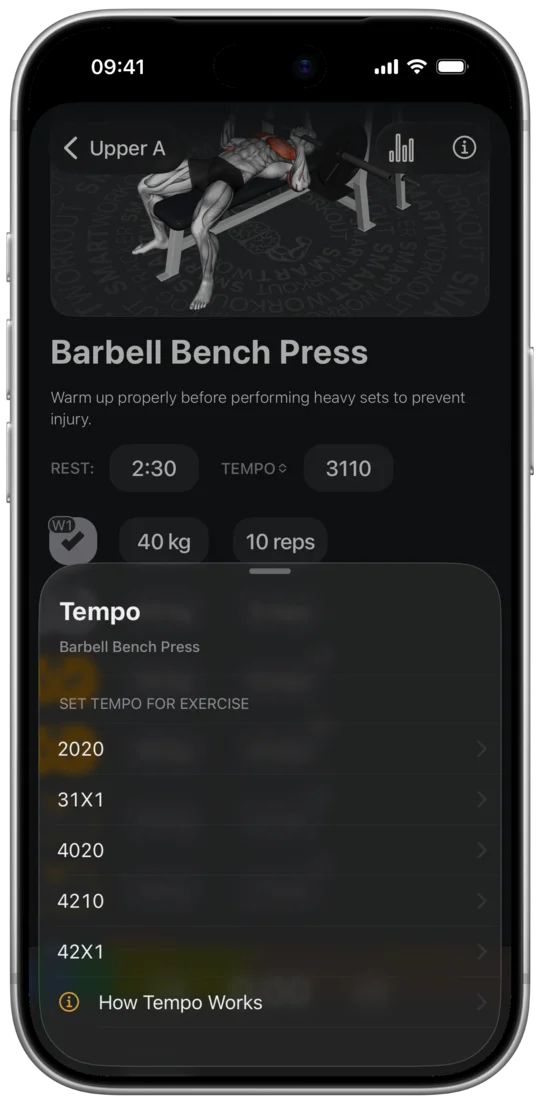
- Enter the lowering time as the first digit in the “TEMPO” field (logging tempo), e.g. 5000; if the field isn't there, turn on “Show tempo” in “Workout Settings”.
A set of negatives counts toward your weekly sets like any working set; negatives written in the exercise note add no sets.
You can paste this fragment through plan import (Workout > My Plans > “+” > “Import plan”); a 5000 tempo means lowering only. Import costs 10 AI credits, so the welcome credits cover it.
DAY: Upper A- Negative Pull-Up | 3x3-5 RIR 1 | TEMPO 5000 | REST 120- Dumbbell Bench Press | 3x8-12 RIR 2 | TEMPO 3010 | REST 120- Cable Lat Pulldown | 3x8-12 RIR 2 | TEMPO 2011 | REST 120- Assisted Pull-Up | 2x6-10 RIR 2 | TEMPO 2011 | REST 90Log it in SmartWorkout
A free workout log for iPhone and Android: sets, RIR, tempo, exercise groups and plans.


Questions
What are negative reps?
Negatives is the common gym name for negative reps. A negative rep is a rep where you do only the eccentric phase: you lower the weight or your body over 3-5 s and get back up with help.
Are negative reps good for hypertrophy?
Not better than regular sets. Treat them as a way into a movement you can't yet do through the full range, or as a short add-on for strength.
How slow should negative reps be?
3-5 s. If you can't hold 3 s, the weight is too heavy; if 5 s comes easily on every rep, you can add weight. The page on tempo covers the lowering in regular sets.
Can you do negative reps without a spotter?
Without a spotter you still have bodyweight negatives, the 2/1 method on a single-lever machine and one-arm exercises where the other hand helps on the way up, e.g. on a cable. In curls you can also lift the weight with a slight swing of your torso and lower it over 3-5 s.
How often should you do negative reps?
Rarely enough that they don't hurt your other workouts for that muscle group: heavy ones once a week for 2-4 weeks, bodyweight ones 1-2 times a week. If soreness lasts until the next session for that muscle group, do fewer sets.
Do negative pull-ups help you get your first pull-up?
They can, together with band-assisted or machine-assisted pull-ups, because you train the same movement in the phase where you're stronger. Do 3 sets of 3-5 reps of the Negative Pull-Up 1-2 times a week, and once you can do 3 sets of 5 lowerings at 5 s each, try a full pull-up at the start of a workout.
See also
- Lifting tempo: how to read 3010, 31X0 and other tempo codesLifting tempo (rep tempo) is a code for how many seconds each of the four phases of a rep takes: lowering, pause in the stretch, lifting and pause at the top. A 3010 tempo means 3 s down and 1 s up with no pauses. In a meta-analysis of 8 studies with sets to failure, reps of 0.5 to 8 s built similar muscle.
- Intensity techniques in lifting: which work, what they cost and when to use themIntensity techniques (also called advanced training techniques) extend a set or cut the rest, as drop sets, rest-pause and supersets do. In meta-analyses with similar work they built no more muscle than straight sets, but supersets, drop sets and rest-pause cut session time by a third or more.
- Training to failure: when it helps and when it just adds fatigueTraining to failure means ending a set only when, despite full effort, you cannot complete the next rep through a full range of motion without changing your form. In a meta-analysis of 15 studies it built no significantly more muscle or strength than stopping short of failure, and it is clearly more fatiguing.
- Drop sets: what they are, how to do them and how much weight to dropA drop set (also called a strip set or descending set) is a set taken to or near failure, then continued without rest after cutting the weight by about 20-30%. In meta-analyses, drop sets built about as much muscle as regular sets in less time. One drop on the last set is usually enough.
- How to count sets per muscle group: direct, indirect and warm-up setsCounting sets per muscle group (fractional set counting) means adding up a week's working sets: 1 for the muscle that mainly does the movement, 0.5 for a muscle that clearly assists, 0 for warm-up sets. In a meta-analysis of 67 studies, this matched muscle growth better than counting assisting muscles as 1 or 0.
- Progressive overload: what it is, linear vs double progression, and how to break a plateauProgressive overload is the gradual increase of training demands, most often load, reps or sets. The ACSM advises adding 2-10% load once you do 1-2 reps over your target in two sessions in a row. In an 8-week study, adding reps built about as much muscle as adding load.
- RIR (reps in reserve): what it means and how to estimate itRIR (reps in reserve) is the number of good reps left before failure when a set ends. RIR 0 means no reps left, and RIR 2-3 in a plan means ending the set with 2-3 reps still in the tank. In a meta-analysis of 12 studies, lifters had on average 1 rep more left than they thought.
Sources
- Nuzzo JL, Pinto MD, Nosaka K, et al. The Eccentric:Concentric Strength Ratio of Human Skeletal Muscle In Vivo: Meta-analysis of the Influences of Sex, Age, Joint Action, and Velocity. Sports Med. 2023;53(6):1125-1136.
- Kelly SB, Brown LE, Hooker SP, et al. Comparison of concentric and eccentric bench press repetitions to failure. J Strength Cond Res. 2015;29(4):1027-32.
- Suchomel TJ, Wagle JP, Douglas J, et al. Implementing Eccentric Resistance Training-Part 2: Practical Recommendations. J Funct Morphol Kinesiol. 2019;4(3):55.
- Zhang X, Weakley J, Li H, et al. Acute and Chronic Effects of Accentuated Eccentric Loading vs. Constant-Load Resistance Training: A Systematic Review and Meta-analysis. Sports Med. 2026;56(7):1749-1770.
- Walker S, Blazevich AJ, Haff GG, et al. Greater Strength Gains after Training with Accentuated Eccentric than Traditional Isoinertial Loads in Already Strength-Trained Men. Front Physiol. 2016;7:149.
- Schoenfeld BJ, Ogborn DI, Vigotsky AD, et al. Hypertrophic Effects of Concentric vs. Eccentric Muscle Actions: A Systematic Review and Meta-analysis. J Strength Cond Res. 2017;31(9):2599-2608.
- Currier BS, D'Souza AC, Singh MAF, et al. American College of Sports Medicine Position Stand. Resistance Training Prescription for Muscle Function, Hypertrophy, and Physical Performance in Healthy Adults: An Overview of Reviews. Med Sci Sports Exerc. 2026;58(4):851-872.
- Roig M, O'Brien K, Kirk G, et al. The effects of eccentric versus concentric resistance training on muscle strength and mass in healthy adults: a systematic review with meta-analysis. Br J Sports Med. 2009;43(8):556-68.
- Drinkwater EJ, Lawton TW, McKenna MJ, et al. Increased number of forced repetitions does not enhance strength development with resistance training. J Strength Cond Res. 2007;21(3):841-7.
- van Dyk N, Behan FP, Whiteley R. Including the Nordic hamstring exercise in injury prevention programmes halves the rate of hamstring injuries: a systematic review and meta-analysis of 8459 athletes. Br J Sports Med. 2019;53(21):1362-1370.
- Cuthbert M, Ripley N, McMahon JJ, et al. The Effect of Nordic Hamstring Exercise Intervention Volume on Eccentric Strength and Muscle Architecture Adaptations: A Systematic Review and Meta-analyses. Sports Med. 2020;50(1):83-99.
- Cheung K, Hume P, Maxwell L. Delayed onset muscle soreness: treatment strategies and performance factors. Sports Med. 2003;33(2):145-64.
- Nosaka K, Sakamoto K, Newton M, et al. How long does the protective effect on eccentric exercise-induced muscle damage last? Med Sci Sports Exerc. 2001;33(9):1490-5.
- Huang MJ, Nosaka K, Wang HS, et al. Damage protective effects conferred by low-intensity eccentric contractions on arm, leg and trunk muscles. Eur J Appl Physiol. 2019;119(5):1055-1064.