
Training volume at a glance: how many sets and how to count them
In hypertrophy training, training volume is the number of working sets a muscle group gets per week. A working set uses your target weight and ends with no more than 4 reps in reserve; sets that end 0-3 reps short of failure give the most.
| Parameter | Value | Source |
|---|---|---|
| Which sets count | at most 4 reps in reserve (RIR), ideally 0-3; no warm-up sets | the limit of 4: our practice; 2026 ACSM position stand: 2-3 RIR is enough |
| Exercise where the muscle group assists | 1 set for the main muscle group, 0.5 for the assisting one | Pelland et al. 2025 |
| Smallest dose with measurable growth | about 4 sets per week | Pelland et al. 2025 |
| More growth | 10 or more sets per week | ACSM 2026 |
| Per muscle group in one workout | up to about 10 sets | our practice; Remmert et al. 2025, preprint: no detectable advantage above about 11 |
| Target in a plan | regular muscle group 4-10 sets (MEV), 1-2 priority groups 10-20 (MAV) | our practice |
Sets of 1-5 reps count too, but one such set builds less muscle than a set of 6-20 (rep ranges); and it's in that range that set count describes the training dose well (Baz-Valle et al. 2021).
Volume zones: MV, MEV, MAV and MRV
A volume zone is a range of weekly sets per muscle group that tells you how much growth each additional set brings.
| Zone | Sets a week |
|---|---|
| Below maintenance | below 2 |
| MV Maintenance zone | 2-4 |
| MEV Growth zone | 4-10 |
| MAV High volume | 10-20 |
| MRV Very high volume | 20+ |
A set counts as 1 for the muscle group an exercise trains directly and as 0.5 for one it trains indirectly. Above about 30 sets a week there are almost no studies.
A boundary belongs to the higher zone, so 4 sets is already MEV and 10 is already MAV. In the coaching practice these abbreviations come from, MEV and MRV are individual thresholds and MAV is the range with the best results; in SmartWorkout each abbreviation names a fixed range of sets.
MV: maintenance zone (2-4 sets)
MV (maintenance volume) is 2-4 sets per muscle group per week: usually enough to keep the muscle you've built, but too little for clear growth. In a review by Spiering et al. 2021, younger people kept their strength and muscle even with 1 set per exercise once a week, as long as the weight stayed heavy.
MV is the target for a muscle group you deliberately only maintain: on a cut, when you're short on time or when another group takes priority. Below 2 sets, SmartWorkout shows the group as below maintenance. For young people lifting heavy that may still be enough, but over many months give the group at least 2 sets of an exercise where it's the main muscle.
MEV: growth zone (4-10 sets)
MEV (minimum effective volume) is the smallest volume at which muscle growth becomes measurable; in SmartWorkout it names the growth zone, 4-10 sets per muscle group per week, where each set gives the most growth. In a meta-analysis of 67 studies, the 5-10 set range was the most efficient: each further detectable gain in muscle took about 6 more weekly sets (Pelland et al. 2025).
MEV is a good default target for most muscle groups: you can stay in it for months as long as your weights or reps keep going up.
MAV: high volume (10-20 sets)
MAV (maximum adaptive volume) is 10-20 sets per muscle group per week: high, still productive volume where the muscle grows more per week, but each set gives a little less. In the meta-analysis the 11-18 set range had intermediate efficiency (Pelland et al. 2025), and a review of studies in young trained men pointed to 12-20 sets as the standard (Baz-Valle et al. 2022).
MAV is the target for 1-2 priority muscle groups. Spread those sets over at least 2 workouts. When progress stalls and fatigue builds, take a few sets away.
MRV: very high volume (20+ sets)
In SmartWorkout, MRV (maximum recoverable volume) is very high volume: 20 or more sets per muscle group per week, where the muscle can still grow but extra sets add little.
In the meta-analysis the 19-29 set range had lower efficiency. The authors found no point where growth stops, but there are few studies above about 25 weekly sets (Pelland et al. 2025): for 30-42 sets the meta-analysis reports the lowest efficiency and the most uncertainty, and above 42 there's no data. Single studies disagree. In trained men, 45 weekly sets for the quads built more muscle over 8 weeks than 9 sets, while the advantage over 27 sets was uncertain (Schoenfeld et al. 2019). In very strong lifters, 12, 18 and 24 weekly sets for the legs gave similar growth (Aube et al. 2022).
Choose MRV deliberately, for one muscle group for a few weeks, with its sets spread over 3-4 workouts; then take a deload or go back to MAV.
How many sets per muscle group per week
For hypertrophy, aim for 4-10 sets per muscle group per week (MEV), and give the 1-2 groups you want to grow faster (muscle priority) 10-20 (MAV).
| Your situation | Weekly target per muscle group | Why |
|---|---|---|
| First six months of training | MEV, 4-10 sets; if one muscle group matters to you, a mild priority at most, 10-12 sets | early on, many programs work as long as you train regularly and progress (2026 ACSM position stand) |
| Women | the same targets | with the same training, muscle grew about as much as in men (Roberts et al. 2020) |
The 4-10 set target is a minimum, not a ceiling. If you've trained for years, aim for about 8-12 sets for each major muscle group, on the border of MEV and MAV: that's where the ACSM threshold for more growth sits, and such a week fits into 4 workouts. If you're growing on what you do now, your current set count is a better starting point than the zone table.
For strength, a few sets per week are already enough to make progress, and extra sets add less to strength than to muscle (Pelland et al. 2025). If you want a better result in one lift, such as the barbell squat, do heavy sets of 1-6 reps in it at least twice a week (training frequency); that gives you more than adding sets.
Sets for back, shoulders, arms, legs and abs
The 4-10 or 10-20 range is the same for every muscle group; what differs is how many sets the group already gets from other exercises.
| Muscle group | Sets from compound exercises | Direct exercise |
|---|---|---|
| Back | rows and pulldowns are back exercises, every set counts in full | 1 vertical and 1 horizontal pull |
| Front delts | half a set from bench presses, a full set from overhead presses | usually unnecessary |
| Side delts | a full set from most overhead presses, nothing from bench presses | Dumbbell Lateral Raise if they're a priority or you don't press overhead |
| Triceps | half a set from bench presses and the barbell overhead press | 1-2 exercises |
| Biceps | half a set from chin-ups and neutral-grip pull-ups; usually nothing from overhand exercises such as the Pull-Up | needed |
| Hamstrings | half a set from the deadlift, nothing from the barbell squat | Romanian Deadlift or Seated Leg Curl |
| Glutes | a full set from a full-depth barbell squat and the deadlift, half from the leg press | usually unnecessary with an MEV target; Barbell Hip Thrust if they're a priority |
| Calves | almost nothing | if you want them to grow |
| Abs | nothing from squats and deadlifts, nothing from the plank either | 2-4 sets of crunches, such as Machine Abdominal Crunches, if you want them to grow |
Count your own week in the training volume calculator; the other weekly variables are covered in the volume, frequency and rest section.
How many sets per workout
In one workout, do usually 6-8 working sets per muscle group, at most about 10; if you want more in a week, move them to another workout. In a meta-analysis of studies with different numbers of sets per session, extra sets above about 11 per muscle group no longer showed a detectable advantage, but the authors don't treat this as an upper limit (Remmert et al. 2025, a preprint not yet peer reviewed).
Spreading a muscle group's sets over more workouts costs little, because at the same weekly set count training frequency barely changes muscle growth (a meta-analysis of 25 studies, Schoenfeld et al. 2019).
| Weekly target per muscle group | Workouts with that group |
|---|---|
| up to 10 sets | 1-2 |
| 10-20 sets | 2-3 |
| more than 20 sets | 3-4 |
For example, 16 chest sets in one workout are about 40 minutes of chest alone with 2-minute rest periods, and you do the last sets very tired. In trained men, 16 sets per muscle group once a week gave similar growth over 8 weeks to 2 workouts of 8, with no significant difference (Brigatto et al. 2019), so splitting doesn't build more muscle; it gives you shorter workouts and fresher last sets.
How to set your volume step by step
- List the muscle groups you want to grow and pick 1-2 priorities among them.
- Count the working sets of a typical week: 1 in an exercise where the group is the main muscle, 0.5 in an exercise where it assists, no warm-ups.
- Compare the totals with the zones in the table above or enter them in the training volume calculator.
- For a group below target, add 2-3 sets a week, ideally in an isolation exercise you already do: an extra set on the seated leg extension machine or of dumbbell lateral raises tires your whole body less than another set of barbell squats.
- Keep this volume for 3-4 weeks and check whether the weights or reps go up in the same exercises (double progression).
- When a group's results drop for 2-3 weeks, cut its sets by about a third or take a deload.
In two 12-week studies of trained people, adding leg sets every 2 weeks gave more strength than constant volume, while the advantage in muscle was uncertain (Enes et al. 2024; Enes et al. 2025).
Signs you're doing too few or too many sets
| Signal | What to do |
|---|---|
| the group has stalled for 3-4 weeks and you end sets with 4 or more reps in reserve | first end your sets at RIR 1-3; don't add sets yet |
| the group has stalled for 3-4 weeks, the sets are hard and you recover well | add 2 sets a week; if it's still stuck after 3-4 weeks, another 2, up to 20 at most |
| weights and reps are going up | keep the volume, even above target |
| strength drops for 2-3 weeks, joints or tendons hurt | first check sleep and food, especially in a calorie deficit; then take away about a third of the sets or take a deload |
| the workout is too long to keep up | move some sets to another day or go from MAV down to MEV for groups outside your priorities |
Example weeks in sets
The table shows week 2 of two free intermediate upper/lower plans: the regular one and the chest-priority one.
| Muscle group | 4-day upper/lower plan | chest-priority plan |
|---|---|---|
| Chest | 9 | 17 |
| Back | 11 | 11 |
| Quadriceps | 10 | 9 |
| Hamstrings | 10.5 | 9 |
| Glutes | 11.5 | 7.5 |
| Side delts | 7 | 6 |
| Triceps | 9.5 | 9 |
| Biceps | 6 | 5 |
| All working sets in the week | 75 | 72 |
Priority doesn't make the week longer: the chest gets 8 more sets, the glutes 4 fewer and the other groups 0 to 1.5 fewer. The plan spreads the 17 chest sets over 3 workouts so that none has more than 7 and the last ones don't come under heavy fatigue. In week 8, the deload, the chest gets 5 sets in the regular plan and 10 in the chest-priority plan.
How many sets popular exercises give each muscle group
A compound exercise gives a set to several muscle groups at once: 1 to the main muscle and 0.5 to the assisting ones. The most popular exercises are broken down on the how to count sets page, and the table below adds four more.
| Exercise | 1 set for | 0.5 set for |
|---|---|---|
| Leg Press | Quadriceps | Glutes |
| Dumbbell Lateral Raise | Side delts | Front delts |
| Barbell Overhead Press | Front delts, Side delts | Triceps |
| Close Grip Bench Press | Triceps | Chest |
Training volume vs tonnage, intensity and frequency
Volume is the number of working sets; tonnage, intensity and frequency describe the same training from other angles. Reviews of studies rarely used weekly tonnage as a measure of training dose (2026 ACSM position stand).
| Term | What it measures | Unit | What it's for |
|---|---|---|---|
| Volume | how many working sets a muscle group gets | sets per muscle group per week | planning muscle growth |
| Tonnage | how many kilograms you lift in total; studies also call it volume load | weight × reps × sets | progress in one exercise |
| Intensity | how heavy the weight is | %1RM | strength training |
| Frequency | how many times a week you train a muscle group | workouts with the group per week | spreading your sets |
Common mistakes
- Counting warm-ups. You end warm-up sets far from failure, so they aren't volume; mark them as warm-up sets.
- Sets with lots of reps left, often called junk volume. A set with 5 or more reps in reserve isn't a working set, and one with 4 counts but gives less, because muscle grows more the closer to failure you end a set (Robinson et al. 2024). Aim for 0-3 reps in reserve; failure isn't necessary.
- Counting assisting muscle groups in full. A set of the barbell bench press is half a set for the triceps and front delts; counting it as a full set inflates their week.
- Every muscle group in MAV at once. If every major group in the 4-day upper/lower plan got about 15 sets instead of about 10, the week would grow from 75 to about 110 working sets and each workout from about an hour to an hour and a half. Pick 1-2 priorities and keep the rest in MEV.
What the research says
The largest body of data on volume is the 67-study meta-analysis; the certainty ratings in the claims table are our assessment.
| Common claim | What studies show | Certainty |
|---|---|---|
| “More sets, more muscle” | yes, but each additional set gives less | high |
| “Muscles don't grow below 10 sets” | in the meta-analysis, growth was measurable from about 4 sets; 10 sets is the threshold for more growth (result above) | moderate |
| “Muscles stop growing above 20 sets” | there's no clear plateau, but studies with that much volume are few and conflicting | low |
| Study | Type and sample | Result | Limitation |
|---|---|---|---|
| Pelland et al. 2025 | meta-analysis, 67 studies, 2,058 people | result above; for strength, the benefit of extra sets falls off faster | short studies, mostly young men (methodology below); the thresholds come from the preprint version of the paper |
| 2026 ACSM position stand | overview of 137 systematic reviews, more than 30,000 people | result above; diminishing returns above about 18-20 sets | most data from untrained people |
| Baz-Valle et al. 2022 | review, young trained men | result above; above 20 sets only the triceps grew more | young men only |
The abbreviations MV, MEV, MAV and MRV come from coaching practice; Renaissance Periodization popularized them as volume landmarks.
It's unknown whether more than 25 weekly sets builds more muscle over many months, or whether different muscle groups, such as the glutes or calves, need a different number of sets, because the meta-analysis had no such data.
Volume zones in SmartWorkout: methodology and sources
The volume zones in SmartWorkout compare each muscle group's weekly sets with what research says about muscle growth. They're a general guide, because people respond very differently to the same number of sets. In a study of 85 people aged about 68, a leg trained with 2 sets of leg extensions a week grew in 34 of them; in the rest of the people, taken as a group, the other leg, trained with 8 sets, grew more (Lixandrão et al. 2024).
We count only working sets: 1 for a muscle group the exercise trains directly, 0.5 for a group it trains indirectly, and nothing for stabilizers or timed exercises such as the plank. Volume counted this way fit the data of the 67-study meta-analysis best (Pelland et al. 2025).
A drop set is 1 set: the working set before the first drop counts, and the drops add nothing, because there's no rest between them.
What comes from research and what is our rule
Research gives a curve, and the zones split it into ranges with round boundaries: 2 near the smallest doses that maintained muscle, 4 from the minimum effective dose in the meta-analysis, 10 from the ACSM 2026 threshold, and 20 near the meta-analysis efficiency thresholds and where ACSM sees diminishing returns. A set or two either side of a boundary changes little. The targets, MEV for a regular group, MAV for a priority and MV for maintenance, are our recommendations, not research findings.
One table applies to all muscle groups, because the studies in the meta-analysis measured only a few muscles, without the glutes, lats, calves or abs. It also applies to all levels, because 39 of the 67 studies in the meta-analysis involved trained people and training status was accounted for in every model; the ACSM position stand also rates the effect of experience as minimal.
Research limitations
About 79% of the meta-analysis participants were men, 25 years old on average, and the studies lasted about 10 weeks on average, so little is known about high volume kept up for many months. About 78% of the muscle outcomes in the meta-analysis came from training to or close to failure, so 10 sets ended with 3-4 reps in reserve probably give less than 10 sets in those studies. The meta-analysis also doesn't describe the costs of high volume: injuries, burnout or whether you can keep it up for months.
What we changed in October 2026
Before, every muscle group and every training level in SmartWorkout had its own ranges taken from coaching guidelines, with upper limits that were too low: 11-14 chest sets was MRV for intermediates. This changes how your past weeks are rated, and any custom zones you set stay as they are. A priority group with 6-9 sets may now show that it's a few sets short of target.
Custom zones
If a muscle group grows at a different set count than the table says, set custom ranges for it. In 16 trained people, a leg trained with the volume from their training log plus 20% grew more than a leg on a standard 22 weekly sets (Scarpelli et al. 2022).
What SmartWorkout logs show
In men the chest is usually in the growth zone or above, while the quads are often below maintenance, so the legs are where adding 2-4 sets a week most often moves a group into another zone. Every number is based on at least 50 people.
How to check your volume in SmartWorkout
SmartWorkout counts volume from your log: each working set goes to a muscle group as 1 or 0.5 sets according to the exercise atlas, and warm-ups don't count.
In weekly sets and volume zones, SmartWorkout counts the whole drop set sequence as 1 set.
You log rest-pause, Myo-reps and cluster set mini sets as separate sets, so SmartWorkout counts each as a full set and shows more sets than studies would count (how to count sets). Don't add sets just to hit a zone target.
Volume zones are part of Premium: you see them in Analytics and during your workout, set priorities and check the sets per muscle group in every week of a plan (what Premium includes).
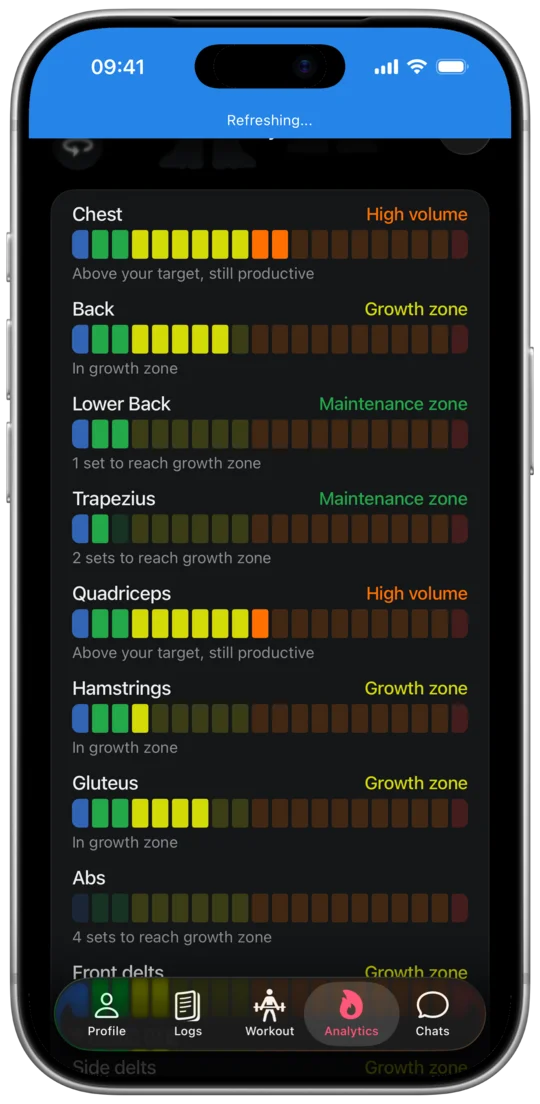
- Open the Analytics tab: each muscle group has a bar with this week's sets against the zones and the number of sets it still needs to reach its target.
- Tap a muscle group, then “What does this zone mean?” to see what to do next.
- Tap “Set Priorities” and choose the groups that should aim for MAV, ideally 1-2; the rest aim for MEV.
- Set custom ranges for a group in “Configure volume zones”.
- Open “Workout Settings” and turn on “Show volume zones” to see a group's bar during your workout.
You can paste this day through plan import (Workout > My Plans > “+” > “Import plan”). It's based on the Upper A day of the chest-priority plan and has 7 chest sets. Import costs 10 AI credits, so the welcome credits cover it.
DAY: Upper A- Barbell Bench Press | WU 2x5 | 4x6-10 RIR 2 | TEMPO 20X0 | REST 180- Seated Cable Row | 3x8-12 RIR 1 | TEMPO 2011 | REST 120- Cable Middle Chest Fly | 3x10-15 RIR 1 | TEMPO 3011 | REST 60- Cable Lat Pulldown | 3x8-12 RIR 1 | TEMPO 2011 | REST 120- Dumbbell Lateral Raise | 3x12-20 RIR 1 | TEMPO 2010 | REST 60- Dumbbell Biceps Curl | 3x10-15 RIR 1 | TEMPO 2010 | REST 60Log it in SmartWorkout
A free workout log for iPhone and Android: sets, RIR, tempo, exercise groups and plans.


Questions
What does training volume mean in lifting?
In hypertrophy training, training volume is the number of working sets a muscle group gets per week. A working set uses your target weight and ends with no more than 4 reps in reserve; sets that end 0-3 reps short of failure give the most. Weight times reps is tonnage, a different measure.
How do you calculate training volume?
Add up each muscle group's working sets for one week and count half a set where the group only assists. For example, 3 sets of the barbell bench press are 3 sets for the chest and 1.5 each for the triceps and front delts.
How many sets per muscle group per week for hypertrophy?
4-10 for a regular muscle group and 10-20 for one you prioritize, the same for every group, chest included. Add half sets from exercises where the group assists: the chest gets them from triceps exercises such as dips or the close grip bench press.
How many sets per muscle group per workout?
Usually 6-8 working sets per muscle group, at most about 10. A whole workout is the sum of that day's groups: in the 4-day upper/lower plan for intermediates, a workout has 16 to 23 working sets, about an hour including rest.
Is 30 sets a week too much?
In SmartWorkout, 20 or more weekly sets per muscle group is MRV, very high volume: the muscle can still grow there, but extra sets add little. There are few studies above about 25 weekly sets and only single studies above 30, so keep that much for one muscle group and a few weeks at most.
How many sets should you do on a cut?
In a calorie deficit, muscle grows less, while strength improves about as much as without one (Murphy and Koehler 2022). Keep the weights and sets for your priority muscle groups, and cut the others to the lower end of MEV at most. Go down to MV only for a few weeks, because the studies on maintaining muscle with few sets weren't done in a deficit.
See also
- How to count sets per muscle group: direct, indirect and warm-up setsCounting sets per muscle group (fractional set counting) means adding up a week's working sets: 1 for the muscle that mainly does the movement, 0.5 for a muscle that clearly assists, 0 for warm-up sets. In a meta-analysis of 67 studies, this matched muscle growth better than counting assisting muscles as 1 or 0.
- How to prioritize lagging muscle groups: which 1-2 to pick and how many setsMuscle priority (prioritizing a lagging muscle group) is a plan in which 1-2 muscle groups get 4-8 more weekly sets than in a balanced plan, usually 12-18, while the rest stay at 4-10. In a meta-analysis of 67 studies, muscle growth rose with weekly sets, though each extra set added less.
- Training frequency: how many times a week to train each muscle groupTraining frequency is the number of sessions per week in which a muscle group does working sets. How often to train a muscle depends on weekly sets: with the same sets, muscles grow about the same with 1 or several sessions (meta-analysis of 25 studies). Strength improves more with 2 or more.
- Deload week: what it means, how often to deload and how to do itA deload (deload week) is a planned period of lighter training, usually 5-7 days, that reduces fatigue before the next training block. Coaches cut the number of sets or reps by 30-50% and stop sets further from failure. In studies, neither a lighter week nor a week off reduced muscle growth.
- Rep ranges: how many reps for hypertrophy, strength and cuttingA rep range is the span of reps, such as 8-12, in which a set with a given weight should end. For muscle growth the exact number matters little: in studies, muscle grew similarly with sets of about 5 to more than 30 reps close to failure, while strength grew most with loads of 80% of 1RM or more.
- Rest between sets: how long to rest for hypertrophy, strength and fat lossRest between sets (rest interval) is the time from the end of one set to the start of the next. For hypertrophy, 1.5-2 minutes is usually enough, 2-3 minutes on heavy lifts and 3-5 minutes for sets of 1-5 reps. In a meta-analysis of 9 studies, rests shorter than a minute produced slightly less muscle.
- RIR (reps in reserve): what it means and how to estimate itRIR (reps in reserve) is the number of good reps left before failure when a set ends. RIR 0 means no reps left, and RIR 2-3 in a plan means ending the set with 2-3 reps still in the tank. In a meta-analysis of 12 studies, lifters had on average 1 rep more left than they thought.
- Progressive overload: what it is, linear vs double progression, and how to break a plateauProgressive overload is the gradual increase of training demands, most often load, reps or sets. The ACSM advises adding 2-10% load once you do 1-2 reps over your target in two sessions in a row. In an 8-week study, adding reps built about as much muscle as adding load.
Sources
- Pelland JC, Remmert JF, Robinson ZP, et al. The Resistance Training Dose Response: Meta-Regressions Exploring the Effects of Weekly Volume and Frequency on Muscle Hypertrophy and Strength Gains. Sports Med. 2026;56(2):481-505 (online 2025).
- Currier BS, D'Souza AC, Singh MAF, et al. American College of Sports Medicine Position Stand. Resistance Training Prescription for Muscle Function, Hypertrophy, and Physical Performance in Healthy Adults: An Overview of Reviews. Med Sci Sports Exerc. 2026;58(4):851-872.
- Baz-Valle E, Fontes-Villalba M, Santos-Concejero J. Total Number of Sets as a Training Volume Quantification Method for Muscle Hypertrophy: A Systematic Review. J Strength Cond Res. 2021;35(3):870-878 (online 2018).
- Remmert JF, Pelland JC, Robinson ZP, et al. Is There Too Much of a Good Thing? Meta-Regressions of the Effect of Per-Session Volume on Hypertrophy and Strength. SportRxiv. 2025 (preprint, not peer reviewed).
- Spiering BA, Mujika I, Sharp MA, et al. Maintaining Physical Performance: The Minimal Dose of Exercise Needed to Preserve Endurance and Strength Over Time. J Strength Cond Res. 2021;35(5):1449-1458.
- Lixandrão ME, Bamman M, Vechin FC, et al. Higher resistance training volume offsets muscle hypertrophy nonresponsiveness in older individuals. J Appl Physiol (1985). 2024;136(2):421-429.
- Baz-Valle E, Balsalobre-Fernández C, Alix-Fages C, et al. A Systematic Review of The Effects of Different Resistance Training Volumes on Muscle Hypertrophy. J Hum Kinet. 2022;81:199-210.
- Schoenfeld BJ, Contreras B, Krieger J, et al. Resistance Training Volume Enhances Muscle Hypertrophy but Not Strength in Trained Men. Med Sci Sports Exerc. 2019;51(1):94-103.
- Aube D, Wadhi T, Rauch J, et al. Progressive Resistance Training Volume: Effects on Muscle Thickness, Mass, and Strength Adaptations in Resistance-Trained Individuals. J Strength Cond Res. 2022;36(3):600-607.
- Roberts BM, Nuckols G, Krieger JW. Sex Differences in Resistance Training: A Systematic Review and Meta-Analysis. J Strength Cond Res. 2020;34(5):1448-1460.
- Schoenfeld BJ, Grgic J, Krieger J. How many times per week should a muscle be trained to maximize muscle hypertrophy? A systematic review and meta-analysis of studies examining the effects of resistance training frequency. J Sports Sci. 2019;37(11):1286-1295 (online 2018).
- Brigatto FA, Braz TV, Zanini TCDC, et al. Effect of Resistance Training Frequency on Neuromuscular Performance and Muscle Morphology After 8 Weeks in Trained Men. J Strength Cond Res. 2019;33(8):2104-2116.
- Enes A, De Souza EO, Souza-Junior TP. Effects of Different Weekly Set Progressions on Muscular Adaptations in Trained Males: Is There a Dose-Response Effect? Med Sci Sports Exerc. 2024;56(3):553-563.
- Enes A, Correa CL, Bernardo MF, et al. Does increasing the resistance-training volume lead to greater gains? The effects of weekly set progressions on muscular adaptations in females. J Sports Sci. 2025;43(4):381-392.
- Robinson ZP, Pelland JC, Remmert JF, et al. Exploring the Dose-Response Relationship Between Estimated Resistance Training Proximity to Failure, Strength Gain, and Muscle Hypertrophy: A Series of Meta-Regressions. Sports Med. 2024;54(9):2209-2231.
- Renaissance Periodization. Training Volume Landmarks for Muscle Growth. rpstrength.com, 2017 (updated 2025).
- Scarpelli MC, Nóbrega SR, Santanielo N, et al. Muscle Hypertrophy Response Is Affected by Previous Resistance Training Volume in Trained Individuals. J Strength Cond Res. 2022;36(4):1153-1157.
- Murphy C, Koehler K. Energy deficiency impairs resistance training gains in lean mass but not strength: A meta-analysis and meta-regression. Scand J Med Sci Sports. 2022;32(1):125-137.