
Muscle priority key numbers
| Parameter | Value | Source |
|---|---|---|
| Weekly sets for a prioritized muscle group | 10-20 (MAV zone), usually 12-18, which is 4-8 more than in a balanced plan | ACSM 2026: 10 or more; Baz-Valle et al. 2022: 12-20 |
| Rest of the body | 4-10 sets (MEV); when time is short, 1-2 muscle groups at 2-4 (MV) | Iversen et al. 2021: at least 4; 2-4 is our practice, maintenance on a small dose: Bickel et al. 2011 |
| Priority sets per session | usually 6-8, about 10 at most | our practice; preprint Remmert et al. 2025: no detectable extra gain above about 11 sets per session, half sets included |
| Place in the workout | start of the muscle group's 2 main sessions | more strength in that exercise, similar muscle growth (Nunes et al. 2021) |
When to prioritize a muscle group
Prioritize a muscle group when you've trained consistently for at least six months, 1-2 muscle groups clearly lag behind, and the rest already get 4-10 sets per week. Beginners don't need it: new lifters grow on many different plans as long as they progress and train consistently (the 2026 ACSM position stand).
The closest study to a priority setup had untrained men do 3 sets for the legs and 1 for the upper body: thigh cross-sectional area grew 11%, versus 7% with 1 set (Rønnestad et al. 2007). Upper-body muscle was measured only in the trapezius, so it says little about the chest or arms.
| Situation | What to do |
|---|---|
| You've trained for less than six months | a balanced plan; if one muscle group matters most to you, a mild priority: 10-12 sets |
| You train 2-3 times a week | put the prioritized muscle group's exercises first in every session, 4-7 sets each (10-12 per week); the rest usually get 3-6, so some muscle groups sit in MV, as in the 2-day full body plan with a glute focus |
| You have time for 4-8 more sets | prioritize, keep the rest as is |
| You won't get more time | prioritize, and drop 1-2 less important muscle groups to 2-4 sets |
| You're on a cut | keep your priority sets, but don't add new ones: muscle grows less in a calorie deficit (Murphy and Koehler 2022) |
How to prioritize a lagging muscle group step by step
- Pick 1-2 muscle groups that lag in front, side and back photos (every 4 weeks, in the same light) or in tape measurements.
- Count their current sets (how to count sets), fastest with the weekly sets per muscle group calculator.
- Add 4-8 sets for that muscle group from the first week of the block, ideally in an isolation or machine exercise; in week 1, end your sets 1 rep further from failure (RIR 1 higher) while you find the right weights. Add another set at most every 2 weeks, when your numbers stall (how to plan a block).
- Spread those sets over 2-3 sessions, usually 6-8 per session: open two sessions with the prioritized muscle group and do the third dose (2-4 sets) at the end of a day that doesn't tire it. End your sets at RIR 1-2, and when you're short on time, do the last one as a drop set.
- Keep the rest of the body at 4-10 sets.
- Keep the priority for 8-12 weeks and compare the weights in its exercises.
You put the priority first in the workout because that's where you'll add weight fastest; muscle grows about the same in any order. A set that ends far from failure gives the muscle less (Robinson et al. 2024), even though the volume zones count it the same as a hard set. Put a small muscle group, such as the biceps, first on a day when it doesn't assist the heavy lifts: before legs, not before rows. Stalled weights justify a priority only when the muscle group gets fewer sets than the rest; check other causes of a plateau first.
How many sets to give a prioritized muscle group
A prioritized muscle group gets 4-8 more weekly sets than in a balanced plan, usually 12-18, which is the middle of the MAV zone. Each extra set adds less, though (Pelland et al. 2025), so you give that volume to only 1-2 muscle groups.
| Zone | Sets a week |
|---|---|
| Below maintenance | below 2 |
| MV Maintenance zone | 2-4 |
| MEV Growth zone | 4-10 |
| MAV High volume | 10-20 |
| MRV Very high volume | 20+ |
A set counts as 1 for the muscle group an exercise trains directly and as 0.5 for one it trains indirectly. Above about 30 sets a week there are almost no studies.
You split the sets across sessions only so that no single session has too many (sets per session), because with the same weekly sets, training frequency barely changes muscle growth (Schoenfeld et al. 2019).
What happens to the rest of your body
The rest of the body stays at 4-10 sets per week, in the MEV growth zone. When you won't get more time, 1-2 muscle groups can drop to 2-4 sets (MV), most easily those that already get half sets from other exercises, such as the front delts from presses. In young adults who had trained for 16 weeks, even a ninth of the earlier dose kept their muscle gains for 32 weeks; in people aged 60-75 it did not (Bickel et al. 2011). Keep the weight where it was, because for maintenance it matters more than the number of sets (Spiering et al. 2021).
How long to keep a priority
Keep a priority for 8-12 weeks, because that's how long the volume studies ran. Compare your weights at the same RIR; after adding sets, the monthly trend counts, not the first 2-3 weeks. If your numbers drop for a whole month, cut 2-4 sets or take a deload. After the block, the muscle group goes back to 4-10 sets, where gains usually hold, and the priority moves to another muscle group or, after a deload, stays with the same one.
Example priority splits by the numbers
In our intermediate plans, the prioritized muscle group gets 15-18 sets over 2-3 sessions, and the week has about as many working sets as the standard 4-day upper/lower split (75), because other muscle groups give up the extra sets.
| Plan | Priority: sets (sessions) | In the standard plan | Sets taken from | Weekly sets |
|---|---|---|---|---|
| chest-focused upper/lower | chest 17 (3) | 9 | glutes 11.5 → 7.5; quads and hamstrings 10-10.5 → 9 | 72 |
| V-taper | back 16 (2), side delts 15 (3) | 11 and 7 | chest 9 → 6; glutes 11.5 → 7.5 | 79 |
| push pull legs plus arm day | biceps and triceps 15 each (3) | 6 and 9.5 | quads, hamstrings and glutes 10-11.5 → 6 | 78 |
| 5-day glute focus | glutes 18 (3) | 11.5 | chest 9 → 5; biceps 6 → 3; triceps 9.5 → 4.5 | 75 |
The table counts sets the way SmartWorkout does: rows and pulldowns give the biceps no sets, and counted the way the meta-analysis does it, the biceps would have a few more in these plans (how to count sets).
- Chest, chest-priority plan
- Chest, standard plan
Exercises to add priority sets
You add priority sets with an exercise where the muscle group is the main mover, because only that counts as a full set.
| Good fit | For prioritizing | Why |
|---|---|---|
| Machine Chest Fly | chest | no triceps fatigue |
| Dumbbell Lateral Raise | side delts | light weight, fits at the end of any day |
| Straight-Arm Lat Pulldown | back | works the lats without the biceps |
| Seated Incline Biceps Curl | biceps | trains the biceps in a stretched position |
| Cable Overhead Triceps Extension | triceps | trains the long head of the triceps in a stretched position |
| Barbell Hip Thrust | glutes | recommended when the glutes should grow more than the rest (Krause Neto et al. 2025) |
| Seated Leg Extension Machine | quads | isolation with no load on the back |
The exercises in the next table also build the muscle group, but SmartWorkout counts them as half a set.
| Counts as half a set | For prioritizing | Why |
|---|---|---|
| Barbell Bench Press | triceps | the main muscle group is the chest |
| Leg Press | glutes | the main muscle group is the quads |
Muscle priority vs specialization vs a balanced plan
Some guides call any plan with extra sets a specialization phase, but specialization is a shorter, stronger priority for one muscle group.
| Balanced plan | Priority for 1-2 muscle groups | Specialization (our practice) | |
|---|---|---|---|
| Muscle group trained the most | none; each in MEV, 4-10 sets (back and glutes up to about 12 in our plans) | 4-8 sets more than before, usually 12-18 | 1 muscle group, about 18-25 sets, from the upper end of MAV to the lower end of MRV |
| Rest of the body | as above | 4-10 | 2-4 (MV) |
| How long | ongoing | 8-12 weeks | 4-6 weeks, then a deload |
| Who it's for | beginners and most lifters | six months of training or more | advanced lifters, when a muscle group still lags after 8-12 weeks of priority |
Common mistakes
- A priority in name only. The muscle group is a "priority" but gets as many sets as before. Count your sets before and after the change, and set the dose from your own log, not from a number in a study: in Scarpelli et al. 2022, the leg trained with 1.2 times the lifter's usual volume (taken from their training log) grew more than the leg given a fixed 22 sets, the same for everyone.
- A priority built from half sets. 8 sets of the barbell bench press are 4 triceps sets, because SmartWorkout counts assisting work as half a set, like the Pelland et al. 2025 meta-analysis. Give the priority an exercise where the muscle group is the main mover.
- Three priorities at once. Three muscle groups with 8 more sets each make 24 sets, almost a third of the week in a 4-day plan.
- New exercises every week. Without the same exercises you can't compare weights, so keep 2-3 priority exercises for the whole block.
What the research says
| Claim | What studies show | Certainty |
|---|---|---|
| More weekly sets, more muscle | yes, but each extra set adds less | high |
| Extra sets mainly grow the muscle group that gets them | yes: in the same person, a leg on 3 sets grew more than a leg on 1, though not in everyone | moderate, data mostly from leg studies in untrained people |
| In trained lifters, more than 20 sets beat 12-16 | conflicting studies | low |
| Study | Type and sample | Result | Limitation |
|---|---|---|---|
| Pelland et al. 2025 | meta-analysis, 67 studies, 2,058 people | result above | 79% men, average age 25 |
| Baz-Valle et al. 2022 | review of 7 studies | result above; more than 20 sets better only for the triceps (p = 0.01) | young trained men only |
| Rønnestad et al. 2007 | 21 men, 11 weeks | result above | untrained |
| Hammarström et al. 2020 | 34 people, 12 weeks, one leg vs the other | muscle cross-sectional area +5.2% vs +3.7%; result above | untrained; clear benefit in 13 of 34 people |
| Brigatto et al. 2022 | 27 trained men, 8 weeks | 32 sets per week: more leg and triceps muscle thickness gain than 16 | 9 people per group |
| Aube et al. 2022 | 35 trained people, squat averaging 2.1 × body weight, 8 weeks | 12, 18 and 24 sets for the legs: similar muscle growth | small sample, legs only |
It's unknown whether prioritizing 1-2 muscle groups gives more than a balanced plan with the same total sets; no study has tested it.
What SmartWorkout logs show
For men the unofficial priority is most often the chest, and for women the glutes. Before you add chest sets, check that your quads and hamstrings get 4-10 sets; before a glute plan, count the sets you already do, because one in four women does 14 or more. Every number is based on at least 50 people.
How to set a muscle priority in SmartWorkout
With Premium, you set your priority in SmartWorkout on the “Training Priorities” screen in Analytics.
- In the “Analytics” tab, open the menu in the top right corner and choose “Optimal volume” in the “Algorithm” section.
- Below the weeks table, tap “Set Priorities”.
- Choose “Priorities” and select 1-2 muscle groups. SmartWorkout preselects “Chest”, so deselect it if that isn't your muscle group; if you pick a third, it warns that this is a lot for recovery.
- Go back to Analytics: prioritized muscle groups target MAV, the rest MEV.
- After 8 weeks, tap the muscle group and check in “Strength vs. Volume” how the strength in its exercises went up.
With Premium, during a workout the muscle group bar shows how many sets a prioritized muscle group still needs to reach MAV this week, if you turn on “Show volume zones” in “Workout Settings”.
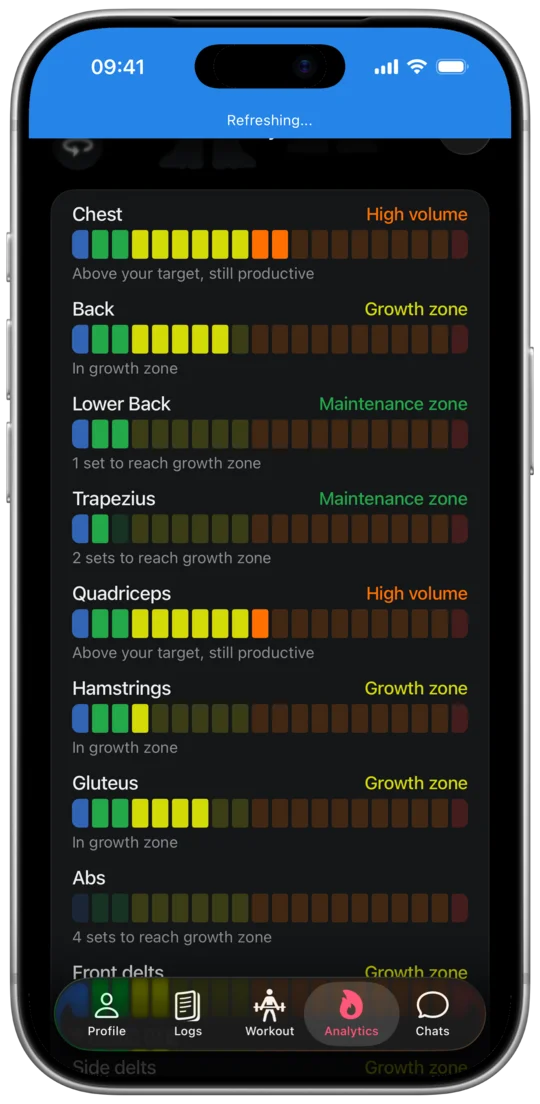
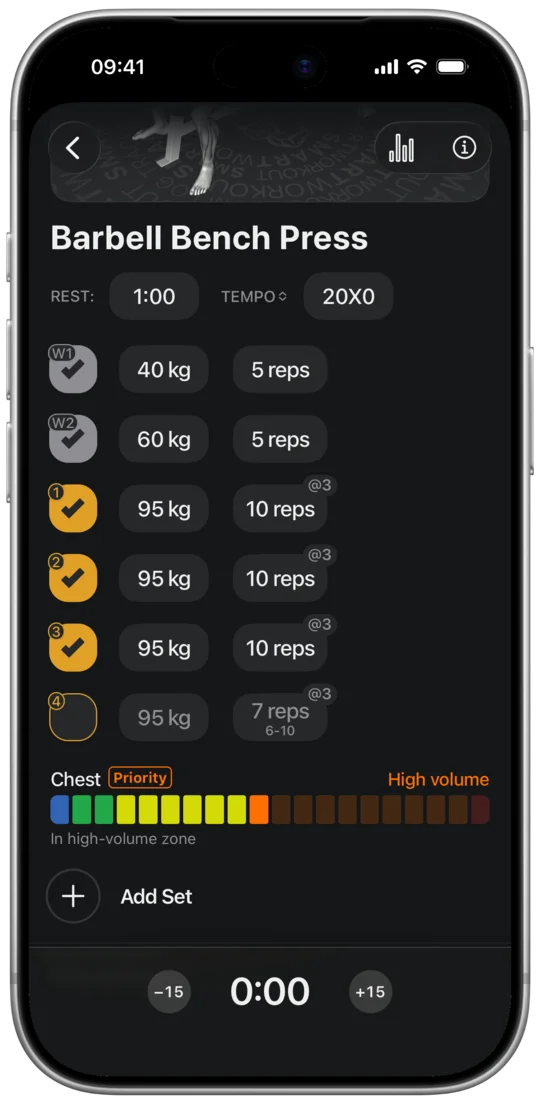
In an AI plan, the muscle groups you choose as a priority get more sets and a spot at the start of the workout.
You can paste this day through plan import (Workout > My Plans > “+”): it's Lower B of the chest-priority plan, with the third chest dose at the end of a leg day. Import costs 10 AI credits, so the welcome credits cover it.
DAY: Lower B- Machine Hack Squat | WU 2x8 | 3x8-12 RIR 1 | TEMPO 3010 | REST 150- Seated Leg Curl | 3x10-15 RIR 1 | TEMPO 2011 | REST 90- Seated Leg Extension Machine | 3x10-15 RIR 1 | TEMPO 2011 | REST 90- Seated Calf Raise | 3x10-15 RIR 1 | TEMPO 2210 | REST 60- Dumbbell Chest Fly | 3x10-15 RIR 1 | TEMPO 3110 | REST 60- Kneeling Cable Abs Crunches | 2x10-15 RIR 1 | TEMPO 2011 | REST 60Log it in SmartWorkout
A free workout log for iPhone and Android: sets, RIR, tempo, exercise groups and plans.


Questions
How many muscle groups can you prioritize at once?
One or two. Small muscle groups such as biceps, triceps or side delts add a few minutes per session; two big ones, such as legs and back, add tens of minutes to your week, so the rest of the body has to give up more sets.
How many sets per week for a lagging muscle group?
Usually 4-8 more than you do now, which means 12-18. In our chest-priority plan the chest gets 17: 7 on each upper day and 3 at the end of a leg day.
How do you bring up a lagging chest?
Give your chest 12-18 sets per week; whether more than 20 adds anything, research hasn't settled. Muscle grows less in a calorie deficit (Murphy and Koehler 2022), so start a new priority outside a cut. After 8-12 weeks, compare your weights at the same RIR and your chest measurement, because the mirror often shows the change only after a few blocks.
How do you grow your glutes without growing your thighs?
Add sets of the barbell hip thrust or another exercise where the glutes are the main mover. In untrained lifters, 9 weeks of hip thrusts grew the glutes about as much as barbell back squats, and the quads and adductors less (Plotkin et al. 2023). Keep squats and lunges at 4-10 sets per week.
Should you train a lagging body part every day?
No need. With the same weekly sets, 2-3 sessions give about the same growth as daily training and are easier to fit into a plan.
Will other muscles shrink while you prioritize one?
Usually not. At 4-10 sets, muscles at least hold their size, and less experienced lifters keep growing; in one study young adults kept their gains even on a ninth of their earlier dose, while people over 60 did not. For muscle groups at 2-4 sets, keep lifting the same weights, and if they drop at the same RIR, add 1-2 sets.
See also
- Training volume: what it is and what MEV, MAV and MRV meanIn hypertrophy training, training volume is the number of working sets a muscle group gets per week. In a meta-analysis of 67 studies, growth was measurable from about 4 weekly sets, with each extra set adding less; the 2026 ACSM position stand links 10 or more weekly sets to more growth.
- How to count sets per muscle group: direct, indirect and warm-up setsCounting sets per muscle group (fractional set counting) means adding up a week's working sets: 1 for the muscle that mainly does the movement, 0.5 for a muscle that clearly assists, 0 for warm-up sets. In a meta-analysis of 67 studies, this matched muscle growth better than counting assisting muscles as 1 or 0.
- Training frequency: how many times a week to train each muscle groupTraining frequency is the number of sessions per week in which a muscle group does working sets. How often to train a muscle depends on weekly sets: with the same sets, muscles grow about the same with 1 or several sessions (meta-analysis of 25 studies). Strength improves more with 2 or more.
- Workout splits: full body, upper/lower, push pull legs or bro splitA workout split is how you spread muscle groups across the week. Full body trains everything each session, upper/lower and push pull legs rotate 2 or 3 day types, and a bro split gives each muscle its own day. With equal weekly sets, full body and splits build similar muscle and strength (meta-analysis of 14 studies).
- How to make a workout plan for the gym: exercises, sets, order and session lengthA workout plan (or workout program) is a written training week: days, exercises, sets, reps, reps in reserve (RIR) and rest. To make one, start with the number of days, then pick exercises and count weekly sets per muscle group. The 2026 ACSM position stand advises at least 2 sets per exercise and 2-3 reps in reserve.
- Progressive overload: what it is, linear vs double progression, and how to break a plateauProgressive overload is the gradual increase of training demands, most often load, reps or sets. The ACSM advises adding 2-10% load once you do 1-2 reps over your target in two sessions in a row. In an 8-week study, adding reps built about as much muscle as adding load.
- Deload week: what it means, how often to deload and how to do itA deload (deload week) is a planned period of lighter training, usually 5-7 days, that reduces fatigue before the next training block. Coaches cut the number of sets or reps by 30-50% and stop sets further from failure. In studies, neither a lighter week nor a week off reduced muscle growth.
Sources
- Pelland JC, Remmert JF, Robinson ZP, et al. The Resistance Training Dose Response: Meta-Regressions Exploring the Effects of Weekly Volume and Frequency on Muscle Hypertrophy and Strength Gains. Sports Med. 2026;56(2):481-505 (online 2025).
- Currier BS, D'Souza AC, Singh MAF, et al. American College of Sports Medicine Position Stand. Resistance Training Prescription for Muscle Function, Hypertrophy, and Physical Performance in Healthy Adults: An Overview of Reviews. Med Sci Sports Exerc. 2026;58(4):851-872.
- Baz-Valle E, Balsalobre-Fernández C, Alix-Fages C, et al. A Systematic Review of The Effects of Different Resistance Training Volumes on Muscle Hypertrophy. J Hum Kinet. 2022;81:199-210.
- Schoenfeld BJ, Grgic J, Krieger J. How many times per week should a muscle be trained to maximize muscle hypertrophy? A systematic review and meta-analysis of studies examining the effects of resistance training frequency. J Sports Sci. 2019;37(11):1286-1295 (online 2018).
- Nunes JP, Grgic J, Cunha PM, et al. What influence does resistance exercise order have on muscular strength gains and muscle hypertrophy? A systematic review and meta-analysis. Eur J Sport Sci. 2021;21(2):149-157 (online 2020).
- Iversen VM, Norum M, Schoenfeld BJ, et al. No Time to Lift? Designing Time-Efficient Training Programs for Strength and Hypertrophy: A Narrative Review. Sports Med. 2021;51(10):2079-2095.
- Rønnestad BR, Egeland W, Kvamme NH, et al. Dissimilar effects of one- and three-set strength training on strength and muscle mass gains in upper and lower body in untrained subjects. J Strength Cond Res. 2007;21(1):157-63.
- Hammarström D, Øfsteng S, Koll L, et al. Benefits of higher resistance-training volume are related to ribosome biogenesis. J Physiol. 2020;598(3):543-565.
- Brigatto FA, Lima LEM, Germano MD, et al. High Resistance-Training Volume Enhances Muscle Thickness in Resistance-Trained Men. J Strength Cond Res. 2022;36(1):22-30.
- Aube D, Wadhi T, Rauch J, et al. Progressive Resistance Training Volume: Effects on Muscle Thickness, Mass, and Strength Adaptations in Resistance-Trained Individuals. J Strength Cond Res. 2022;36(3):600-607.
- Scarpelli MC, Nóbrega SR, Santanielo N, et al. Muscle Hypertrophy Response Is Affected by Previous Resistance Training Volume in Trained Individuals. J Strength Cond Res. 2022;36(4):1153-1157.
- Bickel CS, Cross JM, Bamman MM. Exercise dosing to retain resistance training adaptations in young and older adults. Med Sci Sports Exerc. 2011;43(7):1177-87.
- Spiering BA, Mujika I, Sharp MA, et al. Maintaining Physical Performance: The Minimal Dose of Exercise Needed to Preserve Endurance and Strength Over Time. J Strength Cond Res. 2021;35(5):1449-1458.
- Murphy C, Koehler K. Energy deficiency impairs resistance training gains in lean mass but not strength: A meta-analysis and meta-regression. Scand J Med Sci Sports. 2022;32(1):125-137 (online 2021).
- Remmert JF, Pelland JC, Robinson ZP, et al. Is There Too Much of a Good Thing? Meta-Regressions of the Effect of Per-Session Volume on Hypertrophy and Strength. SportRxiv. 2025 (preprint, not peer reviewed).
- Krause Neto W, Krause TLV, Gama EF. The impact of resistance training on gluteus maximus hypertrophy: a systematic review and meta-analysis. Front Physiol. 2025;16:1542334.
- Plotkin DL, Rodas MA, Vigotsky AD, et al. Hip thrust and back squat training elicit similar gluteus muscle hypertrophy and transfer similarly to the deadlift. Front Physiol. 2023;14:1279170.
- Robinson ZP, Pelland JC, Remmert JF, et al. Exploring the Dose-Response Relationship Between Estimated Resistance Training Proximity to Failure, Strength Gain, and Muscle Hypertrophy: A Series of Meta-Regressions. Sports Med. 2024;54(9):2209-2231.