
Workout splits by the numbers
A workout split sets how many days you train and how many times a week each muscle group works. The table works this out for a large muscle group, such as chest, at 9-11 sets a week.
| Split | Days per week | Large muscle per week | Sets per muscle per session | If you miss 1 session |
|---|---|---|---|---|
| Full body | 2-3 | 2-3 times | 3-4 on 3 days, 4-6 on 2 | the muscle still gets 1-2 sessions |
| Upper/lower or push/pull | 4 (upper/lower also 3) | 2 times | 4-6 | the muscle still gets 1 session |
| Push pull legs | 3 or 6 | 1 or 2 times | 9-11 or 4-6 | on 3 days, the muscle gets no session that week |
| Bro split | 3-5 | once (some muscles twice) | 9-11 | the muscle gets no session that week |
The split doesn't decide how much muscle you build: with the same number of sets, full body and split routines produced similar muscle and strength in a meta-analysis of 14 studies (Ramos-Campo et al. 2024). It decides how many days you need, how long a session takes, how many times a week each muscle works and what you lose when you miss a session.
Full body, upper/lower, push pull legs and bro split explained
When people compare "full body vs split", a split is any routine that trains different muscle groups on different days, upper/lower included; one or two muscle groups per day is a bro split.
Full body training
Full body training means every session covers chest, back and legs, usually with 1 exercise and about 3 sets per muscle, 2-3 times a week with a rest day in between. The main lifts change between days: day A is Barbell Squat, Barbell Bench Press and Cable Lat Pulldown, day B opens with the Romanian deadlift and day C with the leg press. Isolation work gets little room, so a biceps and triceps superset keeps the session short.
Upper/lower split
An upper/lower split alternates an upper body day (chest, back, shoulders, arms) with a lower body day (thighs, glutes, calves), usually 4 sessions a week. The upper day usually opens with the barbell bench press and the barbell bent over row, the lower day with the barbell squat and the Romanian deadlift. With 4 sessions of 40-50 minutes, each muscle works twice a week, but the lower day is the hardest session of the week. On 3 days, the third session is full body so that upper and lower each work twice.
Push pull legs and push/pull
Push pull legs (PPL) splits the week into a push day (chest, shoulders, triceps), a pull day (back, rear delts, biceps) and a leg day (thighs, glutes, calves), 3 or 6 sessions a week. On 6 days a session takes 30-40 minutes, but you're in the gym 6 times; on 3 days each muscle works once a week. A 4-day push/pull split spreads the legs over both days: the squat on push day, the Romanian deadlift on pull day.
Bro split
A bro split, or body part split, gives each day 1-2 muscle groups, such as chest and triceps, back and biceps, legs, shoulders and arms, and each large muscle one session a week. You can fit 3-4 exercises for one muscle, but 9-11 sets in one session means you do the last ones tired, and a missed day is a week without that muscle. A split doesn't have to mean once a week: in a survey of 235 competitive bodybuilders, 85.5% used a split and more than half trained large muscle groups twice a week (Hackett 2022).
How to choose a workout split
The best workout split is the one you can keep up for 8 weeks; the ACSM 2026 position stand calls consistency a top priority.
| Days you actually train | Split | Session length | Free plan |
|---|---|---|---|
| 2 | full body | 45-55 min | 2-day full body plan |
| 3, you're starting out | full body | 40-50 min | 3-day full body plan |
| 3, weights now go up only every 1-2 weeks | upper/lower with a full body day | 45-50 min | 3-day upper/lower split |
| 4 | upper/lower or push/pull | 30-55 min | 4-day upper/lower split, 4-day push/pull split |
| 5 | PPL and upper/lower | 30-45 min | 5-day PPL and upper/lower split |
| 6, short time slots | PPL twice | 30-40 min | 6-day push pull legs split |
| 3-5, you rarely miss sessions | bro split or 3-day PPL | 30-55 min | bro split for 3, 4 or 5 days, 3-day push pull legs split |
In the plans we recommend, large muscle groups work at least twice a week, because a missed session then doesn't cost a muscle the whole week, and a second session per muscle helps strength (Pelland et al. 2025). The heavy lift usually comes once a week, and the second session gives the muscle a different exercise. We mark splits that train a muscle once a week as acceptable. Training frequency shows how often each muscle works in each layout, and how to build a workout plan covers fitting exercises to days.
How to switch splits without losing progress
When you switch workout splits, you move the same sets from the old week into the new one.
- Count each muscle group's weekly working sets: a direct set counts as 1, an indirect set as 0.5 (how to count sets); the weekly volume calculator does it faster.
- Choose a split for the days you averaged over the last 8 weeks, not the days you'd like to train.
- Spread the same sets over the new days, at most about 10 per muscle in one session (sets per session).
- Keep your main exercises and weights. Do the lift you want to get stronger at twice a week, once lighter, e.g. barbell squat 3 × 8 at RIR 3 on the second lower day instead of the machine hack squat.
- Space hard sessions for the same muscle 48-72 h apart, e.g. upper on Monday and Thursday, lower on Tuesday and Friday. If Monday's barbell bent over rows tire your lower back before Tuesday's squats, do the chest supported machine row on upper days.
- After 6-8 weeks, compare your weights and e1RM; if they've stalled, go through the plateau checklist first: effort, sets, rest, sleep and food.
How much recovery a muscle needs, lower back included, is covered under training frequency, and how the weeks change within a block is shown in periodization.
Three days a week in four splits
You can lay out three sessions a week in four splits; the table shows week 2 of our plans.
| Split | Mon | Wed | Fri | Chest sets per week | Quad sets per week | Minutes |
|---|---|---|---|---|---|---|
| Full body | full body A | full body B | full body C | 3 + 3 + 3 | 3 + 3 + 3 | 150 |
| Upper/lower | upper | lower | full body | 6 + 0 + 3 | 0 + 6 + 3 | 145 |
| Push pull legs | push | pull | legs | 9 | 9 | 155 |
| Bro split | chest and triceps | back and biceps | legs and shoulders | 9 | 9 | 130 |
Chest gets 9 sets in every layout, in similar time: full body spreads them over 3 sessions, upper/lower over 2, and PPL and the bro split do them all at once. In a small study (19 people with training experience), with the same 9 sets per muscle, a 3-day split and 3 full body sessions produced similar lean mass and strength over 8 weeks (Thomas and Burns 2016). The difference shows when you miss a session.
- Full body or upper/lower, 3 days
- PPL or bro split, 3 days
Missing the lower day in upper/lower costs the quads 6 of their 9 sets, so on 3 days we recommend full body, and upper/lower with a full body day if you rarely miss sessions. If you miss a day in a bro split or PPL, move it to Saturday instead of skipping it.
Full body vs split for muscle growth, strength and fat loss
Full body and split routines give similar results for every common goal; strength depends not on the split's name but on how often each muscle works and how often you do a given lift.
| Goal | What studies show | What to choose |
|---|---|---|
| Muscle growth (hypertrophy) | similar with the same number of sets | at most about 10 sets per muscle in one session; above that, train the muscle twice a week |
| Strength in the main lifts | split vs full body: similar strength (Ramos-Campo et al. 2024); training a muscle more often helps, with diminishing returns (Pelland et al. 2025) | each muscle twice a week; the lift you want to get stronger at twice (once lighter) |
| Fat loss | a little more fat lost with full body: about 1 kg difference over 8 weeks in Carneiro et al. 2024, without measuring energy expenditure, and over 4 weeks in Crewther et al. 2016 | the split you can keep up in a calorie deficit |
Common mistakes when choosing a split
- A split for more days than you actually train. A 5-day split done 3 times a week trains each muscle about every 12 days. Choose a plan for the number of days you train in a busy week.
- A new split instead of more sets. With the same sets, a new weekly layout won't break a plateau. If your weights stall despite sets at RIR 1-2, decent sleep and enough food, and the muscle gets fewer than 10 sets a week, add 2 sets.
- The same lifts in every full body session. Three heavy squat sessions a week are more tiring than one plus two lighter leg exercises. Rotate the heavy lift between days A, B and C.
- A bro split "because I'm advanced". In trained lifters, too, full body and splits gave similar results. Choose a split by your days and what you enjoy.
What the research says
| Common claim | What studies show | Confidence |
|---|---|---|
| A split builds more muscle | similar with the same number of sets in a meta-analysis of 14 studies (Ramos-Campo et al. 2024); single studies in trained lifters point both ways | moderate |
| Full body for beginners, splits for advanced lifters | older advice set training days by experience (ACSM 2009 position stand); the advice of full body for beginners rested on 3 studies with 59 people (ACSM 2026 position stand) | moderate |
| Every muscle has to be trained twice a week | conclusion of a 2016 meta-analysis of 10 studies (Schoenfeld et al. 2016); in a meta-analysis of 67 studies the effect of frequency on muscle growth was negligible and on strength clear (Pelland et al. 2025) | moderate to high for muscle (a small effect is possible), moderate for strength |
| Study | Design and sample | Result | Limitation |
|---|---|---|---|
| Pedersen et al. 2022 | 50 untrained women, 12 weeks | upper/lower 4 times vs full body 2 times: no differences; 5 of the 6 dropouts were in the 4-session group | supervised sessions |
| Thomas and Burns 2016 | 19 people with training experience, 8 weeks | 3-day split vs full body 3 times, 9 sets per muscle each: similar lean mass and strength | small sample, women and men together |
| Lasevicius et al. 2019 | 36 trained men (28 finished), 10 weeks | 4-day split vs full body 3 times: no significant differences, effect size for muscle in favor of the split | the split trained each muscle twice a week |
| Schoenfeld et al. 2015, Zaroni et al. 2019, Gomes et al. 2019 | 20, 18 and 23 trained men | split once a week vs full body 3-5 times: more muscle with full body in two, no difference in the third; strength similar | small groups |
No study has compared push pull legs with upper/lower directly or checked in which split people miss fewer sessions; the studies lasted 4-12 weeks and mostly involved young men.
What SmartWorkout logs show
Simply rotating through the days would give legs 0.5-0.8 sessions a week at 2-3 workouts a week, so with a median of 0.36, some lifters in our logs, mostly in Poland, who train one part per day do legs rarely or never. Every number is based on at least 50 people.
How to choose and set up a split in SmartWorkout
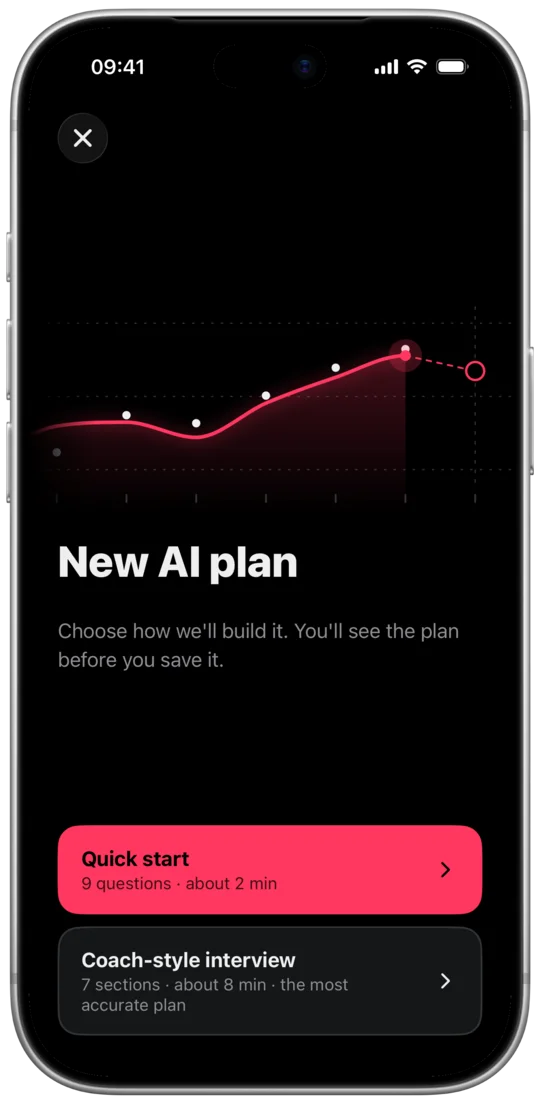
You choose a split in SmartWorkout in an AI plan, and you can build your own week with “Create new plan” or paste it in with “Import plan”.
- On the Workout tab, in “My Plans”, tap “+” and choose “Generate plan with AI”.
- In the quick start, answer “How many days a week can you train?”.
- Under “How do you want to split your training?”, choose “Full body”, “Upper / Lower”, “Push / Pull / Legs”, “Body part split” or “Choose for me”. With 2 days and any split other than “Full body” or “Choose for me”, the app warns that each muscle won't get 2 sessions a week, and with 3 days and “Body part split”, that it gets one.
From version 5.2, the free plans from the table above are also in the app.
The AI writes one week that repeats throughout the plan, and a plan from the Luna model costs 10 AI credits (AI plan).
The free full body to split plan takes you through four splits for 2 weeks each, each as a separate training block in the plan's tabs.
With Premium, the plan's volume analysis shows before you start whether the new split gives each muscle group as many sets as the old one.
You can paste day Lower A from the 4-day upper/lower split, without the crunches, through plan import (Workout > My Plans > “+” > “Import plan”). Import costs 10 AI credits, so the welcome credits cover it.
DAY: Lower A- Barbell Squat | WU 2x5 | 3x6-10 RIR 2 | TEMPO 20X0 | REST 180- Romanian Deadlift | 3x8-12 RIR 2 | TEMPO 3010 | REST 150- Seated Leg Curl | 3x10-15 RIR 1 | TEMPO 2011 | REST 90- Seated Leg Extension Machine | 2x10-15 RIR 1 | TEMPO 2011 | REST 90- Calf Leg Press | 3x10-15 RIR 1 | TEMPO 2210 | REST 60Log it in SmartWorkout
A free workout log for iPhone and Android: sets, RIR, tempo, exercise groups and plans.


Questions
Which workout split is best?
None wins when weekly sets are equal. With 2-3 days, pick full body; with 4-6, a split that hits each muscle twice a week (upper/lower, push/pull, PPL); and a bro split if you like 1-2 muscle groups per session and rarely miss workouts.
Is full body or a split better for muscle growth?
For growth, sets per muscle per week matter, not the split. If you want 15-20 sets per muscle, the top of MAV (10-20), they fit more easily into 2 upper/lower or PPL sessions than into one bro split day.
Is full body or a split better for fat loss?
The one you can keep up in a calorie deficit. In two small studies, full body lost a little more fat, but the result of a cut depends on your diet.
What is the best split for beginners?
Start with full body on 2-3 days: fewer days in the gym and each muscle 2-3 times a week, so you practice similar movements, such as the barbell squat and the leg press, more often. In studies of beginners a split gave the same results, so if you prefer a split, you'll grow too.
Is a 3-day split good?
For muscle, yes, as long as you miss no more than the odd session. Full body on the same 3 days trains each muscle 3 times, which helps strength, and a missed Friday doesn't cost your legs the whole week.
Upper/lower or push pull legs?
Both train each muscle twice a week, but upper/lower needs 4 days and PPL 6. PPL without fixed weekdays (push, pull, legs, rest) hits each muscle every 4 days. No study has compared the two head to head, so choose by the days you have.
See also
- Training frequency: how many times a week to train each muscle groupTraining frequency is the number of sessions per week in which a muscle group does working sets. How often to train a muscle depends on weekly sets: with the same sets, muscles grow about the same with 1 or several sessions (meta-analysis of 25 studies). Strength improves more with 2 or more.
- Training volume: what it is and what MEV, MAV and MRV meanIn hypertrophy training, training volume is the number of working sets a muscle group gets per week. In a meta-analysis of 67 studies, growth was measurable from about 4 weekly sets, with each extra set adding less; the 2026 ACSM position stand links 10 or more weekly sets to more growth.
- How to make a workout plan for the gym: exercises, sets, order and session lengthA workout plan (or workout program) is a written training week: days, exercises, sets, reps, reps in reserve (RIR) and rest. To make one, start with the number of days, then pick exercises and count weekly sets per muscle group. The 2026 ACSM position stand advises at least 2 sets per exercise and 2-3 reps in reserve.
- Supersets in the gym: what they are, examples and superset vs compound setA superset is two exercises for different muscle groups done back to back with no rest in between; you rest only after both. Two exercises for the same muscle group are usually called a compound set. In a meta-analysis of 19 studies, supersets cut session time by about 37% with similar tonnage.
- How to prioritize lagging muscle groups: which 1-2 to pick and how many setsMuscle priority (prioritizing a lagging muscle group) is a plan in which 1-2 muscle groups get 4-8 more weekly sets than in a balanced plan, usually 12-18, while the rest stay at 4-10. In a meta-analysis of 67 studies, muscle growth rose with weekly sets, though each extra set added less.
Sources
- Ramos-Campo DJ, Benito-Peinado PJ, Andreu-Caravaca L, et al. Efficacy of Split Versus Full-Body Resistance Training on Strength and Muscle Growth: A Systematic Review With Meta-Analysis. J Strength Cond Res. 2024;38(7):1330-1340.
- Pelland JC, Remmert JF, Robinson ZP, et al. The Resistance Training Dose Response: Meta-Regressions Exploring the Effects of Weekly Volume and Frequency on Muscle Hypertrophy and Strength Gains. Sports Med. 2026;56(2):481-505 (online 2025).
- Currier BS, D'Souza AC, Singh MAF, et al. American College of Sports Medicine Position Stand. Resistance Training Prescription for Muscle Function, Hypertrophy, and Physical Performance in Healthy Adults: An Overview of Reviews. Med Sci Sports Exerc. 2026;58(4):851-872.
- Pedersen H, Fimland MS, Schoenfeld BJ, et al. A randomized trial on the efficacy of split-body versus full-body resistance training in non-resistance trained women. BMC Sports Sci Med Rehabil. 2022;14(1):87.
- Lasevicius T, Schoenfeld BJ, Grgic J, et al. Similar Muscular Adaptations in Resistance Training Performed Two Versus Three Days Per Week. J Hum Kinet. 2019;68:135-143.
- Thomas MH, Burns SP. Increasing Lean Mass and Strength: A Comparison of High Frequency Strength Training to Lower Frequency Strength Training. Int J Exerc Sci. 2016;9(2):159-167.
- Schoenfeld BJ, Ratamess NA, Peterson MD, et al. Influence of Resistance Training Frequency on Muscular Adaptations in Well-Trained Men. J Strength Cond Res. 2015;29(7):1821-9.
- Zaroni RS, Brigatto FA, Schoenfeld BJ, et al. High Resistance-Training Frequency Enhances Muscle Thickness in Resistance-Trained Men. J Strength Cond Res. 2019;33 Suppl 1:S140-S151.
- Gomes GK, Franco CM, Nunes PRP, et al. High-Frequency Resistance Training Is Not More Effective Than Low-Frequency Resistance Training in Increasing Muscle Mass and Strength in Well-Trained Men. J Strength Cond Res. 2019;33 Suppl 1:S130-S139.
- Carneiro MAS, Nunes PRP, Souza MVC, et al. Full-body resistance training promotes greater fat mass loss than a split-body routine in well-trained males: A randomized trial. Eur J Sport Sci. 2024;24(6):846-854.
- Crewther BT, Heke T, Keogh J. The effects of two equal-volume training protocols upon strength, body composition and salivary hormones in male rugby union players. Biol Sport. 2016;33(2):111-6.
- Hackett DA. Training, Supplementation, and Pharmacological Practices of Competitive Male Bodybuilders Across Training Phases. J Strength Cond Res. 2022;36(4):963-970.
- American College of Sports Medicine. American College of Sports Medicine position stand. Progression models in resistance training for healthy adults. Med Sci Sports Exerc. 2009;41(3):687-708.
- Schoenfeld BJ, Ogborn D, Krieger JW. Effects of Resistance Training Frequency on Measures of Muscle Hypertrophy: A Systematic Review and Meta-Analysis. Sports Med. 2016;46(11):1689-1697.