
Workout plan key numbers
A gym workout plan describes one week: how many days you train, which exercises you do, how many sets and reps, how close to failure and how long you rest.
| Parameter | Value | Source |
|---|---|---|
| Workouts per week | 2-4 to start, later up to 6; at least 2 for strength | at least 2 for strength: ACSM 2026 position stand |
| Weekly sets per muscle group | 4-10 (MEV); a muscle you want to bring up: 10-20 (MAV) | zones based on the Pelland et al. 2025 meta-analysis; more muscle growth from 10 sets: ACSM 2026 |
| Exercises per muscle group in one workout | 1-2; 3-4 only in a split where the muscle gets one day a week | our practice |
| Sets per exercise | 2-4 | at least 2: ACSM 2026 |
| Reps and reserve | 6-12 in compound lifts, 10-20 in isolation; RIR 1-3 | RIR 2-3: ACSM 2026; RIR 1-2 matched training to failure: Refalo et al. 2024; ranges: rep ranges |
| Rest | 2-3 min in heavy compound lifts, about 2 min in other compound lifts, 60-90 s in isolation | Iversen et al. 2021; muscle growth no longer improved beyond 90 s: Singer et al. 2024 |
When to make your own plan and when to use a ready one
Take a ready plan for your first one, or write the simplest possible: 3 full body workouts a week with 5-6 exercises each. Your own plan makes sense when a ready one doesn't fit your days, your equipment or the muscle you want to bring up; results come from sets, effort and progression, not from who wrote the plan. The ACSM 2026 position stand ranks a plan that fits the person, so that they keep training regularly, above the exact numbers from earlier guidelines.
| Your situation | What to do |
|---|---|
| You're starting out or coming back after a few months off | a ready 2-3 day full body plan, unchanged for 8 weeks |
| You have 2 days or an irregular schedule | 2 full body workouts, every major muscle group in both |
| You want to bring up one muscle group | a ready template plus more sets for that muscle (muscle priority) |
| You've trained for over 2 years and your lifts have stalled | 10-20 weekly sets for 1-2 muscle groups, a top set and back-off sets in the main lift, blocks with a deload (periodization) |
| You want more strength in one lift | that lift twice a week at the start of the workout, sets of 3-5 at RIR 1-2 (how many reps for strength) |
| You're cutting | the same plan; the goal is to keep your weights (training on a cut) |
| You have a plan from a coach or an AI chat | check it with the steps below: days, sets per muscle group, RIR, rest and session length |
Treat a plan from an AI chat as a draft: the authors of Washif et al. 2024 concluded that such plans probably need refining before use.
How to make a workout plan step by step
You build a workout plan from the big decisions to the details: first the number of days, then exercises and sets, and finally reps, rest and 8 weeks of progression.
- Pick a split for the days you will actually train: full body for 2-3 days, and after the first few months also upper/lower plus a full body day for 3 days; upper/lower or push/pull for 4 days; push pull legs for 5-6 days (workout splits). For strength, do your main lift twice a week, and deadlift once heavy and once lighter (training frequency).
- For each workout, pick 3-4 compound exercises from different movement patterns (table below) and 1-3 isolation exercises: for the side delts and hamstrings, which presses and squats train too little, and for arms and calves when they are a priority or time allows.
- Count weekly sets per muscle group: 4-10 for a regular one, 10-20 for the one you want to bring up; 2-4 sets per exercise and at most about 10 per muscle group in one workout (how many sets per workout). Count a set where the muscle only assists as half (how to count sets); the weekly volume calculator checks the week for you.
- Set reps and reserve: barbell lifts 6-10, other compound exercises 8-12, isolation 10-15, lateral raises 12-20, and RIR 2 in every exercise to start.
- Set the order and rest: the heavy compound lift goes first, after warm-up sets (for a working weight up to about 40 kg, the empty bar and 1 set; at about 100 kg, 4-5 sets); rest 2-3 min in heavy compound lifts, about 2 min in other compound lifts and 60-90 s in isolation (rest between sets).
- Write out 8 weeks: week 1 with 1 more rep in reserve so you can find your weights, then double progression, and if you've trained for more than a year, a lighter week 8 (deload); work out your starting weight with the 1RM calculator, and the next block is described under mesocycles.
Keep a wide rep range in dumbbell isolation work: the next pair of dumbbells is usually 2-2.5 kg heavier, and going from 8 kg to 10 kg is already 25%.
Choose your split by convenience: with the same number of sets, split and full body training gave the same strength and muscle gains in a meta-analysis of 14 studies (Ramos-Campo et al. 2024). Every extra weekly set adds less than the one before (Pelland et al. 2025), so 4-10 sets are enough for a muscle to grow, and 10-20 go to the one you want to bring up faster. Early on you usually have more reps left than you think (how to estimate RIR), so RIR 2 in the first weeks is a safe margin for learning technique.
How many exercises per muscle group and per workout
One or two exercises per muscle group in a workout are usually enough, and 5-7 for the whole workout; 3-4 exercises per muscle group only make sense in a split where the muscle gets a full day once a week.
| Split | Exercises per muscle group per workout | Exercises per workout | Sets per muscle group per workout |
|---|---|---|---|
| Full body, 2-3 days | 1-2; a different exercise for the same muscle in the next workout | 5-7 | 2-6 |
| Upper/lower, 4 days | 1-2 | 6-7 | 3-8 |
| Push pull legs, 6 days | 2 | 5-7 | 5-8 |
| Body part split, each muscle once a week | 3-4 with 2-3 sets each | 5-7 | 8-11 |
Several different exercises for a muscle group over the week spread the work across the whole muscle: in a 9-week study, different exercises for the same muscle produced growth at every measured site (Costa et al. 2021). The thighs show it best. After 10 weeks of squats alone, the hamstrings did not change, while the glutes and adductors grew (Kubo et al. 2019). A squat-based leg plan therefore needs a hamstring exercise: the leg curl (the seated version grew them by 14%, the lying one by 9%, Maeo et al. 2021) or the Romanian deadlift, and in a 3-day plan ideally both on different days. Arms also grow from presses and pulls alone: in a review of 23 studies, adding isolation work gave no extra gains (Gentil et al. 2017), so when time is short you cut arm isolation, not leg curls.
Starter exercises by movement pattern
For each movement pattern you take one main exercise, and a substitute when the station is taken or the movement doesn't suit you.
| Movement pattern or muscle group | Exercise | Substitute |
|---|---|---|
| Squat, leg press | Barbell Squat | Leg Press |
| Hip hinge | Romanian Deadlift | Dumbbell Romanian Deadlift |
| Horizontal press | Barbell Bench Press | Dumbbell Bench Press |
| Vertical pull | Wide Grip Lat Pulldown | Pull-Up |
| Horizontal pull | Seated Cable Row | Barbell Bent Over Row |
| Overhead press | Seated Dumbbell Shoulder Press | |
| Glutes | Barbell Hip Thrust | |
| Hamstrings | Seated Leg Curl | Prone Lying Leg Curl |
| Side delts | Dumbbell Lateral Raise | |
| Triceps | Cable Overhead Triceps Extension | Cable Triceps Pushdown |
| Biceps | Seated Incline Biceps Curl | Dumbbell Biceps Curl |
According to the ACSM 2026 position stand, 4 movements cover the major muscle groups: a press and a pull for the upper body, and a squat or leg press and a hip hinge for the lower body. For the upper body you can do a horizontal and a vertical press and pull, which makes 6 movements, either in one workout or spread over the week.
Exercise order in a workout
Start the workout with the exercise in which you most want to gain strength, usually a heavy compound lift, and put isolation work at the end. Strength improves most in exercises done early in the workout, while for muscle growth the order made no difference in a meta-analysis of 11 studies (Nunes et al. 2021). You often read that big muscles come first and small ones after. A review of the research advises otherwise: first whatever is the priority for your goal, regardless of muscle size (Simão et al. 2012).
- Do the heavy free-weight compound lift first, after your warm-up sets.
- Train the muscle you want to bring up at the start of the workout, even a small one; but put a small muscle first only on a day when it doesn't assist the heavy lifts, e.g. biceps first on leg day, not on a day with rows (muscle priority).
- Leave isolation and abs for the end; pair two exercises for opposing muscles into a superset.
- Put isolation before a compound exercise for the same muscle only when heavy loads hurt you, e.g. a painful joint: pre-exhaustion doesn't make the big muscle work harder, it lowers the weight in the compound lift.
An example upper day for intermediates: Barbell Bench Press, Barbell Bent Over Row, Seated Dumbbell Shoulder Press, Cable Lat Pulldown, Cable Middle Chest Fly, and to finish an arm superset: Cable Triceps Pushdown and Dumbbell Biceps Curl alternated.
How long should a gym workout be
A gym workout lasts as long as its sets, rest and warm-up: 15-20 working sets with about 2 minutes of rest take 40-55 minutes, and 50-70 minutes with the warm-up and moving between stations. You can work out the time before your first session:
- a set lasts the number of reps times the length of one rep from the tempo: 8 reps at a 3010 tempo are 8 × 4 s = 32 s, so 4 × 8 with 90 s rest is 4 × (32 s + 90 s) = 488 s, about 8 minutes per exercise;
- 6 exercises of 3 sets are 18 sets; with a set of about 40 s and 2 minutes of rest that is 18 × 160 s = 48 minutes, and about an hour with the warm-up and moving between stations.
You can shorten a workout without losing sets by doing warm-up sets in the exercise itself instead of a general warm-up, and by pairing exercises for different muscles into supersets (but not barbell squats or bench presses; Iversen et al. 2021). In a meta-analysis of 19 studies, supersets shortened workouts at the same volume with similar strength and muscle gains, though they were more fatiguing (Zhang et al. 2025). For example, 2 exercises of 3 sets with 60 s rest take about 8 minutes as a superset instead of 11.
Research sets no upper limit on workout length. Add 10-15 minutes for the warm-up and moving between stations to the sum of sets and rest; in SmartWorkout logs, workouts last clearly longer than that sum (box below).
Sample 3-day full body workout plan
The example below is a full body plan for 3 days a week for beginners; every day has legs, a press and a pull:
- Day A: Barbell Squat, Dumbbell Bench Press, Cable Lat Pulldown, Seated Leg Curl, Dumbbell Lateral Raise, Dumbbell Biceps Curl.
- Day B: Dumbbell Romanian Deadlift, Seated Dumbbell Shoulder Press, Seated Cable Row, Dumbbell Goblet Squat, Cable Triceps Pushdown, Dumbbell Biceps Curl.
- Day C: Leg Press, Machine Chest Press, Chest Supported Machine Row, Seated Leg Curl, Machine Reverse Flyes, Dumbbell Biceps Curl, Calf Leg Press.
The table shows day A in week 2.
| Exercise | Sets × reps | RIR | Tempo | Rest |
|---|---|---|---|---|
| Barbell Squat | 2 warm-up × 5, then 3 × 6-10 | 2 | 3010 | 150 s |
| Dumbbell Bench Press | 3 × 8-12 | 2 | 3010 | 120 s |
| Cable Lat Pulldown | 3 × 8-12 | 2 | 3011 | 120 s |
| Seated Leg Curl | 2 × 10-15 | 2 | 3010 | 90 s |
| Dumbbell Lateral Raise | 2 × 12-20 | 2 | 2011 | 60 s |
| Dumbbell Biceps Curl | 2 × 10-15 | 2 | 3010 | 60 s |
That is 15 working sets and about 40 minutes of sets and rest. In our beginner plans, week 1 is at RIR 3 because you are finding your weights in it, and the following weeks are at RIR 2. The weight goes up with double progression:
The plan works if after 8 weeks the weights in your main lifts are higher at the same RIR. If they have stalled in most exercises, first add sets for muscle groups that get only 4-10 sets a week (progressive overload). The 3-day full body plan lays out all 8 weeks, and for 4 days use the 4-day upper/lower plan.
How to read a workout plan: 4 × 8, RIR 2, tempo 3010
“4 × 8, RIR 2, tempo 3010, rest 90 s” means: 4 sets of 8 reps, each ended with 2 reps in reserve, lowering for 3 seconds, lifting for 1 second without pauses, and 90 seconds of rest after every set.
| Notation | Meaning |
|---|---|
4 × 8 (in text 4x8) |
4 sets of 8 reps |
| 3 × 8-12 | 3 sets of 8-12 reps; add weight once you reach 12 in every set |
| 1 × 10+ | AMRAP: at least 10 reps, then as many as you can while keeping the reserve from the plan |
| RIR 2 | end the set with 2 good reps left in reserve |
| RPE 8 | the same on the RPE scale: RPE 10 = RIR 0, RPE 9 = RIR 1 (Zourdos et al. 2016); the differences are covered in RIR vs RPE |
| 75% 1RM | 75% of your one-rep max: 75 kg with a 100 kg 1RM; you can usually do about 10 reps to failure with it, so 3 × 8 at 75% is roughly RIR 2 (1RM calculator) |
| tempo 3010 | 3 s eccentric (lowering in a press, the return upward in a lat pulldown), no pause in the stretch, 1 s lifting, no pause at the top; an “X” in third place means lifting as fast as you can (lifting tempo) |
| rest 90 s | rest after every set of this exercise |
2 × 5 warm-up (WU 2x5) |
warm-up sets before the working sets, here from a beginner plan; with heavier weights there are more of them, with fewer and fewer reps (warm-up set calculator); they don't count toward weekly sets |
| A1, A2 | exercises done in alternation: set A1, straight into set A2, then rest; this is how an exercise group is written, e.g. a superset |
The same row in the text format that AI chats and text plan import understand looks like this: - Incline Dumbbell Bench Press | 4x8 RIR 2 | TEMPO 3010 | REST 90. The plan fragment at the end of the page shows a whole day in this format.
Ready plan vs your own plan vs AI plan
A ready plan, your own plan, a plan from an AI generator and a plan from a chat each need a different check before your first workout.
| Plan | What to check before you start |
|---|---|
| Ready | whether the days and equipment fit |
| Your own | sets per muscle group and session length |
| From an AI generator | whether the exercises fit your equipment and whether the plan has RIR |
| From an AI chat | days, sets per muscle group, RIR and rest |
Common workout plan mistakes
- Five exercises for one muscle group. 5 chest exercises of 4 sets each are 20 sets in one workout, twice the roughly 10 we recommend per muscle group per session (how many sets per workout). Keep 1-2 exercises and move the remaining sets to a second workout in the week.
- Failure on every set. Training to failure doesn't build more strength or muscle (ACSM 2026 position stand). End your sets at RIR 1-3, and go to failure at most on the last set of a machine, cable or dumbbell isolation exercise, never in barbell squats and bench presses (training to failure).
- A plan without progression. The same weights for 2 months mean the plan has stalled. Log the weight and reps of every set and add weight by the rule in your plan (double progression).
- A chat plan taken without a check. In one study, the chatbot recommended training each muscle group twice a week, yet the plan it wrote trained each one only once; coaches rated the plans higher when the prompt was more detailed (Havers et al. 2025). Before you start, count the days and the sets for each muscle group, and ask for what's missing in a follow-up prompt.
What the research says
Research on building a plan compares weekly splits, exercise selection and order, and AI-generated plans.
| Common claim | What the research shows | Certainty |
|---|---|---|
| Train every muscle group twice a week | for muscle growth with the same number of sets, no significant difference in a meta-analysis of 25 studies (Schoenfeld et al. 2019); strength increases with frequency | high for muscle, moderate for strength |
| You need isolation work for your arms | adding isolation to compound exercises didn't increase arm growth (result above, Gentil et al. 2017) | low |
| Study | Type and sample | Result | Limitation |
|---|---|---|---|
| ACSM 2026 position stand | overview of 137 systematic reviews, more than 30,000 people | at least 2 sets per exercise; more muscle from 10 weekly sets; strength: the exercise early in the workout, from 2 sessions a week; muscle: frequency and order make no difference | too little data on isolation and exercise variety |
| Pelland et al. 2025 | meta-regression, 67 studies, 2,058 people | more sets, more muscle and strength, with diminishing returns; frequency helps strength | studies sets and frequency, not exercise selection |
| Ramos-Campo et al. 2024 | meta-analysis, 14 studies, 392 people | result above | applies to plans with the same number of sets |
| Nunes et al. 2021 | meta-analysis, 11 studies | strength: result above; muscle: order makes no difference | only compares the order of compound and isolation exercises |
| Kassiano et al. 2022 | systematic review, 8 studies, 241 people | planned exercise variation helps, random and frequent changes may hold back gains | young men only |
| Havers et al. 2025 | 12 coaches rated plans from GPT-4 and Google Gemini | higher ratings with a detailed prompt; the advice didn't match the plans the models wrote | rates plans, not training results |
How many exercises per muscle group work best is unknown: we know of no study comparing 1, 2 and 3 exercises at the same number of sets, and the ACSM 2026 position stand rates the data on exercise variety as insufficient.
What SmartWorkout logs show
A typical workout in our logs, mostly from lifters in Poland, has as many working sets as the calculation in the session length section (18), yet lasts almost half an hour longer than its 48 minutes of sets and rest. Logged time runs from starting to finishing the workout, so it also includes the warm-up, longer breaks, waiting for a station, and workouts ended in the app some time after you actually finished; plan your time with a margin. Every number is based on at least 50 people.
How to make a plan in SmartWorkout
You can set up a plan in SmartWorkout in four ways: take a ready plan, build your own in the plan creator, generate a plan with AI or paste a plan from a chat.
| Path | Where | What you get |
|---|---|---|
| Ready plan | Workout > “Plan Library” > “See All” > plan > “Add to My Plans”, then “Set plan as active” | written-out weeks with sets and rest |
| Your own plan | Workout > “My Plans” > “See All” > “+” > “Create new plan” | a creator with blocks and weeks; the mesocycle generator lays out your week over 2, 4, 6, 8, 10 or 12 weeks (plan creator) |
| AI plan | the same “+” > “Generate plan with AI” > “Quick start” (about 10 questions and 2 minutes) or “Coach-style interview” (7 sections, about 8 minutes) | one week repeated for 1-16 weeks; you add RIR and further blocks in the creator (AI plan) |
| Plan from a chat | the same “+” > “Import plan” | AI copies the text without correcting it, and you check the plan in the preview |
- Copy a plan from a chat or the fragment below as text.
- On the Workout tab, next to “My Plans”, tap “See All”.
- Tap “+” and choose “Import plan”.
- Paste the text and tap “Create plan”.
- If the app didn't match an exercise, pick the right one and tap “Open editable preview”.
- Check the days, sets and rest in the preview and tap “Save”.
From version 5.2, you create, generate or import a new plan in Workout > Plans.
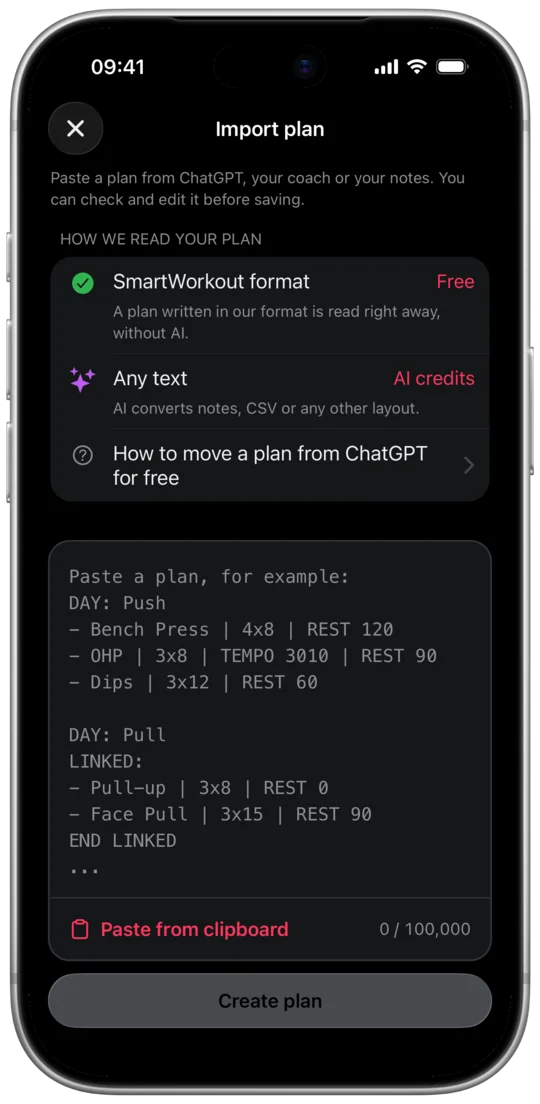
The plan fragment is day A from the sample plan above. Import costs 10 AI credits, so the welcome credits cover it; an AI plan on the default model costs the same.
DAY: Full Body A- Barbell Squat | WU 2x5 | 3x6-10 RIR 2 | TEMPO 3010 | REST 150- Dumbbell Bench Press | 3x8-12 RIR 2 | TEMPO 3010 | REST 120- Cable Lat Pulldown | 3x8-12 RIR 2 | TEMPO 3011 | REST 120- Seated Leg Curl | 2x10-15 RIR 2 | TEMPO 3010 | REST 90- Dumbbell Lateral Raise | 2x12-20 RIR 2 | TEMPO 2011 | REST 60- Dumbbell Biceps Curl | 2x10-15 RIR 2 | TEMPO 3010 | REST 60All our free plans follow the same rules: 8 weeks, RIR and a calibration week to start. The help article on importing a plan from text explains how import works and which format the AI reads most reliably.
With Premium, the creator shows the “Weekly Volume Breakdown” below the blocks: each muscle group's sets in every week of the plan against the zones. During the plan, Premium tells you what to do in your next workout: add a rep, add weight or stay at your current target.
Log it in SmartWorkout
A free workout log for iPhone and Android: sets, RIR, tempo, exercise groups and plans.


Questions
How many exercises per muscle group should I do in one workout?
One or two when the muscle group is trained 2-3 times a week; 2 exercises of 3 sets already give it 6 sets in one session. If you want to give it more work, first add a set to an exercise you already do and save a third exercise for a split.
How many exercises per workout?
Usually 5-7. If the workout doesn't fit your time, first cut isolation work for a muscle that compound lifts already train, e.g. flyes after pressing; keep leg curls and lateral raises, and move the sets of the cut exercise to another day.
How long should a gym workout be?
Usually 50-70 minutes: that is how long 15-20 working sets with about 2 minutes of rest take, warm-up included. If you only have 45 minutes, pair isolation exercises for different muscles into supersets, e.g. biceps with triceps, and warm up only before the first exercise for each muscle group.
Does exercise order matter?
For strength yes, for muscle growth hardly at all. Put the lift you want to set records in first, and feel free to swap isolation exercises around when a machine is taken.
How do I make a workout plan in Excel or Google Sheets?
One row per exercise: day, exercise, sets × reps, RIR, tempo and rest, with a column next to it for the weight in each week. You can later copy that sheet as text into an app that imports plans (plan import).
How do I make a workout plan for beginners?
Start with 3 full body workouts a week, 2-3 sets per exercise with 2 reps in reserve, and stick to the plan for 8 weeks. Add weight once all sets reach the top of the rep range.
See also
- Workout splits: full body, upper/lower, push pull legs or bro splitA workout split is how you spread muscle groups across the week. Full body trains everything each session, upper/lower and push pull legs rotate 2 or 3 day types, and a bro split gives each muscle its own day. With equal weekly sets, full body and splits build similar muscle and strength (meta-analysis of 14 studies).
- Training volume: what it is and what MEV, MAV and MRV meanIn hypertrophy training, training volume is the number of working sets a muscle group gets per week. In a meta-analysis of 67 studies, growth was measurable from about 4 weekly sets, with each extra set adding less; the 2026 ACSM position stand links 10 or more weekly sets to more growth.
- Training frequency: how many times a week to train each muscle groupTraining frequency is the number of sessions per week in which a muscle group does working sets. How often to train a muscle depends on weekly sets: with the same sets, muscles grow about the same with 1 or several sessions (meta-analysis of 25 studies). Strength improves more with 2 or more.
- Rep ranges: how many reps for hypertrophy, strength and cuttingA rep range is the span of reps, such as 8-12, in which a set with a given weight should end. For muscle growth the exact number matters little: in studies, muscle grew similarly with sets of about 5 to more than 30 reps close to failure, while strength grew most with loads of 80% of 1RM or more.
- Rest between sets: how long to rest for hypertrophy, strength and fat lossRest between sets (rest interval) is the time from the end of one set to the start of the next. For hypertrophy, 1.5-2 minutes is usually enough, 2-3 minutes on heavy lifts and 3-5 minutes for sets of 1-5 reps. In a meta-analysis of 9 studies, rests shorter than a minute produced slightly less muscle.
- RIR (reps in reserve): what it means and how to estimate itRIR (reps in reserve) is the number of good reps left before failure when a set ends. RIR 0 means no reps left, and RIR 2-3 in a plan means ending the set with 2-3 reps still in the tank. In a meta-analysis of 12 studies, lifters had on average 1 rep more left than they thought.
- Progressive overload: what it is, linear vs double progression, and how to break a plateauProgressive overload is the gradual increase of training demands, most often load, reps or sets. The ACSM advises adding 2-10% load once you do 1-2 reps over your target in two sessions in a row. In an 8-week study, adding reps built about as much muscle as adding load.
- Mesocycle training: how long a training block lasts and how to plan oneA mesocycle (training block) is a block of several weeks, usually 4-8, built around one goal and often ending with a lighter week (deload). It is made of microcycles, usually one training week each, and several mesocycles form a macrocycle, usually a year.
Sources
- Currier BS, D'Souza AC, Singh MAF, et al. American College of Sports Medicine Position Stand. Resistance Training Prescription for Muscle Function, Hypertrophy, and Physical Performance in Healthy Adults: An Overview of Reviews. Med Sci Sports Exerc. 2026;58(4):851-872.
- Pelland JC, Remmert JF, Robinson ZP, et al. The Resistance Training Dose Response: Meta-Regressions Exploring the Effects of Weekly Volume and Frequency on Muscle Hypertrophy and Strength Gains. Sports Med. 2026;56(2):481-505 (online 2025).
- Refalo MC, Helms ER, Robinson ZP, et al. Similar muscle hypertrophy following eight weeks of resistance training to momentary muscular failure or with repetitions-in-reserve in resistance-trained individuals. J Sports Sci. 2024;42(1):85-101.
- Iversen VM, Norum M, Schoenfeld BJ, et al. No Time to Lift? Designing Time-Efficient Training Programs for Strength and Hypertrophy: A Narrative Review. Sports Med. 2021;51(10):2079-2095.
- Singer A, Wolf M, Generoso L, et al. Give it a rest: a systematic review with Bayesian meta-analysis on the effect of inter-set rest interval duration on muscle hypertrophy. Front Sports Act Living. 2024;6:1429789.
- Washif JA, Pagaduan J, James C, et al. Artificial intelligence in sport: Exploring the potential of using ChatGPT in resistance training prescription. Biol Sport. 2024;41(2):209-220 (online 2023).
- Ramos-Campo DJ, Benito-Peinado PJ, Andreu-Caravaca L, et al. Efficacy of Split Versus Full-Body Resistance Training on Strength and Muscle Growth: A Systematic Review With Meta-Analysis. J Strength Cond Res. 2024;38(7):1330-1340.
- Costa BDV, Kassiano W, Nunes JP, et al. Does Performing Different Resistance Exercises for the Same Muscle Group Induce Non-homogeneous Hypertrophy? Int J Sports Med. 2021;42(9):803-811.
- Kubo K, Ikebukuro T, Yata H. Effects of squat training with different depths on lower limb muscle volumes. Eur J Appl Physiol. 2019;119(9):1933-1942.
- Maeo S, Huang M, Wu Y, et al. Greater Hamstrings Muscle Hypertrophy but Similar Damage Protection after Training at Long versus Short Muscle Lengths. Med Sci Sports Exerc. 2021;53(4):825-837.
- Nunes JP, Grgic J, Cunha PM, et al. What influence does resistance exercise order have on muscular strength gains and muscle hypertrophy? A systematic review and meta-analysis. Eur J Sport Sci. 2021;21(2):149-157 (online 2020).
- Simão R, de Salles BF, Figueiredo T, et al. Exercise order in resistance training. Sports Med. 2012;42(3):251-65.
- Zhang X, Weakley J, Li H, et al. Superset Versus Traditional Resistance Training Prescriptions: A Systematic Review and Meta-analysis Exploring Acute and Chronic Effects on Mechanical, Metabolic, and Perceptual Variables. Sports Med. 2025;55(4):953-975.
- Zourdos MC, Klemp A, Dolan C, et al. Novel Resistance Training-Specific Rating of Perceived Exertion Scale Measuring Repetitions in Reserve. J Strength Cond Res. 2016;30(1):267-75.
- Havers T, Masur L, Isenmann E, et al. Reproducibility and quality of hypertrophy-related training plans generated by GPT-4 and Google Gemini as evaluated by coaching experts. Biol Sport. 2025;42(2):289-329 (online 2024).
- Kassiano W, Nunes JP, Costa B, et al. Does Varying Resistance Exercises Promote Superior Muscle Hypertrophy and Strength Gains? A Systematic Review. J Strength Cond Res. 2022;36(6):1753-1762.
- Schoenfeld BJ, Grgic J, Krieger J. How many times per week should a muscle be trained to maximize muscle hypertrophy? A systematic review and meta-analysis of studies examining the effects of resistance training frequency. J Sports Sci. 2019;37(11):1286-1295 (online 2018).
- Gentil P, Fisher J, Steele J. A Review of the Acute Effects and Long-Term Adaptations of Single- and Multi-Joint Exercises during Resistance Training. Sports Med. 2017;47(5):843-855.