
Compound set key numbers
| Parameter | Value | Source |
|---|---|---|
| Rest between exercises | only the time to switch, usually 10-20 s | under 10 s in studies (De Camargo et al. 2022) |
| Rest after the round | 60-90 s after isolation, 2-3 min with a multi-joint exercise | 60 s: Demirtaş et al. 2022, 120 s: Wallace et al. 2019 |
| Reps | multi-joint 6-12, isolation 10-20 | our practice |
| Second exercise | 10-20% lighter or 2-4 fewer reps; a multi-joint exercise after isolation starts at 50-60% of its usual weight, adjusted in round 2 | our practice; 50%: Trindade et al. 2022, 60% to start: Hermann et al. 2026 |
| Effort | RIR 1-2, RIR 1 in isolation | our practice |
Compound sets, tri-sets and giant sets
A compound set is two exercises for the same muscle group done back to back without rest, and you rest only after both. Some guides call it an agonist superset. Three such exercises make a tri-set (triple set), four or more a giant set.
The name of an exercise group depends on whether its exercises share a main muscle group.
| Exercises in the group | All share a main muscle group | No shared main muscle group |
|---|---|---|
| 2 | Compound Set | Superset |
| 3 | Tri-Set | Circuit |
| 4+ | Giant Set | Circuit |
An exercise's main muscle group is one it works at 70 points out of 100 or more, within 10 points of its most worked group. The three heads of the deltoid count together as shoulders.
Some guides and studies call any pair a superset, two biceps exercises included, and some use “compound set” for any superset. On this page, as in the table, two biceps exercises are a compound set, and biceps with triceps are a superset.
Shoulders count as one muscle group here, so dumbbell lateral raises with cable rear delt flyes make a compound set. Each trains a different head of the deltoid, though, so the second exercise works a fresh part of the muscle and you don't need to lower the weight.
Tri-sets
A tri-set is three exercises for the same muscle group done back to back without rest, e.g. for chest Machine Chest Press, Cable Middle Chest Fly and Push-Up. Do 2-3 rounds of 10-15 reps with 2-3 minutes of rest. Some guides call any three exercises in a row a tri-set; three exercises for different muscle groups are a circuit.
Giant sets in lifting
A giant set is four or more exercises for the same muscle group done back to back without rest, e.g. for shoulders Seated Dumbbell Shoulder Press, Dumbbell Lateral Raise, Dumbbell Front Raise and Cable Rear Delt Fly. In a 6-week study by Demirtaş et al. 2022, untrained men doing giant sets gained as much strength and muscle as a group doing compound sets. For shoulders they did 4 rounds of 10-12 reps once a week with 60 s of rest. With the exercises from the example, that's 10 weekly sets for the front delts, 10 for the side delts and 4 for the rear delts. Start with 2 rounds and 2-3 minutes of rest. Giant sets have their own page.
When compound sets are worth it
Compound sets, like other intensity techniques, don't build more muscle than the same sets done separately: that was the result in 6- and 8-week studies, and with pre-exhaust growth was slightly smaller (Demirtaş et al. 2022, Hermann et al. 2026). What they give you is time, and the price is fatigue: you get fewer reps in the later rounds.
The time saving comes from the rest you skip: compared with straight sets with a rest after each one, the same workout done as pre-exhaust or tri-sets took 36-48% less time (De Camargo et al. 2022 and the Hermann study). With 60 s of rest between straight sets you save less: the 4 shoulder rounds from the example below take about 9 minutes instead of 12.
Tonnage (weight × reps) dropped by 16-23% (least, by 16%, in Wallace et al. 2019), but in the 2026 ACSM position stand muscle growth depended on the number of sets, not on the weight. So the reason to choose a compound set is time: most often, it lets you fit extra sets for a muscle group you want to bring up into a few minutes (muscle priority).
In your first months, stick with straight sets: you'll grow without compound sets, and reps in reserve are hardest to judge on a tired muscle.
How to do a compound set
- Pick two exercises with the same main muscle group at stations next to each other, e.g. dumbbells by the cable stack.
- Start with the heavier or multi-joint one (post-exhaust); the reverse order is pre-exhaust (below).
- If the second exercise trains the same muscle, take 10-20% less than you would fresh or plan 2-4 fewer reps.
- Start the second exercise no later than 20 s after the first.
- After the round, rest 60-90 s, or 2-3 minutes with a multi-joint exercise (rest between sets); do 2-4 rounds.
- Log each set separately and keep the same order every week, so you can compare the second exercise's results.
Pre-exhaust
Pre-exhaust is a compound set in reverse order: an isolation exercise first, then a multi-joint exercise for the same muscle group right away. Arthur Jones, who created the method, recommended taking the isolation exercise to failure for 20-30 reps and the multi-joint one about half as heavy (Trindade et al. 2022).
Flyes before the bench press don't make the chest work harder: EMG showed the triceps working harder instead (Gentil et al. 2007). After 8 weeks in trained lifters, pre-exhaust needed lighter weights on the multi-joint exercise, and muscles grew slightly less than with straight sets (Hermann et al. 2026). On the multi-joint exercise, start at about 60% of the weight you'd use for 10 reps when fresh, and correct it in the second round.
Choose pre-exhaust when heavy weight is the problem: a joint hurts, or you only have light dumbbells at home. Do the multi-joint exercise on a machine, a leg press or with dumbbells, not with a barbell: after isolation, failure comes sooner than you expect.
Compound set examples with weights and reps
Each row is one compound set, done after your main exercises.
| Example | Exercises | RIR | Rest after the round |
|---|---|---|---|
| Shoulders, 4 rounds | Dumbbell Lateral Raise 10 kg × 15, then Cable Rear Delt Fly 5 kg × 15 | 1 and 1 | 60 s |
| Chest, 3 rounds | Machine Chest Press 60 kg × 10, then Machine Chest Fly 40 kg × 12 instead of the usual 50 kg | 2 and 1 | 2 min |
| Legs, pre-exhaust, 3 rounds | Seated Leg Extension Machine 50 kg × 15, then Leg Press 120 kg × 10 instead of the usual 200 kg | 1 and 2 | 2-3 min |
Compound sets for shoulders, chest, back, arms and legs
For compound sets, pick isolation exercises on machines, cables or with dumbbells: if you fail a rep on a tired muscle there, nothing bad happens.
| Good fit | Pair it with |
|---|---|
| Dumbbell Lateral Raise | cable rear delt flyes or cable face pulls |
| Machine Chest Fly | after the machine chest press |
| Wide Grip Lat Pulldown | straight-arm lat pulldowns |
| Rope Triceps Pushdown | cable overhead triceps extensions |
| Seated Incline Biceps Curl | dumbbell hammer curls with the same dumbbells |
| Seated Leg Extension Machine | after the leg press, or before it as pre-exhaust |
Compound sets vs supersets and circuits
| Compound set | Superset | Circuit | |
|---|---|---|---|
| Muscle groups | one | two | different |
| What for | the same number of sets for one muscle group in less time, with lighter weights | a shorter workout; with opposing muscles, no loss of tonnage (Zhang et al. 2025) | a short full-body workout |
How to count compound sets in weekly volume
In a compound set you count sets as usual: every set of every exercise gives 1 set to each muscle group it trains directly and 0.5 to each it trains indirectly (Pelland et al. 2025).
A mechanical drop set is counted differently: there, after failure you change only the grip or angle of the same exercise, and the whole sequence is 1 set. In a compound set, the second exercise has its own rep target and counts separately.
When you count weekly sets, shoulders are three muscle groups (front, side and rear delts): the 4 shoulder rounds from the examples give you 4 sets for the side delts, 4 for the rear delts and 2 for the front delts. You can check your week against the volume zones in the sets per muscle group calculator.
Common mistakes
- Doing the second exercise as if fresh. A tired muscle does fewer reps; lower the weight or the rep target.
- A heavy barbell lift in the group. In a compound set, the barbell bench press lost more speed and power than in supersets (Weakley et al. 2020). Do heavy barbell lifts on their own, before the group.
- Taking too long to switch. If you spend a minute looking for a free station, you're really doing two straight sets; set up the weight for the second exercise before the round.
- A compound set for every muscle group. Exercises done this way raised a muscle damage marker almost twice as much as the same exercises done separately (Brentano et al. 2017), so recovery takes longer. Save compound sets for 1-2 muscle groups at the end of the workout.
What the research says
| Claim | What studies show | Certainty |
|---|---|---|
| Builds more muscle | no (results above) | low |
| Shortens the workout and lowers tonnage | yes (results above) | moderate |
| Study | Type and sample | Result | Limitation |
|---|---|---|---|
| Demirtaş et al. 2022 | 31 untrained men, 6 weeks | no differences between compound sets, giant sets and modified German Volume Training | 9-11 people per group, journal not indexed in PubMed |
| Hermann et al. 2026 | 41 trained people, 8 weeks, legs | pre-exhaust: slightly less muscle growth, no difference in strength, time −36%, tonnage −23% | the muscle difference is uncertain |
There are only a few studies lasting weeks, giant sets were studied once, and it's unknown whether compound sets build muscle as well as straight sets in trained lifters.
What SmartWorkout logs show
Every number is based on at least 50 people.
How to log a compound set in SmartWorkout
You log a compound set in SmartWorkout as an exercise group: in the workout log, in templates and in plans.
- On the workout screen, tap “Add Superset”, select the exercises for the same muscle group and confirm.
- In the menu of every exercise except the last, choose “Set all rest timers” and set 0 s (“Off” on the picker wheel); give the last one the rest after the round, e.g. 60 s.
- Alternate the sets; the timer starts after the last exercise of the round.
From version 5.2 the button is called “Add Exercise Group”, and the group gets its name from the table above, e.g. “Compound Set”.
With Premium, you see these sets against the volume zones while you train.
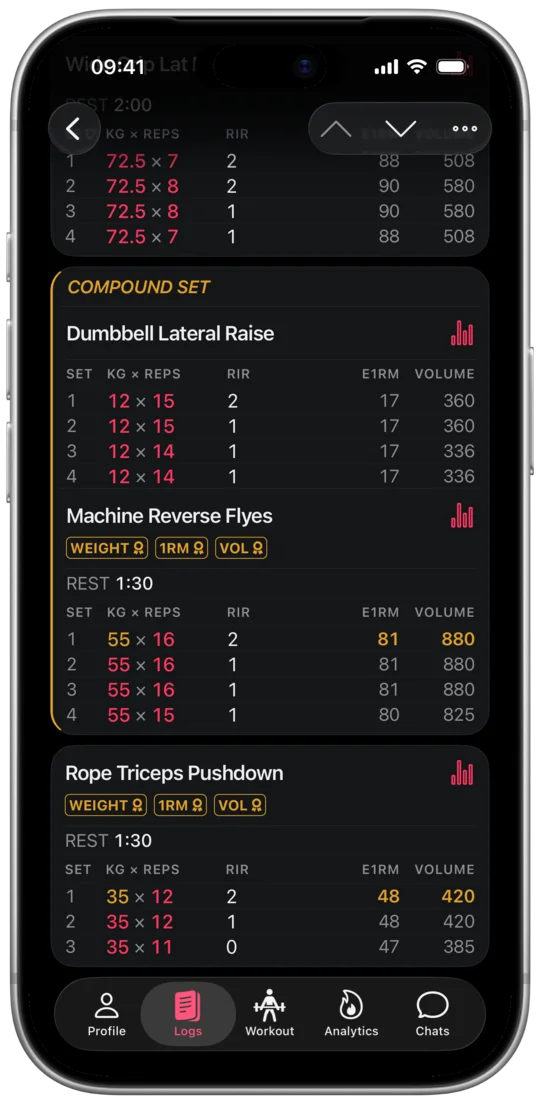
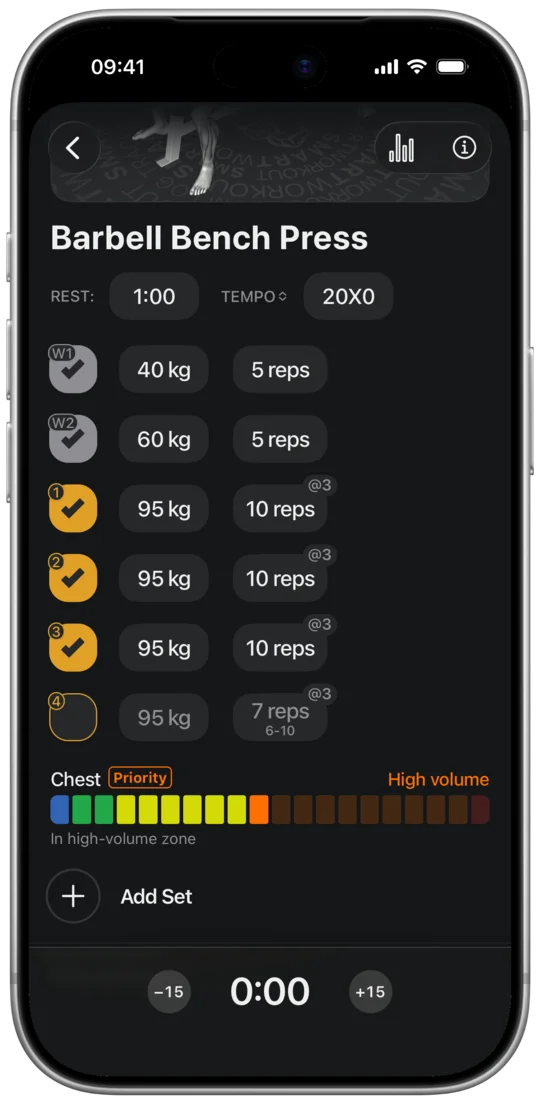
This fragment is a shortened Upper B day from the free 4-day upper/lower plan: a compound set first, then a superset. You can paste it through plan import (Workout > My Plans > “+” > “Import plan”); import costs 10 AI credits, so the welcome credits cover it.
DAY: Upper B- Incline Dumbbell Bench Press | WU 2x8 | 4x8-12 RIR 2 | TEMPO 20X0 | REST 120- Cable Neutral Grip Lat Pulldown | 3x8-12 RIR 1 | TEMPO 2011 | REST 120LINKED:- Dumbbell Lateral Raise | 4x12-20 RIR 1 | TEMPO 2010 | REST 0- Cable Rear Delt Fly | 4x12-20 RIR 1 | TEMPO 2011 | REST 60END LINKEDLINKED:- Cable Overhead Triceps Extension | 3x10-15 RIR 1 | TEMPO 3010 | REST 0- Seated Incline Biceps Curl | 3x10-15 RIR 1 | TEMPO 3010 | REST 60END LINKEDLog it in SmartWorkout
A free workout log for iPhone and Android: sets, RIR, tempo, exercise groups and plans.


Questions
What is a compound set?
A compound set is two exercises for the same muscle group done back to back without rest, and you rest only after both.
What is an example of a compound set?
For chest, the machine chest press followed right away by the machine chest fly, after your heavy barbell bench press sets. For shoulders, dumbbell lateral raises and cable rear delt flyes. For back, the wide grip lat pulldown and the straight-arm lat pulldown.
What's the difference between compound sets and supersets?
A superset pairs two muscle groups, so one rests while the other works; that shortens the workout, and with opposing muscles you lose almost no weight. A compound set hits the same muscle group twice in a row: you go lighter on the second exercise, and recovery takes longer.
What is a tri-set workout?
A tri-set is three exercises for the same muscle group done back to back without rest. Some guides call any three exercises in a row a tri-set; three exercises for different muscle groups are a circuit.
What is pre-exhaust training?
Pre-exhaust is a compound set in reverse order: an isolation exercise first, then a multi-joint exercise for the same muscle group right away, such as leg extensions before the leg press. The usual order, multi-joint first, is called post-exhaust.
Is biceps and triceps a compound set?
No. Biceps and triceps are two muscle groups, so the pair is a superset. An arm compound set is two triceps exercises or two biceps exercises.
See also
- Supersets in the gym: what they are, examples and superset vs compound setA superset is two exercises for different muscle groups done back to back with no rest in between; you rest only after both. Two exercises for the same muscle group are usually called a compound set. In a meta-analysis of 19 studies, supersets cut session time by about 37% with similar tonnage.
- Circuit training for strength: how to build a gym circuitCircuit training (a circuit) is 3 or more exercises, not all for the same muscle group, done one after another in rounds with a short move between stations. In two 8-week studies in trained lifters, circuits with sets close to failure built strength and lean mass about as well as straight sets, in less time.
- How to count sets per muscle group: direct, indirect and warm-up setsCounting sets per muscle group (fractional set counting) means adding up a week's working sets: 1 for the muscle that mainly does the movement, 0.5 for a muscle that clearly assists, 0 for warm-up sets. In a meta-analysis of 67 studies, this matched muscle growth better than counting assisting muscles as 1 or 0.
- Training volume: what it is and what MEV, MAV and MRV meanIn hypertrophy training, training volume is the number of working sets a muscle group gets per week. In a meta-analysis of 67 studies, growth was measurable from about 4 weekly sets, with each extra set adding less; the 2026 ACSM position stand links 10 or more weekly sets to more growth.
- Intensity techniques in lifting: which work, what they cost and when to use themIntensity techniques (also called advanced training techniques) extend a set or cut the rest, as drop sets, rest-pause and supersets do. In meta-analyses with similar work they built no more muscle than straight sets, but supersets, drop sets and rest-pause cut session time by a third or more.
- Rest between sets: how long to rest for hypertrophy, strength and fat lossRest between sets (rest interval) is the time from the end of one set to the start of the next. For hypertrophy, 1.5-2 minutes is usually enough, 2-3 minutes on heavy lifts and 3-5 minutes for sets of 1-5 reps. In a meta-analysis of 9 studies, rests shorter than a minute produced slightly less muscle.
- Drop sets: what they are, how to do them and how much weight to dropA drop set (also called a strip set or descending set) is a set taken to or near failure, then continued without rest after cutting the weight by about 20-30%. In meta-analyses, drop sets built about as much muscle as regular sets in less time. One drop on the last set is usually enough.
- Training to failure: when it helps and when it just adds fatigueTraining to failure means ending a set only when, despite full effort, you cannot complete the next rep through a full range of motion without changing your form. In a meta-analysis of 15 studies it built no significantly more muscle or strength than stopping short of failure, and it is clearly more fatiguing.
Sources
- De Camargo JBB, Zaroni RS, Júnior ACT, et al. Tri-Set Training System Induces a High Muscle Swelling with Short Time Commitment in Resistance-Trained Subjects: A Cross-Over Study. Int J Exerc Sci. 2022;15(3):561-569.
- Hermann T, Mohan AE, Piñero A, et al. Front-Loading Fatigue: Does the Pre-exhaustion Method influence Resistance Training-induced Muscular Adaptations? Int J Exerc Sci. 2026;19(1):1008.
- Demirtaş B, Çetin O, Çakır E, Beyleroğlu M. The effect of three different sets method used in resistance training on hypertrophy and maximal strength changes. Physical Education of Students. 2022;26(6):270-279.
- Wallace W, Ugrinowitsch C, Stefan M, et al. Repeated Bouts of Advanced Strength Training Techniques: Effects on Volume Load, Metabolic Responses, and Muscle Activation in Trained Individuals. Sports (Basel). 2019;7(1):14.
- Weakley JJS, Till K, Read DB, et al. The Effects of Superset Configuration on Kinetic, Kinematic, and Perceived Exertion in the Barbell Bench Press. J Strength Cond Res. 2020;34(1):65-72.
- Brentano MA, Umpierre D, Santos LP, et al. Muscle Damage and Muscle Activity Induced by Strength Training Super-Sets in Physically Active Men. J Strength Cond Res. 2017;31(7):1847-1858.
- Zhang X, Weakley J, Li H, et al. Superset Versus Traditional Resistance Training Prescriptions: A Systematic Review and Meta-analysis Exploring Acute and Chronic Effects on Mechanical, Metabolic, and Perceptual Variables. Sports Med. 2025;55(4):953-975.
- Currier BS, D'Souza AC, Singh MAF, et al. American College of Sports Medicine Position Stand. Resistance Training Prescription for Muscle Function, Hypertrophy, and Physical Performance in Healthy Adults: An Overview of Reviews. Med Sci Sports Exerc. 2026;58(4):851-872.
- Trindade TB, Alves RC, de Castro BM, et al. Pre-exhaustion Training, a Narrative Review of the Acute Responses and Chronic Adaptations. Int J Exerc Sci. 2022;15(3):507-525.
- Gentil P, Oliveira E, de Araújo Rocha Júnior V, et al. Effects of exercise order on upper-body muscle activation and exercise performance. J Strength Cond Res. 2007;21(4):1082-6.
- Pelland JC, Remmert JF, Robinson ZP, et al. The Resistance Training Dose Response: Meta-Regressions Exploring the Effects of Weekly Volume and Frequency on Muscle Hypertrophy and Strength Gains. Sports Med. 2026;56(2):481-505 (online 2025).