
Giant set key numbers
| Parameter | Value | Source |
|---|---|---|
| Exercises per round | 4, rarely 5 | 4 in Demirtaş et al. 2022 |
| Rest between exercises | only the switch, 10-20 s | none in the same study |
| Rest after the round | 60 s to 3 min; start with 2-3 min | 60 s in the same study; longer rest is our practice |
| Rounds | 2-4; start with 2 | 4 rounds of 10-12 reps in the same study |
| Effort | RIR 1-2 on the first exercise, RIR 1 in isolation | our practice |
Two meanings of giant set
A giant set is four or more exercises for the same muscle group done back to back without rest, and you rest only after the round. That's how the one long-term study used the term: four exercises for one muscle group per round (Demirtaş et al. 2022).
Many lifting guides use the term more loosely, for any four or more exercises in a row, including whole-body groups such as a squat, a press, a row and a carry. Research names vary in the same way: in one study a “tri-set” was three exercises for different muscle groups (Weakley et al. 2017).
In this wiki and in the SmartWorkout app, the name of an exercise group depends on whether all its exercises share a main muscle group:
| Exercises in the group | All share a main muscle group | No shared main muscle group |
|---|---|---|
| 2 | Compound Set | Superset |
| 3 | Tri-Set | Circuit |
| 4+ | Giant Set | Circuit |
An exercise's main muscle group is one it works at 70 points out of 100 or more, within 10 points of its most worked group. The three heads of the deltoid count together as shoulders.
So four shoulder exercises make a giant set, and the three deltoid heads count as one muscle group. Two biceps and two triceps exercises, or a whole-body group of four, make a circuit. Two exercises for one muscle group are a compound set, and two for different muscle groups a superset.
When giant sets are worth it
Giant sets don't build more muscle than the same sets done separately. They pack one muscle group's sets into a few minutes and tire that muscle more than any other grouping.
In a 6-week study, untrained men doing giant sets gained as much strength and muscle as groups doing compound sets or a modified German Volume Training (Demirtaş et al. 2022). With trained lifters, a tri-set for chest took 48% less time than the same sets with rest after each, and tonnage was 19% lower (De Camargo et al. 2022).
For example, 4 rounds of the shoulder giant set below take about 17 minutes with sets of about 40 s, 15 s switches and 60 s after each round. The same 16 sets done separately, with 60 s after each, take about 26.
Use a giant set when you're short on time for a muscle group you want to bring up, on machines, cables and dumbbells. In your first months, stick with straight sets: you grow without them, and the later exercises of a round are hard to judge on a tired muscle.
How to do a giant set
- Pick four exercises with the same main muscle group, from the heaviest or multi-joint one to the lightest isolation exercise.
- Set up close together: at peak hours you can't hold four stations, so build the round around one cable stack and one pair of dumbbells, e.g. lateral and front raises with the same dumbbells.
- Go 10-20% lighter than usual on every exercise after the first that trains the same muscle.
- Switch within 10-20 s and rest 2-3 minutes after the round (rest between sets); shorten it to 60-90 s once rounds 2-3 hold their reps.
- Do 2 rounds in the first weeks and add a third when the second round no longer loses more than 2-3 reps per exercise.
- Log every set separately and keep the same order every week.
Heavy barbell lifts don't belong in the round: in a compound set, the barbell bench press lost more speed and power than in supersets (Weakley et al. 2020). Do them first and on their own.
Giant set examples for shoulders, chest, back and legs
Each row is one round, done at the end of the workout; every group passes the table above as a giant set.
| Muscle group | Exercises in order | Reps | Rest after the round |
|---|---|---|---|
| Shoulders, 4 rounds (the study's protocol) | Seated Dumbbell Shoulder Press 18 kg dumbbells, Dumbbell Lateral Raise 8 kg, Dumbbell Front Raise 8 kg, Cable Rear Delt Fly 5 kg | 10-12 each | 60 s |
| Chest, 2-3 rounds | Machine Chest Press, Machine Chest Fly, Cable Middle Chest Fly, Push-Up | 10-15, push-ups to RIR 1 | 2 min |
| Back, 2-3 rounds | Wide Grip Lat Pulldown, Seated Cable Low Row Neutral Grip, Cable Neutral Grip Lat Pulldown, Straight-Arm Lat Pulldown | 10-15 | 2 min |
| Quads, 2 rounds | Leg Press, Dumbbell Goblet Squat, Dumbbell Walking Lunges, Seated Leg Extension Machine | 10-15, lunges 10 per leg | 3 min |
Giant set vs superset, compound set and circuit
| Giant set | Compound set and tri-set | Superset | Circuit | |
|---|---|---|---|---|
| Exercises | 4 or more, one muscle group | 2 or 3, one muscle group | 2, different muscle groups | 3 or more, different muscle groups |
| Fatigue of one muscle | highest | high | lower, the groups rest in turns | spread over the body |
| What for | many sets for one muscle group in a few minutes | a few extra sets for one muscle group | a shorter workout without losing tonnage | a short full-body workout |
How to count giant sets in weekly volume
In a giant set you count sets as usual: every set of every exercise gives 1 set to each muscle group it trains directly and 0.5 to each it trains indirectly (Pelland et al. 2025).
That adds up fast. The 4 shoulder rounds from the examples give 10 weekly sets for the front delts, 10 for the side delts and 4 for the rear delts. 4 rounds of the chest giant set would give 16 chest sets, already in the MAV range of 10-20 for a whole week, which is why we start chest at 2-3 rounds. Check your week against the volume zones in the sets per muscle group calculator.
Common mistakes
- The same weights in every round. By round 3 the last exercises lose reps; lower their weight or rep target.
- Four stations at peak hours. If each switch takes a minute, you're doing straight sets; use one cable stack and one pair of dumbbells.
- Giant sets for several muscle groups. Compound sets already raised a muscle damage marker almost twice as much as the same exercises done separately (Brentano et al. 2017), and a giant set has twice as many exercises. Use one giant set per workout, at the end.
- Counting a round as one set. A round of four exercises is four sets, and your weekly volume counts them all.
What the research says
| Claim | What studies show | Certainty |
|---|---|---|
| Builds more muscle | no: as much as compound sets and German Volume Training (result above) | low |
| Shortens the workout and lowers tonnage | yes in a tri-set study (result above); not measured for giant sets | low to moderate |
| Study | Type and sample | Result | Limitation |
|---|---|---|---|
| Demirtaş et al. 2022 | 31 untrained men, 6 weeks; 4 exercises per muscle group, 4 rounds, 60 s after the round | no differences in strength or muscle size between giant sets, compound sets and modified German Volume Training | 9-11 people per group, journal not indexed in PubMed |
| De Camargo et al. 2022 | 18 trained lifters, one session; 3 chest exercises | tri-set: time −48%, tonnage −19% | a single session, three exercises |
Giant sets have one long-term study, in untrained men over 6 weeks; it's unknown whether trained lifters grow as much with them as with straight sets, and how much more muscle damage four exercises cause than two.
What SmartWorkout logs show
Lifters who link four or more exercises mostly mix muscle groups, so by the table above they log circuits. Every number is based on at least 50 people.
How to log a giant set in SmartWorkout
You log a giant set in SmartWorkout as an exercise group: in the workout log, in templates and in plans.
- On the workout screen, tap “Add Superset”, select four or more exercises for the same muscle group and confirm.
- In the menu of every exercise except the last, choose “Set all rest timers” and set 0 s (“Off” on the picker wheel); give the last one the rest after the round, e.g. 120 s.
- Do one set of each exercise in order; the timer starts after the last exercise of the round.
From version 5.2 the button is called “Add Exercise Group”, and the group gets its name from the table above: “Giant Set” when all exercises share a main muscle group, “Circuit” when they don't.
With Premium, you see these sets against the volume zones while you train, separately for the front, side and rear delts.
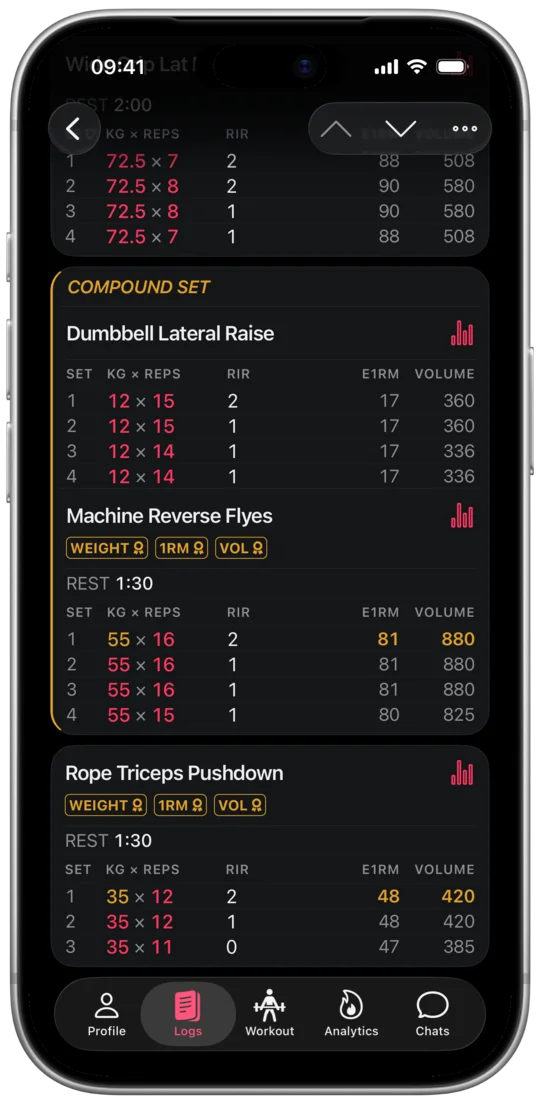
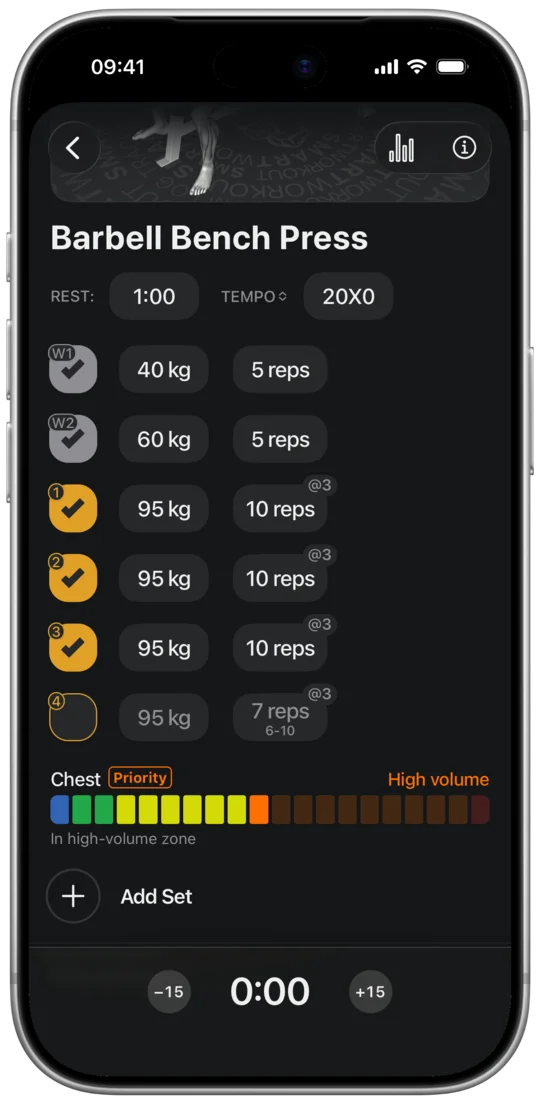
None of our free plans has a giant set. You can paste this shoulder round through plan import (Workout > My Plans > “+” > “Import plan”) and add it to the end of an upper or push day; import costs 10 AI credits, so the welcome credits cover it.
DAY: ShouldersLINKED:- Seated Dumbbell Shoulder Press | 2x10-12 RIR 2 | TEMPO 2010 | REST 0- Dumbbell Lateral Raise | 2x10-12 RIR 1 | TEMPO 2010 | REST 0- Dumbbell Front Raise | 2x10-12 RIR 1 | TEMPO 2010 | REST 0- Cable Rear Delt Fly | 2x10-12 RIR 1 | TEMPO 2011 | REST 120END LINKEDLog it in SmartWorkout
A free workout log for iPhone and Android: sets, RIR, tempo, exercise groups and plans.


Questions
What is a giant set?
A giant set is four or more exercises for the same muscle group done back to back without rest, and you rest only after the round.
What's the difference between a superset and a giant set?
A superset is two exercises for two different muscle groups, which rest in turns. A giant set is four or more exercises for one muscle group, so that muscle works through the whole round and gets far more tired.
Giant set vs circuit: what's the difference?
A giant set keeps all its exercises on one muscle group; a circuit is three or more exercises for different muscle groups, often the whole body. Some guides call a whole-body group of four a giant set too; in this wiki it's a circuit.
What is a good giant set for chest?
The machine chest press, machine chest fly, cable middle chest fly and push-ups, in that order, for 2-3 rounds of 10-15 reps after your heavy pressing. All four have chest as their main muscle group, so the group is a giant set.
Are giant sets good for building muscle?
About as good as the same sets done separately: in a 6-week study, untrained men gained as much strength and muscle with giant sets as with compound sets. Their advantage is time, not extra growth.
How many sets is a giant set?
Each exercise in the round counts as its own set, so 4 rounds of 4 exercises are 16 sets. In weekly volume, every set gives 1 set to each muscle group it trains directly and 0.5 to each it trains indirectly.
See also
- Compound sets in lifting: two exercises for one muscle, back to backA compound set is two exercises for the same muscle group done back to back without rest; three make a tri-set, four or more a giant set. In studies, the same workout done this way took 36-48% less time than straight sets with rest after every set, and muscles grew no more than with straight sets.
- Supersets in the gym: what they are, examples and superset vs compound setA superset is two exercises for different muscle groups done back to back with no rest in between; you rest only after both. Two exercises for the same muscle group are usually called a compound set. In a meta-analysis of 19 studies, supersets cut session time by about 37% with similar tonnage.
- Circuit training for strength: how to build a gym circuitCircuit training (a circuit) is 3 or more exercises, not all for the same muscle group, done one after another in rounds with a short move between stations. In two 8-week studies in trained lifters, circuits with sets close to failure built strength and lean mass about as well as straight sets, in less time.
- How to count sets per muscle group: direct, indirect and warm-up setsCounting sets per muscle group (fractional set counting) means adding up a week's working sets: 1 for the muscle that mainly does the movement, 0.5 for a muscle that clearly assists, 0 for warm-up sets. In a meta-analysis of 67 studies, this matched muscle growth better than counting assisting muscles as 1 or 0.
- Training volume: what it is and what MEV, MAV and MRV meanIn hypertrophy training, training volume is the number of working sets a muscle group gets per week. In a meta-analysis of 67 studies, growth was measurable from about 4 weekly sets, with each extra set adding less; the 2026 ACSM position stand links 10 or more weekly sets to more growth.
- Rest between sets: how long to rest for hypertrophy, strength and fat lossRest between sets (rest interval) is the time from the end of one set to the start of the next. For hypertrophy, 1.5-2 minutes is usually enough, 2-3 minutes on heavy lifts and 3-5 minutes for sets of 1-5 reps. In a meta-analysis of 9 studies, rests shorter than a minute produced slightly less muscle.
- Intensity techniques in lifting: which work, what they cost and when to use themIntensity techniques (also called advanced training techniques) extend a set or cut the rest, as drop sets, rest-pause and supersets do. In meta-analyses with similar work they built no more muscle than straight sets, but supersets, drop sets and rest-pause cut session time by a third or more.
Sources
- Demirtaş B, Çetin O, Çakır E, Beyleroğlu M. The effect of three different sets method used in resistance training on hypertrophy and maximal strength changes. Physical Education of Students. 2022;26(6):270-279.
- De Camargo JBB, Zaroni RS, Júnior ACT, et al. Tri-Set Training System Induces a High Muscle Swelling with Short Time Commitment in Resistance-Trained Subjects: A Cross-Over Study. Int J Exerc Sci. 2022;15(3):561-569.
- Weakley JJS, Till K, Read DB, et al. The effects of traditional, superset, and tri-set resistance training structures on perceived intensity and physiological responses. Eur J Appl Physiol. 2017;117(9):1877-1889.
- Weakley JJS, Till K, Read DB, et al. The Effects of Superset Configuration on Kinetic, Kinematic, and Perceived Exertion in the Barbell Bench Press. J Strength Cond Res. 2020;34(1):65-72.
- Brentano MA, Umpierre D, Santos LP, et al. Muscle Damage and Muscle Activity Induced by Strength Training Super-Sets in Physically Active Men. J Strength Cond Res. 2017;31(7):1847-1858.
- Pelland JC, Remmert JF, Robinson ZP, et al. The Resistance Training Dose Response: Meta-Regressions Exploring the Effects of Weekly Volume and Frequency on Muscle Hypertrophy and Strength Gains. Sports Med. 2026;56(2):481-505 (online 2025).