
Rest between sets at a glance
| Situation | Rest | Source |
|---|---|---|
| Hypertrophy, compound exercises on machines and with dumbbells | 90-120 s | Singer et al. 2024 |
| Heavy compound lifts, such as the squat, bench press and deadlift | 2-3 min; 3-5 min for sets of 1-5 reps | Grgic et al. 2018, Senna et al. 2016 |
| Isolation for small muscle groups (arms, shoulders, calves, abs) and flyes, 10-20 reps | 60-90 s | our practice |
| Leg isolation: leg extensions and leg curls | 90-120 s | Rosa et al. 2023 |
| Beginners | 1-2 min | Iversen et al. 2021 |
| Short on time | a superset with an exercise for another muscle group, or a drop set on the last isolation set; if you rest only 1 minute, add 1-2 sets | 1 minute and extra sets: Longo et al. 2022 |
- 1 min rest
- 3 min rest
How long to rest for hypertrophy, strength and fat loss
Rest between sets is usually 1.5-2 minutes, and 2-3 minutes on heavy lifts, the same whether you're bulking or cutting. Shorter rest builds muscle too, but it costs reps on the sets that follow; more than 3 minutes helps mainly on heavy strength sets.
Rest doesn't change the number of sets that training volume counts, only how many reps and how much weight you manage in each of them. Four things call for longer rest: a compound exercise, a large muscle group (especially legs), a weight above about 80% of 1RM and a set that ends close to failure. On unilateral exercises, the set for the other side doesn't replace rest: after both sides, rest as long as you would after a regular set.
If you've been training for less than a year, 1-2 minutes is enough on most exercises; longer rests pay off only once you lift heavy weights on barbell lifts.
Rest between sets for hypertrophy
For hypertrophy, rest usually 1.5-2 minutes on compound exercises and at least a minute on light isolation work. In a meta-analysis of 9 studies, rests longer than 60 s produced slightly more muscle growth, with no clear difference beyond 90 s, whether or not sets were taken to failure (Singer et al. 2024). The authors tie this to reps: after a short rest at the same RIR, you do fewer of them or have to take weight off.
You often read that 30-60 s is enough for hypertrophy because short rest raises growth hormone. Long-term studies don't support it: muscles didn't grow better with shorter rests, and the link between the brief hormone spike and growth turned out weak (Henselmans and Schoenfeld 2014).
Shorter rest saves less time than it seems. In a 10-week leg extension study, 1 minute of rest instead of 3 produced similar muscle growth only when extra sets evened out the tonnage (Longo et al. 2022); 5 sets with 1 minute instead of 3 sets with 3 minutes saves only 2-3 minutes per exercise. You win back more time with a superset of two exercises for different muscle groups or a drop set on the last isolation set. If you shorten rest and add sets, count them in the sets per muscle group calculator.
Rest between sets for strength
For strength, rest longer on heavy sets: 2-3 minutes at 6-10 reps and 3-5 minutes at 1-5. In a review of 23 studies, strength in trained lifters rose most with rests longer than 2 minutes, while beginners did fine with 60-120 s (Grgic et al. 2018). The overview of reviews in the 2026 ACSM position stand, however, found no difference in strength between rests shorter and longer than a minute, so long rest isn't a condition for progress. When time is short, don't go below 2 minutes on heavy lifts. At about 85% of 1RM with sets to failure, even 5 minutes of rest didn't keep reps steady across 4 sets of bench press (Hernandez et al. 2021); with 1-2 reps in reserve, losing one rep on the last set is normal.
Rest between sets for fat loss
When you're cutting, rest the same as when bulking. Shorter rest doesn't burn more: in a study on the leg press and chest flyes, 1 minute of rest instead of 3 didn't change total energy expenditure (Farinatti and Castinheiras Neto 2011). It does cost reps on heavy sets, so keep the full 2-3 minutes on squats and bench press.
How to set your rest between sets
- Before the workout, set the rest for each exercise by weight and rep range: 2-3 minutes on heavy compound lifts, 90-120 s on other compound exercises and leg isolation, 60-90 s on the rest of your isolation work.
- Start counting when you put the weight down. Unlock your phone only after starting the timer, because replying to messages quietly stretches the rest.
- During the rest, sit or stand still and get the weight ready for the next set; change plates during the rest, not after it.
- Start the next set when the time is up. If a set came out 2 or more reps short of the previous one, or ended in failure, add 30-60 s before the next one.
- Keep the same rest for the whole block, so you can compare reps week to week with double progression.
When you take turns on a station with someone at a busy gym, their set plus the plate change usually gives you 1.5-2 minutes of rest, so on heavy lifts wait another minute.
Rest times in an upper/lower workout example
Rest changes from exercise to exercise within one workout: it's longest after heavy barbell lifts and shortest on isolation. This is the Upper A day in week 2 of the intermediate 4-day upper/lower plan.
| Exercise | Sets × reps | RIR | Rest |
|---|---|---|---|
| Barbell Bench Press | 2 warm-up × 5, then 3 × 6-10 | 2 | 1 min after each warm-up set (2-3 min is better before the first working set), 3 min after working sets |
| Barbell Bent Over Row | 3 × 6-10 | 2 | 2:30 |
| Seated Dumbbell Shoulder Press | 3 × 8-12 | 2 | 2 min |
| Cable Lat Pulldown | 3 × 8-12 | 1 | 2 min |
| Cable Middle Chest Fly | 2 × 10-15 | 1 | 1 min |
| Cable Triceps Pushdown + Dumbbell Biceps Curl (superset) | 3 × 10-15 each | 1 | 0 s between the exercises, 1 min after the pair |
Rest after working sets takes about 34 minutes of this workout. With 1 minute everywhere, the workout would be more than 15 minutes shorter, but you'd lose reps with every set on both barbell lifts. To save time without cutting rest, pair the Seated Dumbbell Shoulder Press and the Cable Lat Pulldown in a superset: 2 minutes of rest only after the pair means 3 rests instead of 6, about 6 minutes less. You still come back to each of these exercises after almost 3 minutes.
Rest between sets for squats, bench press, pull-ups and curls
Rest on squats and bench press is usually 2-3 times longer than on lateral raises or curls.
| Exercise | Rest | Why |
|---|---|---|
| Barbell Squat | 3 min; 3-5 min for sets of 1-5 reps | the heaviest lift of leg day, usually first in the workout |
| Deadlift | 3-4 min; 3-5 min for sets of 1-5 reps | tires the whole body; the next set is limited more often by breathing and the lower back than by the legs |
| Barbell Bench Press | 3 min | the main chest exercise; heavy sets need longer rest than flyes (Senna et al. 2016) |
| Pull-Up | 2-3 min | a heavy compound exercise, usually few reps per set |
| Romanian Deadlift | 2:30 | loads the hamstrings and lower back at once, but less than the conventional deadlift |
| Seated Leg Extension Machine | 90-120 s | isolation, but for a large muscle group; with 1 minute of rest, reps drop fast |
| Dumbbell Biceps Curl | 60-90 s | isolation for a small muscle group; in a superset with triceps, the rest comes after the pair |
| Dumbbell Lateral Raise | 60 s | light weight, 12-20 reps; the same is enough for ab isolation |
For arm, shoulder, calf and ab isolation, 60-90 s is enough. Leg extensions are isolation too, but for a large muscle group: with 1 minute of rest, lifters managed about 10 reps across 3 sets instead of 16 (Longo et al. 2022), so give them 90-120 s. With light weights, rest length matters less: in an 8-week study at 40% of 1RM with sets to failure, 30 s and 150 s rests produced similar gains in muscle and strength (Fink et al. 2017). Sets of 15-20 reps on squats or the leg press still tire the whole body, so rest 2-3 minutes there.
Rest in supersets, circuits and drop sets
In a superset you rest only after both exercises; between them you just move from one to the other. After a pair of compound exercises, rest about 2 minutes, because after 1 minute lifters got less work done (Behenck et al. 2022); for isolation pairs, 60-90 s is enough.
| Group or technique | Rest inside | Rest after the whole group or set |
|---|---|---|
| Superset | 0-20 s, as long as it takes to switch | 60-90 s after an isolation pair, about 2 min after a compound pair |
| Compound set | switching only, usually 10-20 s | 60-90 s after isolation, 2-3 min when the round includes a compound exercise |
| Circuit | 20-40 s between stations | 2-3 min after a round of a strength circuit, 1-2 min in a conditioning circuit |
| Drop set | weight change only, up to 10-15 s | as after a regular set |
| Rest-pause | 15-30 s | as after a regular set |
| Cluster set | 15-45 s between clusters | as after a regular set |
| Myo-reps | 3-5 deep breaths | as after a regular set |
Fixed vs self-selected vs shrinking rest periods
You can time your rest with a stopwatch, go by feel or shorten it week by week. In studies, all three gave similar strength; they differ in workout time and in whether your results stay comparable.
| Fixed, timed | By feel | Shortened each week | |
|---|---|---|---|
| How it works | the same time after every set | you start when you feel ready | e.g. from 2 min down to 30 s over 8 weeks |
| Strength after 8 weeks | reference point | similar with a fixed 75 s and with rest by feel (Simão et al. 2022) | similar in 2 studies (Iversen et al. 2021) |
| Workout time | predictable: as long as you set | varies: in one study shorter than a fixed 2 min (De Salles et al. 2016), on heavy squats it grew from set to set, from 3.5 to 4.6 min (Ibbott et al. 2019) | shortest |
| When | heavy lifts and any exercise where you track progress | isolation exercises | little research; not for beginners |
Common mistakes
- Guessing the rest. Without a timer, rests grow from set to set and change from workout to workout, so you can't compare results across weeks. Use a timer at least on your main lifts.
- Long rests on isolation. 4-5 minutes instead of 1 on lateral raises or curls makes the workout 9-12 minutes longer over 3 sets, and rest that long didn't produce clearly more muscle (Singer et al. 2024). Spend the time you save on an extra set.
- Shorter rest as progress. Cutting rest at the same weight and reps makes the workout harder, but your muscles don't get more work. Track progress in weight and reps at the same rest; that is what progressive overload means.
- Rushing after the warm-up. After the last warm-up set it's easy to load the working weight straight away. Rest 2-3 minutes before the first working set; between light warm-up sets a minute is enough, and 1-2 minutes before the last two, heavier ones.
What the research says
| Claim from guides | What studies show | Certainty |
|---|---|---|
| 30-60 s for hypertrophy, because short rest raises growth hormone | muscles didn't grow better with shorter rests; weak link between the hormone spike and growth (Henselmans and Schoenfeld 2014) | moderate |
| Women need shorter rests | they recovered faster during rest (Nuckols et al. 2026), but still lost reps with 1 minute of rest (Millender et al. 2021) | low |
| Study | Type and sample | Result | Limitation |
|---|---|---|---|
| Singer et al. 2024 | Bayesian meta-analysis, 9 studies, 19 measurements of arms, thighs and whole body | arms SMD 0.13, thighs SMD 0.17 in favor of rests longer than 60 s; no clear difference beyond 90 s (result above) | small effect: 74% (arms) and 88% (thighs) probability that it's above zero at all |
| Grgic et al. 2018 | systematic review, 23 studies, 491 people | strength also rises with rests shorter than 60 s; in trained lifters most with rests longer than 2 min (result above) | no meta-analysis, cautious conclusions |
| Schoenfeld et al. 2016 | 21 trained men, 8 weeks, 1 vs 3 min rest | with 3 min, more strength on squat and bench press and a thicker front thigh | small sample |
| Longo et al. 2022 | 28 people, 10 weeks, single-leg leg extension, 1 vs 3 min rest | quadriceps cross-sectional area +13.1% with 3 min and +12.9% with 1 min plus extra sets, vs +6.8% with 1 min without them | one isolation exercise |
| Senna et al. 2016 | 15 trained men, 5 sets at 3RM, rests of 1, 2, 3 and 5 min | bench press: 7.6 reps in total with 1 min vs 11.7 with 3 min | single sessions |
| The 2026 ACSM position stand | overview of reviews | no difference in strength between rests shorter and longer than a minute; not enough data for muscle growth | assesses reviews, not single studies |
It's unknown how rest length works for the chest, back and shoulders, or in programs longer than 10 weeks: studies mostly measured arms and thighs, usually in young, untrained people.
What SmartWorkout logs show
Templates lean toward 2 minutes whatever the exercise: the median is 120 s in every rep range, on compound and isolation exercises alike. The advice on this page varies rest more, from 60-90 s on isolation for small muscle groups to 3-5 minutes for sets of 1-5 reps. Every number is based on at least 50 people.
How to set rest times in SmartWorkout
SmartWorkout starts the rest timer as soon as you confirm a set, and you set the rest for each set or once for the whole exercise.
- On the workout screen, open the set menu, tap “Set rest timer” and pick a time, e.g. 3 minutes for the bench press.
- Confirm the set: the timer starts counting down your rest.
- Tap “+” when you need more time, or skip the timer to start sooner. You can't pause the rest.
- In your next workout, the time loads on its own: from the previous workout, the template or the plan.
In a superset, give the first exercise 0 s and the second one the rest you want after the pair; the timer starts only after the whole round. A Drop set gets a 0 s rest automatically; if the timer starts after the working set before the drop, skip it and go straight into the drop.
With Premium, you see what to do in your next workout: add a rep, add weight or stay at your current target (progression suggestions).
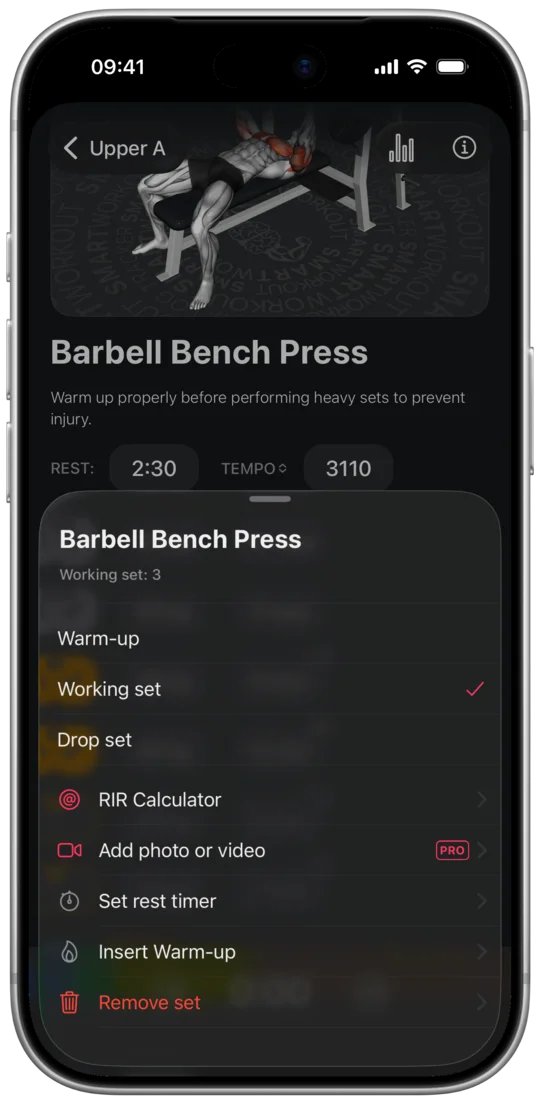
You can paste this day, without the Cable Middle Chest Fly and with the arm superset at the end, through plan import (Workout > My Plans > “+” > “Import plan”). Import gives 3 minutes after every bench press set, warm-ups included, so shorten the rest after the first warm-up set to a minute before saving. Import costs 10 AI credits, so the welcome credits cover it.
DAY: Upper A- Barbell Bench Press | WU 2x5 | 3x6-10 RIR 2 | TEMPO 20X0 | REST 180- Barbell Bent Over Row | 3x6-10 RIR 2 | TEMPO 2010 | REST 150- Seated Dumbbell Shoulder Press | 3x8-12 RIR 2 | TEMPO 2010 | REST 120- Cable Lat Pulldown | 3x8-12 RIR 1 | TEMPO 2011 | REST 120LINKED:- Cable Triceps Pushdown | 3x10-15 RIR 1 | TEMPO 2011 | REST 0- Dumbbell Biceps Curl | 3x10-15 RIR 1 | TEMPO 2010 | REST 60END LINKEDThe free 4-day upper/lower plan uses these rests after working sets in its intermediate version.
Log it in SmartWorkout
A free workout log for iPhone and Android: sets, RIR, tempo, exercise groups and plans.


Questions
How long should you rest between sets for hypertrophy?
Set 2 minutes on compound exercises and 1 to 1.5 minutes on isolation for arms and shoulders; 90-120 s on leg extensions and leg curls. Rest longer after heavy barbell sets, such as squats, bench press and deadlifts.
Do shorter rest periods burn more fat?
No. Rest the same as when you're bulking: the deficit comes from your diet, and shorter rest would cost you reps on heavy sets.
How long should you rest between sets for strength?
For sets of 1-5 reps, usually 3-5 minutes, so you can do the next set with the same weight. If you're at most one rep short on the last set, your rest is long enough.
How long should you rest between exercises?
Usually 2-3 minutes, including setting up the station. In a superset you just move from one exercise to the other, and between workouts for the same muscle group leave 2-3 days (training frequency).
How long should you rest between sets of pull-ups and push-ups?
Treat pull-ups like a heavy lift: 2-3 minutes, because you usually do few reps. Push-ups done for a dozen or more reps need 1 to 1.5 minutes.
Can you rest too long between sets?
Yes, when it makes the workout longer with no benefit: for hypertrophy, rests longer than 90 s didn't produce clearly more muscle, so 3-4 minutes on lateral raises is wasted time. On heavy lifts 4-5 minutes does no harm, but outside sets of 1-5 reps it's rarely needed.
See also
- Supersets in the gym: what they are, examples and superset vs compound setA superset is two exercises for different muscle groups done back to back with no rest in between; you rest only after both. Two exercises for the same muscle group are usually called a compound set. In a meta-analysis of 19 studies, supersets cut session time by about 37% with similar tonnage.
- Circuit training for strength: how to build a gym circuitCircuit training (a circuit) is 3 or more exercises, not all for the same muscle group, done one after another in rounds with a short move between stations. In two 8-week studies in trained lifters, circuits with sets close to failure built strength and lean mass about as well as straight sets, in less time.
- Cluster sets in lifting: what they are and how to use themA cluster set is one set split into mini sets of 1-5 reps with short rests inside the set, usually 15-45 s. In meta-analyses, cluster sets built strength and muscle about as well as traditional sets, with less velocity loss and less fatigue during the session.
- Rest-pause sets: what they are and how to do themA rest-pause set is a set taken to muscular failure, followed by a 20-30 s pause and more reps with the same weight, usually 1-2 times. In studies it built muscle about as well as straight sets in less time, and in some studies it added slightly more strength.
- Warm-up sets: how many to do and what weight to use before working setsWarm-up sets are lighter sets done before your working sets: the weight goes up and the reps go down. Before a heavy compound lift, 3-5 sets from the empty bar to 85-90% of the working weight are enough. In studies, a warm-up with a set at 80% of the working weight beat light sets alone.
- Rep ranges: how many reps for hypertrophy, strength and cuttingA rep range is the span of reps, such as 8-12, in which a set with a given weight should end. For muscle growth the exact number matters little: in studies, muscle grew similarly with sets of about 5 to more than 30 reps close to failure, while strength grew most with loads of 80% of 1RM or more.
- RIR (reps in reserve): what it means and how to estimate itRIR (reps in reserve) is the number of good reps left before failure when a set ends. RIR 0 means no reps left, and RIR 2-3 in a plan means ending the set with 2-3 reps still in the tank. In a meta-analysis of 12 studies, lifters had on average 1 rep more left than they thought.
- Training volume: what it is and what MEV, MAV and MRV meanIn hypertrophy training, training volume is the number of working sets a muscle group gets per week. In a meta-analysis of 67 studies, growth was measurable from about 4 weekly sets, with each extra set adding less; the 2026 ACSM position stand links 10 or more weekly sets to more growth.
Sources
- Singer A, Wolf M, Generoso L, et al. Give it a rest: a systematic review with Bayesian meta-analysis on the effect of inter-set rest interval duration on muscle hypertrophy. Front Sports Act Living. 2024;6:1429789.
- Grgic J, Schoenfeld BJ, Skrepnik M, et al. Effects of Rest Interval Duration in Resistance Training on Measures of Muscular Strength: A Systematic Review. Sports Med. 2018;48(1):137-151.
- Senna GW, Willardson JM, Scudese E, et al. Effect of Different Interset Rest Intervals on Performance of Single and Multijoint Exercises With Near-Maximal Loads. J Strength Cond Res. 2016;30(3):710-6.
- Rosa A, Coleman M, Haun C, et al. Repetition Performance, Rating of Perceived Discomfort, and Blood Lactate Responses to Different Rest Interval Lengths in Single-Joint and Multijoint Lower-Body Exercise. J Strength Cond Res. 2023;37(7):1350-1357.
- Iversen VM, Norum M, Schoenfeld BJ, et al. No Time to Lift? Designing Time-Efficient Training Programs for Strength and Hypertrophy: A Narrative Review. Sports Med. 2021;51(10):2079-2095.
- Behenck C, Sant'Ana H, Pinto de Castro JB, et al. The Effect of Different Rest Intervals Between Agonist-Antagonist Paired Sets on Training Performance and Efficiency. J Strength Cond Res. 2022;36(3):781-786.
- Longo AR, Silva-Batista C, Pedroso K, et al. Volume Load Rather Than Resting Interval Influences Muscle Hypertrophy During High-Intensity Resistance Training. J Strength Cond Res. 2022;36(6):1554-1559 (online 2020).
- Henselmans M, Schoenfeld BJ. The effect of inter-set rest intervals on resistance exercise-induced muscle hypertrophy. Sports Med. 2014;44(12):1635-43.
- Currier BS, D'Souza AC, Singh MAF, et al. American College of Sports Medicine Position Stand. Resistance Training Prescription for Muscle Function, Hypertrophy, and Physical Performance in Healthy Adults: An Overview of Reviews. Med Sci Sports Exerc. 2026;58(4):851-872.
- Hernandez DJ, Healy S, Giacomini ML, et al. Effect of Rest Interval Duration on the Volume Completed During a High-Intensity Bench Press Exercise. J Strength Cond Res. 2021;35(11):2981-2987.
- Farinatti PT, Castinheiras Neto AG. The effect of between-set rest intervals on the oxygen uptake during and after resistance exercise sessions performed with large- and small-muscle mass. J Strength Cond Res. 2011;25(11):3181-90.
- Fink JE, Schoenfeld BJ, Kikuchi N, et al. Acute and Long-term Responses to Different Rest Intervals in Low-load Resistance Training. Int J Sports Med. 2017;38(2):118-124 (online 2016).
- Simão R, Polito M, Freitas de Salles B, et al. Acute and Long-Term Comparison of Fixed vs. Self-Selected Rest Interval Between Sets on Upper-Body Strength. J Strength Cond Res. 2022;36(2):540-544.
- De Salles BF, Polito MD, Goessler KF, et al. Effects of fixed vs. self-suggested rest between sets in upper and lower body exercises performance. Eur J Sport Sci. 2016;16(8):927-31.
- Ibbott P, Ball N, Welvaert M, et al. The Effect of Self-Paced and Prescribed Inter-Set Rest Strategies on Performance in Strength Training. Int J Sports Physiol Perform. 2019;14(7):980-986.
- Schoenfeld BJ, Pope ZK, Benik FM, et al. Longer Interset Rest Periods Enhance Muscle Strength and Hypertrophy in Resistance-Trained Men. J Strength Cond Res. 2016;30(7):1805-12.
- Nuckols GL, Overpeck CA, Hanson ED, et al. The effects of biological sex on fatigue during and recovery from resistance exercise. PeerJ. 2026;14:e20542.
- Millender DJ, Mang ZA, Beam JR, et al. The Effect of Rest Interval Length on Upper and Lower Body Exercises in Resistance-Trained Females. Int J Exerc Sci. 2021;14(7):1178-1191.