
Cluster set key numbers
A cluster set is one set split into several mini sets with short, planned rests in between.
| Parameter | Value | Source |
|---|---|---|
| Rest inside the set | 15-45 s, 20-30 s to start | Latella et al. 2019; 20-30 s is our practice |
| Mini sets | 1-5 reps each: 1 for power, 1-2 for strength, 4 for hypertrophy; usually 2-4 per set, up to 6 with singles | the Latella et al. review; Vargas-Molina et al. 2025; the number of mini sets is our practice |
| Weight | for strength 80-90% 1RM; for hypertrophy more than for a regular set | Nicholson et al. 2016; Tufano et al. 2017 |
| Rest after the set | as after a regular set: 3-5 min for strength, 2-3 min for hypertrophy | definition from the 2026 ACSM position stand; times as in rest between sets |
| Effort | for strength the last mini set at RIR 2, for hypertrophy at RIR 0-1; the first ones will feel lighter | Tsartsapakis et al. 2026: usually not to failure; Vargas-Molina et al.: RIR 0-1 in every mini set; the RIR levels are our practice |
When cluster sets are worth it
Cluster sets don't build more strength or muscle than traditional straight sets: a meta-analysis of 29 studies found no difference in gains (Davies et al. 2021). What they give you is heavy reps that slow down less (Latella et al. 2019), but unlike other intensity techniques, they make your workout longer: barbell squats for 4 × (2+2+2) with 20 s rests take 3-4 minutes longer than 4 × 6, because you unrack the bar before every mini set.
| Goal or experience | Cluster sets | Why |
|---|---|---|
| Strength, technique and power | yes, for heavier and faster reps | strength goes up as with regular sets; one meta-analysis found a small edge in leg power (Kong et al. 2026) |
| Hypertrophy | optional | similar muscle growth if you finish close to failure |
| Beginners (under a year of training) | yes, with your regular-set weight, to practice technique | a heavier weight only once your technique is solid and you can judge RIR |
Cluster sets are a tool for a 4-6 week block in 1-2 exercises, e.g. before a strength test or in a power phase, not for every set. If you're coming back from a break or an injury, end the last mini set at RIR 2.
How to do a cluster set
- Pick an exercise where you can set the weight down in a few seconds; for hypertrophy, a machine works too.
- Split the set into 2-4 mini sets: 1-2 reps each for strength, 4 for hypertrophy.
- Do 3-5 warm-up sets, the last one a single at 90% of your working weight (1RM calculator); before the next exercise for the same muscle group, 1-2 are enough.
- Use more weight than for a regular set: end the last mini set at RIR 2 for strength and 0-1 for hypertrophy.
- Between mini sets, put the bar back in the rack or on the floor (or lock the machine) and rest 20-30 s; after the set, rest 3-5 minutes for strength and 2-3 for hypertrophy.
- Progress: add 2.5-5 kg when the last mini set feels easier than planned, or merge mini sets (2+2+2, then 3+3) until you can do that weight as a regular set (progressive overload).
The rests inside the set let you use more weight: in Tufano et al. 2017, 3 × 12 squats were done at 75-80% 1RM instead of 60%, with the same velocity loss. A short rest is enough because phosphocreatine, the muscle's fastest energy source, recovers fastest in the first 10-20 s (Tsoukos et al. 2026).
Cluster set examples in kg
The notation 4 × (2+2+2) means 4 sets, each made of 3 mini sets of 2 reps.
Cluster sets for strength and power
For strength, you do cluster sets at 80-90% 1RM (1RM calculator); for power, you split the set into fast singles with the same weight (the Latella et al. 2019 review).
| Exercise | Regular sets | Cluster sets | Rest inside / after the set |
|---|---|---|---|
| Barbell Squat | 4 × 6, 120 kg, RIR 1 | 4 × (2+2+2), 127.5 kg, RIR 2 on the last | 20-30 s / 3 min |
| Deadlift | 3 × 5, 150 kg, RIR 2 | 4 × (2+2), 160 kg, RIR 2 on the last | 20 s / 3 min |
| Power Clean | 3 × 6, 80% 1RM (study protocol) | 3 × (1+1+1+1+1+1), same weight, as fast as possible | 20-40 s / 3 min |
Cluster sets for hypertrophy
Cluster sets for hypertrophy were studied as 5 × (4+4+4) with 20 s rests and a weight that left RIR 0-1 in every mini set: muscle grew about as much as with regular sets (Vargas-Molina et al. 2025).
| Exercise | Regular sets | Cluster sets | Rest inside / after the set |
|---|---|---|---|
| Leg Press | 3 × 12, 160 kg, RIR 1 | 3 × (4+4+4), 180 kg, RIR 0-1 on the last | 20 s / 3 min |
| Seated Leg Extension Machine | 3 × 12, 50 kg, RIR 1 | 3 × (4+4+4), 55-60 kg, RIR 0-1 on the last | 20 s / 2 min |
Cluster sets on squats, deadlifts and pull-ups
Cluster sets suit heavy multi-joint lifts where you can set the weight down in a few seconds.
| Good fit | Why |
|---|---|
| Barbell Squat | the best-studied lift; the bar goes back in the rack |
| Barbell Bench Press | between mini sets you rack the bar, so you need a rack with safety arms or a spotter |
| Pull-Up | more clean reps when you can do only 5-8 in a regular set |
| Deadlift | in each break you reset your feet, grip and bracing |
For light isolation work such as the Dumbbell Lateral Raise, myo-reps or a drop set fit better.
Cluster sets vs rest-pause, myo-reps and drop sets
| Cluster set | Rest-pause | Myo-reps | Drop set | |
|---|---|---|---|---|
| When you rest | planned, before fatigue | after a set to or near failure | after an activation set | only to change the weight |
| Weight | more than in a regular set | the same | the same | less after each drop |
| Effort | for strength the last mini set at RIR 2, for hypertrophy RIR 0-1 | every part to failure | RIR 1-2, failure at most in the last one | to or near failure |
| Workout time | longer | shorter | shorter | shorter |
Cluster sets vs rest redistribution
Rest redistribution splits the same total rest into more frequent, shorter breaks, so the workout doesn't get longer. A cluster set adds its breaks on top of the regular rest after the set, so it protects better against fatigue (Jukic et al. 2020).
How to count cluster sets in your weekly sets
Count a cluster set as 1 set in your weekly sets, as the studies do: in Vargas-Molina et al. 2025, a 4+4+4 set was 1 of 10 sets per leg.
Barbell squats for 4 × (2+2+2) twice a week make 8 sets for the quads and glutes, which is MEV; you don't count the mini sets separately, because 2 reps with reps in reserve aren't a full set. You can check your week with the sets per muscle group calculator, and the page on how to count sets covers other techniques.
Common mistakes
- Too short a rest between heavy mini sets. In bench press sets to failure at 85% 1RM, a 10 s rest added almost nothing, while 20 s raised the reps from 7 to 11 on average (Tsoukos et al. 2026). Rest 20-30 s; for power singles, 15-20 s is enough.
- Using your regular-set weight. With your 10-rep weight, a mini set of 5 ends with about 5 reps in reserve (Vargas-Molina et al. 2025); add weight until the last mini set ends with the reserve you planned.
- Failure in the first mini set. The next mini sets get shorter and the cluster turns into rest-pause. For strength, don't go down to RIR 0-1; for hypertrophy, only near the end of the set.
- Clusters when you're short on time. Use rest redistribution instead: rather than barbell squats for 4 × 6 with 3-minute rests, do 12 × 2 with the same weight and 50 s rests.
What the research says
The certainty ratings are our assessment; ES is the effect size, and a value above zero means an advantage for cluster sets.
| Claim | What studies show | Certainty |
|---|---|---|
| More strength | no difference in three meta-analyses or in the 2026 ACSM position stand; in the subgroup of 9-12 week programs, regular sets built more leg strength (Kong et al. 2026) | high |
| More muscle | no difference in two meta-analyses or in a study with matched RIR; ACSM 2026: not enough data | moderate to low |
| Faster reps and less fatigue during the session | yes (Latella et al. 2019, Jukic et al. 2020) | high |
| Study | Type and sample | Result | Limitation |
|---|---|---|---|
| Davies et al. 2021 | long-term meta-analysis, 29 studies | strength ES -0.05, hypertrophy -0.05, power 0.02 | few muscle size measurements |
| Vargas-Molina et al. 2025 | 10 trained people, 8 weeks, cluster sets on one leg, regular sets on the other | similar increase in muscle thickness | small sample, thigh only |
The studies mostly tested young men and leg exercises; for upper-body lifts, isolation exercises, women and older adults there are single studies or none.
How to log cluster sets in SmartWorkout
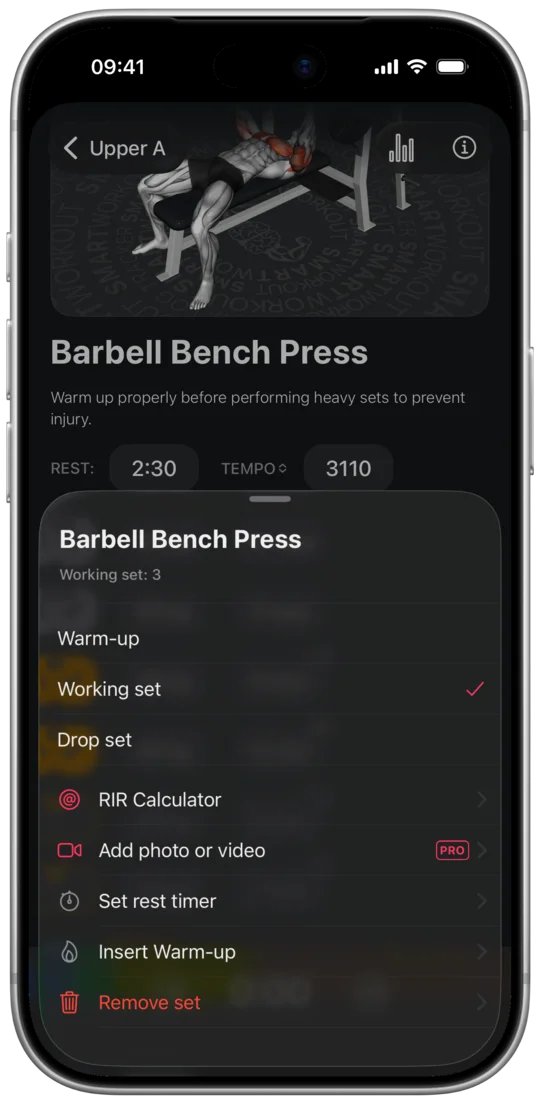
You log a cluster set in SmartWorkout as regular sets in the workout log, templates and plans: each mini set separately, with its own rest.
- In “Workout Settings” (Profile > Settings > Workout Settings), under “Rest time entry”, choose “Per set”.
- Add as many sets as you have mini sets (“Add Set”), e.g. 12 for 4 × (2+2+2).
- In each mini set's menu, choose “Set rest timer”: 20 s, and 3 minutes on the last mini set of each set.
- Enter the weight, reps and RIR of each mini set right after you rack the bar; the timer starts on its own, and the 20 s include the time you spend logging.
Don't merge mini sets into one set with the total reps, because 127.5 kg × 6 would inflate your estimated 1RM and records. In weekly sets, SmartWorkout counts each mini set as a set (4 × (2+2+2) is 12 sets); when you plan your week, count clusters as described in the section above.
The Premium progression suggestions recognize a cluster set for strength (mini sets of up to 3 reps, rests shorter than 45 s) and leave you the choice of progression from step 6 above. They treat mini sets of 4 as regular sets, so accept the weight suggestion only when the last mini set ended with the reserve you planned.
You can paste this fragment through plan import (Workout > My Plans > “+” > “Import plan”). Every mini set gets REST 20, so in the preview change the rest after the 3rd, 6th and 9th set to 3 minutes. Import costs 10 AI credits, so the welcome credits cover it.
DAY: Legs- Barbell Squat | 12x2 RIR 2 | TEMPO 20X0 | REST 20- Leg Press | 3x10-12 RIR 1 | TEMPO 2010 | REST 120- Seated Leg Curl | 3x10-12 RIR 1 | TEMPO 2011 | REST 90Log it in SmartWorkout
A free workout log for iPhone and Android: sets, RIR, tempo, exercise groups and plans.


Questions
What are cluster sets?
A cluster set is one set split into several mini sets with short, planned rests in between. After the whole set you rest as you would after a regular set. The method is also called cluster training.
Are cluster sets good for hypertrophy?
They work as well as regular sets, not better: in a study with mini sets of 4 reps, each ended at RIR 0-1, muscle growth was similar. For hypertrophy, choose them when your form breaks down in a long set.
Are cluster sets good for strength?
Strength goes up about as much as with regular sets, but you do your heavy reps with more weight and at a higher speed. They're a good choice when you practice the technique of a heavy lift or bar speed.
Rest-pause vs cluster sets: what's the difference?
In a cluster set you plan the rests before fatigue sets in and usually stop short of failure. In rest-pause you take a set to or near failure and only then take short pauses.
What is an example of a cluster set?
Barbell squats for 4 × (2+2+2) are 4 sets, each made of three rounds of 2 reps with 20 s of rest between them, and 3 minutes of rest between sets.
What does cluster mean in CrossFit?
In CrossFit, a cluster is a barbell movement: a squat clean that you drive straight into an overhead press. It shares only the name with splitting a set into mini sets.
See also
- Rest-pause sets: what they are and how to do themA rest-pause set is a set taken to muscular failure, followed by a 20-30 s pause and more reps with the same weight, usually 1-2 times. In studies it built muscle about as well as straight sets in less time, and in some studies it added slightly more strength.
- Myo-reps: what they are and how to do the activation set and mini setsMyo-reps are a rest-pause method developed by Børge Fagerli: an activation set stopped 1-2 reps short of failure, then 2-5 mini sets of 2-4 reps with the same weight after 3-5 deep breaths (10-15 s). In an 8-week study they built muscle and strength about as well as straight sets, in shorter sessions.
- Drop sets: what they are, how to do them and how much weight to dropA drop set (also called a strip set or descending set) is a set taken to or near failure, then continued without rest after cutting the weight by about 20-30%. In meta-analyses, drop sets built about as much muscle as regular sets in less time. One drop on the last set is usually enough.
- Rest between sets: how long to rest for hypertrophy, strength and fat lossRest between sets (rest interval) is the time from the end of one set to the start of the next. For hypertrophy, 1.5-2 minutes is usually enough, 2-3 minutes on heavy lifts and 3-5 minutes for sets of 1-5 reps. In a meta-analysis of 9 studies, rests shorter than a minute produced slightly less muscle.
- How to count sets per muscle group: direct, indirect and warm-up setsCounting sets per muscle group (fractional set counting) means adding up a week's working sets: 1 for the muscle that mainly does the movement, 0.5 for a muscle that clearly assists, 0 for warm-up sets. In a meta-analysis of 67 studies, this matched muscle growth better than counting assisting muscles as 1 or 0.
- Top set and back-off sets: what they are and how much weight to dropA top set is the heaviest working set of an exercise in a session, and back-off sets are 2-4 working sets after it, done after full rest and usually 5-20% lighter. In a 6-week study of powerlifters, 2 back-off sets at 80% of the top set weight gave clearer strength gains than the top set alone.
- Rep ranges: how many reps for hypertrophy, strength and cuttingA rep range is the span of reps, such as 8-12, in which a set with a given weight should end. For muscle growth the exact number matters little: in studies, muscle grew similarly with sets of about 5 to more than 30 reps close to failure, while strength grew most with loads of 80% of 1RM or more.
- RIR (reps in reserve): what it means and how to estimate itRIR (reps in reserve) is the number of good reps left before failure when a set ends. RIR 0 means no reps left, and RIR 2-3 in a plan means ending the set with 2-3 reps still in the tank. In a meta-analysis of 12 studies, lifters had on average 1 rep more left than they thought.
Sources
- Latella C, Teo WP, Drinkwater EJ, et al. The Acute Neuromuscular Responses to Cluster Set Resistance Training: A Systematic Review and Meta-Analysis. Sports Med. 2019;49(12):1861-1877.
- Vargas-Molina S, García-Sillero M, Maroto-Izquierdo S, et al. Cluster sets and traditional sets elicit similar muscular hypertrophy: a volume and effort-matched study in resistance-trained individuals. Eur J Appl Physiol. 2025;125(6):1725-1734.
- Nicholson G, Ispoglou T, Bissas A. The impact of repetition mechanics on the adaptations resulting from strength-, hypertrophy- and cluster-type resistance training. Eur J Appl Physiol. 2016;116(10):1875-88.
- Currier BS, D'Souza AC, Singh MAF, et al. American College of Sports Medicine Position Stand. Resistance Training Prescription for Muscle Function, Hypertrophy, and Physical Performance in Healthy Adults: An Overview of Reviews. Med Sci Sports Exerc. 2026;58(4):851-872.
- Tsartsapakis I, Zafeiroudi A, Kouthouris C. Effects of Advanced Resistance Training Systems on Muscle Hypertrophy and Strength in Recreationally Trained Adults: A Systematic Review and Meta-Analysis. J Funct Morphol Kinesiol. 2026;11(1).
- Davies TB, Tran DL, Hogan CM, et al. Chronic Effects of Altering Resistance Training Set Configurations Using Cluster Sets: A Systematic Review and Meta-Analysis. Sports Med. 2021;51(4):707-736.
- Kong Z, Zhang M, Xin X, et al. Cluster training versus traditional resistance training on lower-limb muscle strength, jumping, and explosive power performance: a systematic review and meta-analysis. BMC Sports Sci Med Rehabil. 2026;18(1):127.
- Tufano JJ, Conlon JA, Nimphius S, et al. Cluster Sets: Permitting Greater Mechanical Stress Without Decreasing Relative Velocity. Int J Sports Physiol Perform. 2017;12(4):463-469 (online 2016).
- Tsoukos A, Ververis A, Bogdanis GC. Effects of Continuous and Cluster-Set Configurations Performed to Failure on Performance and Physiological Responses in the Bench Press and Half Squat. Scand J Med Sci Sports. 2026;36(7):e70337.
- Jukic I, Ramos AG, Helms ER, et al. Acute Effects of Cluster and Rest Redistribution Set Structures on Mechanical, Metabolic, and Perceptual Fatigue During and After Resistance Training: A Systematic Review and Meta-analysis. Sports Med. 2020;50(12):2209-2236.