
Key numbers: how many reps for each goal
| Goal | Range | Source |
|---|---|---|
| Muscle growth | similar growth from about 30% of 1RM, i.e. from about 5 to more than 30 reps close to failure; 6-20 in practice | Schoenfeld et al. 2021; 6-20 is our practice |
| Strength | loads of 80% of 1RM or more, usually 1-5 reps with 1-2 in reserve | load: the 2026 ACSM position stand; reps: converted with the RIR/RPE table |
| Muscular endurance | more than 15 reps at 40-60% of 1RM | ACSM 2009; mixed evidence |
| First months of training | 6-10 or 8-12 on barbell lifts at RIR 2-3; heavy sets of 1-5 only after a few months | ACSM 2009: 8-12RM, i.e. sets to failure; at RIR 2 the same weight gives about 6-10 reps |
| Range width | at least as many reps as you lose when you add the smallest weight jump: about 1 on a barbell (6-10 is enough), 4-7 with light dumbbells (e.g. 12-20) | our practice |
How many reps for muscle, strength and endurance
For muscle growth, the number of reps matters less than you might think: muscle grows about equally across a wide range. For strength, the load matters, so on the lift you want to improve you stay with lower reps. That's what a network meta-analysis found (Currier et al. 2023).
How many sets to do per muscle group each week is covered on the training volume page.
Rep range for hypertrophy
Muscle grows about equally across a wide range of loads, from about 30% of 1RM up, as long as the set ends close to failure (Schoenfeld et al. 2021). In trained men, sets of 20-25 reps to failure built as much muscle over 12 weeks as sets of 8-12 (Morton et al. 2016).
In practice, 6-20 reps is easier to work with: light sets last longer and burn more, while heavy sets put more strain on your joints when you do a lot of them (same review). With the same number of sets, 2-4 reps produced less thigh muscle growth than 8-12 in one study (Schoenfeld et al. 2016), while in a newer one, sets of 3-5 to failure built as much as sets of 20-25 (Cumming et al. 2025). So do your hypertrophy sets mostly from 6 reps up, and count sets of 1-5 in your weekly sets like any others.
If all you have at home is light dumbbells, do sets of 15-30 reps and end them at a perceived RIR 0-1.
Rep range for strength
Strength goes up more the heavier the load: loads of 80% of 1RM or more give the most (the 2026 ACSM position stand), sets of 9-15 reps only a little less, and only light sets of more than 15 reps clearly less (Lopez et al. 2021). The advantage of heavy sets shows up mainly in your 1RM on the exercise you trained (Schoenfeld et al. 2021), so do heavy sets of 1-5 at RIR 1-2 on the lift you want to improve and everything else in your usual ranges.
Rep range for endurance
For muscular endurance, ACSM 2009 recommended light sets of more than 15 reps with rests shorter than 90 s. In one study, sets of 25-35 reps improved bench press endurance by 17%, and sets of 8-12 not at all (Schoenfeld et al. 2015).
Rep range when cutting
When you cut to lose fat, training is there to protect your muscle, so you keep the same ranges and try to hold on to your weights. Recommendations for natural bodybuilders preparing for a contest are 3-15 reps, mostly 6-12 (Helms et al. 2015).
How to choose a rep range step by step
- Pick a range by exercise: main barbell lifts 6-10 (deadlift 5-8), other multi-joint exercises 8-12, isolation 10-15, lateral raises and rear delt raises 12-20.
- Check the smallest weight jump on your equipment and widen the range if the jump is big (table below).
- Add a reserve in RIR to the range, e.g. “8-12, RIR 1-2”.
- In your first workout, pick a weight so the last set ends at the bottom of the range with the target reserve; the first set usually comes out 1-2 reps higher.
- Add reps from workout to workout until every set reaches the top of the range.
- Then add the smallest weight jump and start again from the bottom of the range.
A barbell with 1.25 kg plates lets you add 2.5 kg, while a cable stack usually goes up in 5 kg steps; if there are 1.25-2.5 kg add-on weights next to the stack, the range on that cable can be narrower.
Rep range and percentage of 1RM
The same percentage of 1RM gives a different number of reps in different exercises and for different people: at 80% of 1RM you get about 9 reps to failure on the barbell bench press and about 13 on the leg press (Nuzzo et al. 2024). That's why a plan gives a range and an RIR, and you adjust the weight after the first set. For other percentages, see the table on the intensity page and the 1RM calculator.
How wide a range light weights need
A rep range has to be at least as wide as the drop in reps after the smallest weight jump. We calculate that drop at the same RIR with the RIR/RPE table, from the top of the range; for isolation exercises and long sets it's only an approximation, and your first set at the new weight shows your real number.
| Current set | Next weight | Jump | Reps at the same RIR (approx.) | Range |
|---|---|---|---|---|
| Barbell Bench Press, 80 kg × 10, RIR 2 | 82.5 kg | 3% | 9 | 6-10 is enough |
| Incline Dumbbell Bench Press, 24 kg × 12, RIR 1 | 26 kg | 8% | 9 | 8-12 is enough |
| Dumbbell Lateral Raise, 8 kg × 12, RIR 1 | 10 kg | 25% | 5 | 8-12 is too narrow |
With light dumbbells even the smallest jump is big: 8 to 9 kg is 12.5%, about 3 reps fewer in a set of 12 and more in a set of 20, so lateral raises need a 12-20 range. A jump from 8 to 10 kg (25%) already costs 7 reps in a set of 12, and no sensible range can absorb it. In that case, do a few reps above the top of the range before you move up, or do your first set with the heavier dumbbell and the rest with the lighter one. You can work out sets of up to 12 reps in the RIR/RPE calculator.
Rep ranges and double progression
A rep range is where your reps grow before your weight does; that's how double progression works. In an 8-week study of people with at least a year of training, both adding weight within 8-12 reps and adding reps at a fixed weight worked (Plotkin et al. 2022).
Rep ranges in one workout
Within one workout, exercises have different ranges: the heaviest lift the lowest, isolation the highest. The table shows the Lower A day from week 2 of the free 4-day upper/lower plan for intermediates.
| Exercise | Sets and range | RIR | Rest |
|---|---|---|---|
| Barbell Squat | 2 warm-up, 3 × 6-10 | 2 | 180 s |
| Romanian Deadlift | 3 × 8-12 | 2 | 150 s |
| Seated Leg Curl | 3 × 10-15 | 1 | 90 s |
| Seated Leg Extension Machine | 2 × 10-15 | 1 | 90 s |
| Calf Leg Press | 3 × 10-15 | 1 | 60 s |
| Kneeling Cable Abs Crunches | 2 × 10-15 | 1 | 60 s |
In the full body to split plan for beginners, the main lifts use 8-12 for 4 weeks, then 6-10 with about 5-10% more weight.
Rep ranges for squats, bench press, lateral raises and calves
The right rep range depends on the exercise: barbell lifts get the lowest one, and light dumbbells the widest, because they go up in big jumps.
| Exercise | Range | Smallest jump | Why |
|---|---|---|---|
| Barbell Bench Press | 6-10 | 2.5 kg | the jump is 2-4% of the weight |
| Barbell Squat | 6-10 | 2.5 kg | in a long set, breathing and technique give out first |
| Deadlift | 5-8 | 2.5-5 kg | in a long set your back position breaks down first, and it's the most tiring lift |
| Pull-Up | 5-10 | 1.25-2.5 kg on a belt | once you get 10 on every set, add weight; if you get fewer than 5, do the Assisted Pull-Up instead |
| Cable Lat Pulldown | 8-12 | 5 kg on the stack | at 60 kg the jump is 8% |
| Dumbbell Lateral Raise | 12-20 | 1-2 kg | 8 to 9 kg is 12.5%; before a 2 kg jump (25%), do reps above the range |
| Dumbbell Biceps Curl | 10-15 | 2 kg | at 12 kg the jump is 17%; before moving up, do reps above 15 |
| Cable Triceps Pushdown | 10-15 | 2.5-5 kg on the stack | at 25 kg the jump is 10-20% |
| Seated Calf Raise | 10-15 | 2.5 kg | short movement; a 2.5 kg plate is 5-10% of the weight, so 10-15 is enough |
| Dumbbell Russian Twist | 10-20 | 1-2 kg | always count the same way: each twist or each left-right cycle |
If you want strength on the three barbell lifts, add heavy sets of 1-5 reps on top of these ranges. The Deadlift, Pull-Up and Dumbbell Russian Twist aren't in our plans; the ranges for them are our practice.
Rep range vs fixed reps vs AMRAP vs top set
| Range (3 × 8-12) | Fixed reps (3 × 5) | AMRAP (1 × 10+) | Top set and back-off sets | |
|---|---|---|---|---|
| What the plan says | a minimum and a maximum | exactly that many reps | a minimum with no upper limit | one heavy set, then lighter ones |
| When you add weight | when every set reaches the top of the range | every workout, as long as you get all the reps (linear progression) | when you beat the minimum by 3 or more | when the top set reaches the top of its range with reps in reserve |
| Who it's for | most exercises | beginners on linear progression in barbell lifts | testing, bodyweight exercises | heavy lifts for intermediates |
Common mistakes
- Range narrower than the jump. On dumbbell lateral raises in a 10-12 range, the jump from 8 to 10 kg pushes you below the bottom of the range. Set 12-20, and with a 25% jump, stay with your current dumbbell and do a few reps above 20, or switch to the One-Arm Cable Lateral Raise with 1.25-2.5 kg add-on weights.
- No RIR target. A set of about 20 reps with a weight you could lift about 34 times built almost no muscle (Lasevicius et al. 2022). Log an RIR target with every range, and every few weeks check your long sets with one set to failure on a machine, because above 12 reps you judge your reserve less accurately (Halperin et al. 2022).
- Reps at the cost of form. Twelve reps with half the range of motion or with swinging aren't progress over ten full ones. Count only reps with the same range of motion and tempo as in your last workout.
- A new range at every plateau. Switching from 8-12 to 6-8 and back every week ruins the comparison of your results. Change the range between blocks or on a set schedule, as in undulating periodization, and work through a plateau with the list of plateau causes.
What the research says
| Claim from guides | What studies show | Certainty |
|---|---|---|
| “Only 8-12 for hypertrophy” | similar growth across a wide range of loads, in sets close to failure | high |
| “1-5 for strength” | more strength after heavier loads, mainly in 1RM of the same exercise | high |
| “Light sets build as much as heavy ones” | yes, but only close to failure | high; that the sets must be close to failure: moderate (one study of 25 people with light sets, and a meta-regression, Robinson et al. 2024) |
| “High reps for endurance” | sometimes a better result with light sets; mixed evidence | low |
| Study | Type and sample | Result | Limitation |
|---|---|---|---|
| Lopez et al. 2021 | network meta-analysis, 28 studies, 747 people | muscle: no difference between sets of up to 8, 9-15 and more than 15RM; strength: better after heavy (SMD 0.60-0.63) and moderate loads (0.34-0.35) than after light ones | sets to failure only |
| Currier et al. 2023 | network meta-analysis, 119 studies on muscle and 178 on strength, 45-47% women | strength best after heavy loads; muscle similar across all programs | some comparisons indirect |
| Morton et al. 2016 | 49 trained men, 12 weeks | muscle: no difference (result above); 1RM differed only in the bench press (+9 kg after light, +14 kg after heavier loads) | young men only |
It's unknown whether combining different ranges in one plan builds more muscle than a single range; the evidence is weak (Schoenfeld et al. 2021).
What SmartWorkout logs show
Lifters in our logs, mostly in Poland, do fewer reps on heavy lifts than on isolation exercises, but on lateral raises the typical set falls below our 12-20 range. Every number is based on at least 50 people.
How to set a rep range in SmartWorkout
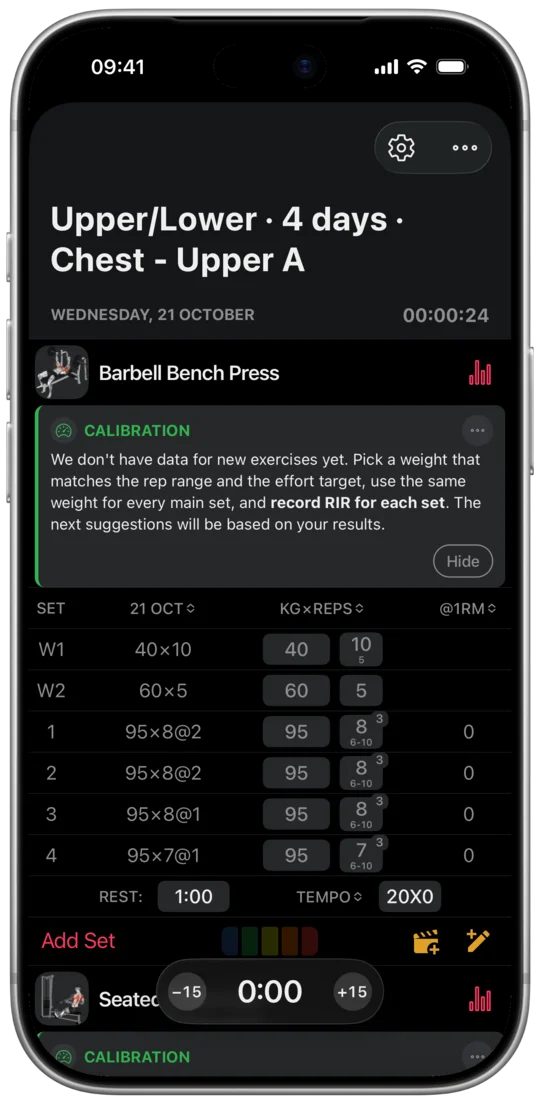
In SmartWorkout you set a rep range on every set of a template or plan, and during the workout you see it in the reps field.
- In a plan (Workout > My Plans) or a template, tap the “REPS” column header of an exercise.
- In the “Repetition options” sheet, choose “Repetition range”.
- Enter the bottom of the range in the “min” field and the top in the second field, e.g. 8 and 12. An empty second field means AMRAP with a minimum.
- During the workout, enter the reps you actually did and your reserve (RIR or RPE): approving a set with an empty field logs the target, usually the top of the range, so 12 even if you did 9.
In your Profile, under “Statistics”, the “Rep ranges” section shows how many reps your working sets have.
With Premium you know what to do next workout: add a rep, add weight or stay at your current target. When the next weight is too big a jump for your range, the card tells you how many reps you'll get with it and suggests a wider range or more reps at your current weight. The help article on progression suggestions explains how it works.
You can paste the Lower A day through plan import (Workout > My Plans > “+” > “Import plan”) and check it in the preview. Import costs 10 AI credits, so the welcome credits cover it.
DAY: Lower A- Barbell Squat | WU 2x5 | 3x6-10 RIR 2 | TEMPO 20X0 | REST 180- Romanian Deadlift | 3x8-12 RIR 2 | TEMPO 3010 | REST 150- Seated Leg Curl | 3x10-15 RIR 1 | TEMPO 2011 | REST 90- Seated Leg Extension Machine | 2x10-15 RIR 1 | TEMPO 2011 | REST 90- Calf Leg Press | 3x10-15 RIR 1 | TEMPO 2210 | REST 60- Kneeling Cable Abs Crunches | 2x10-15 RIR 1 | TEMPO 2011 | REST 60Log it in SmartWorkout
A free workout log for iPhone and Android: sets, RIR, tempo, exercise groups and plans.


Questions
What is the best rep range for hypertrophy?
6-10 on the main barbell lifts, 8-15 on other exercises and 12-20 on lateral raises. Leave 1-2 reps in reserve, and take sets of 20 or more reps closer to failure, at a perceived RIR 0-1. Sets of 20-30 build muscle too, but they take longer and are more tiring.
How many sets and reps to build muscle?
You choose reps by exercise and count sets per muscle group per week: usually 4-10 (MEV), and 10-20 (MAV) for a muscle group you want to grow faster. You can count your week in the sets per muscle group calculator.
What rep range is best for strength?
On the lift you want to improve, 2-3 heavy sets of 1-5 reps with 1-2 reps in reserve. Keep doing the other exercises in your hypertrophy ranges.
How many reps should a beginner do?
6-10 or 8-12 on the main barbell lifts and 10-15 on isolation exercises, with 2-3 reps in reserve. That's how you learn technique and how to judge your reserve. Save heavy sets of 1-5 for when your technique is consistent, usually after a few months.
How many reps to build muscle and lose fat?
The same as when bulking. When cutting, you change your diet, and in training you try to keep your weights; save sets to failure for isolation exercises, not heavy lifts.
How many reps for biceps and shoulders?
10-15 for biceps. For shoulders, 6-10 or 8-12 on the barbell overhead press, 8-12 with dumbbells, and 12-20 on lateral raises, because with light dumbbells, even the next pair up is a big jump in weight.
See also
- Progressive overload: what it is, linear vs double progression, and how to break a plateauProgressive overload is the gradual increase of training demands, most often load, reps or sets. The ACSM advises adding 2-10% load once you do 1-2 reps over your target in two sessions in a row. In an 8-week study, adding reps built about as much muscle as adding load.
- AMRAP: what it means and how to do an AMRAP set at the gymAn AMRAP set (as many reps as possible) is a set in which you do as many clean reps as you can with a given weight. Plans write it as “10+”: a minimum with no upper limit. In CrossFit the same abbreviation means a timed workout: as many rounds as possible, e.g. in 20 minutes.
- RIR (reps in reserve): what it means and how to estimate itRIR (reps in reserve) is the number of good reps left before failure when a set ends. RIR 0 means no reps left, and RIR 2-3 in a plan means ending the set with 2-3 reps still in the tank. In a meta-analysis of 12 studies, lifters had on average 1 rep more left than they thought.
- Training volume: what it is and what MEV, MAV and MRV meanIn hypertrophy training, training volume is the number of working sets a muscle group gets per week. In a meta-analysis of 67 studies, growth was measurable from about 4 weekly sets, with each extra set adding less; the 2026 ACSM position stand links 10 or more weekly sets to more growth.
- Rest between sets: how long to rest for hypertrophy, strength and fat lossRest between sets (rest interval) is the time from the end of one set to the start of the next. For hypertrophy, 1.5-2 minutes is usually enough, 2-3 minutes on heavy lifts and 3-5 minutes for sets of 1-5 reps. In a meta-analysis of 9 studies, rests shorter than a minute produced slightly less muscle.
- Training to failure: when it helps and when it just adds fatigueTraining to failure means ending a set only when, despite full effort, you cannot complete the next rep through a full range of motion without changing your form. In a meta-analysis of 15 studies it built no significantly more muscle or strength than stopping short of failure, and it is clearly more fatiguing.
- Top set and back-off sets: what they are and how much weight to dropA top set is the heaviest working set of an exercise in a session, and back-off sets are 2-4 working sets after it, done after full rest and usually 5-20% lighter. In a 6-week study of powerlifters, 2 back-off sets at 80% of the top set weight gave clearer strength gains than the top set alone.
- Undulating periodization: changing the load across the weekUndulating periodization is a plan in which the rep range and load change from session to session (daily undulating periodization, DUP) or every week, e.g. 8, 6 and 4 reps across three sessions. In meta-analyses muscle grew the same as with linear periodization; one of three found a strength edge in trained lifters.
Sources
- Schoenfeld BJ, Grgic J, Van Every DW, et al. Loading Recommendations for Muscle Strength, Hypertrophy, and Local Endurance: A Re-Examination of the Repetition Continuum. Sports (Basel). 2021;9(2):32.
- Currier BS, D'Souza AC, Singh MAF, et al. American College of Sports Medicine Position Stand. Resistance Training Prescription for Muscle Function, Hypertrophy, and Physical Performance in Healthy Adults: An Overview of Reviews. Med Sci Sports Exerc. 2026;58(4):851-872.
- American College of Sports Medicine. American College of Sports Medicine position stand. Progression models in resistance training for healthy adults. Med Sci Sports Exerc. 2009;41(3):687-708.
- Lasevicius T, Schoenfeld BJ, Silva-Batista C, et al. Muscle Failure Promotes Greater Muscle Hypertrophy in Low-Load but Not in High-Load Resistance Training. J Strength Cond Res. 2022;36(2):346-351.
- Currier BS, Mcleod JC, Banfield L, et al. Resistance training prescription for muscle strength and hypertrophy in healthy adults: a systematic review and Bayesian network meta-analysis. Br J Sports Med. 2023;57(18):1211-1220.
- Morton RW, Oikawa SY, Wavell CG, et al. Neither load nor systemic hormones determine resistance training-mediated hypertrophy or strength gains in resistance-trained young men. J Appl Physiol (1985). 2016;121(1):129-38.
- Schoenfeld BJ, Peterson MD, Ogborn D, et al. Effects of Low- vs. High-Load Resistance Training on Muscle Strength and Hypertrophy in Well-Trained Men. J Strength Cond Res. 2015;29(10):2954-63.
- Schoenfeld BJ, Contreras B, Vigotsky AD, et al. Differential Effects of Heavy Versus Moderate Loads on Measures of Strength and Hypertrophy in Resistance-Trained Men. J Sports Sci Med. 2016;15(4):715-722.
- Cumming KT, Elvatun IC, Kalenius R, et al. Divergent strength gains but similar hypertrophy after low-load and high-load resistance exercise training in trained individuals: many roads lead to Rome. J Appl Physiol (1985). 2025;139(3):685-697.
- Helms ER, Fitschen PJ, Aragon AA, et al. Recommendations for natural bodybuilding contest preparation: resistance and cardiovascular training. J Sports Med Phys Fitness. 2015;55(3):164-78 (online 2014).
- Nuzzo JL, Pinto MD, Nosaka K, et al. Maximal Number of Repetitions at Percentages of the One Repetition Maximum: A Meta-Regression and Moderator Analysis of Sex, Age, Training Status, and Exercise. Sports Med. 2024;54(2):303-321 (online 2023).
- Plotkin D, Coleman M, Van Every D, et al. Progressive overload without progressing load? The effects of load or repetition progression on muscular adaptations. PeerJ. 2022;10:e14142.
- Halperin I, Malleron T, Har-Nir I, et al. Accuracy in Predicting Repetitions to Task Failure in Resistance Exercise: A Scoping Review and Exploratory Meta-analysis. Sports Med. 2022;52(2):377-390 (online 2021).
- Lopez P, Radaelli R, Taaffe DR, et al. Resistance Training Load Effects on Muscle Hypertrophy and Strength Gain: Systematic Review and Network Meta-analysis. Med Sci Sports Exerc. 2021;53(6):1206-1216.
- Robinson ZP, Pelland JC, Remmert JF, et al. Exploring the Dose-Response Relationship Between Estimated Resistance Training Proximity to Failure, Strength Gain, and Muscle Hypertrophy: A Series of Meta-Regressions. Sports Med. 2024;54(9):2209-2231.