
Top set and back-off key numbers
| Parameter | Value | Source |
|---|---|---|
| Top set | 1 set, 1-8 reps, RIR 1-2 (RPE 8-9), RIR 2 in the deadlift | failure only on the last set (Helms et al. 2016) |
| Rest after the top set | 3-5 min | de Salles et al. 2009 |
| Weight drop | 2-7% for the same reps, 5-20% for more reps; worked out with 1 more RIR for fatigue | the calculator's RPE table; the fatigue margin is our practice |
| Back-off sets | 2-4 with the same weight | 2 in the powerlifter study (Androulakis-Korakakis et al. 2021); 3-4 is our practice |
| Effort and rest in back-off sets | RIR 2-3 in the first (1-2 for hypertrophy); 2-3 min, and 3-4 min after sets of 1-5 reps in the squat and deadlift | our practice |
- Working set
- Warm-up
Top set meaning
A top set is the heaviest working set of an exercise in a session, usually just one. The lighter working sets after it, done after full rest, are back-off sets (also called down sets). A planned weight drop lets you hold your reps in them despite fatigue (Rodriguez et al. 2021).
When a top set and back-off sets are worth it
No study has compared a top set with back-off sets against straight sets at the same number of sets, for either muscle or strength. The advantage is practical: the top set shows how strong you are today, and you work out the back-off weight from its result, as in Helms et al. 2018, so on a weaker day your back-off sets get lighter on their own. Among intensity techniques, a top set suits heavy multi-joint exercises. A planned weight drop across sets produced muscle growth similar to a fixed weight in the only long study (Lima et al. 2018).
| Goal or experience | Setup | Why |
|---|---|---|
| Strength | a top set of 1-5 reps, then 2-3 sets of 3-5 | strength improves most with loads of 80% 1RM or more (2026 ACSM position stand) |
| Hypertrophy | a top set of 5-8 reps, then 2-3 sets of 8-12 | muscle grows across a wide range of loads (Schoenfeld et al. 2017), so the number of sets is what counts |
| First months | straight sets | the weight goes up every session, and your RIR calls are still taking shape |
| Progress slows | a top set at RIR 2, then 2-3 back-off sets | move to RIR 1 once you can judge your reserve to within one rep |
| Dumbbell isolation | straight sets; back-off sets only on a machine or cable with a small stack step | dropping from 8 kg to 6 kg is already 25% |
How to do a top set and back-off sets
- Do warm-up sets from the empty bar up to 85-90% of your top set weight (warm-up calculator).
- Do the top set for 1-8 reps with 1-2 reps in reserve (RIR 1-2, RPE 8-9).
- Rest 3-5 minutes (rest between sets).
- Work out the back-off weight from the table below with 1 more rep in reserve than you plan: for a planned RIR 2, use RIR 3, because you're fatigued after the top set.
- Do 2-4 back-off sets with the same weight: leave 2-3 reps in reserve in the first; the last will usually have 1 fewer.
- When you hit the top of the rep range on the top set with reps to spare, add weight and recalculate the back-off sets (double progression). When the last back-off set reaches failure, go one step lighter next time.
- Top set (kg × 5-6)
- Back-off sets (kg × 8)
Do a heavy barbell top set in a rack with the safety bars set just below the bottom of the movement, or with a spotter. Work out the back-off weight before the top set.
Top set variants
You can do the top set to a target RIR: work up to the weight that leaves 1-2 reps in reserve. If it went up with more in reserve than you planned, add weight and do a second top set, and base the back-off sets on the heavier one.
How many back-off sets to do and what RPE stop means
You either set the number of back-off sets in advance or stop when a set reaches your target RPE (RPE stop). In Helms et al. 2018, powerlifters did a second top set when the first one was too light, and their back-off sets had as many reps as the top set; the bigger the drop (2, 4 or 6%), the more sets they did. No one has studied the long-term effects (Hickmott et al. 2022), so stick to a fixed 2-4 sets.
How much weight to drop for back-off sets
For back-off sets you usually cut the weight by 5-20% from the top set, or by 2-7% for the same number of reps: the more reps and reserve you want in them, the bigger the drop.
| Top set | Back-off sets | Drop | With a 100 kg top set | With a fatigue margin (+1 RIR) |
|---|---|---|---|---|
| 5 reps, RIR 1 | 5 reps, RIR 2 | 3% | 97.5 kg | 95 kg |
| 1 rep, RIR 1 | 3 reps, RIR 3 | 12% | 87.5 kg | 85 kg |
| 3 reps, RIR 1 | 5 reps, RIR 2 | 9% | 90 kg | 87.5 kg |
| 5 reps, RIR 1 | 8 reps, RIR 2 | 12% | 87.5 kg | 85 kg |
| 8 reps, RIR 1 | 12 reps, RIR 2 | 18% | 82.5 kg | 77.5 kg |
Each extra rep or rep in reserve here means about 3% less weight, and about 4% above 8 reps; the top set and back-off calculator works out the weight for your reps and RIR.
Powerlifters in Androulakis-Korakakis et al. 2021 followed a single-rep top set with 2 sets of 3 at 80% of its weight and rated them at RPE 6-7, although the table would put them below RPE 6. So fatigue after the top set adds 1-2 RPE points, hence the extra rep in reserve in step 4. On top of that, people differ by about 2.5 reps at 80% 1RM (Nuzzo et al. 2024), so treat your first back-off set as a test.
Top set and back-off examples in kg
Here we work out the back-off weight from the RPE table with 1 more rep in reserve, and in the deadlift as 80-85% of the top set: the powerlifter study used 80% after a single at about RIR 1, and our top set is at RIR 2.
| Exercise | Top set | Back-off sets | Rest after the top set / then |
|---|---|---|---|
| Barbell Squat | 140 kg × 3, RIR 1 | 3 × 5 at 122.5 kg (13% less), RIR 2 | 4 min / 3-4 min |
| Barbell Bench Press | 100 kg × 5, RIR 1 | 3 × 8 at 85 kg (15% less), RIR 2 | 3 min / 2-3 min |
| Deadlift | 180 kg × 1, RIR 2 | 2 × 3 at 150 kg (17% less), RIR 3-4 | 5 min / 3 min |
Top sets in the squat, bench press and deadlift
A top set with back-off sets suits multi-joint exercises with a small weight step.
| Good fit | Why |
|---|---|
| Barbell Bench Press | 1.25 kg plates give a 2.5% step at 100 kg |
| Barbell Squat | a heavy top set for strength, and back-off sets to add more sets |
| Deadlift | one heavy set instead of several, and technique is easier to hold on the lighter ones |
| Barbell Overhead Press | progress stalls fastest here, and a top set gives you one heavy set; at 50 kg a 2.5 kg step is already 5% |
Back-off sets vs straight sets, reverse pyramid and drop sets
You do a back-off set after full rest; in a drop set you cut the weight without rest.
| Top set and back-off | Straight sets | Reverse pyramid | Drop set | |
|---|---|---|---|---|
| Weight | after the heaviest first set, several equal, lighter ones | the same in every set | goes down every set | goes down within the same set |
| Reps | the same or more in back-off sets | often fewer from set to set | usually more | to failure in each drop |
| Weekly sets count | each set | each set | each set | the whole drop set as 1 set |
Common mistakes
- A top set to failure. A set to failure takes reps from the sets that follow (Helms et al. 2016). Leave 1-2 reps in reserve on the top set.
- Guessing the drop. With a top set of 8 and back-off sets of 12, the table gives 18%; with a 10% drop you'll reach twelve reps only by going to failure, if at all. Take the drop from the table, with 1 more rep in reserve.
- Short rest after the top set. With a minute of rest, holding 10 squat reps took a drop of about 10% per set (Willardson et al. 2012). Rest at least 3 minutes.
- A top set in every exercise. In later exercises you're already fatigued when you get to it. Give it to the first 1-2 multi-joint exercises, and use straight sets for isolation.
What the research says
| Claim from guides | What studies show | Certainty |
|---|---|---|
| More muscle than straight sets | no direct comparison; the weight drop didn't cost muscle growth | low |
| Back-off sets add strength | yes, in one powerlifter study, but compared with doing the single top set alone, which meant fewer sets | low |
| Study | Type and sample | Result | Limitation |
|---|---|---|---|
| Androulakis-Korakakis et al. 2021 | powerlifters, 6 weeks, 8 men per group | most likely gain in the powerlifting total: about 34 kg vs 11 kg without back-off sets | quasi-random allocation, exploratory analysis |
| Helms et al. 2018 | 12 powerlifters (9 men, 3 women), 3 weeks | RPE stop: with drops of 2, 4 and 6%, relative tonnage of 74.6, 88.4 and 114.4 | no strength or muscle measurement |
| Lima et al. 2018 | 21 men, 16 weeks, biceps curls | muscle thickness and 10RM gains similar to a fixed weight; lower RPE with a 10% drop | 7 people per group, no top set |
It's unknown whether these results hold for women and over several months: the studies lasted 3-16 weeks, with 7-12 people per group, almost all of them men.
What SmartWorkout logs show
Lifters drop more weight than the RPE table gives for the same reps (14% vs 2-7%), but half of these exercises are isolation moves, where the smallest dumbbell or stack step is 10-25%. Every number is based on at least 50 people.
How to log a top set and back-off sets in SmartWorkout
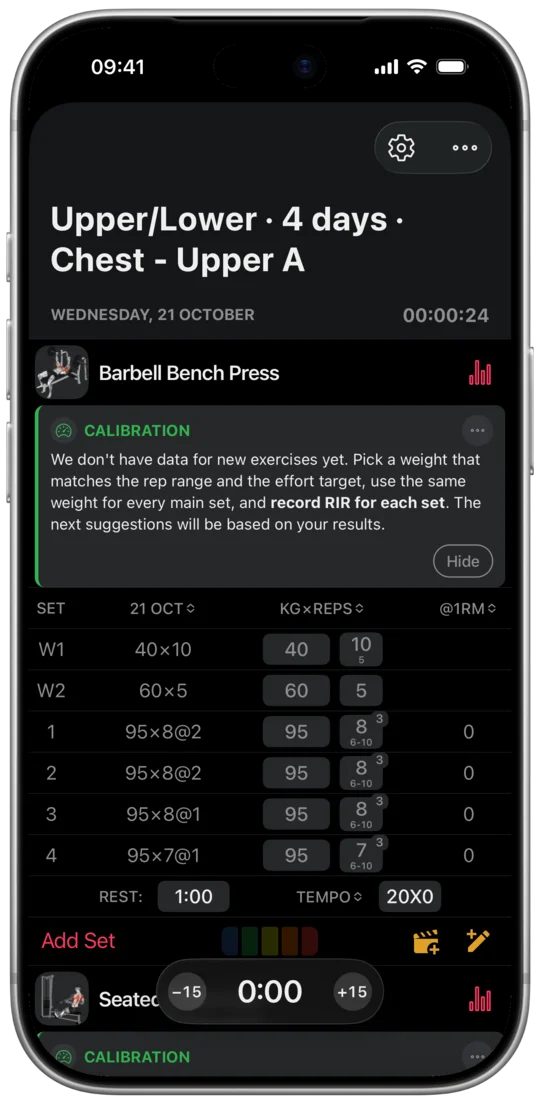
You log a top set and back-off sets in SmartWorkout as regular working sets: in the workout log, in templates and in plans.
- Mark the build-up sets as “Warm-up” in the set menu, or add them with “Insert Warm-up”.
- Enter the top set in the first working set, e.g. 100 kg × 5, RIR 1.
- Add the back-off sets with “Add Set”, e.g. 3 sets of 85 kg × 8; you can work out the weight in “Profile” > “Calculators” > “RIR/RPE Calculator”.
- For a longer rest after the top set, choose “Workout Settings” > “Rest time entry” > “Per set”, then tap “Set rest timer” in the top set's menu.
- In a template or plan, give the top set and the back-off sets separate rep ranges.
With Premium, progression suggestions recognize this setup and suggest separate targets for the top set and the back-off sets in your next session.
You can paste this fragment through plan import (Workout > My Plans > “+” > “Import plan”). Import costs 10 AI credits, so the welcome credits cover it.
DAY: Upper A- Barbell Bench Press | WU 2x5 | 1x4-6 RIR 1 + 3x6-8 RIR 2 | TEMPO 20X0 | REST 180- Barbell Bent Over Row | 1x6-8 RIR 1 + 2x10-12 RIR 2 | TEMPO 2010 | REST 180- Incline Dumbbell Bench Press | 3x8-12 RIR 1 | TEMPO 2010 | REST 120- Wide Grip Lat Pulldown | 3x10-12 RIR 1 | TEMPO 2010 | REST 120Log it in SmartWorkout
A free workout log for iPhone and Android: sets, RIR, tempo, exercise groups and plans.


Questions
What is a back-off set?
A back-off set is a lighter working set after your top set, the heaviest set of the exercise, done after full rest. You usually do 2-4 of them with the same weight.
What does top set mean?
A top set is the heaviest working set of an exercise in a session, usually just one. The sets before it are warm-ups, and the lighter working sets after it are back-off sets.
What percentage should back-off sets be?
Take about 3% off the weight for each extra rep or extra rep in reserve, plus another 3% for fatigue: with a top set of 5 at RIR 1 and back-off sets of 8 at RIR 2, that comes to about 15%. You can work out the weight for your reps and RIR in the 1RM calculator.
What is the difference between a drop set and a back-off set?
A back-off set is a separate set after full rest, usually with reps in reserve. A drop set cuts the weight without rest within the same set, usually to failure.
How many back-off sets should I do?
Usually 2-4. In a study of powerlifters, just 2 sets of 3 gave clearer strength gains than the top set alone; more makes sense when it's the only exercise for that muscle group in the session.
Are back-off sets good for hypertrophy?
As good as regular sets, because each one is a full working set. For hypertrophy, end them closer to failure, with 1-2 reps in reserve instead of 2-3.
See also
- Pyramid sets and ramping sets: how to add weight set by setPyramid sets change the weight from set to set: the load goes up while reps go down, for example 12, 10, 8. A reverse pyramid starts with the heaviest set, and ramping sets add weight at fixed reps. In a review of 15 studies, pyramids built no more strength or muscle than a constant weight.
- Warm-up sets: how many to do and what weight to use before working setsWarm-up sets are lighter sets done before your working sets: the weight goes up and the reps go down. Before a heavy compound lift, 3-5 sets from the empty bar to 85-90% of the working weight are enough. In studies, a warm-up with a set at 80% of the working weight beat light sets alone.
- RPE scale for lifting: what it is and what RPE 8, 9 and 10 meanThe RPE scale (rating of perceived exertion) in strength training rates a set by the reps left in reserve: RPE 10 means none left, RPE 9 one and RPE 8 two. It is a different scale from the Borg scale used in endurance training, which rates overall exertion.
- RIR (reps in reserve): what it means and how to estimate itRIR (reps in reserve) is the number of good reps left before failure when a set ends. RIR 0 means no reps left, and RIR 2-3 in a plan means ending the set with 2-3 reps still in the tank. In a meta-analysis of 12 studies, lifters had on average 1 rep more left than they thought.
- Progressive overload: what it is, linear vs double progression, and how to break a plateauProgressive overload is the gradual increase of training demands, most often load, reps or sets. The ACSM advises adding 2-10% load once you do 1-2 reps over your target in two sessions in a row. In an 8-week study, adding reps built about as much muscle as adding load.
- Drop sets: what they are, how to do them and how much weight to dropA drop set (also called a strip set or descending set) is a set taken to or near failure, then continued without rest after cutting the weight by about 20-30%. In meta-analyses, drop sets built about as much muscle as regular sets in less time. One drop on the last set is usually enough.
- Rest between sets: how long to rest for hypertrophy, strength and fat lossRest between sets (rest interval) is the time from the end of one set to the start of the next. For hypertrophy, 1.5-2 minutes is usually enough, 2-3 minutes on heavy lifts and 3-5 minutes for sets of 1-5 reps. In a meta-analysis of 9 studies, rests shorter than a minute produced slightly less muscle.
- Training volume: what it is and what MEV, MAV and MRV meanIn hypertrophy training, training volume is the number of working sets a muscle group gets per week. In a meta-analysis of 67 studies, growth was measurable from about 4 weekly sets, with each extra set adding less; the 2026 ACSM position stand links 10 or more weekly sets to more growth.
Sources
- Rodriguez J, Hanney WJ, Kolber MJ, et al. Utility of Back-Off Sets: An Overview. Strength Cond J. 2021;43(5):65-76.
- Androulakis-Korakakis P, Michalopoulos N, Fisher JP, et al. The Minimum Effective Training Dose Required for 1RM Strength in Powerlifters. Front Sports Act Living. 2021;3:713655.
- Helms ER, Cronin J, Storey A, et al. Application of the Repetitions in Reserve-Based Rating of Perceived Exertion Scale for Resistance Training. Strength Cond J. 2016;38(4):42-49.
- Helms ER, Cross MR, Brown SR, et al. Rating of Perceived Exertion as a Method of Volume Autoregulation Within a Periodized Program. J Strength Cond Res. 2018;32(6):1627-1636.
- de Salles BF, Simão R, Miranda F, et al. Rest interval between sets in strength training. Sports Med. 2009;39(9):765-77.
- Lima BM, Amancio RS, Gonçalves DS, et al. Planned Load Reduction Versus Fixed Load: A Strategy to Reduce the Perception of Effort With Similar Improvements in Hypertrophy and Strength. Int J Sports Physiol Perform. 2018;13(9):1164-1168.
- Currier BS, D'Souza AC, Singh MAF, et al. American College of Sports Medicine Position Stand. Resistance Training Prescription for Muscle Function, Hypertrophy, and Physical Performance in Healthy Adults: An Overview of Reviews. Med Sci Sports Exerc. 2026;58(4):851-872.
- Schoenfeld BJ, Grgic J, Ogborn D, et al. Strength and Hypertrophy Adaptations Between Low- vs. High-Load Resistance Training: A Systematic Review and Meta-analysis. J Strength Cond Res. 2017;31(12):3508-3523.
- Hickmott LM, Chilibeck PD, Shaw KA, et al. The Effect of Load and Volume Autoregulation on Muscular Strength and Hypertrophy: A Systematic Review and Meta-Analysis. Sports Med Open. 2022;8(1):9.
- Nuzzo JL, Pinto MD, Nosaka K, et al. Maximal Number of Repetitions at Percentages of the One Repetition Maximum: A Meta-Regression and Moderator Analysis of Sex, Age, Training Status, and Exercise. Sports Med. 2024;54(2):303-321 (online 2023).
- Willardson JM, Simão R, Fontana FE. The effect of load reductions on repetition performance for commonly performed multijoint resistance exercises. J Strength Cond Res. 2012;26(11):2939-45.