
RPE at a glance
| Parameter | Value | Source |
|---|---|---|
| What RPE measures in the gym | reps in reserve at the end of a set: RPE = 10 − RIR | Zourdos et al. 2016 |
| Load change for the next set | 2% for every 0.5 RPE outside the target range | protocol of the study by Helms et al. 2018 |
| Enough effort | RPE 7-8 or a set close to failure | ACSM 2026 |
What RPE 10, 9, 8 and lower mean
On the RIR-based RPE scale, every point below 10 means one more rep in reserve (Helms et al. 2016), and half points are the states in between (Helms et al. 2018). How to recognize your reserve during a set is shown in the signals table on the RIR page.
| RPE | Reps in reserve (RIR) |
|---|---|
| 10 | 0 |
| 9.5 | 0, but a slightly heavier weight would have gone up |
| 9 | 1 |
| 8.5 | 1-2 |
| 8 | 2 |
| 7 | 3 |
| 5-6 | 4-6 |
| 1-4 | light or no effort |
RPE 10
RPE 10 is the point where you cannot do another rep through the full range of motion without swinging. Research calls this muscular failure; if you stop earlier because your form breaks down, that is technical failure, and you log it the same way, as RPE 10.
RPE 9
RPE 9 means one good rep is left after the set: the last rep moves slowly, but your form holds. In our plans it is the upper limit of the target for a top set and the target for sets on machines and cables: if you misjudge your reserve there and hit failure, nothing bad happens.
RPE 8
RPE 8 means you end the set with two good reps in reserve: the last rep clearly slows down, but two more would go up. It is the usual target for working sets on heavy barbell lifts.
RPE 7 and lower
RPE 7 means three reps in reserve and, according to the 2026 ACSM position stand, still enough effort. Below that, ratings lose accuracy: in a long set of barbell squats, an “RPE 5” call was off by 5 reps on average (Zourdos et al. 2021).
RIR vs RPE
RIR and RIR-based RPE say the same thing with different numbers: RPE 8 is RIR 2 and RPE 10 is RIR 0. RPE also has a 9.5 level and verbal levels for light sets. Pick one scale for your plan and your log: RIR if you think in reps, RPE if your plan sets its targets in RPE, for example next to %1RM in powerlifting.
| RIR | RPE | What it feels like |
|---|---|---|
| 0 | 10 | Nothing left: the next rep would fail |
| 0.5 | 9.5 | Between RIR 0 and 1 |
| 1 | 9 | One more clean rep |
| 1.5 | 8.5 | Between RIR 1 and 2 |
| 2 | 8 | Two more clean reps |
| 2.5 | 7.5 | Between RIR 2 and 3 |
| 3 | 7 | Three left: moderate |
| 3.5 | 6.5 | Between RIR 3 and 4 |
| 4 | 6 | Easy: four or more left |
In SmartWorkout, RPE 6 to 10 in steps of 0.5 maps 1:1 to RIR 4 to 0. This simplifies the RIR-based RPE scale.
The SmartWorkout log simplifies the scale in two places: RPE 9.5 is simply RIR 0.5, and RPE 6 (RIR 4) is the lowest value. Mark a set with more in reserve as a warm-up, because only sets with up to 4 reps in reserve count toward weekly volume (set counting).
What RPE is for in strength training
RPE is a way to match the load to how strong you are on the day, not a separate method for building muscle. It measures effort, while %1RM measures load: they are the two sides of training intensity. In an 8-week study, loads chosen by RPE produced similar or slightly greater strength gains than a fixed percentage of 1RM (Helms et al. 2018), probably because the load rose along with strength: the %1RM group trained lighter than their form allowed (average bench press RPE of 5.8 vs 7.3). RPE also works with bands and bodyweight, where %1RM makes no sense (ACSM 2026); the cost is a few weeks of learning.
| Situation | Use RPE? | Why |
|---|---|---|
| Muscle growth | yes, as a target for proximity to failure | muscles grow more the closer to failure you end your sets (Robinson et al. 2024), but failure itself is not required |
| First weeks of training | log RPE, aim for RPE 7-8 | add weight based on reps (double progression), and switch to RPE once your ratings become accurate (Helms et al. 2016) |
| Sets above 15 reps, light power sets, warm-ups | no | ratings far from failure are off by several reps (Zourdos et al. 2021) |
How to pick the weight by RPE
You pick the weight by RPE set by set, but use step 4 only once the test in step 6 shows that your calls are accurate.
- Take the target from your plan: on a heavy compound lift usually RPE 7-8, for example “4 × 8 RPE 7-8”, on isolation up to RPE 9-10 on the last set.
- On your last warm-up set (for example 85% of the working weight × 2), compare bar speed with your previous workout: a slower rep means a higher RPE (Zourdos et al. 2016), so if it moves slower today, start lighter.
- Start the first working set with the weight from your previous workout and aim for the bottom of the RPE range, because fatigue will push the later sets higher; log the RPE right after the set.
- After the first set, change the weight only if you are off by at least a full point, because the rating of the first set is the least accurate (judging your reserve). From the second set on, change it by 2% for every half point outside the target range; with a single-number target such as “RPE 8”, half a point up in the last sets is ordinary fatigue. With a barbell under about 60 kg, 2% is less than 1.25 kg, which rounds to nothing with 2.5 kg jumps; with such a light bar, react only to a full point. When your form breaks down on a heavy barbell lift, take weight off right away.
- On dumbbells and pin-loaded machines the jumps are bigger (going from 10 kg to 12 kg is 20%), so change the reps within a wide rep range instead.
- Every few weeks, check your calls with a set to failure on a machine, for example Machine Chest Fly, as in the test on the RIR page.
RPE set by set in kilograms
In these examples, the weight of the next set follows the RPE of the previous one.
| Exercise | Target | Sets: kg × reps, RPE | Rest | What it tells you |
|---|---|---|---|---|
| Barbell Squat | 3 × 5 RPE 8 | 100 × 5, RPE 7; 105 × 5, RPE 8; 105 × 5, RPE 8.5 | 180 s | a full point below target, so +4% right after the first set: 104, rounded to 105 kg |
| Dumbbell Lateral Raise | 3 × 12-20 RPE 9 | 10 × 16, RPE 8; 10 × 17, RPE 9; 10 × 16, RPE 9 | 90 s | a full point below target, and a 2% change is impossible with dumbbells, so one more rep in the second set; once you reach 20 in every set, double progression takes you to 12 kg × about 12 |
RPE vs %1RM vs the Borg scale
RPE measures the reps left in a set, %1RM the load relative to your max, and the Borg scale overall exertion.
RPE chart with %1RM
The SmartWorkout calculator chart gives the percentage of 1RM for a given number of reps and RPE.
| Reps | RPE 7 | RPE 8 | RPE 9 | RPE 10 |
|---|---|---|---|---|
| 1 | 89% | 92% | 96% | 100% |
| 3 | 84% | 86% | 89% | 92% |
| 5 | 79% | 81% | 84% | 86% |
| 8 | 71% | 74% | 76% | 79% |
| 10 | 65% | 68% | 71% | 74% |
The chart describes a rested muscle on heavy barbell lifts; after harder sets, the same percentage will give a higher RPE. Neighboring columns differ by about 3%, almost as much as the adjustment in step 4. Half points and other rep counts are worked out by the RIR/RPE calculator.
RPE scale in running and in the gym
The Borg scale is the oldest RPE scale, used mainly for aerobic exercise: the 6-20 version roughly matches heart rate, and the CR-10 was the first scale with ratings up to 10 (Helms et al. 2016), but it describes overall exertion, not reps in reserve. In a single strength set it falls short: sets to failure were rated 6.8-8.1 on it (Helms et al. 2020).
Common RPE mistakes
- Rating your fatigue. Reps in reserve are a more reliable measure than breathlessness, burn or a feeling of “very hard” (Helms et al. 2020). After a set, ask yourself only about your reserve.
- Rating too high. You usually have one more rep left than you feel (Halperin et al. 2022). If you are torn between RPE 8 and 9, log 8.5, not 9.
- RPE 10 on every set. Failure itself does not add to strength or muscle gains (ACSM 2026), and the fatigue it causes can lower your performance in the following sets (Helms et al. 2016). Save RPE 10 for the last set of an isolation or machine exercise.
- Treating the %1RM chart as fact. At 8 reps with 70% 1RM, most people report 2-4 reps in reserve, and some 1 or 5 (Helms et al. 2016). The chart percentage sets the weight for your first set, and RPE sets the rest.
What the research says about RPE
The RIR-based scale was described in 2008 in a powerlifting manual by Reactive Training Systems and brought into research by Zourdos's team (Helms et al. 2016).
| Study | Type and sample | Result | Limitation |
|---|---|---|---|
| Zourdos et al. 2016 | 29 people, barbell squat at 60-90% 1RM | experienced lifters rated their 1RM attempt at RPE 9.8, novices at 9.0 | one exercise |
| Helms et al. 2017 | 12 powerlifters, 3 weeks, the three powerlifts | lifters picked loads for a target RPE and missed it by 0.33 points on average | one set per exercise |
| Halperin et al. 2022 | meta-analysis, 12 studies, 414 people | reserve underestimated by 0.95 reps on average; training experience made no difference | results varied a lot between studies (I² 97.9%) |
| Helms et al. 2018 | 21 trained men, 8 weeks | 1RM with %1RM vs RPE: barbell squat +13.9 vs +17.1 kg, barbell bench press +9.6 vs +10.7 kg; differences not significant | small sample; the %1RM group trained lighter |
| Hickmott et al. 2022 | meta-analysis of 15 studies, 6 on load selection | no significant difference in 1RM (SMD 0.21); with subjective ratings SMD 0.30 (p = 0.06) | analyzes RPE together with objective methods |
Whether an error of about one rep is acceptable remains unknown (Halperin et al. 2022), and according to ACSM 2026 there is too little data to tell whether adjusting the load during training changes strength gains.
What SmartWorkout logs show about RPE
Since you usually have more left than you feel, some of those RPE 9-10 sets still had reps in reserve. We convert ratings logged in RIR to RPE, and every number comes from at least 50 people.
How to log RPE in SmartWorkout
You can log RPE in SmartWorkout on every working set once you switch the default effort scale from RIR to RPE.
- Open “Workout Settings” (the settings icon on the workout screen) and under “Effort scale” set “Scale type” to RPE.
- During a workout, enter the reps, tap “RPE” on the keyboard and pick a value from 6 to 10; the description below it tells you how many reps were left.
- In the plan creator, choose RPE as the “Load Indicator” and enter the target RPE for each set.
You log a set to failure as RPE 10, because there is no separate failure flag. How the effort scale works in the app is covered in the help article on logging RIR, RPE and tempo.
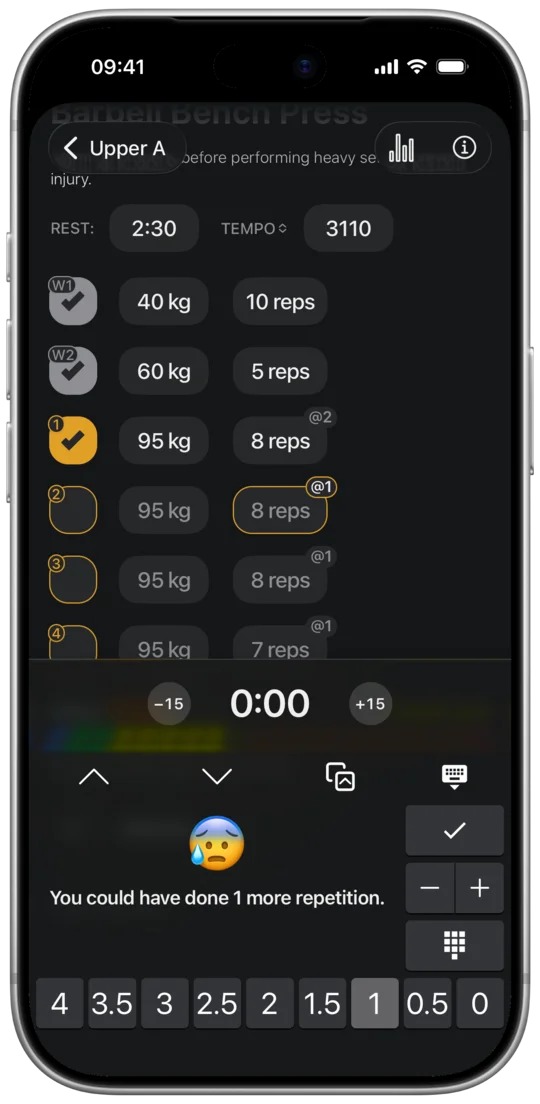
In Premium, you know what to do at your next workout: add a rep, add weight or stay at your current target. The suggestions take your logged RPE into account (progression suggestions).
You can paste this fragment through plan import (Workout > My Plans > “+” > “Import plan”). It is the first four exercises of the Lower A day from the free 4-day upper/lower plan (week 2), with RPE instead of RIR. Import costs 10 AI credits, so your welcome credits cover it.
DAY: Lower A- Barbell Squat | WU 2x5 | 3x6-10 RPE 8 | TEMPO 20X0 | REST 180- Romanian Deadlift | 3x8-12 RPE 8 | TEMPO 3010 | REST 150- Seated Leg Curl | 3x10-15 RPE 9 | TEMPO 2011 | REST 90- Seated Leg Extension Machine | 2x10-15 RPE 9 | TEMPO 2011 | REST 90Log it in SmartWorkout
A free workout log for iPhone and Android: sets, RIR, tempo, exercise groups and plans.


Questions
What does RPE 8 mean?
RPE 8 means you end the set with two good reps in reserve. If a set with an RPE 9 target came out at RPE 8, add about 4% to the next one; with dumbbells, do one more rep instead.
Is RPE 10 failure?
Yes. RPE 10 is the point where you cannot do another rep through the full range of motion without swinging. Research calls this muscular failure; if you stop earlier because your form breaks down, that is technical failure, and you log it the same way, as RPE 10.
What is the difference between RPE and RIR?
The scales run in opposite directions: RIR goes up with your reserve and RPE goes down, because RPE = 10 − RIR. If your plan says RPE 8 and you log in RIR, aim for RIR 2.
Are RPE and the Borg scale the same?
No. Running and other aerobic exercise usually use the Borg scale, in its 6-20 or CR-10 version, which rates the overall exertion of an interval or a whole session. If you both run and lift, keep the ratings separate, because an “8” after a run does not mean two reps in reserve.
What percentage of 1RM is RPE 8?
It depends on the reps: in the SmartWorkout calculator chart, from 92% of 1RM at 1 rep to 68% at 10. The percentage gives you the weight for the first set, and you adjust the next ones by RPE; the RIR/RPE calculator works out other combinations.
What does RPE 9.5 mean?
RPE 9.5 means no rep was left, but a slightly heavier weight would have gone up for the same reps. In a 1RM test, it tells you the next attempt can go up by the smallest jump; if your plan called for RPE 8-9, it is half a point above the range: after the first set keep the weight, after later sets take off about 2%.
See also
- RIR (reps in reserve): what it means and how to estimate itRIR (reps in reserve) is the number of good reps left before failure when a set ends. RIR 0 means no reps left, and RIR 2-3 in a plan means ending the set with 2-3 reps still in the tank. In a meta-analysis of 12 studies, lifters had on average 1 rep more left than they thought.
- Training to failure: when it helps and when it just adds fatigueTraining to failure means ending a set only when, despite full effort, you cannot complete the next rep through a full range of motion without changing your form. In a meta-analysis of 15 studies it built no significantly more muscle or strength than stopping short of failure, and it is clearly more fatiguing.
- Training intensity: percentage of 1RM vs proximity to failure and how to increase itTraining intensity has two meanings in lifting: load as a percentage of one-rep max (%1RM) and effort, meaning how close to failure a set ends (RIR). At 80% of 1RM lifters average about 9 reps to failure on the bench press and 13 on the leg press. Muscle grows from about 30% of 1RM when sets end close to failure.
- Top set and back-off sets: what they are and how much weight to dropA top set is the heaviest working set of an exercise in a session, and back-off sets are 2-4 working sets after it, done after full rest and usually 5-20% lighter. In a 6-week study of powerlifters, 2 back-off sets at 80% of the top set weight gave clearer strength gains than the top set alone.
- Progressive overload: what it is, linear vs double progression, and how to break a plateauProgressive overload is the gradual increase of training demands, most often load, reps or sets. The ACSM advises adding 2-10% load once you do 1-2 reps over your target in two sessions in a row. In an 8-week study, adding reps built about as much muscle as adding load.
- Rep ranges: how many reps for hypertrophy, strength and cuttingA rep range is the span of reps, such as 8-12, in which a set with a given weight should end. For muscle growth the exact number matters little: in studies, muscle grew similarly with sets of about 5 to more than 30 reps close to failure, while strength grew most with loads of 80% of 1RM or more.
- Warm-up sets: how many to do and what weight to use before working setsWarm-up sets are lighter sets done before your working sets: the weight goes up and the reps go down. Before a heavy compound lift, 3-5 sets from the empty bar to 85-90% of the working weight are enough. In studies, a warm-up with a set at 80% of the working weight beat light sets alone.
- Deload week: what it means, how often to deload and how to do itA deload (deload week) is a planned period of lighter training, usually 5-7 days, that reduces fatigue before the next training block. Coaches cut the number of sets or reps by 30-50% and stop sets further from failure. In studies, neither a lighter week nor a week off reduced muscle growth.
Sources
- Zourdos MC, Klemp A, Dolan C, et al. Novel Resistance Training-Specific Rating of Perceived Exertion Scale Measuring Repetitions in Reserve. J Strength Cond Res. 2016;30(1):267-75.
- Helms ER, Cronin J, Storey A, et al. Application of the Repetitions in Reserve-Based Rating of Perceived Exertion Scale for Resistance Training. Strength Cond J. 2016;38(4):42-49.
- Helms ER, Brown SR, Cross MR, et al. Self-Rated Accuracy of Rating of Perceived Exertion-Based Load Prescription in Powerlifters. J Strength Cond Res. 2017;31(10):2938-2943.
- Helms ER, Byrnes RK, Cooke DM, et al. RPE vs. Percentage 1RM Loading in Periodized Programs Matched for Sets and Repetitions. Front Physiol. 2018;9:247.
- Helms ER, Kwan K, Sousa CA, et al. Methods for Regulating and Monitoring Resistance Training. J Hum Kinet. 2020;74:23-42.
- Zourdos MC, Goldsmith JA, Helms ER, et al. Proximity to Failure and Total Repetitions Performed in a Set Influences Accuracy of Intraset Repetitions in Reserve-Based Rating of Perceived Exertion. J Strength Cond Res. 2021;35(Suppl 1):S158-S165.
- Halperin I, Malleron T, Har-Nir I, et al. Accuracy in Predicting Repetitions to Task Failure in Resistance Exercise: A Scoping Review and Exploratory Meta-analysis. Sports Med. 2022;52(2):377-390 (online 2021).
- Hickmott LM, Chilibeck PD, Shaw KA, et al. The Effect of Load and Volume Autoregulation on Muscular Strength and Hypertrophy: A Systematic Review and Meta-Analysis. Sports Med Open. 2022;8(1):9.
- Currier BS, D'Souza AC, Singh MAF, et al. American College of Sports Medicine Position Stand. Resistance Training Prescription for Muscle Function, Hypertrophy, and Physical Performance in Healthy Adults: An Overview of Reviews. Med Sci Sports Exerc. 2026;58(4):851-872.
- Robinson ZP, Pelland JC, Remmert JF, et al. Exploring the Dose-Response Relationship Between Estimated Resistance Training Proximity to Failure, Strength Gain, and Muscle Hypertrophy: A Series of Meta-Regressions. Sports Med. 2024;54(9):2209-2231.