
Warm-up sets at a glance
| Parameter | Value | Source |
|---|---|---|
| Number of sets | 3-5 before a heavy compound lift; 1-2 before the next compound lift for the same muscle group, 0-1 before an isolation exercise | our practice; before a 1RM test, studies usually use 1-3 sets (Grgic et al. 2020) |
| Weight and reps | empty bar × 10, then about 40% × 8, 60% × 5 and 75% × 3 | our practice; studies usually use 40-80% 1RM for 1-10 reps (same review) |
| Last set | 85% × 2, or 90% × 1 before sets of up to 5 reps | in studies, 80% for 5-6 reps did better (Ribeiro et al. 2020, Viveiros et al. 2024) and is a good choice too; we make it heavier because it's where you check how a near-working weight moves today |
| Rest | 30-60 s after the light sets, 1-2 min before the last two, 2-3 min before the first working set | studies used 1 min between sets and 3 min before working sets in Ribeiro et al. 2020, 2 min in Souza et al. 2024 |
| Weekly sets | 0 | you count only working sets (how to count sets) |
- Working set
- Warm-up
When to do warm-up sets
Do warm-up sets before the first exercise for a muscle group, especially before a heavy compound lift. Before the next exercise for the same muscle group, 1-2 short sets or none are enough.
Warm-up sets let you practice the movement as the weight goes up, which helps beginners most. The last one tells you how today is going: when 85% moves slowly, start your working sets lighter (that's how you pick the weight by RPE). A set close to the working weight prepares you for it better than light sets alone (Ribeiro et al. 2020).
Warm-up sets are too light to build muscle, so the scheme depends on the working set, not on your training goal: the heavier and shorter the working set, the closer to it you finish the warm-up. In the list of intensity techniques, warm-up sets sit next to ramping sets, though they don't intensify anything.
| Situation | Warm-up sets |
|---|---|
| First barbell exercise, working set from about 100 kg | 4-5 including the bar |
| First exercise on a machine or with a lighter weight | 1-2, e.g. 50% × 10 and 75-80% × 5 |
| Beginner, working set up to about 40 kg | the bar and 1 set |
| Weighted Pull-Up or Weighted Dips | 1-2: no added weight × 5, then half the added weight × 3 |
| Set of 1-3 reps | the full scheme, and after 75% add 85% × 1 and 90% × 1 |
| Max test | the full scheme, last set at about 85% of the expected max × 1, then attempts in 2.5-5 kg steps; attempts from about 90% are working sets |
| Second compound lift for a muscle group, e.g. the incline barbell bench press after the flat one | 1-2 short ones, e.g. 60% × 5 and 80% × 2 |
| Isolation exercise for a warmed-up muscle group, e.g. leg extensions after squats | 0-1 |
In the morning, in a cold gym or when your joints ache, add 1-2 lighter sets at the start.
How to do warm-up sets step by step
- Start with 5-10 minutes of light movement (described below).
- Do the first set with the empty bar or the lightest weight for 8-10 reps (in the deadlift, with full-diameter plates or from blocks, 5 reps at most).
- Add weight in 2-3 steps up to about 75% of your working weight and drop the reps: 8, 5, 3. Do each set like a working set: same setup, grip, depth and tempo; if you use a belt, put it on from about 75%.
- Do the last set close to your working weight: 85% × 2 before sets of 6 reps or more, 90% × 1 before heavier ones.
- After the light sets, rest as long as it takes to load the plates, 1-2 minutes before the last two, and 2-3 minutes before the first working set.
Add plates to the ones already on the bar: at 100 kg, sets of 40, 60, 75 and 85 kg mean 10, 20, 27.5 and 32.5 kg per side, so one or two more plates each set.
Warm-up sets in kg
In the table, each warm-up set is a percentage of the working weight rounded to 2.5 kg, with a 20 kg bar, and the working set is 8 reps.
| Working set | Bar | ~40% | ~60% | ~75% | ~85% |
|---|---|---|---|---|---|
| 100 kg × 8 | 20 kg × 10 | 40 kg × 8 | 60 kg × 5 | 75 kg × 3 | 85 kg × 2 |
| 140 kg × 8 | 20 kg × 10 | 55 kg × 8 | 85 kg × 5 | 105 kg × 3 | 120 kg × 2 |
With a lighter weight the steps end up close together and you can skip the first ones, even though the calculator shows the full scheme: before 60 kg × 8, the bar × 10, 45 kg × 3 and 50 kg × 2 are enough, and before 40 kg or less, the bar × 10 and one set halfway. With a working set from about 180 kg, add 1-2 sets so that no jump is bigger than 40 kg, e.g. before 200 kg: 20, 60, 100, 130, 150 and 170 kg. Warm up dumbbells in pairs, e.g. before 30 kg dumbbells: 12.5 kg × 10, 20 kg × 5 and 25 kg × 2. Work out the sets for your own weight in the warm-up set calculator.
Warm-up before lifting
A warm-up before strength training is 5-10 minutes of light movement and a few dynamic moves for the joints that will work, followed by warm-up sets of the first exercise. The RAMP model (Raise, Activate, Mobilise, Potentiate) describes the same order.
| Part | How long | Examples |
|---|---|---|
| Light movement | 5-10 min at a conversational pace | Stationary Bike, Elliptical Trainer, Rowing Machine, Treadmill Run |
| Before an upper-body day | 1-2 min | Arm Circles, Band Warm-Up Dynamic Shoulder Stretch, Dumbbell Cuban Rotation |
| Before a lower-body day | 1-2 min | Hip Circles, Leg Swings, Lateral Monster Walk |
Keep the general warm-up light: before a max test on the leg press, 15 minutes of light effort raised the result by 3% on average, 5 minutes changed nothing, and 15 minutes at a moderate pace lowered it by 4% (Barroso et al. 2013). For a regular workout, 5-10 minutes of light movement is enough to loosen up; before a test or a heavy day, stretch it to 15 minutes, since that's what raised the result. When you're short on time, cut the light movement and keep the warm-up sets. At home, marching in place is enough.
Warm muscles produce force faster, not harder: in a meta-analysis of 33 studies, a warmer muscle gave more power with no change in maximal strength, and sex didn't meaningfully change the effect (Wilson et al. 2025).
Which exercises need a full warm-up
Do a full warm-up before the first heavy compound lift for a muscle group.
| Good fit | Why |
|---|---|
| Barbell Squat | the heaviest load on your back; you check depth and foot position with the empty bar |
| Barbell Bench Press | the same grip and shoulder blade position in every set; on the last warm-up set you check how unracking a heavy bar feels |
| Deadlift | usually the heaviest exercise of the day; do the first set with full-diameter plates (20 kg or 5-10 kg bumpers), and when that's too heavy, put lighter plates on blocks so the bar sits at the same height; 5 reps at most in warm-up sets |
| Barbell Overhead Press | a small working weight, so steps of 5-10 kg; you check the full overhead range with the empty bar |
| Incline Dumbbell Bench Press | heavy dumbbells have to be brought safely into the starting position, so a lighter pair first |
Warm-up sets vs working sets, ramping sets and top sets
A working set is a set with the target weight that ends with at most 4 reps in reserve; it's the only kind you count for the week.
| Warm-up set | Working set | Ramping sets | Top set | |
|---|---|---|---|---|
| Purpose | prepare the movement and the weight | stimulus for strength and muscle growth | build up to the heaviest set | heaviest set before back-off sets |
| Weight | from the bar to 85-90% of working weight | target | goes up set by set | highest in the exercise |
| Effort | more than 4 reps in reserve | RIR 0-4 | light ones far from failure, last ones close | close to failure |
| Weekly sets | 0 | 1 | light ones 0, heavy ones 1 each | 1 for each set |
Do warm-up sets count toward volume
Warm-up sets don't count toward volume. The number of sets taken to or close to failure is a good measure of volume (Baz-Valle et al. 2021), and the ACSM 2026 position stand treats sets close to failure or with 2-3 reps in reserve as enough effort. A warm-up set ends far from failure, so it doesn't meet either standard.
In SmartWorkout, a set with 0-4 reps in reserve is a working set and one with more is a warm-up. The threshold of 4 is our margin for errors in judging reps in reserve, and it's also the top of the RIR scale in the app. You split the light and heavy sets of a ramp the same way.
For example, squats as the only leg exercise, twice a week with 2 warm-up sets and 3 working sets, make 6 weekly sets for the quads and glutes, which is MEV. Counting the warm-ups would give 10, the bottom of MAV. Check your own week in the weekly volume calculator.
Common mistakes
- Warming up until you're tired. Long light sets don't prepare you for the weight: in a study of 15 men, 15 reps at 40% of their 10-rep-max weight gave less tonnage in the working sets than 5 reps at 80% (Viveiros et al. 2024). The closer you get to the working weight, the fewer reps.
- A last set that's too light. Before a heavy barbell lift, a jump from half the working weight is too big: the first working set goes worse and its reps in reserve are harder to judge. Make the last warm-up set 85-90% instead; before a machine set of 10-15 reps, 1-2 sets are enough, the last at about 75-80% of the working weight for 4-5 reps.
- Logging a warm-up as a working set. It inflates your weekly sets (10 instead of 6 in the example above) and skews the comparison with your last workout, so mark it as a warm-up in your log.
- Long stretching right before a set. Static stretching shorter than 60 s per muscle group lowered performance by about 1% on average, and longer stretching by about 5%; when dynamic movement followed, no clear drop was seen (Behm et al. 2016). Save long stretching for the end of your workout.
What the research says
Warm-up studies measure performance in working sets on the same day; the certainty rating is our assessment.
| Common claim | What studies show | Certainty |
|---|---|---|
| The last warm-up set should be close to the working weight | better than lighter sets alone in two studies (results in the table below) | low to moderate |
| A warm-up improves a set to failure at 80% 1RM | in 15 men, none of the warm-ups (specific, aerobic or combined) changed the number of reps compared with skipping the warm-up (Ribeiro et al. 2014) | low |
| A heavy short set before working sets gives more reps | in the bench press, 1 more rep in the first two sets (Alves et al. 2021); in the Smith machine squat, 3 reps at 90% 1RM gave no more reps than a regular warm-up (Souza et al. 2024) | low |
| Study | Type and sample | Result | Limitation |
|---|---|---|---|
| Ribeiro et al. 2020 | 40 trained men, 3 × 6 at 80% 1RM | squat: best with 6 × 80% of working weight; bench press: 6 × 40%, then 6 × 80% | only two exercises |
| Viveiros et al. 2024 | 15 men, 3 exercises of 3 sets to failure | 80% × 5: more tonnage than 60% × 10 and 40% × 15 | measured tonnage, not fatigue |
The comparisons included 14-40 men each, so we don't know whether a better warm-up leads to more strength or muscle over months. We also don't know whether it protects against injury in the gym: in sports, 3 of 5 studies showed fewer injuries and 2 showed no difference (Fradkin et al. 2006).
What SmartWorkout logs show
The last logged warm-up set is lighter and longer than in the studies; the table above ends the warm-up closer to the working weight, at 85-90%. Many people log only their last warm-up set or none at all, so the number of sets in the logs is understated. Every number is an aggregate of at least 50 people and comes only from sets marked as warm-ups.
How to log warm-up sets in SmartWorkout
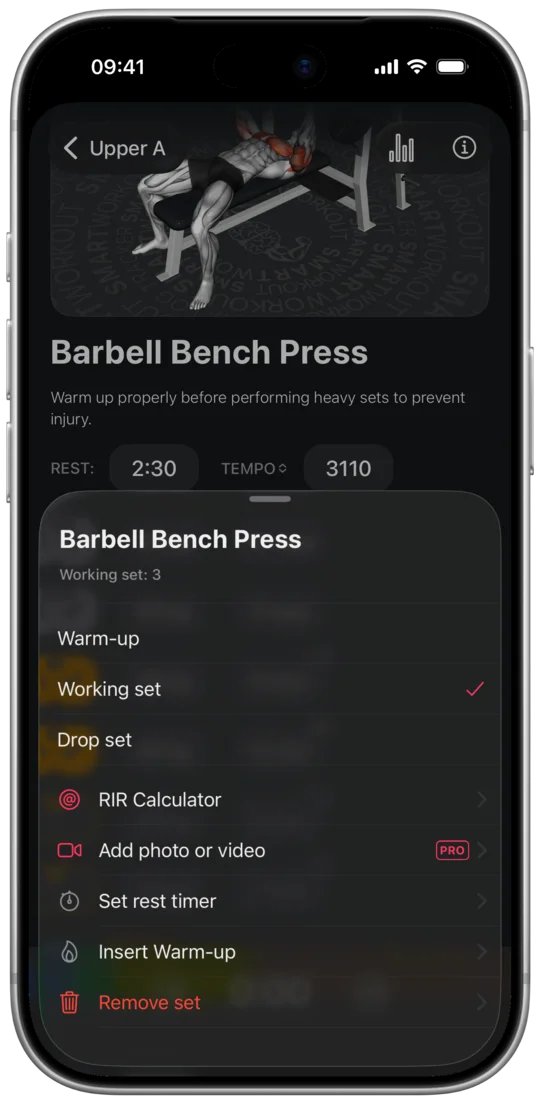
You log a warm-up set in SmartWorkout as a set of the Warm-up type: in the workout log, in templates and in plans.
- In the exercise, open any set's menu and tap “Insert Warm-up”. The set goes before the first working set with a “W” label (W1, W2 when there are several).
- To change a set you logged as a working set, choose “Warm-up” in the same menu.
- In the warm-up set's menu, tap “Set rest timer” and set a shorter rest, e.g. 60 s.
In a template and in the plan creator, tap “Add” below the exercise's sets and choose “Warm-up”; an exercise in a group doesn't have this button there. In the workout log, an exercise in a group (e.g. a superset) has no “Insert Warm-up” button, but you can still mark an existing set as “Warm-up”. The help article on set types and exercise groups explains how set types work.
A warm-up set doesn't count toward weekly sets, volume zones or workout tonnage, and it has no RIR or RPE.
With Premium, progression suggestions notice a lighter set with more reps than the range calls for and suggest marking it as a warm-up.
This fragment is the start of the Lower A day from the 4-day upper/lower plan; you can paste it through plan import (Workout > My Plans > “+” > “Import plan”). Import costs 10 AI credits, so the welcome credits cover it. The plan gives the first exercise 2 warm-up sets of 5 reps with no weight given; before a heavy working set, add the missing steps from the table above in your log.
DAY: Lower A- Barbell Squat | WU 2x5 | 3x6-10 RIR 2 | TEMPO 20X0 | REST 180- Romanian Deadlift | 3x8-12 RIR 2 | TEMPO 3010 | REST 150- Seated Leg Curl | 3x10-15 RIR 1 | TEMPO 2011 | REST 90- Seated Leg Extension Machine | 2x10-15 RIR 1 | TEMPO 2011 | REST 90Log it in SmartWorkout
A free workout log for iPhone and Android: sets, RIR, tempo, exercise groups and plans.


Questions
What should a warm-up set be?
A lighter set of the same exercise before your working sets. Each one is heavier with fewer reps than the last, and none of them comes close to failure.
How many warm-up sets should I do?
Count back from the end: the last one lands at 85-90% of your working weight, and the earlier ones just fill the jump from the empty bar. That makes 4-5 before 140 kg and 2-3 before a light weight.
How many warm-up sets for bench press?
Before a barbell bench press of 80 kg × 8, the bar and 3-4 sets up to 67.5 kg are enough. Before a second chest exercise, do 1-2 short sets if it's a barbell lift and at most one before flyes.
Do warm-up sets count toward volume?
No. A lighter build-up set does count as a working set, though, if it ended with 0-4 reps in reserve (how to count sets).
How long should a warm-up before lifting be?
About 10-15 minutes including warm-up sets, and up to 20 before a heavy day or a max test.
Should you stretch before lifting weights?
You can, as long as you hold each stretch for less than a minute per muscle group. Save longer stretching for flexibility, 60 s or more per muscle group, for after training or another day.
See also
- Pyramid sets and ramping sets: how to add weight set by setPyramid sets change the weight from set to set: the load goes up while reps go down, for example 12, 10, 8. A reverse pyramid starts with the heaviest set, and ramping sets add weight at fixed reps. In a review of 15 studies, pyramids built no more strength or muscle than a constant weight.
- Top set and back-off sets: what they are and how much weight to dropA top set is the heaviest working set of an exercise in a session, and back-off sets are 2-4 working sets after it, done after full rest and usually 5-20% lighter. In a 6-week study of powerlifters, 2 back-off sets at 80% of the top set weight gave clearer strength gains than the top set alone.
- How to count sets per muscle group: direct, indirect and warm-up setsCounting sets per muscle group (fractional set counting) means adding up a week's working sets: 1 for the muscle that mainly does the movement, 0.5 for a muscle that clearly assists, 0 for warm-up sets. In a meta-analysis of 67 studies, this matched muscle growth better than counting assisting muscles as 1 or 0.
- Training volume: what it is and what MEV, MAV and MRV meanIn hypertrophy training, training volume is the number of working sets a muscle group gets per week. In a meta-analysis of 67 studies, growth was measurable from about 4 weekly sets, with each extra set adding less; the 2026 ACSM position stand links 10 or more weekly sets to more growth.
- Rest between sets: how long to rest for hypertrophy, strength and fat lossRest between sets (rest interval) is the time from the end of one set to the start of the next. For hypertrophy, 1.5-2 minutes is usually enough, 2-3 minutes on heavy lifts and 3-5 minutes for sets of 1-5 reps. In a meta-analysis of 9 studies, rests shorter than a minute produced slightly less muscle.
- RIR (reps in reserve): what it means and how to estimate itRIR (reps in reserve) is the number of good reps left before failure when a set ends. RIR 0 means no reps left, and RIR 2-3 in a plan means ending the set with 2-3 reps still in the tank. In a meta-analysis of 12 studies, lifters had on average 1 rep more left than they thought.
- Rep ranges: how many reps for hypertrophy, strength and cuttingA rep range is the span of reps, such as 8-12, in which a set with a given weight should end. For muscle growth the exact number matters little: in studies, muscle grew similarly with sets of about 5 to more than 30 reps close to failure, while strength grew most with loads of 80% of 1RM or more.
Sources
- Grgic J, Lazinica B, Schoenfeld BJ, et al. Test-Retest Reliability of the One-Repetition Maximum (1RM) Strength Assessment: a Systematic Review. Sports Med Open. 2020;6(1):31.
- Ribeiro B, Pereira A, Neves PP, et al. The Role of Specific Warm-up during Bench Press and Squat Exercises: A Novel Approach. Int J Environ Res Public Health. 2020;17(18):6882.
- Viveiros L, Gioia K, Nasser I, et al. High-load and low-volume warm-up increases performance in a resistance training session. J Bodyw Mov Ther. 2024;40:1487-1491.
- Souza D, Silva AG, Vale A, et al. Effect of warm-up protocols using lower and higher loads on multiple-set back squat volume-load. PeerJ. 2024;12:e17347.
- Baz-Valle E, Fontes-Villalba M, Santos-Concejero J. Total Number of Sets as a Training Volume Quantification Method for Muscle Hypertrophy: A Systematic Review. J Strength Cond Res. 2021;35(3):870-878 (online 2018).
- Barroso R, Silva-Batista C, Tricoli V, et al. The effects of different intensities and durations of the general warm-up on leg press 1RM. J Strength Cond Res. 2013;27(4):1009-13.
- Wilson CJ, Nunes JP, Blazevich AJ. The effect of muscle warm-up on voluntary and evoked force-time parameters: A systematic review and meta-analysis with meta-regression. J Sport Health Sci. 2025;14:101024.
- Behm DG, Blazevich AJ, Kay AD, et al. Acute effects of muscle stretching on physical performance, range of motion, and injury incidence in healthy active individuals: a systematic review. Appl Physiol Nutr Metab. 2016;41(1):1-11 (online 2015).
- Currier BS, D'Souza AC, Singh MAF, et al. American College of Sports Medicine Position Stand. Resistance Training Prescription for Muscle Function, Hypertrophy, and Physical Performance in Healthy Adults: An Overview of Reviews. Med Sci Sports Exerc. 2026;58(4):851-872.
- Ribeiro AS, Romanzini M, Schoenfeld BJ, et al. Effect of different warm-up procedures on the performance of resistance training exercises. Percept Mot Skills. 2014;119(1):133-45.
- Alves RR, Viana RB, Silva MH, et al. Postactivation Potentiation Improves Performance in a Resistance Training Session in Trained Men. J Strength Cond Res. 2021;35(12):3296-3299 (online 2019).
- Fradkin AJ, Gabbe BJ, Cameron PA. Does warming up prevent injury in sport? The evidence from randomised controlled trials? J Sci Med Sport. 2006;9(3):214-20.