
Ramping sets, pyramids and reverse pyramids at a glance
Ramping sets, pyramids and reverse pyramids are three ways to change the weight from set to set in one gym exercise.
| Layout | Weight | Weight in % 1RM | Reps | Working sets | Rest | Source |
|---|---|---|---|---|---|---|
| Ramp | goes up to the heaviest set of the day | last set of 5 at about 80-85% | fixed, e.g. 5 | 0-4 reps in reserve, usually the last 1-2 | 60-90 s after light sets, 2-3 min before heavy ones | our practice |
| Pyramid | goes up | about 60, 68 and 75% | go down, e.g. 12, 10, 8 | every set, close to failure | 2-3 min | 12, 10, 8: Ribeiro et al. 2017; rest: Kassiano et al. 2020 |
| Reverse pyramid | heaviest first, then about 10% less per set | about 80, 73 and 67% | go up, e.g. 6, 8, 10 | every set, close to failure | 3 min on a barbell, 2 min on dumbbells and cables; a warm-up ramp before the first set | our practice |
We worked out the percentages from the app's RIR/RPE table; the RIR/RPE calculator works out your own weights.
- Working set
- Warm-up
Ramping and pyramid sets for strength and hypertrophy
Pyramid sets don't build more muscle or strength than straight sets at a constant weight: in a review of 15 studies (9 long-term), pyramids were no better than traditional sets (Cardozo and Destro 2023). Nobody has compared ramping sets this way, and reverse pyramids only in small studies, with the same result. What counts is the number of sets close to failure and the weight of your heaviest set, so pick the layout in which you find it easier to keep your reps in reserve and to progress. They differ from other intensity techniques in the full rest before every working set.
| Your goal | What to choose | Why |
|---|---|---|
| Strength on the big lifts | straight sets of 3-5 × 3-6, a ramp or a reverse pyramid | strength goes up more with loads from 80% 1RM (ACSM 2026 position stand), and each of these layouts has sets at that load |
| Muscle growth (hypertrophy) | any layout | muscle grew similarly with loads from 30% to 100% 1RM (same position stand); the training volume page covers how many sets to do |
| You're starting out or want simple progress | straight sets and 1-2 warm-up sets | double progression at a constant weight is simpler, and judging reps in reserve in a ramp takes practice |
How to do ramping and pyramid sets step by step
In ramping and pyramid sets you end the heavy sets with 1-3 reps in reserve and the heaviest one with 1-2; the light build-up sets are warm-ups.
Ramping sets: same reps, more weight each set
Ramping sets in strength training are consecutive sets with the same reps and more weight each time, up to the heaviest set of the day.
- Decide on the heaviest set of the day, e.g. 100 kg × 5 on the barbell bench press.
- After a few reps with the empty bar, start at about 60% of that weight and add weight every set at the same 5 reps: 60, 80, 90, 95 and 100 kg; 4-6 sets in total.
- Rest 60-90 s after the light sets and 2-3 min before the last two.
- Finish with 1-2 reps in reserve; if the bar clearly slows down on the set before, that set is your heaviest for today.
Choose a ramp when you set the day's weight by how fast the bar moves. When you know it in advance, the warm-up calculator lays out a shorter warm-up with fewer reps each set.
Pyramid sets: more weight, fewer reps
Pyramid sets in strength training are consecutive sets in which the weight goes up and the reps go down, for example 12, 10, 8.
- Pick 3 sets with falling reps, e.g. 12, 10 and 8.
- Choose weights so that your reserve shrinks set by set: about 3, 2 and 1 rep, e.g. 22.5, 25 and 27.5 kg on the incline dumbbell bench press. Every hard set takes 0.5-1 rep of reserve from the sets after it, so if you plan RIR 1 for every set of a pyramid, the last one ends at failure.
- Rest 2-3 min between sets.
- When you get 2 reps more than planned on the heaviest set with 1 in reserve (27.5 kg × 10 instead of 8), move every set up one dumbbell step next session: 25, 27.5 and 30 kg.
In a pyramid to failure on the leg press (20 young women, 60-80% 1RM), 2 min of rest gave as much tonnage as 3 min, and 1 min gave less (Kassiano et al. 2020); on heavy barbell lifts, rest 3 min.
Reverse pyramid: heaviest set first
A reverse pyramid is a set layout in which the heaviest set comes first after the warm-up, and each following set gets lighter with more reps.
- Ramp up to warm up: empty bar, then about 40, 60, 75 and 85% of the first set's weight.
- Do the heaviest set of the day, e.g. 100 kg × 6 on the barbell squat, with 1-2 reps in reserve.
- After 3 min, take off about 10% and add 2 reps: 90 kg × 8.
- On the third set, take off about 10% again: 82.5 kg × 10.
When you get 8 reps instead of 6 on the first set, add 2.5-5 kg next session and keep dropping about 10% per set; the top set and back-off calculator works out other drops.
- Working set
- Warm-up
Ramping and pyramid set examples in kg
The table shows the working sets of ramping and pyramid examples; the warm-up goes as in the steps above, and on dumbbells and cables it's one lighter set at most.
| Exercise | Working sets (kg × reps) | RIR | Rest |
|---|---|---|---|
| Barbell Bench Press, ramp | 95 × 5, 100 × 5 | 2-3, then 1 | 2-3 min |
| Incline Dumbbell Bench Press, pyramid (kg per dumbbell) | 22.5 × 12, 25 × 10, 27.5 × 8 | 2-3, 1-2, 1 | 2 min |
| Wide Grip Lat Pulldown, reverse pyramid | 70 × 8, 62.5 × 10, 55 × 12 | 1, 1-2, 1-2 | 2 min |
| Barbell Squat, reverse pyramid | 100 × 6, 90 × 8, 82.5 × 10 | 1-2, 1-2, 1-2 | 3 min |
RIR in the table is the reserve you'll feel in the set: we worked out the weights from the RIR/RPE table, adjusted for fatigue from the earlier sets. On a stack in 5 kg steps, take 60 kg instead of 62.5 kg. If you miss the planned reps on the last set, drop that set by one step next session: one plate on the stack, 2-2.5 kg on dumbbells, 2.5-5 kg on a barbell.
Ramping and pyramids on the bench press, squat and machines
Ramping fits barbell exercises, and pyramids fit exercises with a small weight step.
| Good fit | Why |
|---|---|
| Barbell Bench Press | ramp and reverse pyramid; do the heavy set with a spotter or in a rack with safety bars |
| Barbell Squat | you ramp up to warm up anyway, and do the reverse pyramid in a rack with safety bars |
| Incline Dumbbell Bench Press | pyramid: at 22.5-27.5 kg, one dumbbell step is about 10% |
| Wide Grip Lat Pulldown | pyramid and reverse pyramid: you change the weight with the pin |
| Seated Leg Extension Machine | pyramid on the stack, safe even when you're tired |
| Be careful | Why |
|---|---|
| Dumbbell Lateral Raise | at 8-10 kg, a 2 kg step is 20-25%, so a pyramid jumps too far |
| Deadlift | a ramp in sets of 3-5 reps is fine; our plans have no sets of 10-12 when you're already tired, because your technique is hard to keep then |
Ramping sets vs pyramids, top sets and straight sets
| Ramp | Pyramid | Reverse pyramid | Top set and back-off sets | Straight sets | Drop set | |
|---|---|---|---|---|---|---|
| Weight | goes up to the heaviest set | goes up | goes down from the heaviest | one heavy set, then lighter sets at one weight | the same | goes down with no rest |
| Reps | fixed | go down | go up | few in the top set, the same or more in back-off sets | the same or within a range | to failure on each drop |
| Working sets | heavy ones only | every set | every set | every set | every set | rules on the drop set page |
| Best for | a heavy set when you set the day's weight in the gym | several rep ranges in one exercise | 2-3 heavy sets in a short time | strength and extra sets at one weight | simple progress | saving time on isolation exercises |
Warm-up or working set in a ramp
A build-up set is a working set when you end it with 0-4 reps in reserve, and a warm-up when you have more than 4 left.
The ACSM 2026 position stand treats sets with 2-3 reps in reserve as enough. In SmartWorkout we set the cutoff at 4 to leave room for misjudging your reserve, and 4 is also the end of the RIR scale in the app.
Reps in reserve are hardest to judge far from failure, so in the gym go by the weight: at the same reps, a set 10% lighter than the heaviest one at RIR 1 (13% at 7-12 reps) is already a warm-up, like 90 kg against 100 kg in the ramp above. In a reverse pyramid the lighter set has 2 more reps, so it stays a working set.
That ramp has 5 sets, 2 of them working sets: with two workouts a week, your chest gets 4 sets from it, the bottom of MEV. Logging every set as a working set would give 10, the bottom of MAV, for the same work. You can check your week in the sets per muscle group calculator; the pages on how to count sets and warm-up sets cover other cases.
Common mistakes
- Wrong set type in a ramp. Light sets logged as working sets inflate your weekly sets, and a heavy set logged as a warm-up drops out of them. Choose the type by reps in reserve.
- Reverse pyramid without a ramp. Before the heaviest set at the start of an exercise, do the warm-up ramp from step 1.
- Too small or too big a drop. At 5% less and 2 more reps, the second and third sets end at failure. At 25% less (75 kg × 8 after 100 kg × 6), the set is too light to be a working set. Take off about 10% and add 2 reps.
- Failure on every pyramid set. Failure on a lighter set takes reps away from the heavier sets after it, and it doesn't give your muscles more than a set stopped earlier (Refalo et al. 2023). Save failure at most for the last set on a machine or cable, never on the barbell squat.
What the research says
| Common claim | What studies show | Certainty |
|---|---|---|
| Pyramids build more muscle than a constant weight | no, in trained men too (Cardozo and Destro 2023, Angleri et al. 2017 in the table below) | moderate |
| Pyramids build more strength | not as a group; of 15 trained men, 4 gained more leg press 1RM on the pyramid and 1 on traditional sets (Angleri et al. 2022) | moderate |
| A reverse pyramid is better because the heaviest set comes when you're fresh | no: in 21 moderately trained men over 16 weeks, sets 5-10% lighter than the first gave the same muscle growth and 10RM gain as a constant weight, at lower perceived effort (Lima et al. 2018) | low |
| The direction of the weight matters | a DeLorme ramp (up) and the Oxford method (down) at 10 reps gave 50 people a similar 10RM gain on the leg extension over 9 weeks (Fish et al. 2003) | low |
| Study | Type and sample | Result | Limitation |
|---|---|---|---|
| Cardozo and Destro 2023 | review, 15 studies (6 acute, 9 long-term) | result above | no meta-analysis |
| Angleri et al. 2017 | 32 trained men; one leg always on traditional sets, the other on a pyramid or a drop set; 12 weeks, equal tonnage | muscle cross-sectional area +7.6% (traditional sets) vs +7.5% (pyramid); leg press 1RM +25.9% in both | legs and men only |
| ACSM 2026 position stand | overview of systematic reviews | set structure did not consistently change outcomes | doesn't name pyramids |
Pyramid studies used 8-12 reps, so it's unknown whether the results hold for sets of 1-5; we found no studies of ramping to such a set, and reverse pyramids were studied only on biceps curls (Lima) and leg extensions (Fish).
What SmartWorkout logs show
With the last set at RIR 1, such a first set has about 4-5 reps in reserve, right at the edge of the rule above: log it as a working set only with 4 in reserve at most. Every number is based on at least 50 people.
How to log ramping and pyramid sets in SmartWorkout
You log ramping and pyramid sets in SmartWorkout as regular sets, and the light build-up sets as warm-up sets.
- In the exercise, add as many sets as the ramp or pyramid has (“Add Set”) and enter the weight and reps in each.
- Open the menu of each light build-up set and choose “Warm-up”; the set gets a “W” label.
- Leave the heavy ramp sets and all pyramid sets as “Working set” and enter RIR for them.
- In each light set's menu, tap “Set rest timer” and set 60-90 s; before the heavy sets, keep 2-3 min.
A warm-up set doesn't count toward weekly sets, and a working set counts like any other: 1 for the main muscle group and 0.5 for a secondary one.
With Premium, you see each muscle group's weekly sets against the volume zones while you train, including those from the working sets of a ramp.
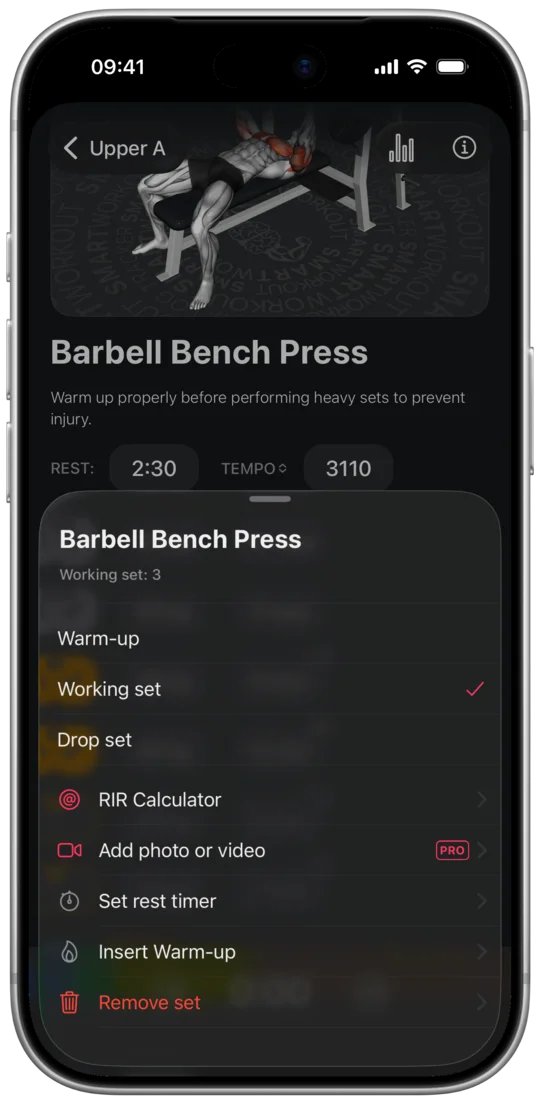
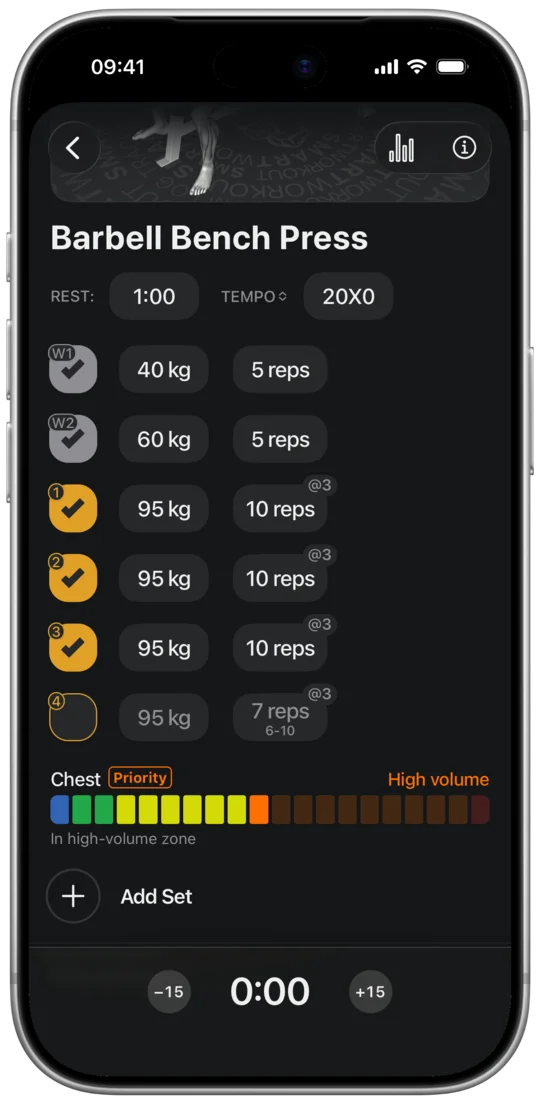
The rest from your plan applies to warm-up sets too, so shorten it as in step 4. You can paste this day through plan import (Workout > My Plans > “+” > “Import plan”). Import costs 10 AI credits.
DAY: Upper A- Barbell Bench Press | WU 3x5 | 1x5 RIR 2 + 1x5 RIR 1 | TEMPO 20X0 | REST 180- Incline Dumbbell Bench Press | 1x12 RIR 2 + 1x10 RIR 2 + 1x8 RIR 1 | TEMPO 2010 | REST 120- Wide Grip Lat Pulldown | WU 1x10 | 1x8 RIR 1 + 1x10 RIR 1 + 1x12 RIR 2 | TEMPO 2011 | REST 120The help article on set types and exercise groups explains how set types work in the app.
Log it in SmartWorkout
A free workout log for iPhone and Android: sets, RIR, tempo, exercise groups and plans.


Questions
What is a pyramid set?
Pyramid sets in strength training are consecutive sets in which the weight goes up and the reps go down, for example 12, 10, 8. The opposite direction, starting from the heaviest set, is a reverse pyramid.
Are pyramid sets better than straight sets?
For muscle and strength the result is about the same, and straight sets are easier to compare from one workout to the next. Start with straight sets and keep pyramids for 1-2 exercises if you enjoy them.
What are ramping sets?
Ramping sets are consecutive sets with the same reps and more weight each time, up to the heaviest set of the day. Only the last, heavy sets count toward your weekly sets; log the light ones as warm-ups.
What is a reverse pyramid?
A reverse pyramid is a set layout in which the heaviest set comes first after the warm-up, and each following set gets lighter with more reps. Choose it when you want to do a heavy set while fresh and add 1-2 lighter ones to it.
Is The Muscle and Strength Pyramid about pyramid sets?
No. It's a hierarchy of training priorities from the books by Eric Helms and co-authors, not a set layout. The weight across the sets of one exercise is a separate topic, covered on this page.
What does a pyramid sets workout look like?
Usually 1-2 exercises in a workout get a pyramid and the rest stay at a constant weight, e.g. a barbell bench press ramp to a set of 5, a 12, 10, 8 pyramid on the incline dumbbell bench press and a reverse 8, 10, 12 pyramid on the wide grip lat pulldown.
See also
- Top set and back-off sets: what they are and how much weight to dropA top set is the heaviest working set of an exercise in a session, and back-off sets are 2-4 working sets after it, done after full rest and usually 5-20% lighter. In a 6-week study of powerlifters, 2 back-off sets at 80% of the top set weight gave clearer strength gains than the top set alone.
- Warm-up sets: how many to do and what weight to use before working setsWarm-up sets are lighter sets done before your working sets: the weight goes up and the reps go down. Before a heavy compound lift, 3-5 sets from the empty bar to 85-90% of the working weight are enough. In studies, a warm-up with a set at 80% of the working weight beat light sets alone.
- Drop sets: what they are, how to do them and how much weight to dropA drop set (also called a strip set or descending set) is a set taken to or near failure, then continued without rest after cutting the weight by about 20-30%. In meta-analyses, drop sets built about as much muscle as regular sets in less time. One drop on the last set is usually enough.
- RIR (reps in reserve): what it means and how to estimate itRIR (reps in reserve) is the number of good reps left before failure when a set ends. RIR 0 means no reps left, and RIR 2-3 in a plan means ending the set with 2-3 reps still in the tank. In a meta-analysis of 12 studies, lifters had on average 1 rep more left than they thought.
- How to count sets per muscle group: direct, indirect and warm-up setsCounting sets per muscle group (fractional set counting) means adding up a week's working sets: 1 for the muscle that mainly does the movement, 0.5 for a muscle that clearly assists, 0 for warm-up sets. In a meta-analysis of 67 studies, this matched muscle growth better than counting assisting muscles as 1 or 0.
- Progressive overload: what it is, linear vs double progression, and how to break a plateauProgressive overload is the gradual increase of training demands, most often load, reps or sets. The ACSM advises adding 2-10% load once you do 1-2 reps over your target in two sessions in a row. In an 8-week study, adding reps built about as much muscle as adding load.
- Rep ranges: how many reps for hypertrophy, strength and cuttingA rep range is the span of reps, such as 8-12, in which a set with a given weight should end. For muscle growth the exact number matters little: in studies, muscle grew similarly with sets of about 5 to more than 30 reps close to failure, while strength grew most with loads of 80% of 1RM or more.
- Rest between sets: how long to rest for hypertrophy, strength and fat lossRest between sets (rest interval) is the time from the end of one set to the start of the next. For hypertrophy, 1.5-2 minutes is usually enough, 2-3 minutes on heavy lifts and 3-5 minutes for sets of 1-5 reps. In a meta-analysis of 9 studies, rests shorter than a minute produced slightly less muscle.
Sources
- Cardozo DC, de Souza Destro D. Pyramidal resistance training: A brief review of acute responses and long-term adaptations. J Bodyw Mov Ther. 2023;35:21-27.
- Currier BS, D'Souza AC, Singh MAF, et al. American College of Sports Medicine Position Stand. Resistance Training Prescription for Muscle Function, Hypertrophy, and Physical Performance in Healthy Adults: An Overview of Reviews. Med Sci Sports Exerc. 2026;58(4):851-872.
- Ribeiro AS, Schoenfeld BJ, Fleck SJ, et al. Effects of Traditional and Pyramidal Resistance Training Systems on Muscular Strength, Muscle Mass, and Hormonal Responses in Older Women: A Randomized Crossover Trial. J Strength Cond Res. 2017;31(7):1888-1896.
- Kassiano W, Medeiros AI, de Vasconcelos Costa BD, et al. Does rest interval between sets affect resistance training volume, density, and rating of perceived exertion when adopting the crescent pyramid system in young women? J Sports Med Phys Fitness. 2020;60(7):992-998.
- Fish DE, Krabak BJ, Johnson-Greene D, et al. Optimal resistance training: comparison of DeLorme with Oxford techniques. Am J Phys Med Rehabil. 2003;82(12):903-9.
- Refalo MC, Helms ER, Trexler ET, et al. Influence of Resistance Training Proximity-to-Failure on Skeletal Muscle Hypertrophy: A Systematic Review with Meta-analysis. Sports Med. 2023;53(3):649-665 (online 2022).
- Lima BM, Amancio RS, Gonçalves DS, et al. Planned Load Reduction Versus Fixed Load: A Strategy to Reduce the Perception of Effort With Similar Improvements in Hypertrophy and Strength. Int J Sports Physiol Perform. 2018;13(9):1164-1168.
- Angleri V, Ugrinowitsch C, Libardi CA. Crescent pyramid and drop-set systems do not promote greater strength gains, muscle hypertrophy, and changes on muscle architecture compared with traditional resistance training in well-trained men. Eur J Appl Physiol. 2017;117(2):359-369.
- Angleri V, Ugrinowitsch C, Libardi CA. Individual Muscle Adaptations in different Resistance Training Systems in Well-Trained Men. Int J Sports Med. 2022;43(1):55-60 (online 2021).
- Helms E, Morgan A, Valdez A. The Muscle and Strength Pyramid: Training. (book; official site)