
Four levers of progression
Progressive overload is the gradual increase of training demands, most often load, reps or sets (the 2026 ACSM position stand). In the gym you have four levers; the last two rows show how much strength grows and when to call it a plateau.
| Lever | How and how much | Source |
|---|---|---|
| Load | +2-10% once you do 1-2 reps over the target in two sessions in a row; smaller steps for exercises that train small muscle groups | the 2009 ACSM position stand |
| Reps | +1 rep per set at the same weight, within a range such as 8-12 | similar muscle growth to adding load (Plotkin et al. 2022); the step: our practice |
| Sets | for a muscle group below its target (MEV, MAV if it's a priority), add 2-3 weekly sets; for a group that has stalled for 3-4 weeks despite hard sets, add 2; judge the effect after 3-4 weeks; about 20 sets at most | more sets give more, but less and less (Pelland et al. 2025); for muscle the gains level off at about 18-20 sets (2026 ACSM position stand); the step: our practice |
| Proximity to failure | working sets ended closer to failure, down to RIR 1-2 (RIR 2 on heavy free-weight exercises); this lever runs out once you're there | muscle grows more closer to failure, while strength gains are similar across a wide range (Robinson et al. 2024) |
| Strength gain | about 40% in total for untrained people and about 10% for advanced lifters, in studies lasting from 4 weeks to 2 years | Kraemer and Ratamess 2004 |
| Plateau in one exercise | 2 sessions without progress in your first year of training, 3-4 after that | our practice |
When you need progression and how fast the weight goes up
Your first weeks of training bring results even without progression. Further progress requires training to get harder over time (the 2026 ACSM position stand), but that doesn't have to mean more weight every week: an extra rep at the same weight is progression too.
| Training age | Method | How often the weight goes up |
|---|---|---|
| First months of training | double progression in a rep range, e.g. 6-10 on the squat; linear progression if you train with fixed reps, e.g. 3 × 5 | every session or every week |
| After the first months, usually from six months | double progression with RIR on every exercise | every few weeks; reps go up in between |
| Years of training, strength goal | double progression and periodization, or a top set with back-off sets | in cycles of a few weeks |
The rep ranges page covers how to choose the range itself, and the progression section of the knowledge base lists every topic. How fast estimated 1RM grows at each level is in the data box below, and the strength standards show where you stand compared with other lifters.
How to plan progression step by step
- Give each exercise a rep range and a target RIR, e.g. 6-10 on the barbell squat and 8-12 on the dumbbell bench press at RIR 2, 12-20 on dumbbell lateral raises at RIR 1-2; in your first weeks of training, RIR 2-3.
- Choose the method: double progression with a rep range, linear progression with fixed reps on barbell exercises, e.g. 3 × 5 on the squat.
- Pick a starting weight that gets you to the bottom of the range with one more rep in reserve than the target, e.g. 8 reps at RIR 3 for a target of 8-12 at RIR 2; the RIR/RPE calculator works it out.
- Log every working set (weight, reps and RIR), and next session add a rep to it or, at the top of the range, the smallest weight step.
- Every 4 weeks, compare the estimated 1RM of your main exercises with the figure from a month earlier.
- When one exercise stalls for 2 sessions in a row (3-4 after your first year), go through the plateau checklist below.
Always log dumbbell weight the same way, ideally per dumbbell, because logging the weight of one dumbbell one time and of both the next breaks the comparison with your last workout.
The guide how to progress in a plan shows how these rules work in our 8-week plans, from the calibration week to a plateau.
Linear progression in the gym
Linear progression means adding a fixed weight step every session at the same sets and reps, such as 2.5 kg on a 3 × 5 squat. The rule has three points:
- If you complete all sets and reps through the full range of motion, with at least 1 rep left in reserve on the last set, add 2.5 kg next session, or even 5 kg on the deadlift at the start, because the 2009 ACSM position stand advises a larger percentage for exercises that train large muscle groups.
- If a set falls short, or the last rep is at the edge of failure, stay at that weight.
- After a third failed session in a row, take off about 10% and work back up in 2.5 kg steps.
Example: you start the barbell squat at 3 × 5 with 40 kg and 3-4 reps left in reserve, and squat twice a week; by the 8th session, after 4 weeks, you're at 57.5 kg. The first weeks mostly get you to a weight you can already lift; after that, each 2.5 kg step gets harder.
A 2.5 kg step is 2.5% of a 100 kg squat but already 5% of a 50 kg bench press, which is why the bench press and rows stall sooner than the squat and deadlift. When the weight stalls at the same point again after the 10% reset, move to a rep range and double progression, or, with a strength goal, to linear periodization or a top set with back-off sets.
Linear progression is not linear periodization. Progression is what you do with the weight from session to session; linear periodization is a plan over weeks and phases in which the reps go down while the load goes up (2009 ACSM position stand).
Double progression: reps first, then weight
Double progression is a rep-range method, e.g. 3 × 8-12 at RIR 2: you add reps at the same weight, and once all sets reach the top of the range, you increase the weight and drop back toward the bottom.
- As long as you finish a set with the reserve from your plan, add one rep to it next session.
- Once all working sets reach the top of the range at your target RIR, add the smallest weight step next session.
- If you have 2 more reps in reserve than the target at the top of the range, the step can be bigger, e.g. 5 kg on a barbell; the RIR/RPE calculator works out the weight for your target RIR.
This is a faster version of the 2-10% rule from the 2009 ACSM position stand: instead of two sessions with 1-2 reps over the target, one session at the top of the range at your target RIR is enough, because the logged reserve tells you the same thing as the extra reps would. Beginners in a 6-10 range add weight almost every week anyway, so at the start double progression looks like linear progression.
| Week | Dumbbell Bench Press, 3 × 8-12, RIR 2 | Next |
|---|---|---|
| 1 | 20 kg × 8, 8, 8 | add reps |
| 2-4 | 20 kg × 9-11 in the first set, the last set 1-2 reps behind | add reps |
| 5 | 20 kg × 12, 12, 12 | next session: 22 kg |
| 6 | 22 kg × 9, 9, 8 | add reps again |
The last set usually lags behind, and the weight goes up once it catches up with the first ones. In the set-by-set variant (often called dynamic double progression), the first set moves to 22 kg when it reaches 12 reps, while the others stay at 20 kg until they get there too; this softens the big jump on dumbbells.
For five weeks the weight stays put while estimated 1RM rises from 25 to 27 kg (the average of the formulas in the 1RM calculator). A set of 22 kg × 9 gives an estimated 1RM of about 28 kg, so the weight change only records strength you already built with reps. That's why you measure progress with estimated 1RM, comparing sets in a similar rep range.
In an 8-week study of trained lifters, those who added reps built about as much muscle as those who added load; strength rose slightly more with added load (Plotkin et al. 2022). In untrained people, both approaches increased strength and muscle mass over 10 weeks (Chaves et al. 2024).
The smallest weight step on barbells, dumbbells, machines and the pull-up bar
The smallest weight step depends on the equipment, and its size as a percentage decides whether linear progression is enough for an exercise or whether you need a rep range.
| Exercise | Smallest step | How to progress |
|---|---|---|
| Barbell Squat | 2.5 kg (1.25 kg plates per side); at 80 kg that's 3% | double progression in a 6-10 range, or linear with a fixed 3 × 5 |
| Barbell Bench Press | 2.5 kg; at 60 kg that's 4% | like the squat, but linear progression stalls sooner |
| Incline Dumbbell Bench Press | the next pair, 2 or 2.5 kg per dumbbell; at 16 kg that's 13-16% | double progression in an 8-12 range; after the weight change, usually 2-3 fewer reps |
| Dumbbell Lateral Raise | from 8 to 10 kg is 25% | a 12-20 range; before moving up, go 1-2 reps past the top of the range, or use an in-between weight |
| Seated Leg Extension Machine | one stack plate, usually 5 kg; some machines have an extra 2.5 kg add-on weight | double progression in a 10-15 range |
| Wide Grip Lat Pulldown | one stack plate | double progression in an 8-12 range |
| Pull-Up | one rep, then 2.5 kg on a dip belt | reps up to 8-12, then added load; with fewer than 5 reps, Assisted Pull-Up with less and less assistance |
Linear vs double progression vs periodization
The table compares linear and double progression with linear periodization.
| Linear progression | Double progression | Linear periodization | |
|---|---|---|---|
| What changes | the weight, every session | reps first, then the weight | reps and weight in phases of a few weeks |
| When the weight goes up | every session | when all sets reach the top of the range | as the phase plan says |
| Who it's for | first months, barbell work, programs with fixed reps | everyone, every exercise, including at the start | lifters with a strength goal |
| Where it ends | when the 2.5 kg step stops working | when the weight step is too big for the range | when a phase brings no progress |
For muscle, periodization gives no advantage over a non-periodized program with the same number of sets, and for strength in trained lifters it gives a small one (Moesgaard et al. 2022).
What to check when you hit a plateau in the gym
A plateau (stagnation) is when you stop making progress despite training regularly. In a single exercise, a plateau is two sessions in a row at the same weight, with no added reps and no easier RIR. That's how you count it in your first year of training; after that, reps come less often than every session, so judge an exercise plateau over 3-4 sessions or 2-3 weeks.
First work out whether one exercise has stalled or most of them. For one, go through the list from the top; for most, start with sleep, food and fatigue.
| Check | Signal | What to change | Source |
|---|---|---|---|
| Is it really a plateau | the weight is stuck, but reps go up or the same reps come with more in reserve | that's progress; compare estimated 1RM, e.g. in the 1RM calculator | the double progression studies above |
| Effort | sets ended with 3-4 reps in reserve, or a logged RIR 1-2 while the last rep moves as fast as the first | end sets at RIR 1-2 and check your rating against the signals within a set; training to failure isn't necessary | Robinson et al. 2024 |
| Number of sets | the muscle group has fewer sets than its target (under 4, under 10 if it's a priority), or has been stuck for 3-4 weeks despite sets at RIR 1-2, good sleep and food; or it has over 20 sets and results have been falling for 2-3 weeks | add 2 weekly sets (2-3 below the target) and keep them for 3-4 weeks, up to 20 at most; if results fall, cut about a third of the group's sets; the weekly volume calculator counts your week | adding: Pelland et al. 2025; cutting: too few and too many sets |
| Rest | on the squat and bench press, rests shorter than usual or different every time | rest 2-3 minutes (1-2 are enough in your first weeks of training), the same every week so results are comparable | the 2009 ACSM position stand; beginners: rest between sets |
| Sleep | several nights in a row of shorter sleep | strength on multi-joint exercises drops; don't judge a plateau by a week like that | Knowles et al. 2018 |
| Food | protein below about 1.6 g per kg of body weight per day; a deficit of about 500 kcal per day | protein at least about 1.6 g/kg, up to about 2.2 g/kg to be safe; on a cut, holding your weights and reps is a good result, because lean mass usually doesn't grow at that deficit, so don't drop the weight or change exercises; if your goal is muscle gain, shrink the deficit | Morton et al. 2018, Murphy and Koehler 2022 |
| Fatigue | results stuck or falling on most exercises for 2 sessions, with sleep and food in order | a deload, or 1-3 days off in your first months of training; then go back to the weights from your last normal week | Bell et al. 2023 |
| Exercise | one exercise stuck for several weeks | swap it at the start of a new cycle and keep it until the cycle ends | Kassiano et al. 2022 |
When one exercise is stuck and the list turns up nothing, after the next session without progress take off about 10% of the weight and rebuild the reps; if it stalls at the same point again, change the range or the exercise in your next cycle.
Common mistakes
- More weight every week on every exercise. On dumbbells and isolation exercises, one step is often more than your reps can make up for, so sets fall below the range. Add reps first.
- Reps at the cost of form or reserve. A shallower squat, a faster lowering phase or swinging your torso on curls adds a rep only on paper, and so does a rep at RIR 0 instead of the planned RIR 2. Count reps through the full range of motion, at the tempo from your plan and at your target RIR.
- Adding set after set. Each extra set gives less, and in strength the diminishing returns are even clearer (Pelland et al. 2025). As long as a muscle group's sets are within its target and the weights or reps are going up, don't add sets.
- A new plan every week. When exercises change every session, you have nothing to compare your result with, and frequent random changes may slow gains (Kassiano et al. 2022). Keep your plan for the whole cycle, e.g. 8 weeks.
- Old weights after a break. After a week or two off, the first session at your old weight usually feels harder than the plan intends. Do it about 5-10% lighter and return to the old weight within 1-2 sessions.
- A result from a different machine. The same number on the stacks of two machines is a different resistance, and on the same machine a different seat setting changes your reps. Log the setting, and after switching gyms start that exercise's progression from scratch.
What the research says
Research on progression asks whether you need to add weight, how fast strength grows and whether periodization protects against plateaus.
| Claim from guides | What studies show | Certainty |
|---|---|---|
| “No progression, no results” | the first results come without it; further progress requires it | moderate (overview of reviews) |
| “Muscle only grows from heavier weights” | adding reps gave similar muscle growth in trained and untrained people; strength slightly better with added load | low to moderate (two short studies of about 40 people each, legs only) |
| “Linear progression is best for beginners” | beginners progress fast, but we found no study comparing this method alone with another | low |
| “Without periodization you'll plateau” | periodization gives a small strength advantage in trained lifters and none for muscle | moderate |
| Study | Type and sample | Result | Limitation |
|---|---|---|---|
| The 2009 ACSM position stand | position stand with evidence grading | the load rule above, with evidence grade A; rests of at least 2-3 minutes on heavy exercises; definition of linear periodization | a recommendation, not a comparison of methods |
| The 2026 ACSM position stand | overview of reviews | progression is required for further progress; with proper progression, periodization is not better; gains from sets level off for muscle at about 18-20 weekly sets and for strength at 2-3 sets per exercise | too little data on autoregulation (adjusting the load to how you perform on the day) and exercise variation |
| Kraemer and Ratamess 2004 | review | strength rises by about 40% in untrained people, 20% in moderately trained, 10% in advanced and 2% in elite athletes | studies of different lengths and methods |
| Plotkin et al. 2022 | 43 trained people, 8 weeks, 4 leg exercises | rectus femoris 2.8 mm in favor of reps, strength 2 kg in favor of load; the authors consider the differences of questionable practical meaning | quadriceps and calves only, sets to failure; the reps group never increased the load |
| Pelland et al. 2025 | meta-analysis of 67 studies, 2,058 people | more sets give more muscle and strength, with diminishing returns | 79% men, average age 25 |
| Moesgaard et al. 2022 | meta-analysis of volume-equated programs | 1RM: ES 0.31 in favor of periodization, only in trained lifters; muscle: no difference (ES 0.13) | different definitions of periodization |
It's unknown which progression method works best for advanced lifters over more than a few months: the comparisons of load and reps lasted less than three months and covered only the legs.
What SmartWorkout logs show
Most sessions repeat the previous weight, and when it does go up, the jumps are large: usually 14% on dumbbells and 5 kg on a barbell, which is two of the smallest steps. For beginners on the squat, starting from an estimated 1RM of about 67 kg, 15% is about 10 kg in six months, or just under half a kilogram a week on average. If a jump drops you below your range, add 2.5 kg at a time on a barbell, and on dumbbells add reps first. Every number is based on at least 50 people.
How to track progression in SmartWorkout
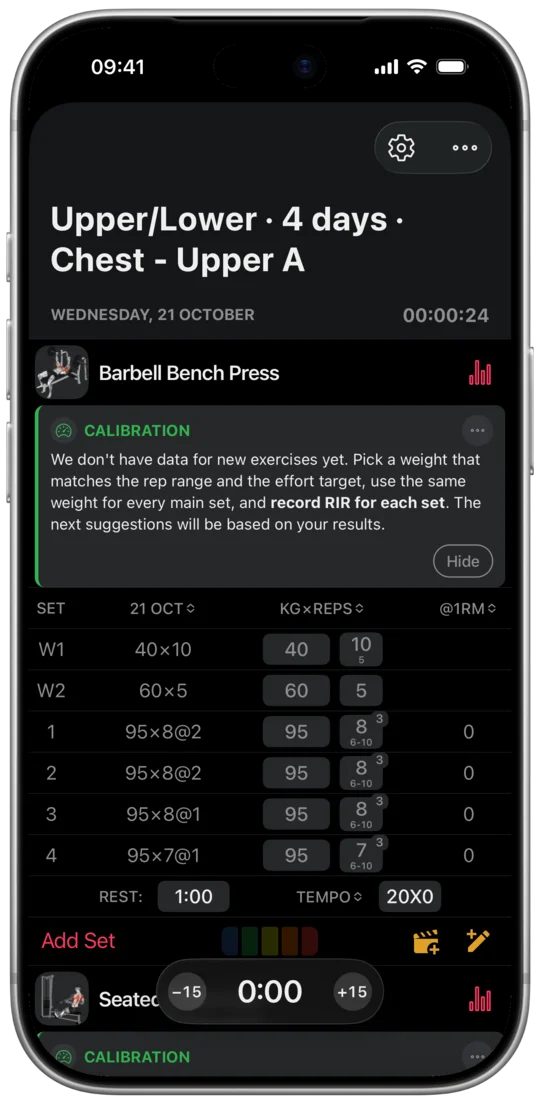
You track progression in SmartWorkout from your log: next to every set you see your previous result, estimated 1RM and the rep range from your plan.
- Open “Workout Settings” (the settings icon on the workout screen) and under “Effort scale” choose the “Scale type”: RIR or RPE.
- In the plan creator (Workout > My Plans > “+” > “Create new plan”), choose RIR as the “Load Indicator”, and for each set enter a rep range, e.g. 8-12, and a target RIR.
- After every working set, log the weight, reps and RIR, and next session compare them with the previous result next to the set.
- Every few weeks, check on the exercise chart that your estimated 1RM is going up.
With Premium, you know what to do at your next workout: add a rep, add weight or stay at your current target. With a rep range, the suggestions run double progression for you and match the weight step to your equipment, and with logged RIR they are more accurate. The help article on progression suggestions explains how they work.
You can paste this fragment through plan import (Workout > My Plans > “+” > “Import plan”). It's a shortened Full Body A day from week 2 of the 3-day full body plan for beginners: every exercise, the squat included, has a rep range and RIR 2. Import costs 10 AI credits, so the welcome credits cover it.
DAY: Full Body A- Barbell Squat | 3x6-10 RIR 2 | TEMPO 3010 | REST 150- Dumbbell Bench Press | 3x8-12 RIR 2 | TEMPO 3010 | REST 120- Cable Lat Pulldown | 3x8-12 RIR 2 | TEMPO 3011 | REST 120- Dumbbell Lateral Raise | 2x12-20 RIR 2 | TEMPO 2011 | REST 60Log it in SmartWorkout
A free workout log for iPhone and Android: sets, RIR, tempo, exercise groups and plans.


Questions
What is a good example of progressive overload?
Dumbbell bench press, 3 × 8-12 at RIR 2: with 20 kg dumbbells you add one rep per session until every set reaches 12, then move to 22 kg and start again at about 9 reps.
What is the 2 for 2 rule for progressive overload?
It's a common name for adding weight once you beat your rep target in two sessions in a row. The ACSM puts it as a 2-10% load increase after 1-2 reps over the target on two consecutive sessions, with smaller steps for exercises that train small muscle groups.
Is double progression the same as progressive overload?
No. Progressive overload is the principle, and double progression is one way to apply it: first reps, then weight. When all sets reach the top of the rep range, you take the next weight and start again near the bottom.
What is the difference between linear progression and linear periodization?
Linear progression adds a fixed weight step every session at the same sets and reps, such as 2.5 kg on a 3 × 5 squat. Linear periodization is a plan over weeks and phases in which the reps go down while the load goes up.
Do you have to add weight to build muscle?
Not every week. One more rep at the same weight also builds muscle. Add weight when all working sets reach the top of your rep range at your target RIR, usually by the smallest step: 2.5 kg on a barbell or the next pair of dumbbells.
How do you progressive overload push-ups?
Add reps first, one per session. Once every set reaches the top of your rep range, add load with a plate on your back or a weighted vest, or switch to a harder variation.
See also
- Rep ranges: how many reps for hypertrophy, strength and cuttingA rep range is the span of reps, such as 8-12, in which a set with a given weight should end. For muscle growth the exact number matters little: in studies, muscle grew similarly with sets of about 5 to more than 30 reps close to failure, while strength grew most with loads of 80% of 1RM or more.
- RIR (reps in reserve): what it means and how to estimate itRIR (reps in reserve) is the number of good reps left before failure when a set ends. RIR 0 means no reps left, and RIR 2-3 in a plan means ending the set with 2-3 reps still in the tank. In a meta-analysis of 12 studies, lifters had on average 1 rep more left than they thought.
- Training volume: what it is and what MEV, MAV and MRV meanIn hypertrophy training, training volume is the number of working sets a muscle group gets per week. In a meta-analysis of 67 studies, growth was measurable from about 4 weekly sets, with each extra set adding less; the 2026 ACSM position stand links 10 or more weekly sets to more growth.
- Deload week: what it means, how often to deload and how to do itA deload (deload week) is a planned period of lighter training, usually 5-7 days, that reduces fatigue before the next training block. Coaches cut the number of sets or reps by 30-50% and stop sets further from failure. In studies, neither a lighter week nor a week off reduced muscle growth.
- Periodization in strength training: linear, undulating and block modelsPeriodization is planned variation of load, sets and reps across weeks, usually in a linear, undulating or block model. In a meta-analysis of 35 studies it produced slightly larger strength gains than a program with constant sets and reps, but no extra muscle growth.
- Linear periodization training: how it works and who it's forLinear periodization (or traditional periodization) is a plan in which the load rises and the reps per set fall every few weeks, e.g. from 4 × 10 at 65% of 1RM to 5 × 3 at 85% over 12 weeks. In meta-analyses it built as much muscle as undulating periodization; in one, trained lifters gained a bit less strength with it.
- Top set and back-off sets: what they are and how much weight to dropA top set is the heaviest working set of an exercise in a session, and back-off sets are 2-4 working sets after it, done after full rest and usually 5-20% lighter. In a 6-week study of powerlifters, 2 back-off sets at 80% of the top set weight gave clearer strength gains than the top set alone.
- Training to failure: when it helps and when it just adds fatigueTraining to failure means ending a set only when, despite full effort, you cannot complete the next rep through a full range of motion without changing your form. In a meta-analysis of 15 studies it built no significantly more muscle or strength than stopping short of failure, and it is clearly more fatiguing.
Sources
- Currier BS, D'Souza AC, Singh MAF, et al. American College of Sports Medicine Position Stand. Resistance Training Prescription for Muscle Function, Hypertrophy, and Physical Performance in Healthy Adults: An Overview of Reviews. Med Sci Sports Exerc. 2026;58(4):851-872.
- American College of Sports Medicine. American College of Sports Medicine position stand. Progression models in resistance training for healthy adults. Med Sci Sports Exerc. 2009;41(3):687-708.
- Plotkin D, Coleman M, Van Every D, et al. Progressive overload without progressing load? The effects of load or repetition progression on muscular adaptations. PeerJ. 2022;10:e14142.
- Pelland JC, Remmert JF, Robinson ZP, et al. The Resistance Training Dose Response: Meta-Regressions Exploring the Effects of Weekly Volume and Frequency on Muscle Hypertrophy and Strength Gains. Sports Med. 2026;56(2):481-505 (online 2025).
- Robinson ZP, Pelland JC, Remmert JF, et al. Exploring the Dose-Response Relationship Between Estimated Resistance Training Proximity to Failure, Strength Gain, and Muscle Hypertrophy: A Series of Meta-Regressions. Sports Med. 2024;54(9):2209-2231.
- Kraemer WJ, Ratamess NA. Fundamentals of resistance training: progression and exercise prescription. Med Sci Sports Exerc. 2004;36(4):674-88.
- Chaves TS, Scarpelli MC, Bergamasco JGA, et al. Effects of Resistance Training Overload Progression Protocols on Strength and Muscle Mass. Int J Sports Med. 2024;45(7):504-510.
- Moesgaard L, Beck MM, Christiansen L, et al. Effects of Periodization on Strength and Muscle Hypertrophy in Volume-Equated Resistance Training Programs: A Systematic Review and Meta-analysis. Sports Med. 2022;52(7):1647-1666.
- Knowles OE, Drinkwater EJ, Urwin CS, et al. Inadequate sleep and muscle strength: Implications for resistance training. J Sci Med Sport. 2018;21(9):959-968.
- Morton RW, Murphy KT, McKellar SR, et al. A systematic review, meta-analysis and meta-regression of the effect of protein supplementation on resistance training-induced gains in muscle mass and strength in healthy adults. Br J Sports Med. 2018;52(6):376-384 (online 2017).
- Murphy C, Koehler K. Energy deficiency impairs resistance training gains in lean mass but not strength: A meta-analysis and meta-regression. Scand J Med Sci Sports. 2022;32(1):125-137 (online 2021).
- Bell L, Strafford BW, Coleman M, et al. Integrating Deloading into Strength and Physique Sports Training Programmes: An International Delphi Consensus Approach. Sports Med Open. 2023;9(1):87.
- Kassiano W, Nunes JP, Costa B, et al. Does Varying Resistance Exercises Promote Superior Muscle Hypertrophy and Strength Gains? A Systematic Review. J Strength Cond Res. 2022;36(6):1753-1762.