
What counts and how much, at a glance
| What you count | Value | Source |
|---|---|---|
| A working set for the muscle that mainly does the movement | 1 set | Pelland et al. 2025 |
| The same set for a muscle that clearly assists | 0.5 set | same meta-analysis |
| A warm-up set, and any set with more than 4 reps in reserve | 0 | our practice |
| Drop set: a working set plus drops without rest | 1 set | SmartWorkout rule; one set in research (Fink et al. 2018) |
| A mini set after a pause in rest-pause, Myo-reps and cluster sets | 1 set each in SmartWorkout; fewer when planning (table below) | SmartWorkout rule; studies count differently |
| A timed exercise, e.g. a plank | 0 | our practice |
- Working set
- Drop
- Warm-up
Why count sets, not tonnage
Count working sets per muscle group across the whole week, because that is the unit in which research measures the training dose that drives muscle growth.
A review of 14 studies judged the number of sets taken to or near failure a good measure of volume (Baz-Valle et al. 2021). Weight times reps is tonnage, a separate measure.
For strength, the set count alone isn't enough: at the same effort, strength rose more after heavier sets (Lopez et al. 2021), so intensity matters too.
How to count a week's sets step by step
- List the week's working sets, Monday to Sunday, without warm-up sets. If your cycle doesn't fit in 7 days, take the average of 2 weeks.
- For each exercise, count a set as 1 for the muscle that mainly does the movement and 0.5 for each muscle that clearly assists (table below). Muscles that only stabilize or work lightly get 0.
- Count a drop set as 1 set, and convert mini sets with the techniques table below.
- Add up the sets for each muscle group.
- Compare the total with the zones: MEV starts at 4 sets, MAV at 10. The weekly volume calculator does this faster.
Ramp-up sets in the squat, e.g. 60 kg × 5 and 80 kg × 3 before sets at 100 kg, are warm-up sets even if you do them wearing a belt.
If you've been training for less than a year, you don't need to count halves down to the set: 4-10 working sets per muscle group per week, which is MEV, is enough. Halves start to matter when you aim a priority muscle group at MAV and when a muscle group has stopped growing.
You add up the whole week because, at the same number of sets, training frequency didn't change muscle growth (frequency meta-analysis, Schoenfeld et al. 2019). Within one session, though, usually do up to about 10 sets per muscle group and split more volume over two sessions (how many sets per session).
Which sets count as working sets
A set is a run of reps done without rest (ACSM 2026 position stand). A working set is a set with your target weight, stopped with at most 4 reps in reserve; only these sets, which many guides call hard sets, count toward weekly volume. The limit of 4 is our counting convention, not a physiological threshold. The studies behind the zones mostly ended sets at or near failure, and further from failure, judging reps in reserve gets less accurate: on the RIR-based RPE scale, 4-6 reps in reserve is a single level (Helms et al. 2016).
Muscles grew more the closer to muscular failure sets ended (Robinson et al. 2024). A set with 5-6 reps in reserve, often written off as junk volume, still does something, but you don't count it toward the zones. Aim for 0-3 reps in reserve, most often 1-3; the ACSM position stand considers 2-3 enough effort.
A bodyweight set, like push-ups or pull-ups, counts the same as a barbell set if you stop it with up to 4 reps in reserve: push-ups to failure built about as much muscle and strength as a low-load barbell bench press (Kikuchi and Nakazato 2017).
A timed exercise like the plank adds no sets to the zones, because the meta-analysis behind them only included training that lowers and lifts a weight.
Full sets and half sets in compound exercises
In a compound exercise, the muscle that mainly does the movement gets a full set and a muscle that clearly assists gets half a set; this is called fractional set counting. One set of barbell bench press is 1 set for chest and 0.5 each for triceps and front delts.
The 67-study meta-analysis by Pelland et al. 2025 split sets into direct and indirect this way; of three ways to count indirect sets, as 1, 0.5 or 0, 0.5 fit best. The authors suggest that a set ends when the main muscle fatigues, while the assisting muscle is still further from failure.
A muscle that works lightly or only stabilizes gets 0, like the hamstrings in the barbell squat. Their activity in the squat is about half that of the quadriceps (Schoenfeld et al. 2019, a review on counting sets), and after 10 weeks of squats they didn't grow (Kubo et al. 2019).
Biceps also grow from pulling: the lat pulldown built as much biceps as curls, and the dumbbell row half as much (research table below), so the meta-analysis counted pulling as half a set for them. The SmartWorkout atlas gives biceps half a set in underhand-grip variations and nothing in most rows and pulldowns with an overhand or neutral grip. If biceps are your priority muscle group, add half a set for every such set.
How to count drop sets, rest-pause, Myo-reps and cluster sets
You count a drop set as one set, because there's no rest between drops. That's a conservative rule: in Fink et al. 2018, one drop set built at least as much muscle as 3 regular sets. SmartWorkout counts mini sets after a pause separately, because you log them as separate sets; when planning a week, convert them with the last column of the table.
| Technique | How it runs | Sets SmartWorkout shows | How to count when planning the week |
|---|---|---|---|
| Drop set | drops without rest | 1 | 1 (Fink et al. 2018) |
| Rest-pause | a set and 1-2 continuations after 20-30 s | 1 for each part | as 1-2 sets: Enes et al. 2023 counted the whole thing as 1, Marshall et al. 2012 as about 2 |
| Myo-reps | mini sets after a few breaths | 1 for each mini set | a sequence with 3-4 mini sets as about 3 sets (Fagerli 2023) |
| Cluster set | mini sets after 15-45 s | 1 for each mini set | the whole cluster as 1 set (Vargas-Molina et al. 2025) |
| Superset, compound set and circuit | several exercises in rotation | like regular sets | like regular sets |
In rest-pause and Myo-reps, the more mini sets you do, the more you count. SmartWorkout shows more sets for these techniques than most studies and the author of Myo-reps count: rest-pause with 2 continuations on the last of 3 sets is 5 sets in the app and 3-4 in your weekly plan. Don't add mini sets just to push the count up to the zone target.
A week of an upper/lower plan counted three ways
Week 2 of the 4-day upper/lower plan for intermediate lifters is 4 workouts at RIR 1-2; the table counts it without warm-up sets, with muscle groups as in the SmartWorkout atlas.
| Muscle group | Direct sets only | Half set for assisting muscles | Full set for assisting muscles |
|---|---|---|---|
| Chest | 9 | 9 | 9 |
| Triceps | 6 | 9.5 | 13 |
| Front delts | 3 | 8.5 | 14 |
| Biceps | 6 | 6 | 6 |
| Glutes | 9 | 11.5 | 14 |
| Hamstrings | 9 | 10.5 | 12 |
You count triceps like this: 6 sets of triceps extensions plus half of 3 sets of barbell bench press and 4 sets of incline dumbbell bench press, so 6 + 3.5 = 9.5.
Front delts get 3, 8.5 or 14 sets, which is MV, MEV or MAV: if they were a priority muscle group with a MAV target, the counting method would decide whether you add an exercise for them.
Biceps get 6 in every column, because the rows and pulldowns in this plan give them no sets in the atlas; if you counted pulls as half a set, as the meta-analysis did, they would have 11.5.
How many sets each exercise gives
The table shows the split from the SmartWorkout atlas; a muscle that works lightly or only stabilizes gets nothing.
| Exercise | Full set | Half set |
|---|---|---|
| Barbell Bench Press | chest | triceps, front delts |
| Barbell Squat | quadriceps, glutes | none (hamstrings 0) |
| Chin-Up | back | trapezius, biceps, rear delts |
| Pull-Up | back | trapezius (biceps 0) |
| Dumbbell Bent Over Row | back, trapezius | rear delts (biceps 0) |
| Romanian Deadlift | glutes, hamstrings, lower back | forearms |
| Barbell Hip Thrust | glutes | hamstrings, lower back |
Common mistakes
- Counting warm-up sets. Ramp-up sets logged as working sets add several sets per muscle group to the week. Mark them as warm-up sets.
- A full set for every muscle group. Triceps and front delts then collect more sets than the chest, which mainly does the movement. Give them half a set each.
- Skipping the halves. Then front delts look undertrained even after several presses, and you add exercises for them that they don't need. Count half a set from every press.
- Counting a one-arm set twice. You do the Dumbbell Bent Over Row with one arm, then the other; count both sides together as 1 set for back.
What the research says
| Study | Type and sample | Result | Limitation |
|---|---|---|---|
| Pelland et al. 2025 | meta-analysis, 67 studies, 2,058 people (79% men) | counting indirect work as half a set fit muscle and strength gains better than 1 or 0 | the authors' split into direct and indirect sets isn't fully objective |
| Kubo et al. 2019 | 17 men, 10 weeks of squats | knee extensors +4.9% (full squat) and +4.6% (half squat); glutes +6.7% and +2.2%; adductors +6.2% after full squats; hamstrings unchanged | small sample |
| Gentil et al. 2015, Mannarino et al. 2021 | 29 and 10 untrained men, 10 and 8 weeks | Gentil: biceps +6.1% after lat pulldowns, +5.8% after curls; Mannarino: +5.2% after dumbbell rows, +11.1% after curls | small samples, untrained men |
We don't know whether half a set fits every muscle and exercise, or how to count drops and mini sets; studies comparing compound and isolation exercises are almost all about the biceps.
What SmartWorkout logs show
Triceps collect almost as many sets as chest, and front delts about three quarters of that; some of these sets are halves from presses and, for people who don't mark warm-ups, ramp-up sets too. Every number is based on at least 50 people.
How to count sets in SmartWorkout
SmartWorkout counts weekly sets for you; in the log, you mark warm-ups with a set type so they don't inflate the week.
- In the set menu, mark lighter sets before your working sets as “Warm-up”, or add them with “Insert Warm-up”. SmartWorkout doesn't check reps in reserve, so every completed working set goes into the zones. In a week of lighter sets (technique work, a deload, a strength block), the zones count those sets in full and show more than you really did; don't add sets that week.
- Mark drop-set drops in the same menu as “Drop set”.
- Log rest-pause, Myo-reps and cluster-set mini sets as separate working sets (“Working set”) with a short rest.
- You also see set totals in Profile > Statistics (“Sets by muscle group”), but there every set goes to the exercise's one main muscle group, without halves.
SmartWorkout counts a drop set as 1 set: sets of the Drop set type add nothing, and the working set before them counts.
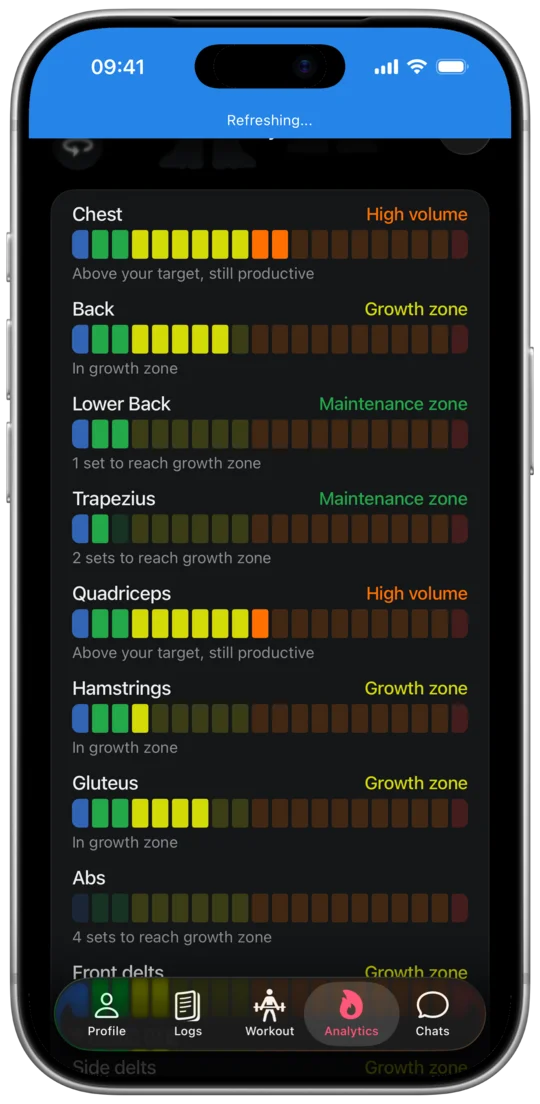
With Premium, you see each muscle group's weekly sets against the volume zones while you train, and in “Strength vs. Volume” whether an exercise “counts as full set” or “counts as ½ set” for that muscle group.
You can paste the “Upper A” day below through plan import (Workout > My Plans > “+” > “Import plan”). Import costs 10 AI credits, so the welcome credits cover it.
DAY: Upper A- Barbell Bench Press | WU 2x5 | 4x6-8 RIR 2 | TEMPO 20X0 | REST 180- Chin-Up | 3x6-10 RIR 2 | TEMPO 2010 | REST 150- Barbell Bent Over Row | 3x8-10 RIR 2 | TEMPO 2010 | REST 120- Barbell Overhead Press | 3x8-10 RIR 2 | TEMPO 2010 | REST 120- Rope Triceps Pushdown | 3x10-15 RIR 1 + DROPSET 1x8-12 | TEMPO 2011 | REST 60Log it in SmartWorkout
A free workout log for iPhone and Android: sets, RIR, tempo, exercise groups and plans.


Questions
Do warm-up sets count toward volume?
No. A warm-up set ends far from failure, so it counts toward neither weekly sets nor the volume zones. A heavy ramp set with up to 4 reps in reserve already counts as a working set.
What is a working set?
A working set is a set with your target weight, stopped with at most 4 reps in reserve; only these sets count toward weekly volume. Many guides call them “hard sets”.
Do compound exercises count for multiple muscles?
Yes, but not equally: 4 sets of barbell bench press are 4 sets for chest and 2 each for triceps and front delts.
Does a drop set count as one set?
Yes, with any number of drops: 12 reps, then 8 and 6 with a lighter weight and no rest, is 1 set for the week.
How do you count Myo-reps sets?
In SmartWorkout, an activation set and 4 mini sets are 5 sets, because you log each one separately. When planning the week, count less: according to the method's author, a whole sequence with 3-4 mini sets replaces about 3 regular sets (Myo-reps).
How do you calculate training volume?
Count each muscle group's working sets across the whole week, with halves for exercises where the muscle group clearly assists, and compare the total with the zones in the weekly volume calculator. Kilograms times reps is tonnage and doesn't count toward the zones.
See also
- Training volume: what it is and what MEV, MAV and MRV meanIn hypertrophy training, training volume is the number of working sets a muscle group gets per week. In a meta-analysis of 67 studies, growth was measurable from about 4 weekly sets, with each extra set adding less; the 2026 ACSM position stand links 10 or more weekly sets to more growth.
- Warm-up sets: how many to do and what weight to use before working setsWarm-up sets are lighter sets done before your working sets: the weight goes up and the reps go down. Before a heavy compound lift, 3-5 sets from the empty bar to 85-90% of the working weight are enough. In studies, a warm-up with a set at 80% of the working weight beat light sets alone.
- Drop sets: what they are, how to do them and how much weight to dropA drop set (also called a strip set or descending set) is a set taken to or near failure, then continued without rest after cutting the weight by about 20-30%. In meta-analyses, drop sets built about as much muscle as regular sets in less time. One drop on the last set is usually enough.
- Rest-pause sets: what they are and how to do themA rest-pause set is a set taken to muscular failure, followed by a 20-30 s pause and more reps with the same weight, usually 1-2 times. In studies it built muscle about as well as straight sets in less time, and in some studies it added slightly more strength.
- Myo-reps: what they are and how to do the activation set and mini setsMyo-reps are a rest-pause method developed by Børge Fagerli: an activation set stopped 1-2 reps short of failure, then 2-5 mini sets of 2-4 reps with the same weight after 3-5 deep breaths (10-15 s). In an 8-week study they built muscle and strength about as well as straight sets, in shorter sessions.
- Cluster sets in lifting: what they are and how to use themA cluster set is one set split into mini sets of 1-5 reps with short rests inside the set, usually 15-45 s. In meta-analyses, cluster sets built strength and muscle about as well as traditional sets, with less velocity loss and less fatigue during the session.
- How to prioritize lagging muscle groups: which 1-2 to pick and how many setsMuscle priority (prioritizing a lagging muscle group) is a plan in which 1-2 muscle groups get 4-8 more weekly sets than in a balanced plan, usually 12-18, while the rest stay at 4-10. In a meta-analysis of 67 studies, muscle growth rose with weekly sets, though each extra set added less.
- Training frequency: how many times a week to train each muscle groupTraining frequency is the number of sessions per week in which a muscle group does working sets. How often to train a muscle depends on weekly sets: with the same sets, muscles grow about the same with 1 or several sessions (meta-analysis of 25 studies). Strength improves more with 2 or more.
Sources
- Pelland JC, Remmert JF, Robinson ZP, et al. The Resistance Training Dose Response: Meta-Regressions Exploring the Effects of Weekly Volume and Frequency on Muscle Hypertrophy and Strength Gains. Sports Med. 2026;56(2):481-505 (online 2025).
- Currier BS, D'Souza AC, Singh MAF, et al. American College of Sports Medicine Position Stand. Resistance Training Prescription for Muscle Function, Hypertrophy, and Physical Performance in Healthy Adults: An Overview of Reviews. Med Sci Sports Exerc. 2026;58(4):851-872.
- Schoenfeld BJ, Grgic J, Krieger J. How many times per week should a muscle be trained to maximize muscle hypertrophy? A systematic review and meta-analysis of studies examining the effects of resistance training frequency. J Sports Sci. 2019;37(11):1286-1295 (online 2018).
- Baz-Valle E, Fontes-Villalba M, Santos-Concejero J. Total Number of Sets as a Training Volume Quantification Method for Muscle Hypertrophy: A Systematic Review. J Strength Cond Res. 2021;35(3):870-878 (online 2018).
- Lopez P, Radaelli R, Taaffe DR, et al. Resistance Training Load Effects on Muscle Hypertrophy and Strength Gain: Systematic Review and Network Meta-analysis. Med Sci Sports Exerc. 2021;53(6):1206-1216.
- Helms ER, Cronin J, Storey A, et al. Application of the Repetitions in Reserve-Based Rating of Perceived Exertion Scale for Resistance Training. Strength Cond J. 2016;38(4):42-49.
- Robinson ZP, Pelland JC, Remmert JF, et al. Exploring the Dose-Response Relationship Between Estimated Resistance Training Proximity to Failure, Strength Gain, and Muscle Hypertrophy: A Series of Meta-Regressions. Sports Med. 2024;54(9):2209-2231.
- Kikuchi N, Nakazato K. Low-load bench press and push-up induce similar muscle hypertrophy and strength gain. J Exerc Sci Fit. 2017;15(1):37-42.
- Schoenfeld BJ, Grgic J, Haun C, Itagaki T, Helms ER. Calculating Set-Volume for the Limb Muscles with the Performance of Multi-Joint Exercises: Implications for Resistance Training Prescription. Sports (Basel). 2019;7(7):177.
- Kubo K, Ikebukuro T, Yata H. Effects of squat training with different depths on lower limb muscle volumes. Eur J Appl Physiol. 2019;119(9):1933-1942.
- Gentil P, Soares S, Bottaro M. Single vs. Multi-Joint Resistance Exercises: Effects on Muscle Strength and Hypertrophy. Asian J Sports Med. 2015;6(2):e24057.
- Mannarino P, Matta T, Lima J, Simão R, Freitas de Salles B. Single-Joint Exercise Results in Higher Hypertrophy of Elbow Flexors Than Multijoint Exercise. J Strength Cond Res. 2021;35(10):2677-2681.
- Fink J, Schoenfeld BJ, Kikuchi N, et al. Effects of drop set resistance training on acute stress indicators and long-term muscle hypertrophy and strength. J Sports Med Phys Fitness. 2018;58(5):597-605 (online 2017).
- Enes A, Leonel DF, Oneda G, et al. Muscular Adaptations and Psychophysiological Responses in Resistance Training Systems. Res Q Exerc Sport. 2023;94(4):982-989 (online 2022).
- Marshall PW, Robbins DA, Wrightson AW, et al. Acute neuromuscular and fatigue responses to the rest-pause method. J Sci Med Sport. 2012;15(2):153-158 (online 2011).
- Vargas-Molina S, García-Sillero M, Maroto-Izquierdo S, et al. Cluster sets and traditional sets elicit similar muscular hypertrophy: a volume and effort-matched study in resistance-trained individuals. Eur J Appl Physiol. 2025;125(6):1725-1734.
- Fagerli BA. Myo-reps: a time-efficient method for maximum muscle growth. borgefagerli.com; first version 2006, revised May 2023 (Internet Archive copy of 12 March 2026).