
Circuit key numbers
| Parameter | Value | Source |
|---|---|---|
| Stations | 3-6, each for a different muscle group than the one before | usually 6-10 in a meta-analysis of 45 studies (Ramos-Campo et al. 2021); 3-6 is our practice, because at a gym you can rarely take up more stations at once |
| Weight | for strength: about 6 reps; for muscle: 8-15; both 1-2 reps short of failure; for conditioning: about 30 s of work with a light weight | 6RM in Alcaraz et al. 2011, 8-15 close to failure in Carpenter et al. 2025; 30 s in the meta-analysis |
| Move between stations | 20-40 s | about 35 s in both studies |
| Rest after the round | 2-3 min in a strength circuit, 1-2 min in a conditioning circuit | usually 2-5 min in the meta-analysis; in Carpenter et al. only 35 s with 3 stations, the same as between stations; the different rests for the two kinds of circuit are our practice |
| Rounds | 3-4 | most often 2-3 in the meta-analysis |
When a circuit makes sense
A gym circuit is real strength training if you end your sets 1-2 reps short of failure: in two studies in trained lifters, strength and lean mass went up as much as with straight sets, and the sessions were shorter (Alcaraz et al. 2011, Carpenter et al. 2025). You pay with more fatigue: after a session done in rounds of three exercises, jump performance was still lower 24 h later (Weakley et al. 2017), so do a full-body circuit 2-3 times a week with a rest day between sessions. A circuit with light weights done for time is mainly conditioning.
| Goal | Circuit? |
|---|---|
| Short on time | yes: the same sets in about 40% less time (example below) |
| Strength in the barbell lifts | do squats and deadlifts before the circuit, because a heavy set needs several warm-up sets, and when your lower back is already tired, your form breaks down more easily |
| Beginner | yes: 4-5 stations on machines and cables, 10-15 reps, RIR 3 in the first week, then 2; 2 working rounds for 2 weeks, then 3. Learn the squat and deadlift with straight sets |
How to build a circuit step by step
- Choose 3-6 exercises so that consecutive stations train different muscles: legs, a push, a pull, and hamstrings and glutes (these can go in a second circuit).
- Before the first round, set the machine seats and put your dumbbells next to the bench; leave the plates on the leg press between rounds.
- Do two lighter rounds as a warm-up: at about 50%, then 80% of your working weight, 5 reps each.
- Do one set at each station and go straight to the next one; the move is your rest.
- After the last station, rest 2-3 minutes and repeat the round, 3-4 working rounds in total.
- End your sets at RIR 1-2; once you reach the top of the rep range in every round, add weight (progressive overload). Keep the station order the same every week, because your result at a station depends on what came before it.
At peak hours you can build a circuit around one bench and a set of dumbbells: Dumbbell Goblet Squat, Dumbbell Bent Over Row, Dumbbell Bench Press and Dumbbell Romanian Deadlift.
Rest in a circuit: between stations and after the round
In the programs from the Ramos-Campo et al. 2021 meta-analysis, the move between stations usually took 15-35 s, and programs with 10-30 s moves and lighter weights reduced fat mass more.
The muscle rests longer than you do: in circuit A in the example below, your chest waits about 6 minutes for its next set. That's why a short move usually doesn't cost you reps: in a circuit with 35 s between exercises, lifters did as many bench press reps at the same speed as in straight sets with 3 minutes of rest (Alcaraz et al. 2008). The set that suffers is usually the one after a heavy leg station, or a second station for the triceps and front delts, like the shoulder press in circuit A: lengthen that move to 45-60 s or take a lighter weight.
Circuit examples in kilograms
Strength circuit at the gym
Circuit A puts the exercises from Carpenter et al. 2025 in a single circuit, with a seated shoulder press; in the study, the bench press and the shoulder press were in separate circuits. 3 rounds, 30 s to move and 2.5 minutes after the round, weights for an intermediate man.
| Exercise | Weight | Reps | RIR |
|---|---|---|---|
| Leg Press | 160 kg | 8-12 | 2 |
| Dumbbell Bench Press | 2 × 26 kg | 8-12 | 2 |
| Wide Grip Lat Pulldown | 60 kg | 8-12 | 1 |
| Seated Dumbbell Shoulder Press | 2 × 18 kg | 8-12 | 2 |
The leg press gets RIR 2 even though it's a machine, because a heavy leg set drains you for the stations that follow.
A set of 10 reps including setup takes about 40 s, so 3 rounds with two 2.5-minute rests take about 18 minutes, while the same 12 sets done as straight sets with 2 minutes of rest take 30 minutes.
Circuit A has no hip hinge (like a deadlift), so a second circuit after a 5-minute break, as in the study, covers the hamstrings, glutes and biceps, e.g. Dumbbell Romanian Deadlift, Dumbbell Biceps Curl and Machine Hip Thrust.
Conditioning circuit
Circuit B is 5 stations of 30 s of work with a light weight, 20 s to move and 1.5 minutes after the round; 4 rounds take about 20 minutes.
| Exercise | Weight |
|---|---|
| Dumbbell Goblet Squat | 16-20 kg dumbbell, women 8-12 kg |
| Push-Up | bodyweight; switch to your knees when you can't keep the pace |
| Kettlebell Swing | 16 kg kettlebell, women 8-12 kg, drive from the hips |
| Chest Supported Machine Row | light |
| Plank | bodyweight |
Circuit programs raised aerobic capacity (VO2max) by 6% on average (Ramos-Campo et al. 2021), and lowered body weight by 4-5 kg only in people with overweight or obesity (Seo et al. 2019).
Exercises for a gym circuit
Machines, cables and dumbbells suit a circuit, because you can change the weight in a few seconds.
| Good fit | Why |
|---|---|
| Wide Grip Lat Pulldown | you change the weight with a pin |
| Leg Press | legs without a barbell on your back |
| Dumbbell Bench Press | no rack and no spotter needed |
| Chest Supported Machine Row | the chest pad takes load off your lower back |
| Machine Abdominal Crunches | abs work done in reps, so unlike a plank it counts toward your weekly sets |
| Machine Hip Thrust | glutes without setting up a barbell |
Circuit training vs supersets, straight sets and HIIT
| Circuit | Superset | Straight sets | Tabata (HIIT) | |
|---|---|---|---|---|
| Exercises | 3 or more, not all for the same muscle group | 2 for different muscle groups | one at a time | one, a bike in the study |
| Rest between exercises | 20-40 s, 10-30 s for conditioning | 0-20 s, as long as the move takes | not applicable | 10 s between 7-8 bouts of 20 s (Tabata et al. 1996) |
| Full rest | 2-3 min after the round, 1-2 min for conditioning | 1-2 min after the pair | 2-3 min in the heavy barbell lifts, 90-120 s in other compound lifts, 60-90 s in isolation | not applicable |
A circuit done for time is interval training made of several exercises, while Tabata is one protocol with one exercise.
Circuit, tri-set or giant set
Some guides call any pair a superset and any larger group a giant set. In SmartWorkout, the name of an exercise group depends on whether all its exercises share one main muscle group, so a biceps and triceps pair is a superset.
| Exercises in the group | All share a main muscle group | No shared main muscle group |
|---|---|---|
| 2 | Compound Set | Superset |
| 3 | Tri-Set | Circuit |
| 4+ | Giant Set | Circuit |
An exercise's main muscle group is one it works at 70 points out of 100 or more, within 10 points of its most worked group. The three heads of the deltoid count together as shoulders.
- Dumbbell Bench Press + Chest Supported Machine Row + Push-Up is a circuit: two exercises train the chest, the third trains the back, and it stands between them.
- Dumbbell Bench Press + Machine Chest Press + Machine Chest Fly is a tri-set, because all three train the chest; with a fourth such exercise it would be a giant set.
How to count sets from a circuit
Every working set in a circuit counts toward your weekly sets like a straight set: 1 set for the muscle doing the movement, 0.5 for a muscle that clearly assists (Pelland et al. 2025), and the warm-up rounds not at all.
Circuit A for 3 rounds gives 3 sets each to the quads, chest, back and side delts, and 4.5 to the front delts, because they work in both presses; the glutes and triceps get 1.5 each, and the hamstrings nothing. With 2-3 such sessions a week, those four muscle groups get 6-9 sets, which is MEV. To bring a priority muscle group into MAV (10-20 sets), add a fourth round with 3 sessions a week or a second exercise; you can check your week in the sets per muscle group calculator.
A plank and other timed exercises don't count toward your weekly sets. A light set far from failure counts as a working set, even though it does less for your muscles than a set close to failure (Robinson et al. 2024), so don't count a conditioning circuit toward the target for a priority muscle group.
Common mistakes
- The same muscle group back to back. A dumbbell bench press, push-ups and an overhead press in a row work the chest, triceps and front delts without a break, so the weight drops from round to round; alternate pushing, pulling and legs.
- A light weight far from failure. In a classic timed circuit, sets end with plenty of reps left, and muscle can grow about as well with a weight as light as 30% 1RM, but only in sets close to failure (rep ranges). For muscle, end your sets at RIR 1-2. If strength is your goal, use a weight for about 6 reps in the circuit, as in Alcaraz et al. 2011.
- A move as long as a rest. With 2 minutes between stations, a circuit takes as long as straight sets. Take a full rest only after the round.
- A heavy first round. Then every station starts with a heavy set and no warm-up; start with two lighter rounds.
What the research says
Only small studies compare circuits with straight sets.
| Study | Type and sample | Result | Limitation |
|---|---|---|---|
| Ramos-Campo et al. 2021 | meta-analysis, 45 studies, 897 people | muscle mass +1.9%, fat mass −4.3%, VO2max +6.3%; in subgroups, muscle grew only in untrained people | compared with no training |
| Alcaraz et al. 2011 | 33 trained men in 3 groups, 8 weeks | 1RM and lean mass rose as much as with straight sets | small sample |
| Carpenter et al. 2025 | 14 trained women, 8 weeks | strength and lean mass rose as much as with straight sets; sessions of 50-60 min instead of 75-85 min | 7 people per group |
| Weakley et al. 2017 | 14 rugby players, one session, 18 sets | rounds of 3 exercises for different muscle groups took 17.7 min instead of 42.3 min; higher RPE and lactate, weaker jump 24 h later | effect of a single session |
Both 8-week studies measured lean mass, not muscle thickness; it's unknown whether a circuit close to failure keeps up with straight sets over longer periods and in advanced lifters.
What SmartWorkout logs show
Every number is based on at least 50 people.
How to log a circuit in SmartWorkout
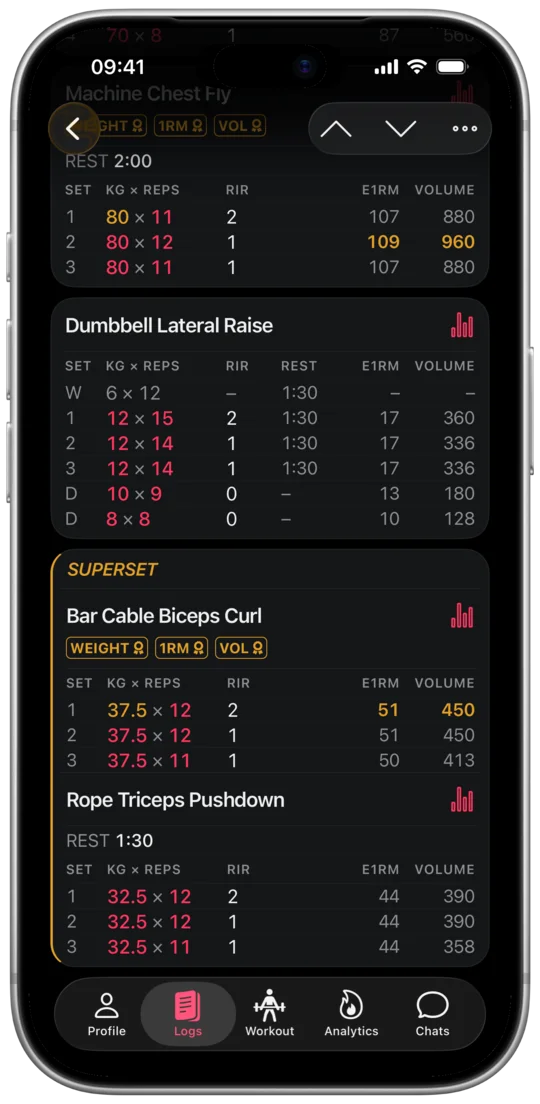
You log a circuit as an exercise group: in the workout log, in templates and in plans.
- On the workout screen, tap “Add Superset”.
- Select 3-6 exercises, e.g. the four from circuit A, and confirm.
- In each exercise's menu, choose “Set all rest timers”: set 0 s for the stations before the last one (“Off” on the picker wheel) and 2-3 minutes for the last one. The timer starts only after the whole round.
- Mark the first two sets of each station as “Warm-up” in the set menu.
From version 5.2 the button is called “Add Exercise Group”, and SmartWorkout labels such a group “Circuit” on its own. The interval timer then runs a timed station, such as a plank, on free accounts too; it counts down only that exercise, not the whole circuit.
With Premium, you know what to do in your next workout: add a rep, add weight or stay at your current target.
You can paste circuit A through plan import (Workout > My Plans > “+” > “Import plan”); WU 2x5 means the two lighter rounds. Import costs 10 AI credits, so the welcome credits cover it.
DAY: Circuit ALINKED:- Leg Press | WU 2x5 | 3x8-12 RIR 2 | TEMPO 2010 | REST 0- Dumbbell Bench Press | WU 2x5 | 3x8-12 RIR 2 | TEMPO 3010 | REST 0- Wide Grip Lat Pulldown | WU 2x5 | 3x8-12 RIR 1 | TEMPO 2011 | REST 0- Seated Dumbbell Shoulder Press | WU 2x5 | 3x8-12 RIR 2 | TEMPO 2010 | REST 150END LINKEDThe help article on set types and exercise groups explains how groups and set types work in the app.
Log it in SmartWorkout
A free workout log for iPhone and Android: sets, RIR, tempo, exercise groups and plans.


Questions
What is circuit training?
Circuit training is 3 or more exercises, not all for the same muscle group, done one after another in rounds: one set at each station, a short move to the next one and a longer rest after the round.
Does circuit training help you lose weight?
Mainly if you're overweight or obese: only in that group did circuit programs reduce body weight (Seo et al. 2019). Weight loss depends mostly on your calorie balance; at a normal weight the scale usually stays put, because you can lose fat while beginners also gain muscle, so measure changes with a tape measure.
How long should a circuit workout be?
One strength circuit of 4 stations for 3 rounds takes about 18 minutes, and about 25 with two lighter warm-up rounds. A full session with a second, shorter circuit for the hamstrings, glutes and arms takes about 40-45 minutes. If circuit A alone takes more than 30 minutes, your moves between stations are too long.
What's the difference between circuit training and strength training?
A circuit with a weight for 6-15 reps, ending 1-2 reps short of failure, is strength training too. Only the order changes: you do one set of each exercise in turn instead of all sets of one exercise.
How do you do circuit training at home?
A pair of dumbbells is enough: Dumbbell Goblet Squat, Dumbbell Bent Over Row, Push-Up, Dumbbell Romanian Deadlift and Plank, 30-40 s of work each, 20 s to move and 1-2 minutes after the round, 3-4 rounds. Push-ups sit between the row and the deadlift so your grip gets a rest.
Is circuit training good for women?
Yes, for strength and muscle too: in trained women, a circuit of 3 sets of 8-15 reps close to failure gave strength and lean mass gains similar to straight sets after 8 weeks. Alternate a glute-focused circuit with upper-body work, e.g. in this order: Dumbbell Goblet Squat, Wide Grip Lat Pulldown, Machine Hip Thrust, Dumbbell Bench Press.
See also
- Supersets in the gym: what they are, examples and superset vs compound setA superset is two exercises for different muscle groups done back to back with no rest in between; you rest only after both. Two exercises for the same muscle group are usually called a compound set. In a meta-analysis of 19 studies, supersets cut session time by about 37% with similar tonnage.
- Compound sets in lifting: two exercises for one muscle, back to backA compound set is two exercises for the same muscle group done back to back without rest; three make a tri-set, four or more a giant set. In studies, the same workout done this way took 36-48% less time than straight sets with rest after every set, and muscles grew no more than with straight sets.
- Rest between sets: how long to rest for hypertrophy, strength and fat lossRest between sets (rest interval) is the time from the end of one set to the start of the next. For hypertrophy, 1.5-2 minutes is usually enough, 2-3 minutes on heavy lifts and 3-5 minutes for sets of 1-5 reps. In a meta-analysis of 9 studies, rests shorter than a minute produced slightly less muscle.
- How to count sets per muscle group: direct, indirect and warm-up setsCounting sets per muscle group (fractional set counting) means adding up a week's working sets: 1 for the muscle that mainly does the movement, 0.5 for a muscle that clearly assists, 0 for warm-up sets. In a meta-analysis of 67 studies, this matched muscle growth better than counting assisting muscles as 1 or 0.
- Training volume: what it is and what MEV, MAV and MRV meanIn hypertrophy training, training volume is the number of working sets a muscle group gets per week. In a meta-analysis of 67 studies, growth was measurable from about 4 weekly sets, with each extra set adding less; the 2026 ACSM position stand links 10 or more weekly sets to more growth.
- Training frequency: how many times a week to train each muscle groupTraining frequency is the number of sessions per week in which a muscle group does working sets. How often to train a muscle depends on weekly sets: with the same sets, muscles grow about the same with 1 or several sessions (meta-analysis of 25 studies). Strength improves more with 2 or more.
- Workout splits: full body, upper/lower, push pull legs or bro splitA workout split is how you spread muscle groups across the week. Full body trains everything each session, upper/lower and push pull legs rotate 2 or 3 day types, and a bro split gives each muscle its own day. With equal weekly sets, full body and splits build similar muscle and strength (meta-analysis of 14 studies).
- RIR (reps in reserve): what it means and how to estimate itRIR (reps in reserve) is the number of good reps left before failure when a set ends. RIR 0 means no reps left, and RIR 2-3 in a plan means ending the set with 2-3 reps still in the tank. In a meta-analysis of 12 studies, lifters had on average 1 rep more left than they thought.
Sources
- Ramos-Campo DJ, Andreu Caravaca L, Martínez-Rodríguez A, et al. Effects of Resistance Circuit-Based Training on Body Composition, Strength and Cardiorespiratory Fitness: A Systematic Review and Meta-Analysis. Biology (Basel). 2021;10(5):377.
- Alcaraz PE, Perez-Gomez J, Chavarrias M, et al. Similarity in adaptations to high-resistance circuit vs. traditional strength training in resistance-trained men. J Strength Cond Res. 2011;25(9):2519-27.
- Carpenter SL, Helms ER, Pendakur RC, et al. Effects of High Intensity Circuit Versus Traditional Strength Training on Physiological Responses in Trained Women. Eur J Sport Sci. 2025;25(5):e12298.
- Weakley JJS, Till K, Read DB, et al. The effects of traditional, superset, and tri-set resistance training structures on perceived intensity and physiological responses. Eur J Appl Physiol. 2017;117(9):1877-1889.
- Alcaraz PE, Sánchez-Lorente J, Blazevich AJ. Physical performance and cardiovascular responses to an acute bout of heavy resistance circuit training versus traditional strength training. J Strength Cond Res. 2008;22(3):667-71.
- Seo YG, Noh HM, Kim SY. Weight loss effects of circuit training interventions: A systematic review and meta-analysis. Obes Rev. 2019;20(11):1642-1650.
- Pelland JC, Remmert JF, Robinson ZP, et al. The Resistance Training Dose Response: Meta-Regressions Exploring the Effects of Weekly Volume and Frequency on Muscle Hypertrophy and Strength Gains. Sports Med. 2026;56(2):481-505 (online 2025).
- Robinson ZP, Pelland JC, Remmert JF, et al. Exploring the Dose-Response Relationship Between Estimated Resistance Training Proximity to Failure, Strength Gain, and Muscle Hypertrophy: A Series of Meta-Regressions. Sports Med. 2024;54(9):2209-2231.
- Tabata I, Nishimura K, Kouzaki M, et al. Effects of moderate-intensity endurance and high-intensity intermittent training on anaerobic capacity and VO2max. Med Sci Sports Exerc. 1996;28(10):1327-30.