
Training frequency key numbers
| Parameter | Value | Source |
|---|---|---|
| Frequency per muscle | the number of sessions a week with working sets for that muscle; a session where the muscle only assists (biceps in rows) counts as half | Pelland et al. 2025 |
| Muscle growth | with the same weekly sets, about the same with 1 or several sessions per muscle | Schoenfeld et al. 2019 |
| Strength | improves more with at least 2 sessions a week | ACSM 2026 position stand |
| Sets per muscle in one session | usually 6-8, at most about 10; above about 11 (counting half sets for assisting work), extra sets added too little growth to detect | our practice; Remmert et al. 2025, preprint |
| Rest between hard sessions for a muscle | 48-72 h after sets close to failure; 2-4 sets far from failure you can handle on back-to-back days | our practice |
| Minimum for health | 2 days a week of exercises for all major muscle groups | WHO 2020 guidelines |
- Once a week
- Twice
- 3 times
How often to train each muscle for hypertrophy and for strength
For muscle growth, what counts is how many sets you do in a week, not how many sessions you split them into. For strength, a second weekly session for a muscle gives more than a third, so twice a week is a sensible choice for most lifters.
In a meta-analysis of 25 studies, with the same number of sets, muscle growth did not differ significantly between frequencies, trained lifters included (Schoenfeld et al. 2019); if training more often adds anything for muscle, it isn't much. Strength rose with the number of sessions, though each extra one added less (Pelland et al. 2025), and with the same number of sets, the edge of more frequent training was small (ACSM 2026 position stand). So you set your training volume first and then split it into sessions.
| Situation | Sessions per muscle a week | Why |
|---|---|---|
| Building muscle, 4-10 sets per muscle (MEV) | 1-2 | up to about 8 sets fit in one session |
| Building muscle, 10-20 sets per muscle (MAV) | 2-3 | 5-8 sets per session |
| Doing 20 or more sets per muscle (MRV) | 3-4 | 6-8 sets per session, and only for a few weeks |
| Strength in the main lifts | Barbell Bench Press 2-3, Barbell Squat 2, Deadlift once heavy and once with a lighter variation | the second weekly session helps strength most, especially in upper-body multi-joint exercises (Grgic et al. 2018); the deadlift is hard on the lower back |
| Beginner | 2-3, full body every session | more frequent technique practice |
| Over 60 | 2 | training more often added only a little strength and no muscle (Kneffel et al. 2021) |
| A priority muscle | 2-3 | more sets need to be spread out |
How to match frequency to your weekly sets
- Count each muscle's weekly working sets: a set where the muscle works directly is 1, one where it assists is 0.5 (how to count sets); the weekly volume calculator does it faster.
- Divide the total by 8 and round up: that's how many sessions the muscle needs. 8 chest sets fit in one session, 16 make 2 sessions of 8, and 17 sets for a priority muscle make 3 sessions.
- Pick a number of days you can keep up for 8 weeks.
- Space hard sessions for the same muscle 2-3 days apart, e.g. Monday, Wednesday, Friday.
- Change the exercise between sessions for a muscle. For quads, for example: Monday Barbell Squat, Wednesday Seated Leg Extension Machine, Friday Leg Press. One heavy squat session and two exercises that barely load your spine tire you less than three sessions of heavy squats.
- After 4-6 weeks, compare the weights in your main exercises. If many lifts stall at once, start with a deload; if a lift you want to get stronger in stalls, move 2-3 of its sets to a second session in the week; if strength goes up but the muscle doesn't grow, add 2 sets and add a session only once the sets no longer fit (what to check at a plateau).
In a study with this kind of split, 16 sets per muscle once a week gave trained lifters the same results as 2 sessions of 8, with a slight edge for 2 sessions (Brigatto et al. 2019). We split the sets anyway, because after about 8 sets for one muscle you do the next ones with the same weight for fewer reps, and each additional set in one session gives less.
How often each muscle works in a 2, 3, 4, 5 and 6 day split
In our free plans, how often the large muscle groups (chest, back, thighs, glutes) work follows from the number of days and the split.
| Days | Split | Large muscle per week | Plan |
|---|---|---|---|
| 2 | full body | 2 | 2-day full body plan |
| 3 | full body | 2-3 (intermediates 3) | 3-day full body plan |
| 3 | upper, lower, full body | 2 | 3-day upper/lower plan |
| 3 | push pull legs | 1 | 3-day push pull legs |
| 3 | body part split | 1 | 3-day body part split |
| 4 | upper/lower | 2 | 4-day upper/lower plan |
| 4 | push and pull | 2 | 4-day push/pull plan |
| 4 | body part split | 1 (biceps and triceps 2) | 4-day body part split |
| 5 | push pull legs plus upper/lower | 2 | 5-day PPL and upper/lower plan |
| 5 | body part split | 1 (hamstrings and glutes 2) | 5-day body part split |
| 6 | push pull legs twice | 2 | 6-day push pull legs |
How to choose a split is covered on full body vs split, and the full programs are in our free plans.
Training frequency example: the same chest sets in 1, 2 and 3 sessions
Three of our free plans for intermediates split about 10 weekly chest sets into 1, 2 or 3 sessions (counted in week 2 of each plan).
| Plan | Chest sessions | Sets per session | Total |
|---|---|---|---|
| 3-day full body plan | 3 | A: Barbell Bench Press 3; B: Cable Middle Chest Fly 3; C: Incline Dumbbell Bench Press 3 | 9 |
| 4-day upper/lower plan | 2 | Upper A: Barbell Bench Press 3, Cable Middle Chest Fly 2; Upper B: Incline Dumbbell Bench Press 4 | 9 |
| 4-day body part split | 1 | Chest & Triceps: 4 exercises of 2-3 sets each | 11 |
A priority muscle gets more sets, and more sessions follow: in the chest-focused plan that's 17 sets over 3 sessions, at most 7 in one.
How many rest days between training the same muscle
Leave 48-72 h, or 2-3 days, between hard sessions for the same muscle.
A set to muscular failure lengthens recovery: in trained men, bench press and squat sets to failure still slowed recovery 24-48 h after the session, more than the same number of reps without failure (Morán-Navarro et al. 2017). How long strength takes to come back after a hard session, and why the supercompensation model is a simplification, has its own article.
A shorter break is enough when you spread the same sets over more sessions. Full body training 5 days a week, with every muscle also trained on back-to-back days, gave trained men the same strength as a split with each muscle once a week, and the elbow flexors and vastus lateralis grew more (Zaroni et al. 2019). With the same number of sets, 3 and 6 sessions a week gave similar muscle and strength (Saric et al. 2019).
If for two sessions in a row you get 2 or more fewer reps than before on the first set of your main exercise at the same weight, check your sleep and food; if they're fine, the break between sessions for that muscle is too short, and if several exercises drop at once, it's time for a deload.
Training frequency vs volume and workout splits
| Frequency | Volume | Workout split | |
|---|---|---|---|
| What it measures | how many times a week a muscle does working sets | how many sets a muscle does in a week | how you spread muscles across days |
| Effect on muscle growth | small with the same number of sets | the main one: more sets, more muscle, with diminishing returns (Pelland et al. 2025) | similar at the same volume (Ramos-Campo et al. 2024) |
| Effect on strength | a second session for a muscle helps, more sessions help less | goes up, but returns diminish faster than for muscle | depends on how often you do the main lift |
Common mistakes
- “Every muscle twice a week” as a law. Newer meta-analyses see no difference for muscle growth with the same number of sets (Schoenfeld et al. 2019), so if your sets fit in one session and you're growing, once a week works too.
- More days without more sets. Going from 4 to 6 days with the same 10 sets per muscle means more trips to the gym and more warm-ups, and your muscles grow about the same. Add a day when you add sets or want shorter sessions.
- A whole week of sets in one session. With 16-20 chest sets, you do the last ones very fatigued and for fewer reps, and chest alone takes 40-50 minutes. In studies one long session didn't come out clearly worse, but each extra set in it gave less, so spread them over 2-3 sessions of 6-8, as in step 2.
- A 6-day plan when you really manage 4. In a body part split, every missed day is a week without that muscle, so pick as many days as you can keep in busy weeks.
What the research says
| Claim in guides | What studies show | Certainty |
|---|---|---|
| Every muscle has to be trained at least twice a week | that was the conclusion of a 2016 meta-analysis of 10 studies (Schoenfeld et al. 2016); newer meta-analyses and the ACSM 2026 position stand see no difference for muscle growth with the same number of sets; single studies in trained lifters saw a small edge for more frequent training | moderate to high for muscle growth |
| Training more often builds more strength | yes, with diminishing returns; with the same number of sets, Grgic et al. 2018 (22 studies, mostly untrained people) found no difference, and Ralston et al. 2018 found one only for the upper body (3 or more times better than once); the newest meta-analysis sees an effect, largest between 1 and 2 sessions (Pelland et al. 2025) | moderate |
| A muscle needs 48 h of rest | this is an old ACSM recommendation for splits, not the result of comparing rest periods (Dankel et al. 2017); full body training 5 days a week, back-to-back days included, did no worse than a split (Zaroni et al. 2019, 18 trained men) | low |
| Train a muscle again when protein synthesis drops after 48 h | after a heavy session, muscle protein synthesis is more than twice as high after 24 h and almost back to baseline after 36 h (MacDougall et al. 1995, 6 men), in trained lifters the rise is shorter, and its rise after training didn't predict later muscle growth (Damas et al. 2015) | low: a hypothesis, not a comparison of frequencies |
| Study | Type and sample | Result | Limitation |
|---|---|---|---|
| Pelland et al. 2025 | meta-regressions, 67 studies, 2,058 people | muscle: the effect of frequency was likely negligible; strength: rises with diminishing returns | 79% men, mean age 25 |
| Schoenfeld et al. 2019 | meta-analysis, 25 studies | result above; without equated sets, more frequent training gave little extra | muscle growth only |
| Remmert et al. 2025 | meta-regressions of sets per session, preprint | result above; for strength, above about 2 direct sets per session, extra sets gave no detectable advantage | little data on very many sets per session |
It's unknown whether more frequent training helps muscle growth only once sets per session go above about 10: nobody has tested this directly, and the studies mostly included young men.
What SmartWorkout logs show
Lifters in our logs, mostly in Poland, usually train 2-3 times a week but hit chest and back only once, a layout closer to a body part split than to full body. If that one session has 6-8 sets for the muscle, that's enough for growth, and a second one would help strength. Every number is based on at least 50 people.
How to set training frequency in SmartWorkout
You set training frequency in SmartWorkout when you build a plan.
- On the Workout tab, in “My Plans”, tap “+” and choose “Generate plan with AI”.
- In the quick start, answer “How many days a week can you train?”.
- Under “How do you want to split your training?”, choose “Full body” for 2-3 days or “Upper / Lower” for 4; “Choose for me” matches the split to your days and goal. With 3 days and “Body part split”, the app warns that each muscle gets one session a week.
A plan from the Luna model costs 10 AI credits (AI plan), and you can also lay out the sessions yourself in the plan creator (“Create new plan”).
Profile > Statistics shows “Workouts per week” and “Sets by muscle group”; to see how many times a muscle worked, check the plan.
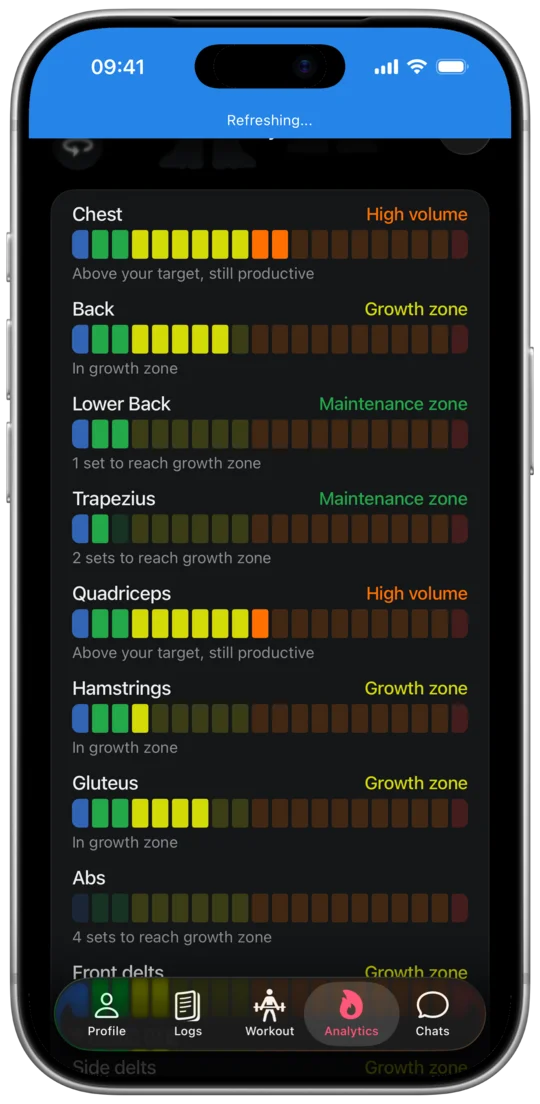
With Premium, you see each muscle group's sets against the volume zones while you train, and the plan's volume analysis shows them week by week.
You can paste this day A from the 3-day full body plan for intermediates, without the arm supersets, through plan import (Workout > My Plans > “+” > “Import plan”). It gives 3 sets each for chest, back, quads and hamstrings. Import costs 10 AI credits, so the welcome credits cover it.
DAY: Full Body A- Barbell Squat | WU 2x5 | 3x6-10 RIR 2 | TEMPO 20X0 | REST 180- Barbell Bench Press | 3x6-10 RIR 2 | TEMPO 2010 | REST 180- Cable Lat Pulldown | 3x8-12 RIR 1 | TEMPO 2011 | REST 120- Seated Leg Curl | 3x10-15 RIR 1 | TEMPO 2011 | REST 90- Dumbbell Lateral Raise | 3x12-20 RIR 1 | TEMPO 2010 | REST 60The full plan with days B and C is the free 3-day full body plan for intermediates.
Log it in SmartWorkout
A free workout log for iPhone and Android: sets, RIR, tempo, exercise groups and plans.


Questions
How many times a week should I train each muscle group?
Twice by default. Up to about 8 weekly sets per muscle, once a week also works; spread 9-20 sets over 2-3 sessions.
Is training a muscle once a week enough?
For muscle growth, yes, as long as all of that muscle's sets fit in one session, which means up to about 8: with the same number of sets, a meta-analysis of 25 studies found no difference. You give up a little strength, and every missed session is a week without that muscle.
How many rest days between training the same muscle?
2-3 days after a hard session. A few sets of light isolation work you can do on back-to-back days.
How many days a week should I lift?
The minimum for health is 2 days of exercises for all major muscle groups (WHO guidelines). For physique goals, usually 3-4: that's how many days our plans need to fit 9-12 sets per large muscle group; how to make a workout plan explains how to match a plan to your days.
Training frequency vs volume: which matters more?
Volume. Frequency decides how many sessions you split your sets into, and it starts to matter once you have more sets than fit in one session.
Can you train small muscles more often?
Yes, if the sets fit: in the 3-day full body plan for intermediates, side delts work 3 times a week, and in the arm-focused plan biceps and triceps do too. Also count the half sets biceps get from rows and triceps from presses.
See also
- Training volume: what it is and what MEV, MAV and MRV meanIn hypertrophy training, training volume is the number of working sets a muscle group gets per week. In a meta-analysis of 67 studies, growth was measurable from about 4 weekly sets, with each extra set adding less; the 2026 ACSM position stand links 10 or more weekly sets to more growth.
- How to count sets per muscle group: direct, indirect and warm-up setsCounting sets per muscle group (fractional set counting) means adding up a week's working sets: 1 for the muscle that mainly does the movement, 0.5 for a muscle that clearly assists, 0 for warm-up sets. In a meta-analysis of 67 studies, this matched muscle growth better than counting assisting muscles as 1 or 0.
- Workout splits: full body, upper/lower, push pull legs or bro splitA workout split is how you spread muscle groups across the week. Full body trains everything each session, upper/lower and push pull legs rotate 2 or 3 day types, and a bro split gives each muscle its own day. With equal weekly sets, full body and splits build similar muscle and strength (meta-analysis of 14 studies).
- How to prioritize lagging muscle groups: which 1-2 to pick and how many setsMuscle priority (prioritizing a lagging muscle group) is a plan in which 1-2 muscle groups get 4-8 more weekly sets than in a balanced plan, usually 12-18, while the rest stay at 4-10. In a meta-analysis of 67 studies, muscle growth rose with weekly sets, though each extra set added less.
- How to make a workout plan for the gym: exercises, sets, order and session lengthA workout plan (or workout program) is a written training week: days, exercises, sets, reps, reps in reserve (RIR) and rest. To make one, start with the number of days, then pick exercises and count weekly sets per muscle group. The 2026 ACSM position stand advises at least 2 sets per exercise and 2-3 reps in reserve.
- Training to failure: when it helps and when it just adds fatigueTraining to failure means ending a set only when, despite full effort, you cannot complete the next rep through a full range of motion without changing your form. In a meta-analysis of 15 studies it built no significantly more muscle or strength than stopping short of failure, and it is clearly more fatiguing.
- Progressive overload: what it is, linear vs double progression, and how to break a plateauProgressive overload is the gradual increase of training demands, most often load, reps or sets. The ACSM advises adding 2-10% load once you do 1-2 reps over your target in two sessions in a row. In an 8-week study, adding reps built about as much muscle as adding load.
Sources
- Pelland JC, Remmert JF, Robinson ZP, et al. The Resistance Training Dose Response: Meta-Regressions Exploring the Effects of Weekly Volume and Frequency on Muscle Hypertrophy and Strength Gains. Sports Med. 2026;56(2):481-505 (online 2025).
- Schoenfeld BJ, Grgic J, Krieger J. How many times per week should a muscle be trained to maximize muscle hypertrophy? A systematic review and meta-analysis of studies examining the effects of resistance training frequency. J Sports Sci. 2019;37(11):1286-1295 (online 2018).
- Currier BS, D'Souza AC, Singh MAF, et al. American College of Sports Medicine Position Stand. Resistance Training Prescription for Muscle Function, Hypertrophy, and Physical Performance in Healthy Adults: An Overview of Reviews. Med Sci Sports Exerc. 2026;58(4):851-872.
- Schoenfeld BJ, Ogborn D, Krieger JW. Effects of Resistance Training Frequency on Measures of Muscle Hypertrophy: A Systematic Review and Meta-Analysis. Sports Med. 2016;46(11):1689-1697.
- Grgic J, Schoenfeld BJ, Davies TB, et al. Effect of Resistance Training Frequency on Gains in Muscular Strength: A Systematic Review and Meta-Analysis. Sports Med. 2018;48(5):1207-1220.
- Ralston GW, Kilgore L, Wyatt FB, et al. Weekly Training Frequency Effects on Strength Gain: A Meta-Analysis. Sports Med Open. 2018;4(1):36.
- Remmert JF, Pelland JC, Robinson ZP, et al. Is There Too Much of a Good Thing? Meta-Regressions of the Effect of Per-Session Volume on Hypertrophy and Strength. SportRxiv. 2025 (preprint, not peer reviewed).
- Brigatto FA, Braz TV, Zanini TCDC, et al. Effect of Resistance Training Frequency on Neuromuscular Performance and Muscle Morphology After 8 Weeks in Trained Men. J Strength Cond Res. 2019;33(8):2104-2116.
- Ramos-Campo DJ, Benito-Peinado PJ, Andreu-Caravaca L, et al. Efficacy of Split Versus Full-Body Resistance Training on Strength and Muscle Growth: A Systematic Review With Meta-Analysis. J Strength Cond Res. 2024;38(7):1330-1340.
- Zaroni RS, Brigatto FA, Schoenfeld BJ, et al. High Resistance-Training Frequency Enhances Muscle Thickness in Resistance-Trained Men. J Strength Cond Res. 2019;33 Suppl 1:S140-S151.
- Saric J, Lisica D, Orlic I, et al. Resistance Training Frequencies of 3 and 6 Times Per Week Produce Similar Muscular Adaptations in Resistance-Trained Men. J Strength Cond Res. 2019;33 Suppl 1:S122-S129.
- Kneffel Z, Murlasits Z, Reed J, et al. A meta-regression of the effects of resistance training frequency on muscular strength and hypertrophy in adults over 60 years of age. J Sports Sci. 2021;39(3):351-358.
- MacDougall JD, Gibala MJ, Tarnopolsky MA, et al. The time course for elevated muscle protein synthesis following heavy resistance exercise. Can J Appl Physiol. 1995;20(4):480-6.
- Damas F, Phillips S, Vechin FC, et al. A review of resistance training-induced changes in skeletal muscle protein synthesis and their contribution to hypertrophy. Sports Med. 2015;45(6):801-7.
- Dankel SJ, Mattocks KT, Jessee MB, et al. Frequency: The Overlooked Resistance Training Variable for Inducing Muscle Hypertrophy? Sports Med. 2017;47(5):799-805.
- Bull FC, Al-Ansari SS, Biddle S, et al. World Health Organization 2020 guidelines on physical activity and sedentary behaviour. Br J Sports Med. 2020;54(24):1451-1462.